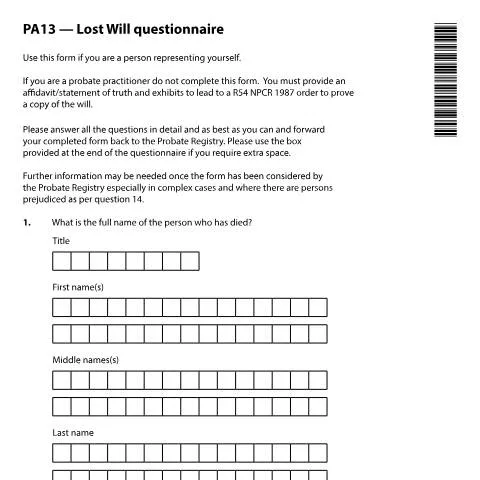
When Death Leaves Behind a Missing Will: The Critical Role of Form PA13
The discovery that a deceased person's original will has vanished can transform what should be a straightforward probate application into a complex legal challenge. In such circumstances, Form PA13 - Lost Will questionnaire becomes an essential bridge between having evidence of the deceased's final wishes and obtaining the legal authority to act upon them. This detailed questionnaire, administered by HM Courts & Tribunals Service, serves as the formal mechanism through which personal representatives can seek permission to prove a copy of a will when the original document cannot be located.
The implications extend far beyond mere paperwork. Without the original will, the law presumes the deceased destroyed it intentionally during their lifetime—effectively revoking their testamentary intentions. Form PA13 allows applicants to challenge this presumption by providing comprehensive evidence about the will's disappearance, potentially saving beneficiaries from the drastically different outcomes that would result from an intestacy distribution.
Understanding the Legal Framework Behind Lost Will Applications
The requirement for Form PA13 stems from fundamental principles embedded within the Non-Contentious Probate Rules, which establish strict protocols for proving wills when original documents are missing. The courts must balance two competing interests: respecting the deceased's genuine testamentary intentions whilst preventing fraudulent claims based on fabricated or superseded documents.
Under Rule 54 of the Non-Contentious Probate Rules 1987, the Probate Registry can only accept a copy of a will in exceptional circumstances, supported by substantial evidence. This creates a presumption of revocation by destruction—the legal assumption that if an original will cannot be found, the deceased deliberately destroyed it to cancel its provisions.
Form PA13 provides the structured framework for rebutting this presumption. Unlike the abbreviated affidavit process available to probate practitioners, this questionnaire enables personal representatives to present their case comprehensively without requiring legal representation. The form's detailed questions systematically address every aspect the court considers when determining whether sufficient evidence exists to prove a copy will.
The Distinction Between Personal Representatives and Probate Practitioners
A crucial limitation appears immediately on the form: probate practitioners cannot use PA13. Instead, they must prepare formal affidavits or statements of truth with supporting exhibits to obtain a Rule 54 order. This distinction reflects the different standards of legal knowledge expected from qualified practitioners versus individuals representing themselves.
Personal representatives using Form PA13 benefit from guided questions that ensure they address all relevant factors, whilst practitioners are expected to understand independently which evidence the court requires. However, this also means that complex cases involving professional practitioners may proceed through different procedural channels, potentially affecting timelines and requirements.
Identifying Who Must Complete Form PA13
The form specifically targets personal representatives acting without professional legal assistance. This includes executors named in the missing will, administrators seeking to prove the will's validity, and beneficiaries who would be entitled to apply for probate if the will's existence can be established.
Several scenarios commonly trigger PA13 applications. Family members may discover a photocopy of a will among the deceased's papers but cannot locate the original after exhaustive searches. Alternatively, a solicitor might confirm they prepared a will but have no record of retaining the original, leaving the family with only their office copy. In other cases, the original will may have been posted but never arrived at its destination, supported only by proof of posting.
Situations Where PA13 Cannot Be Used
Form PA13 cannot resolve every missing will scenario. If the deceased left multiple wills and only the most recent version has disappeared, the earlier will typically remains valid without requiring special procedures. Similarly, if witnesses or other parties saw the original will after the death, specific alternative evidence requirements apply, including letters from probate practitioners confirming post-death sightings.
Cases involving suspected fraud, family disputes about the will's contents, or situations where multiple versions exist with conflicting provisions may require court proceedings beyond the scope of Form PA13. The Probate Registry retains discretion to refuse applications and direct complex cases toward formal litigation.
Navigating the Detailed Evidence Requirements
Form PA13's sixteen questions create a comprehensive evidentiary framework designed to establish both the will's genuine existence and the circumstances of its disappearance. Each question targets specific aspects that courts historically consider when evaluating lost will claims.
| Evidence Category | Key Questions | Supporting Documentation |
|---|---|---|
| Last Known Location | Questions 4-6 | Solicitor's safe custody records, bank deposit confirmations |
| Search Efforts | Questions 7, 10 | Property search records, correspondence with institutions |
| Witness Availability | Questions 11-12 | Witness contact details, statements if available |
| Prejudiced Parties | Question 14 | Family tree, intestacy entitlements analysis |
The Critical Question of Presumed Destruction
Question 3 addresses the fundamental legal hurdle: whether the original will has been seen since death. A 'No' answer triggers the presumption of deliberate destruction, requiring applicants to provide compelling evidence explaining why the deceased did not revoke the will intentionally. This might include evidence of the deceased's mental state, physical capabilities, or consistent statements about their testamentary intentions.
Successful applications often demonstrate that the will disappeared due to circumstances beyond the deceased's control—theft, fire, flood, or administrative errors by third parties. Medical evidence showing the deceased lacked the physical ability to destroy documents can also support the application, particularly in cases involving dementia or physical incapacity.
Documenting Comprehensive Search Efforts
Questions 7 and 10 require detailed accounts of all attempts to locate the original will. The Probate Registry expects evidence of thorough, systematic searches extending beyond the deceased's immediate possessions. This includes contacting banks, insurance companies, solicitors, and other professional services the deceased used, plus searching safety deposit boxes, filing cabinets, and any locations where the deceased stored important documents.
Effective responses include dated correspondence with third parties, receipts for professional search services, and witness statements from family members who participated in property searches. The more comprehensive and documented the search efforts, the stronger the evidence that the will genuinely cannot be found rather than being overlooked or concealed.
Addressing Prejudiced Parties and Potential Conflicts
Question 14 identifies one of the most sensitive aspects of lost will applications: determining who would be prejudiced if the copy will were proved. These are individuals who would receive larger inheritances under intestacy rules compared to the provisions in the missing will. Their existence significantly complicates the application process and may require additional procedural steps.
The intestacy rules create a specific hierarchy of beneficiaries. If the deceased left a spouse and children, the spouse receives the first £270,000 plus personal possessions and half the remaining estate, with children sharing the remainder equally. If no spouse survives, children inherit everything equally. More distant relatives inherit only when closer family members don't exist.
Notification and Consent Requirements
When prejudiced parties exist, the Probate Registry may require formal notification or even consent before approving the application. This protects individuals whose inheritance prospects would be reduced if the copy will were proved. In contentious cases, the Registry might direct the matter toward formal court proceedings where all interested parties can present evidence and arguments.
Family dynamics often complicate these situations. Adult children who would inherit equally under intestacy may resist proving a will that leaves everything to their surviving parent. Conversely, second spouses may face opposition from stepchildren when seeking to prove wills that favor the surviving spouse over the deceased's children from previous relationships.
The Probate Registry's Assessment Process
Once submitted, Form PA13 undergoes careful evaluation by experienced Probate Registry staff who assess whether the evidence supports proving the copy will. This process involves more than simply checking that all questions are answered—the Registry evaluates the overall strength and consistency of the evidence presented.
The assessment considers multiple factors simultaneously. Strong evidence of the will's genuine execution, combined with compelling explanations for its disappearance and thorough search efforts, creates a favorable foundation. However, inconsistencies between witness accounts, gaps in the documentary evidence, or implausible explanations for the will's disappearance can trigger requests for additional information or outright refusal.
Complex Cases and Additional Requirements
The form explicitly warns that further information may be needed, especially in complex cases and where there are persons prejudiced. Complex cases might involve disputed family relationships, questions about the deceased's mental capacity when making the will, or situations where multiple versions of wills existed with different provisions.
Additional requirements might include statutory declarations from witnesses, expert handwriting analysis if the copy will's authenticity is questioned, or medical evidence regarding the deceased's mental state. In some cases, the Registry may require formal advertisements in newspapers to alert potential claimants before making a final decision.
Practical Implications and Strategic Considerations
The timing of PA13 applications can significantly impact their success. Applications submitted promptly after discovering the will's absence, supported by immediate and comprehensive search efforts, typically receive more favorable consideration than those filed months later with limited evidence of systematic searching.
The quality of the copy will also matters substantially. Clear, complete photocopies or certified copies from solicitors' files carry more weight than faded, partial, or handwritten transcriptions. If multiple copies exist with slight variations, applicants must explain these discrepancies and identify which version represents the deceased's final intentions.
Financial and Emotional Stakes
The financial implications of successful PA13 applications can be enormous. Estates worth hundreds of thousands of pounds may be distributed entirely differently depending on whether the missing will is proved or intestacy rules apply. Beyond financial considerations, the emotional significance of honoring the deceased's expressed wishes often motivates families to pursue complex applications despite uncertain outcomes.
However, unsuccessful applications can lead to costly delays and family conflicts. If the Probate Registry refuses the application, the estate may proceed under intestacy rules, potentially leaving intended beneficiaries without inheritance while enriching distant relatives who never expected to benefit.
The Declaration and Legal Consequences
Form PA13 concludes with a solemn declaration requiring the applicant's signature and explicit acknowledgment that the information provided is correct to the best of their knowledge. This creates significant legal obligations extending beyond simple form completion.
The declaration specifically warns that proceedings for contempt of court may be brought if evidence is found to be deliberately untruthful or dishonest. This reflects the serious nature of probate proceedings, where false statements can result in criminal charges, substantial fines, and imprisonment. The warning serves both as a deterrent against fraudulent applications and as legal protection for the Registry when relying on applicant-provided evidence.
The requirement that information will be stored as a public record also has practical implications. Once submitted, PA13 forms become part of the permanent court record, accessible to interested parties and potentially relevant in future legal proceedings involving the estate or family members.
Given these stakes, Form PA13 represents far more than administrative paperwork. It serves as a crucial legal instrument enabling families to honor deceased relatives' wishes when original wills disappear, whilst maintaining essential safeguards against fraud and ensuring fair treatment of all potential beneficiaries. The form's detailed structure reflects decades of legal experience in balancing competing interests, providing a systematic approach to one of probate law's most challenging scenarios.
Common Scenarios Requiring Form PA13 and Supporting Documentation
Different circumstances surrounding a lost will require varying approaches when completing Form PA13. Understanding these scenarios helps ensure you provide the appropriate evidence and explanations to support your probate application.
House Clearance and Accidental Disposal
One of the most frequent situations involves family members discovering that important documents, including the will, were inadvertently discarded during property clearance after the deceased's death. In such cases, you'll need to demonstrate on Form PA13 that reasonable searches were conducted before disposal occurred.
Document any efforts made to locate the will during the clearance process. If family members or house clearance companies were involved, obtain written statements from them confirming what searches were undertaken and when the disposal took place. The Probate Registry particularly values contemporaneous records, so diary entries, photographs of the clearance process, or invoices from clearance companies can strengthen your application.
Include details about the deceased's filing systems or storage habits. If they typically kept important documents in a specific location that was thoroughly searched, explain this pattern. Conversely, if the deceased was known to move documents frequently or had multiple properties, this context helps explain why the will might have been mislaid.
Fire, Flood, or Other Property Damage
Natural disasters or accidents that damage the deceased's property create clear grounds for reporting a lost will. When completing Form PA13 for such circumstances, attach supporting documentation from relevant authorities.
Fire service reports, insurance assessments, or local authority damage reports provide official confirmation of the incident. These documents establish both the date of loss and the extent of damage, which the Probate Registry requires to assess your application. If the will was stored in a specific room or safe that was damaged, include photographs showing the affected area.
Consider whether the deceased might have stored copies elsewhere. Banks, solicitors' offices, or family members sometimes hold duplicate copies. Even if these searches prove unsuccessful, documenting them on Form PA13 demonstrates thoroughness and may prevent delays in processing your application.
Solicitor or Bank Storage Issues
Sometimes wills stored with professional services become lost due to firm closures, mergers, or administrative failures. This scenario requires careful documentation on Form PA13, as the Probate Registry may need to verify your claims with regulatory bodies.
Contact the Solicitors Regulation Authority or relevant professional body if a law firm has closed or merged. They maintain records of what happened to client files and can provide written confirmation if documents were lost during transitions. Similarly, if a bank's safe deposit facility has closed, their head office can usually provide documentation about file transfers or losses.
Include correspondence with these institutions showing your attempts to locate the will. Even negative responses help build your case, as they demonstrate professional storage facilities have confirmed the document's absence from their records.
Dealing with Complex Family Situations and Disputed Claims
Form PA13 applications often arise in families where relationships are strained or where multiple parties claim knowledge of different wills. These situations require particularly careful handling to ensure your application succeeds.
Fill in your form directly online
No printing: type your details into the boxes of the official form, tick, then download the PDF ready to send.
- 1Type into the form boxes
- 2Tick in one click
- 3Save and download the PDF
Multiple Alleged Wills and Family Disputes
When family members claim the deceased made different wills at various times, but none can be located, Form PA13 must address these competing claims transparently. The Probate Registry needs to understand why you believe a will existed and why others might dispute this.
Document conversations or written communications where the deceased mentioned making or updating their will. Include dates, witnesses present, and the specific content discussed. If the deceased mentioned destroying an earlier will to create a new one, this information helps establish why certain documents might be missing.
Be prepared for potential challenges from other beneficiaries or family members. If someone contests your Form PA13 application by claiming they possess the "real" will or that no will ever existed, the Probate Registry may require additional evidence or witness statements to resolve the dispute.
Estranged Family Members and Limited Access
When the deceased was estranged from parts of their family, locating their will becomes more challenging, as you may lack access to their usual confidants or storage locations. Form PA13 should acknowledge these limitations while demonstrating the searches you could reasonably conduct.
If estranged family members might have information about the will's location, consider whether approaching them directly is appropriate. Sometimes a formal letter from a solicitor can facilitate communication where direct family contact has broken down. Document any attempts made and responses received, as this shows the Probate Registry you've explored all reasonable avenues.
Explain on Form PA13 if certain searches couldn't be conducted due to family circumstances. For example, if the deceased's children from a first marriage have restricted access to the family home, this context helps explain why comprehensive searches weren't possible.
Professional Relationships and Business Connections
The deceased's professional advisors often hold copies of wills or know about their existence. When completing Form PA13, systematically contact accountants, financial advisors, insurance brokers, and business partners who might have relevant information.
Professional indemnity requirements mean many advisors keep detailed records of client interactions. Even if they don't hold will copies, they may have file notes indicating when the deceased mentioned updating their will or expressed intentions about their estate. Request written confirmation of searches conducted through their records.
Business partnerships sometimes involve cross-insurance arrangements or succession planning that references personal wills. If the deceased owned business interests, their business partners or company secretaries might have relevant information about estate planning documents.
Technical Requirements and Processing Considerations
Successfully submitting Form PA13 requires attention to technical details that can significantly impact processing times and outcomes. Understanding these requirements helps avoid common pitfalls that delay probate applications.
Evidence Standards and Documentation Quality
The Probate Registry applies specific standards when evaluating evidence submitted with Form PA13. Original documents carry more weight than photocopies, and certified copies are preferred when originals cannot be provided. Understanding these evidence hierarchies helps you prioritise which supporting materials to include.
Witness statements should follow formal structure, including the witness's full name, address, occupation, and relationship to the deceased. Each statement must be dated and signed, with the witness confirming they understand their statement may be used in legal proceedings. If witnesses are elderly or unwell, consider obtaining their statements promptly, as their availability might change during the probate process.
Contemporary evidence carries particular weight. Documents created at the time of relevant events - such as diary entries mentioning will discussions, appointment calendars showing solicitor meetings, or correspondence about estate planning - provide stronger support than recollections recorded months or years later.
Timing Considerations and Deadlines
While there's no absolute deadline for submitting probate applications, practical considerations often create urgency around Form PA13 submissions. Banks and financial institutions typically freeze the deceased's accounts until probate is granted, creating pressure to resolve will-related issues quickly.
The Probate Registry's processing times vary depending on application complexity and current workload. Standard probate applications typically take 8-12 weeks, but Form PA13 cases often require additional review time. Factor this extended timeline into your planning, particularly if beneficiaries are experiencing financial hardship or if property sales depend on probate completion.
Consider submitting Form PA13 early in your probate preparation, even if you're still conducting searches for the will. The Registry can process your application while you continue looking, and you can always withdraw or amend your application if the will is subsequently found.
Registry Communication and Follow-up Procedures
The Probate Registry may request additional information after reviewing your Form PA13 submission. Understanding their communication procedures helps ensure prompt responses that keep your application progressing.
Registry correspondence typically arrives by post to the address provided on your application. Ensure this address remains current throughout the process, and arrange mail forwarding if you move during probate proceedings. Some registries now offer email communication for certain types of correspondence, though formal decisions are usually posted.
If the Registry requests additional evidence or clarification, respond within their specified timeframe - usually 14 or 28 days. Late responses can result in application suspension or rejection, requiring you to restart the entire process. Keep copies of all correspondence and note important dates in your diary to track response deadlines.
Sometimes the Registry schedules telephone interviews or face-to-face meetings to discuss Form PA13 applications, particularly in complex cases or where evidence appears contradictory. Prepare for these interactions by reviewing your submitted materials and gathering any additional evidence that might address their concerns. These meetings provide opportunities to clarify misunderstandings and strengthen your application, so approach them as collaborative discussions rather than adversarial proceedings.