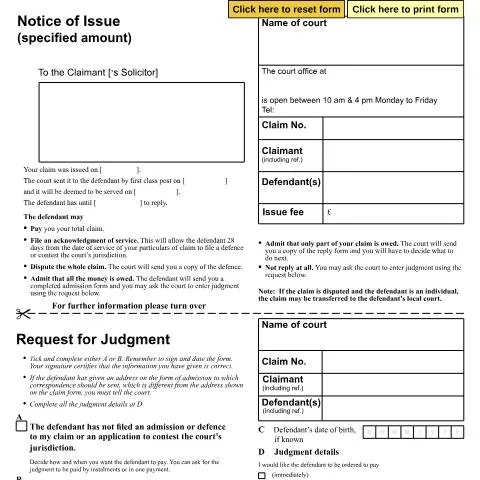
Understanding the N205A: Your Gateway to Civil Court Judgment
When pursuing a money claim through the courts in England and Wales, the Form N205A represents a crucial juncture in your legal journey. This document serves a dual purpose: it notifies you that your claim has been officially issued by HM Courts & Tribunals Service whilst simultaneously providing the mechanism to request judgment should circumstances permit. The N205A arrives at your doorstep once the court has processed your initial claim and dispatched it to the defendant, marking the transition from preparation to active litigation.
The significance of this notice extends beyond mere confirmation of administrative action. It establishes the timeline within which the defendant must respond and outlines the various paths your case might take. Understanding these pathways proves essential for making informed decisions about how to proceed, whether the defendant chooses to pay, defend, admit liability, or simply ignore your claim altogether.
Decoding the Service Timeline and Defendant Response Windows
The N205A provides specific dates that govern the entire subsequent process. When the court states that your claim was "sent to the defendant by first class post" on a particular date, this triggers a carefully calculated service timeline. The document indicates when the claim will be deemed to be served, typically several days after posting to account for delivery time.
From this deemed service date, the defendant receives a precise window to respond. The standard period allows defendants 14 days to reply, though this can extend to 28 days if they file an acknowledgment of service. This acknowledgment serves as a formal indication that the defendant intends to contest either the claim itself or the court's jurisdiction to hear the matter.
The Critical Service Provisions
The guidance notes reveal important constraints on service validity. Claims must be served within four months of issue for domestic service, extending to six months for service outside England and Wales. These timeframes prove rigid, with applications for extension generally required before the original period expires. This emphasises the importance of maintaining accurate defendant addresses and acting promptly once your claim is issued.
Navigating the Five Potential Defendant Responses
The N205A systematically outlines five distinct ways defendants might respond to your claim, each triggering different procedural consequences and strategic considerations for claimants.
| Defendant Response | Immediate Consequence | Claimant Action Required |
|---|---|---|
| Full payment of total claim | Case concludes successfully | Confirm receipt and case closure |
| File acknowledgment of service | 28-day extension for defence | Await defence or jurisdiction challenge |
| Dispute the entire claim | Court sends defence copy | Consider defence merits and next steps |
| Admit full liability | Admission form provided | May request judgment immediately |
| Admit partial liability only | Reply form sent to claimant | Decide whether to accept partial admission |
The Consequences of Defendant Silence
Perhaps most significantly for claimants, the N205A confirms that defendants who fail to respond at all leave themselves vulnerable to default judgment. This scenario often provides the quickest route to obtaining a court order, as it requires no admission of liability or negotiation over payment terms.
Mastering the Request for Judgment Mechanism
The reverse side of the N205A transforms from informational notice into active legal instrument. The "Request for Judgment" section enables claimants to secure court orders in two specific circumstances: when defendants fail to respond entirely, or when they admit full liability for the claimed amount.
Scenario A: Default Judgment Applications
When completing Section A for default judgment, claimants must certify that the defendant has neither filed an admission, defence, nor application to contest jurisdiction. This certification carries legal weight, requiring accuracy about the defendant's response status. The form demands specific decisions about payment terms, allowing claimants to request either immediate full payment or structured instalments.
Scenario B: Judgment on Admission
Section B addresses situations where defendants admit owing the full amount but may propose payment arrangements. The form provides three distinct pathways:
- Accepting defendant proposals: Streamlines the process by endorsing the defendant's suggested payment schedule
- No proposal received: Allows claimants to specify their preferred payment terms when defendants admit liability without suggesting arrangements
- Rejecting defendant proposals: Enables claimants to contest inadequate payment offers, requiring detailed objections in Part E
Critical Timing Considerations and Stay Provisions
The N205A guidance notes contain a crucial warning about timing that many claimants overlook. If you fail to request judgment within six months of the defence period ending, your claim becomes automatically stayed. This stay effectively freezes proceedings, permitting only judicial applications to lift the restriction.
This six-month limitation operates independently of whether defendants have actually responded. It applies from the expiry of their response period, not from any actual communication or lack thereof. Claimants must therefore maintain awareness of these deadlines and act decisively when circumstances permit judgment requests.
The Individual Defendant Transfer Provision
An important procedural note warns that disputed claims against individual defendants may be transferred to the defendant's local court. This transfer can affect convenience, costs, and hearing logistics, particularly for claimants who initiated proceedings in courts distant from the defendant's location.
Constructing Effective Payment Enforcement Strategies
The judgment details section (Part D) requires careful calculation of the total amount owed, encompassing multiple financial components that extend beyond the original claim value. Claimants must account for:
- The original claim amount including any interest calculated to the issue date
- Additional interest accrued since claim issue, requiring specific period details and applicable rates
- Court fees incurred during the claim process
- Solicitor costs for both claim issue and judgment entry, where applicable
- Any payments received since issue, which must be deducted from the total
Payment Term Considerations
When specifying payment arrangements, claimants face strategic decisions about immediate payment versus instalments. Immediate payment demands may prove unrealistic for defendants with limited resources, potentially leading to enforcement difficulties. Conversely, extended instalment arrangements might delay full recovery but increase the likelihood of voluntary compliance.
Record-Keeping Requirements and Payment Monitoring
The N205A emphasises ongoing record-keeping obligations that extend well beyond the initial judgment request. Claimants must maintain detailed payment records, providing receipts for all payments received and acknowledging cash payments appropriately. These records prove essential for subsequent enforcement actions and court hearings.
The guidance specifically requires immediate court notification of any payments received before hearings or after enforcement requests. This requirement reflects the court's need for accurate financial information when making procedural decisions and prevents unnecessary enforcement actions against defendants who have made payments.
Balance Calculation Obligations
Should enforcement proceedings become necessary, claimants must satisfy the court regarding outstanding balances. This requires more than simple arithmetic; courts expect comprehensive documentation demonstrating payment history, interest calculations, and any additional costs incurred. Defendants retain the right to request balance information, creating ongoing disclosure obligations for successful claimants.
Avoiding Common Procedural Pitfalls
The N205A process contains several potential complications that can derail otherwise straightforward money claims. Address accuracy proves particularly crucial, as the form specifically requires notification if defendants provide alternative correspondence addresses on admission forms. Failure to update the court with correct address information can compromise future enforcement efforts.
Certification requirements demand careful attention to accuracy. When signing the judgment request, claimants legally certify the correctness of all provided information. False certifications can result in judgment setting aside, costs sanctions, and potential contempt proceedings.
The Six-Month Limitation Trap
Perhaps the most significant pitfall involves the six-month stay provision mentioned in the guidance notes. Many claimants assume they can delay judgment requests indefinitely, particularly when hoping for voluntary payment or settlement negotiations. The automatic stay provision eliminates this flexibility, requiring active judicial intervention to resurrect dormant claims.
This limitation proves particularly problematic for claims where defendants file acknowledgments of service but never submit actual defences. The 28-day extension period still triggers the six-month countdown, regardless of whether defendants utilise their extended time.
Strategic Decision-Making at the Judgment Crossroads
The N205A represents more than administrative correspondence; it presents strategic decision points that can significantly influence case outcomes. When defendants admit partial liability, claimants face complex choices about accepting reduced amounts versus pursuing full claims through defended proceedings.
Partial admissions require careful evaluation of the admitted amount against litigation costs, time investment, and enforcement prospects for any judgment obtained. The N205A enables immediate judgment for admitted portions while preserving rights to pursue remaining amounts, though this approach may complicate subsequent proceedings.
Enforcement Preparation Considerations
Even successful judgment applications merely establish legal obligations; they do not guarantee payment. The N205A process should therefore incorporate forward-looking enforcement planning. Claimants benefit from researching defendant assets, employment status, and financial circumstances before finalising judgment terms.
Payment arrangement decisions significantly impact enforcement options. Immediate payment judgments enable swift enforcement action but may prove unrealistic. Instalment arrangements provide structured recovery but limit enforcement options until defaults occur. The N205A requires these fundamental strategic choices at the judgment request stage, emphasising the importance of informed decision-making based on comprehensive defendant assessment.
Understanding the N205A process empowers claimants to navigate this critical phase effectively, maximising recovery prospects while minimising procedural complications. The document's dual function as information source and judgment mechanism reflects the court system's efficiency focus, combining notification with action capability in a single, comprehensive instrument.
Strategic Considerations for Claimants Using Form N205A
Filing a Form N205A requires careful strategic planning beyond simply completing the paperwork correctly. The timing of your claim can significantly impact both the likelihood of recovery and the overall cost-effectiveness of the process. Consider submitting your claim during periods when the defendant is most likely to have available funds – for instance, avoiding times when businesses typically face cash flow challenges, such as immediately after the Christmas trading period or during quarterly VAT payment periods.
The specified amount procedure works most effectively when you have comprehensive documentation supporting your claim. Before completing Form N205A, gather all relevant evidence including contracts, invoices, delivery receipts, correspondence, and any acknowledgment of the debt from the defendant. While you won't submit this evidence with the initial form, having it readily available strengthens your position if the defendant files a defence or if enforcement becomes necessary later.
Consider the defendant's likely response when structuring your claim. If dealing with a sophisticated commercial entity, they may scrutinise every aspect of your claim and potentially file a defence even for legitimate debts to delay payment. In such cases, ensure your particulars of claim on Form N205A are meticulously detailed, leaving little room for technical challenges. Conversely, when pursuing individuals or smaller businesses, a more straightforward approach may suffice, focusing on clarity rather than exhaustive legal detail.
The geographical jurisdiction where you file can affect both convenience and enforcement prospects. While you can generally choose between the defendant's address or where the contract was performed, consider practical factors such as your ability to attend hearings if required, and the local court's efficiency in processing claims. Some county courts have notably faster processing times than others, though this shouldn't be your primary consideration if it compromises the legal strength of your claim.
When calculating interest and costs, be precise about the legal basis for each element. For contractual interest, reference the specific clause in your agreement and calculate from the date payment became due. For statutory interest under the Late Payment of Commercial Debts (Interest) Act 1998, ensure you're applying the correct rate – currently 8% plus the Bank of England base rate for business-to-business transactions. Remember that this statutory right doesn't apply to consumer debts, where you'll need to rely on contractual provisions or the court's discretionary power to award interest.
Consider whether alternative dispute resolution might be more appropriate before commencing proceedings. While Form N205A is designed for straightforward debt recovery, if there are genuine disputes about the quality of goods or services provided, mediation might achieve a better commercial outcome. However, don't delay indefinitely – the six-year limitation period for most contractual claims is absolute, and commercial relationships often deteriorate rather than improve over time.
Fill in your form directly online
No printing: type your details into the boxes of the official form, tick, then download the PDF ready to send.
- 1Type into the form boxes
- 2Tick in one click
- 3Save and download the PDF
Post-Judgment Enforcement Strategies and Practical Challenges
Obtaining judgment through Form N205A is often just the beginning of the debt recovery process. A significant proportion of judgments remain unsatisfied, making your enforcement strategy crucial to actual recovery. Before selecting enforcement methods, conduct thorough research into the judgment debtor's assets and financial circumstances. This intelligence-gathering phase can make the difference between successful recovery and throwing good money after bad.
The most common enforcement method is the warrant of control, executed by High Court Enforcement Officers (HCEOs) or county court bailiffs. However, the effectiveness varies dramatically depending on the debtor's circumstances. For commercial debtors with valuable equipment or stock, enforcement agents can often achieve swift resolution. For individual debtors or service-based businesses with limited tangible assets, this method may prove futile. Consider the debtor's business model – a consultancy operating from serviced offices offers limited enforcement opportunities compared to a manufacturing business with substantial machinery.
Third-party debt orders (formerly garnishee orders) can be highly effective against debtors with known bank accounts or regular income streams. However, success depends on precise timing and accurate information about the debtor's financial arrangements. Banks are only required to freeze funds actually held at the time they receive the interim order, so timing your application when accounts are likely to contain significant balances is crucial. For business debtors, consider their typical cash flow cycles – construction companies, for instance, often receive substantial payments following completion of project milestones.
Charging orders against property provide security for your debt but rarely result in immediate payment. They're most valuable as a long-term strategy, particularly against property-rich but cash-poor debtors. The charging order process requires careful consideration of existing mortgages and other charges – your charge will rank behind existing secured creditors, potentially leaving little equity available. However, charging orders can be psychologically powerful, often prompting settlement negotiations as debtors realise their property is at risk.
For judgments exceeding £5,000, consider transferring enforcement to the High Court, where HCEOs often achieve better results than county court bailiffs. High Court enforcement offers several advantages: HCEOs typically have more experience with commercial debt recovery, can enter business premises without the debtor's permission, and often command greater respect from debtors. The additional costs are usually modest compared to the improved recovery prospects, particularly for substantial commercial debts.
Attachment of earnings orders work exclusively against employed debtors and require current employment details. While powerful against individuals with regular salaries, they're ineffective against company directors who can easily adjust their remuneration arrangements. The administrative burden on employers means some may pressure the debtor to resolve the debt privately rather than comply with ongoing deduction requirements.
Bankruptcy or winding-up proceedings represent the ultimate enforcement sanction but should be used judiciously. For individuals, bankruptcy proceedings can be commenced for debts exceeding £5,000, while companies can be wound up for debts over £750. However, these procedures often result in little or no recovery for unsecured creditors, and the costs can be substantial. They're most effective as leverage tools, often prompting settlement before the proceedings conclude. Consider the debtor's other creditors – if insolvency is inevitable, being first to act may improve your recovery prospects.
Complex Scenarios and Procedural Variations in Form N205A Applications
While Form N205A is designed for straightforward claims, various complex scenarios require careful navigation of procedural requirements and strategic considerations. Multi-defendant claims present particular challenges, as each defendant must be served individually and may respond differently to the proceedings. When pursuing multiple parties for joint and several liability, consider whether to include all potential defendants initially or pursue the most promising target first, keeping others in reserve if the primary claim fails.
Claims involving disputed jurisdiction require careful analysis of connecting factors. For contracts performed across multiple jurisdictions, identify the strongest connection to England and Wales – this might be the defendant's domicile, the place of performance, or where the contract was concluded. EU-domiciled defendants benefit from additional procedural protections under retained EU legislation, potentially requiring service through official channels and extended response periods. Brexit has complicated cross-border enforcement, making domestic assets increasingly important for recovery prospects.
Corporate structure complications frequently arise in commercial debt recovery. When dealing with group companies, ensure you're pursuing the correct legal entity – the company that signed the contract may differ from the one that received goods or services. Parent company guarantees, if available, should be explicitly referenced in your particulars of claim. For recently incorporated companies or those with minimal assets, consider whether directors' personal guarantees exist, though these would typically require separate proceedings unless explicitly included in the original contract.
Set-off and counterclaim scenarios can complicate apparently straightforward debt claims. While Form N205A is designed for uncontested amounts, defendants may raise legitimate set-offs that weren't apparent when filing. Commercial contracts often contain cross-claims for defective work, late delivery, or consequential losses. Anticipate potential set-offs by reviewing the entire commercial relationship, not just the specific invoice being pursued. If substantial counterclaims are likely, consider whether the specified amount procedure remains appropriate or whether standard Part 7 proceedings would be more suitable.
Interest calculations become complex when dealing with partial payments, disputed amounts, or varying contractual rates. For running account relationships, determine whether interest should be calculated on individual invoices or the overall balance, as this can significantly affect the total claim. When contractual and statutory interest rates differ, choose the more favourable rate while ensuring you have legal entitlement to it. Commercial contracts sometimes specify compound interest, which can substantially increase claims over time, but ensure the contractual language clearly permits compounding.
Assignment scenarios require careful documentation and notice requirements. If pursuing assigned debts, ensure the assignment complies with section 136 of the Law of Property Act 1925 for legal assignments, or acknowledge the equitable nature of informal assignments. The original creditor's involvement may be necessary for equitable assignments, complicating the proceedings. Notice to the debtor must be properly documented, as this affects both the validity of the assignment and the assignee's right to pursue the debt independently.
Limitation period calculations can be surprisingly complex, particularly for continuing obligations or acknowledgment of debt scenarios. The six-year period runs from when the cause of action accrued, not necessarily when the invoice was issued. For goods supplied, this is typically delivery date; for services, completion date; for loans, the due date for repayment. Partial payments or written acknowledgments can restart the limitation period, but only if they unambiguously acknowledge the specific debt being pursued. Email communications and payment references should be carefully analysed to determine whether they constitute valid acknowledgments.
Security for costs applications may arise when pursuing overseas defendants or companies with limited assets. The court has discretion to require claimants to provide security for the defendant's potential costs, particularly where enforcement of any costs order would be difficult. This can significantly increase the financial risk of proceedings and should be factored into your cost-benefit analysis before commencing the claim.