When UK Courts Must Issue European Matrimonial Certificates
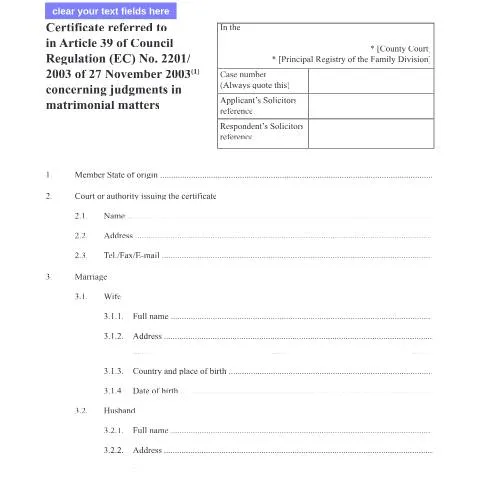
Following a divorce, annulment, or legal separation granted by a UK court, obtaining recognition of that judgment across European jurisdictions requires specific documentation. Form D180 serves as the official certificate mandated by Council Regulation (EC) No. 2201/2003, commonly known as Brussels II bis, which governs cross-border matrimonial matters between EU member states and continues to apply in certain UK contexts post-Brexit.
This certificate becomes essential when former spouses need to prove their changed marital status in countries where the original UK judgment might not be automatically recognised. Unlike standard decree documents issued for domestic purposes, the D180 certificate follows a standardised European format designed to facilitate swift recognition without lengthy legal procedures in the destination country.
The form's significance extends beyond mere administrative convenience. It provides legal certainty for individuals who may need to remarry, claim inheritance rights, or establish parental authority in different jurisdictions. Without proper certification, a UK matrimonial judgment might face challenges or delays when presented to foreign authorities, potentially creating significant personal and financial complications.
Navigating the Complex Web of Cross-Border Matrimonial Recognition
The D180 certificate operates within a sophisticated legal framework designed to streamline matrimonial judgment recognition across European borders. Article 39 of Council Regulation (EC) No. 2201/2003 specifically requires courts to issue these certificates upon request, establishing a uniform system that transcends individual national legal traditions.
This regulation emerged from the practical need to address the complications faced by internationally mobile couples. Before its implementation, obtaining recognition of matrimonial judgments often involved complex legal proceedings in each destination country, requiring extensive documentation and legal representation. The standardised certificate system dramatically reduces these barriers.
The certificate's legal weight derives from the principle of mutual recognition between participating jurisdictions. When properly completed and authenticated, a D180 certificate should be accepted by authorities in other member states without requiring additional verification of the underlying judgment's validity. This creates a streamlined pathway for individuals to establish their legal status across borders.
| Judgment Type | Certificate Requirements | Recognition Scope |
|---|---|---|
| Divorce | Complete D180 with effective date | Full matrimonial status change |
| Annulment | D180 plus nullity grounds | Marriage deemed never existed |
| Legal Separation | D180 with separation terms | Limited marital rights suspension |
Who Must Navigate This Certification Process
The requirement for a D180 certificate typically arises for individuals with cross-border connections who need to establish their matrimonial status in jurisdictions beyond where their original judgment was granted. This encompasses several distinct categories of applicants, each facing unique circumstances and urgency levels.
International relocators represent the most common category. These individuals have obtained UK matrimonial judgments but subsequently moved to other European countries where they must prove their legal status for various purposes. They might need the certificate to register with local authorities, obtain residence permits based on their single status, or demonstrate eligibility for certain social benefits.
Property owners with assets across multiple jurisdictions frequently require D180 certificates when dealing with inheritance planning or property transfers. European inheritance laws often differ significantly regarding spousal rights, making clear documentation of matrimonial status crucial for effective estate planning. Without proper certification, beneficiaries might face complications when attempting to claim inheritance rights.
Prospective remarriage candidates constitute another significant group. Many European countries require proof that previous marriages have been legally dissolved before permitting new marriages. While some registrars might accept translated UK decree documents, others specifically request the standardised European certificate format to ensure compliance with local requirements.
Special Circumstances Requiring Enhanced Documentation
Certain situations demand additional attention when requesting D180 certificates. Default judgments – where one party failed to appear in court – require specific documentation under Article 37(2) of the regulation. The certificate must indicate this circumstance, and supporting evidence demonstrating proper service of proceedings must accompany the application.
Cases involving ongoing appeals present particular complexity. The certificate must clearly indicate whether the judgment remains subject to further appeal under UK law, as this affects its enforceability in other jurisdictions. Recipient authorities need this information to determine whether to grant provisional or final recognition.
Individuals who received legal aid during their matrimonial proceedings must ensure this information appears on their certificate. Some jurisdictions provide reciprocal legal aid arrangements, and proper documentation of previous assistance can facilitate access to legal services in the destination country.
Completing the Certificate Application Process
Requesting a D180 certificate begins with identifying the correct court registry. Applications must be submitted to the same court that granted the original matrimonial judgment – either the specific County Court or the Principal Registry of the Family Division for High Court cases. This ensures access to the complete case file and proper authentication procedures.
The application requires precise information matching the original court records. Applicants must provide the exact case number from their matrimonial proceedings, as this enables court staff to locate the relevant file efficiently. Any discrepancies between the application details and court records can result in delays or requests for additional documentation.
Personal details verification represents a critical component of the process. The certificate must include full names exactly as they appeared in the original proceedings, current addresses for both parties, and complete birth information including countries and places of birth. These details enable foreign authorities to verify identity and prevent fraudulent use of the certificate.
Technical Requirements for Certificate Completion
Court staff complete most sections of the D180 form based on information from the case file, but applicants must ensure accuracy of personal details. The marriage information section requires particular attention, as it must reflect the original marriage details rather than any subsequent name changes or address updates.
The judgment section provides crucial information for receiving authorities. It specifies whether the court granted divorce, annulment, or legal separation, along with the judgment date and reference number. This information enables foreign authorities to understand the exact nature and scope of the UK court's decision.
Timing information proves especially important for practical purposes. The certificate must indicate when the judgment became legally effective in the UK, as this determines when individuals could legally remarry or when other legal consequences took effect. Different types of judgments have varying effective dates, and accurate recording prevents complications in the destination jurisdiction.
Processing Timelines and Administrative Procedures
Court processing times for D180 certificates vary depending on several factors, including the complexity of the original case and current court workloads. Standard applications typically require two to four weeks for completion, though this timeframe can extend during busy periods or when additional verification becomes necessary.
Applications requiring file retrieval from archives may experience longer processing times. Older cases, particularly those predating electronic record-keeping systems, might require manual file location and review. Courts prioritise applications based on demonstrated urgency, such as impending remarriage dates or time-sensitive legal proceedings in other jurisdictions.
The authentication process involves multiple verification steps. Court staff must confirm the accuracy of all information against the original case file, ensure proper completion of all required fields, and apply appropriate official seals or stamps. This thorough verification process, while time-consuming, provides the legal certainty that receiving authorities require.
Expedited Processing for Urgent Situations
Emergency applications receive special consideration when applicants can demonstrate genuine urgency. Common urgent situations include impending remarriage ceremonies, time-sensitive inheritance claims, or employment opportunities requiring immediate proof of marital status. However, courts require substantial evidence of urgency and may charge additional fees for expedited processing.
Legal representatives can often facilitate faster processing by maintaining direct communication channels with court staff and ensuring complete, accurate applications. However, even with professional assistance, certain verification steps cannot be abbreviated without compromising the certificate's legal validity.
Distinguishing D180 from Other Matrimonial Documentation
The D180 certificate serves a distinct purpose from other matrimonial court documents, and understanding these differences prevents confusion and delays. Decree absolute or final orders constitute the original judgment documents but lack the standardised format required for European recognition. While these documents prove sufficient for domestic purposes, they may not satisfy foreign administrative requirements.
Certified copies of court orders represent another category of documentation that applicants sometimes confuse with D180 certificates. These copies reproduce the exact wording of original court judgments but do not provide the structured information format that European authorities expect. The D180's standardised fields enable efficient processing by foreign bureaucracies unfamiliar with UK legal terminology.
Translation requirements highlight another key distinction. While other UK court documents typically require certified translation for use abroad, the D180 certificate's standardised European format reduces translation needs. Many receiving authorities can process these certificates directly, though some jurisdictions may still require translation of certain fields into their official languages.
International Apostille Considerations
Some destination countries may require apostille authentication in addition to the D180 certificate. This additional step involves obtaining authentication from the Foreign, Commonwealth & Development Office confirming the document's origin from a recognised UK court. However, within the European framework covered by Brussels II bis, apostille requirements are typically waived for properly completed D180 certificates.
| Document Type | Primary Use | Recognition Method |
|---|---|---|
| D180 Certificate | European cross-border recognition | Direct acceptance under Brussels II bis |
| Decree Absolute | UK domestic purposes | Translation plus legalisation required |
| Certified Court Copy | Legal proceedings evidence | Full authentication process needed |
Addressing Complications and Administrative Challenges
Several common complications can arise during the D180 certificate application process, requiring specific responses and additional documentation. Incomplete court records represent one of the most frequent challenges, particularly for older cases or those involving multiple court transfers. When original files lack essential information, courts may require applicants to provide additional evidence or statutory declarations to complete missing details.
Name discrepancies between current identification documents and court records create another common obstacle. Individuals who have changed names since their matrimonial proceedings must provide evidence linking their current identity to the court records. This typically involves producing marriage certificates, deed polls, or other official name change documentation.
Address verification issues can complicate the application process, especially when parties have relocated multiple times since the original proceedings. Courts require current addresses for certificate completion, but may struggle to verify these details. Applicants should provide recent utility bills, council tax statements, or other official correspondence to establish their current residential status.
Resolving Cross-Border Administrative Disputes
When receiving authorities in other jurisdictions question or reject D180 certificates, applicants face complex resolution procedures. Initial challenges often arise from minor formatting issues or unfamiliarity with UK court procedures. In such cases, providing additional explanatory documentation or engaging local legal representatives can facilitate acceptance.
More serious disputes may require formal legal intervention. If foreign authorities refuse to recognise properly completed D180 certificates, applicants might need to initiate enforcement proceedings under the Brussels II bis framework. These procedures can be complex and time-consuming, emphasising the importance of ensuring certificate accuracy from the outset.
Professional legal advice becomes invaluable when facing systematic recognition problems. Solicitors specialising in international family law can provide guidance on jurisdiction-specific requirements and alternative approaches when standard procedures encounter obstacles. However, such professional assistance involves additional costs that applicants should consider when planning their cross-border recognition strategy.
Post-Brexit Implications and Future Considerations
The UK's departure from the European Union has created significant uncertainty regarding the continued utility of D180 certificates for new matrimonial judgments. While existing certificates retain their validity under transitional arrangements, the framework for issuing new certificates has become more complex and jurisdiction-specific.
Current arrangements vary depending on the specific EU member state and the timing of the original matrimonial judgment. Some jurisdictions continue to accept D180 certificates from UK courts under bilateral agreements or retained EU law provisions, while others have reverted to more traditional recognition procedures requiring extensive documentation and legal proceedings.
Alternative recognition methods are becoming increasingly important for UK matrimonial judgments. These may include traditional apostille procedures, bilateral treaty arrangements, or reciprocal recognition agreements negotiated as part of broader UK-EU relationships. However, these alternatives often involve more complex and time-consuming procedures than the streamlined D180 system.
Individuals with ongoing cross-border matrimonial recognition needs should seek current legal advice regarding the most appropriate procedures for their specific circumstances. The evolving nature of post-Brexit arrangements means that guidance from qualified international family law practitioners becomes increasingly valuable for navigating these complex recognition requirements effectively.