The Sworn Statement in Court Proceedings: Understanding Form N285 in Practice
When legal proceedings require evidence that carries the full weight of criminal penalty for false statements, the affidavit stands as one of the most powerful tools in the English court system. Form N285 provides the standardised template through which individuals make sworn declarations before an authorised officer, transforming personal testimony into legally binding evidence. Unlike witness statements or statutory declarations, affidavits carry the gravity of an oath taken before God or a solemn affirmation, making perjury charges a real consequence for dishonesty.
This general form of affidavit serves across virtually all civil court proceedings in England and Wales, from complex commercial disputes in the High Court to straightforward possession claims in county courts. The document's deceptively simple layout belies its critical role in establishing facts, supporting applications, and providing evidence where personal attendance at hearings proves impossible or impractical.
Who Takes the Oath: Deponents and Their Circumstances
The individual making the affidavit, known as the deponent, must possess direct personal knowledge of the facts being sworn to. This fundamental requirement distinguishes affidavits from hearsay evidence and ensures that only first-hand testimony receives the protection of sworn status. Deponents typically include parties to litigation, witnesses to crucial events, expert professionals providing opinion evidence, and individuals with relevant documentary evidence in their possession or control.
Company directors frequently serve as deponents when corporate entities require sworn evidence, though they must clearly distinguish between facts known personally and information gleaned from company records or colleagues. Similarly, solicitors occasionally act as deponents regarding procedural matters within their direct knowledge, such as service of documents or attempts to contact opposing parties.
Age and capacity requirements apply strictly to affidavit swearing. Individuals under 18 years cannot generally swear affidavits, though exceptions exist where young people possess unique knowledge unavailable elsewhere. Those lacking mental capacity require careful assessment, as the oath's solemnity demands understanding of both the facts being sworn and the consequences of false testimony.
Special Considerations for Foreign Nationals
Non-UK nationals may swear affidavits using Form N285, provided they understand English sufficiently to comprehend both the document's contents and the oath's significance. Where language barriers exist, certified translation becomes essential, with the deponent swearing to the translated version while the original language document typically accompanies the affidavit as an exhibit.
Diplomatic immunity presents unique challenges, as individuals holding such status cannot generally be compelled to swear affidavits, though they may choose to do so voluntarily. Their evidence often carries particular weight given the diplomatic consequences of any false statements.
Navigating the Technical Requirements: Adobe Reader and Alternative Access
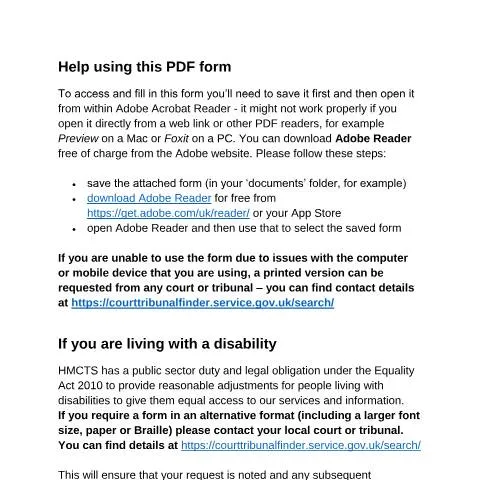
Form N285's PDF format incorporates interactive fields designed specifically for Adobe Acrobat Reader, creating a common stumbling block for users attempting completion through alternative software. The form's underlying technology relies on Adobe's proprietary field validation and formatting features, meaning that opening the document through Mac Preview, Foxit Reader, or directly through web browsers frequently results in non-functional form fields or formatting errors.
The prescribed process requires downloading the form to local storage before opening through Adobe Reader, ensuring proper field functionality and preventing data loss during completion. This technical requirement reflects the court system's emphasis on document integrity and consistent formatting across all submitted affidavits.
| Access Method | Compatibility | Potential Issues |
|---|---|---|
| Adobe Acrobat Reader | Full compatibility | None when properly installed |
| Web browser direct view | Limited functionality | Non-editable fields, formatting problems |
| Mac Preview | View only | Cannot complete interactive elements |
| Foxit Reader | Partial compatibility | Field validation errors, layout issues |
For individuals unable to access appropriate technology, printed versions remain available through any court or tribunal office. The Court and Tribunal Finder service provides comprehensive contact details, ensuring that technological barriers never prevent access to justice. This backup provision particularly benefits elderly users, those in rural areas with limited internet connectivity, and individuals whose disabilities affect computer use.
Accessibility Provisions Under the Equality Act 2010
HM Courts & Tribunals Service operates under strict legal obligations to provide reasonable adjustments for disabled users, transforming Form N285 accessibility from courtesy into legal requirement. These obligations extend beyond simple format conversion to encompass comprehensive support ensuring equal participation in legal proceedings.
Alternative format options include large print versions with adjustable font sizes, Braille transcription for visually impaired users, and audio formats for those with reading difficulties. The service also provides easy-read versions using simplified language and visual aids for individuals with learning disabilities or cognitive impairments.
Screen reader compatibility receives particular attention, with form fields properly tagged and navigation sequences optimised for assistive technology. However, users requiring such adjustments must contact their local court or tribunal directly, ensuring that subsequent case documents maintain consistent formatting throughout proceedings.
Reasonable Adjustment Request Process
Initial contact with court disability liaison officers triggers assessment of individual needs and available solutions. This process considers not only immediate form completion requirements but also ongoing case management needs, ensuring that affidavit accessibility forms part of broader litigation support.
Documentation of adjustment requirements becomes part of the case file, automatically alerting court staff to provide consistent support throughout proceedings. This systematic approach prevents repeated explanations and ensures continuity when cases transfer between courts or judicial personnel.
Structural Elements: Dissecting the Affidavit Template
Form N285's layout follows centuries-old legal conventions while accommodating modern case management systems. The document header establishes crucial procedural context, identifying the specific court, claim number, and parties involved. This information enables proper case file association and ensures that sworn evidence reaches appropriate judicial consideration.
The deponent identification section requires full names and occupation, establishing both identity and potential bias or expertise relevant to the sworn facts. Address details serve multiple purposes: enabling service of documents, establishing jurisdiction for oath-taking, and providing contact information for potential cross-examination.
The central "make oath and say as follows" phrase represents the formal transition from administrative information to sworn testimony. This traditional language carries specific legal significance, distinguishing affidavits from less formal evidence types and triggering perjury protections under criminal law.
Numbered Paragraph Requirements
The template's emphasis on numbered paragraphs reflects practical litigation needs rather than mere formality. Each paragraph should contain a single fact or closely related group of facts, enabling precise reference during hearings and facilitating targeted challenges by opposing parties. This structure proves essential when affidavits span multiple pages or address complex factual scenarios.
Chronological ordering generally provides the clearest presentation, though subject-matter grouping may prove more appropriate for technical evidence or expert opinion. The key principle requires logical progression that enables readers to follow the deponent's knowledge development and understand relationships between different factual elements.
The Swearing Process: Officers and Oath Administration
Proper oath administration transforms a completed Form N285 from mere document into legally binding evidence. Only specifically authorised officers possess power to administer oaths for court affidavits, with this authority deriving from judicial appointment rather than general professional qualification.
Authorised officers typically include court staff specifically appointed for this purpose, practising solicitors holding current practising certificates, and certain other legal professionals with appropriate authority. Notably, commissioners for oaths represent the most common alternative to court-based swearing, though their availability varies significantly between geographical areas.
The swearing ceremony itself requires physical presence of both deponent and authorising officer, with remote oath-taking generally prohibited except in exceptional circumstances approved by specific judicial direction. The officer must verify the deponent's identity through appropriate documentation and ensure comprehension of both the affidavit contents and the oath's significance.
Religious and Non-Religious Options
Traditional oath-taking involves swearing before God while holding religious text appropriate to the deponent's faith. However, secular affirmations carry identical legal weight for those preferring non-religious commitment. The choice between oath and affirmation remains entirely personal, with no legal consequences flowing from either selection.
The officer must accommodate various religious requirements, from Islamic oath-taking using the Quran to Hindu ceremonies involving appropriate sacred texts. However, the legal framework requires actual ceremony rather than mere written confirmation, distinguishing affidavits from statutory declarations or witness statements.
Procedural Integration: When Courts Demand Sworn Evidence
Form N285 affidavits serve multiple procedural functions throughout civil litigation, from initial case establishment through final enforcement. Summary judgment applications frequently rely on affidavit evidence establishing clear facts supporting swift resolution, while interim injunction hearings demand sworn testimony regarding urgency and potential damages.
The Civil Procedure Rules specify numerous circumstances requiring sworn rather than simple witness statement evidence. These include applications involving contempt of court allegations, certain family proceedings addressing child welfare, and commercial cases where document authenticity faces challenge.
Affidavit timing often proves crucial, with courts setting strict deadlines for sworn evidence supporting specific applications. Late submission typically requires judicial permission accompanied by explanation for delay, potentially affecting case timetables and cost consequences.
Exhibit Attachment Protocol
Documents referenced within affidavits frequently require formal exhibition, transforming separate materials into sworn evidence components. The exhibition process involves specific marking and verification procedures, ensuring that attached documents receive protection equivalent to the sworn testimony itself.
Exhibit numbering follows established conventions, typically using the deponent's initials combined with sequential numbering. This system enables precise reference during hearings while maintaining clear audit trails for complex cases involving multiple deponents and extensive documentation.
Post-Swearing Obligations and Consequences
Once properly sworn and filed, Form N285 affidavits become permanent court record components, accessible to parties and potentially to public inspection depending upon case circumstances. This permanency carries ongoing obligations, particularly regarding subsequent discoveries of error or omission in sworn testimony.
Deponents discovering mistakes in filed affidavits face immediate disclosure obligations, typically requiring supplementary sworn statements correcting errors and explaining circumstances surrounding initial inaccuracies. Deliberate concealment of known errors may constitute contempt of court beyond any perjury implications.
The criminal law consequences of false affidavit testimony extend beyond simple civil case outcomes. Perjury charges carry potential imprisonment, making affidavit accuracy a matter transcending individual litigation interests. However, honest mistakes, clearly distinguished from deliberate falsehoods, typically attract civil rather than criminal consequences.
Cross-examination opportunities provide opposing parties with powerful tools for testing affidavit evidence, though such examination requires specific court permission rather than automatic right. The interplay between written sworn testimony and potential oral examination shapes strategic decisions throughout complex litigation, influencing both evidence presentation timing and overall case management approaches.
Common Scenarios Requiring Form N285 Affidavits
Form N285 serves multiple purposes across different legal proceedings, with specific requirements varying according to the nature of your case. Understanding these common scenarios helps ensure you're completing the correct template for your circumstances.
Debt Recovery and Enforcement Proceedings
In debt recovery cases, Form N285 frequently supports applications for charging orders, attachment of earnings orders, or third-party debt orders. When pursuing judgment enforcement, you might need to swear an affidavit confirming the judgment debtor's current financial position, their employment status, or the location of their assets. The court requires specific evidence about attempts to recover the debt through standard methods before granting more robust enforcement measures.
For charging order applications, your affidavit must detail the judgment debt amount, any payments received since judgment, and evidence of the debtor's interest in the property you're seeking to charge. You'll need to exhibit copies of the original judgment, any statutory demands served, and correspondence showing the debtor's failure to pay. The court particularly scrutinises whether you've followed the correct preliminary steps, including serving a notice of the charging order application on the debtor.
Family Law Proceedings
Family courts regularly require Form N285 affidavits for financial remedy applications, child arrangement orders, and domestic violence injunctions. In financial remedy cases following divorce or dissolution, you'll need to swear detailed affidavits about your financial circumstances, including income, expenditure, assets, and liabilities. These affidavits form the foundation for the court's decision on financial settlements, maintenance orders, and property transfers.
When seeking non-molestation orders or occupation orders under the Family Law Act 1996, your affidavit must provide compelling evidence of the alleged behaviour and its impact on you and any children. The court needs specific incidents with dates, witnesses where available, and evidence of any police involvement or medical treatment. Remember that family proceedings often involve without notice applications, where the court must rely entirely on your sworn evidence to decide whether to grant interim protection.
Landlord and Tenant Disputes
Housing cases frequently require Form N285 affidavits, particularly for possession proceedings, rent arrears claims, and disrepair disputes. As a landlord seeking possession, your affidavit must prove service of the appropriate notices, compliance with statutory requirements, and the current rent arrears position. For assured shorthold tenancies, you'll need to exhibit the section 21 notice, evidence of deposit protection compliance, and proof that you've provided the tenant with required documentation including the Energy Performance Certificate and gas safety certificate.
In disrepair cases, tenant affidavits typically detail the condition of the property, the impact on their enjoyment and health, and their attempts to notify the landlord. You'll need to exhibit photographs showing the disrepair, correspondence with the landlord, and any expert reports obtained. The court expects clear evidence linking the disrepair to any claimed damages, whether for alternative accommodation costs, damaged possessions, or personal injury.
Technical Requirements and Formatting Standards
The physical presentation of your Form N285 affidavit must comply with strict court rules, as non-compliance can result in the court refusing to accept your document or ordering you to file a fresh affidavit at additional cost.
Document Structure and Layout
Your affidavit must be typed or clearly handwritten in black ink, using single-sided A4 paper with a 3.5cm margin on the left-hand side for court filing. Each page requires consecutive numbering, and if your affidavit exceeds one page, you must sign or initial every page except the final page, which contains your full signature and the commissioner's details.
The standard format begins with the court heading, case number, and parties' names exactly as they appear on the claim form. Your opening paragraph must state your full name, address, occupation, and relationship to the case (such as "the claimant" or "the defendant's solicitor"). Each substantive paragraph should be numbered consecutively and contain only one main point or piece of evidence.
Exhibits and Supporting Documents
When referring to documents within your affidavit, you must exhibit them using the format "This is exhibit [your initials][exhibit number] referred to in the affidavit of [your name] sworn this [date]". Each exhibit requires a separate exhibit sheet, signed by the person taking your oath or affirmation. Exhibits should be arranged in chronological order where possible, or in the order you refer to them in your affidavit text.
Original documents should be exhibited where possible, but the court accepts clear copies if originals are unavailable. However, you must explain in your affidavit why you cannot produce the original. For electronic communications such as emails or text messages, print them clearly showing the sender, recipient, date, and time. Screenshots of social media posts or messaging apps must show sufficient context to verify their authenticity.
Language and Content Standards
Your affidavit must be written in clear, straightforward English, avoiding legal jargon unless necessary for precision. Each statement should be factual rather than opinion-based, unless you're specifically qualified to give expert opinion evidence. Where you're stating something from your own knowledge, make this clear by using phrases such as "I know from my own involvement that..." or "I personally witnessed..."
When relying on information from others, you must identify your source and explain why you believe the information to be true. For example, "I am informed by my accountant, John Smith of Smith & Co Accountants, and believe it to be true, that the company's turnover for the year ending 31 March 2024 was £150,000." This approach helps the court assess the reliability of second-hand evidence while protecting you from accusations of misleading the court.
Potential Consequences and Risk Management
Understanding the serious legal implications of Form N285 affidavits helps you approach the process with appropriate care and attention to accuracy.
Criminal and Civil Penalties
Making a false statement in an affidavit constitutes perjury under the Perjury Act 1911, carrying a maximum sentence of seven years' imprisonment. The prosecution must prove you knowingly made a false statement material to the proceedings, but ignorance of the facts isn't a defence if you've sworn to knowledge you don't actually possess. Even if criminal proceedings don't follow, the court can strike out your case entirely or make adverse costs orders against you for misleading the court.
Beyond criminal sanctions, false affidavits can result in committal proceedings for contempt of court, professional disciplinary action if you hold professional qualifications, and civil liability for any losses caused by your false statements. Insurance policies typically exclude cover for deliberate wrongdoing, leaving you personally liable for damages and legal costs.
Procedural Consequences
Technical defects in your affidavit can cause significant delays and additional costs in your case. If the court identifies errors, you may need to file a fresh affidavit, potentially missing crucial deadlines for applications or responses. In urgent cases, such as injunction applications, these delays could result in irreparable harm or the loss of your legal remedy.
The court has discretion to exclude defective affidavit evidence entirely, particularly where the defects suggest carelessness or an attempt to mislead. This could leave you without sufficient evidence to prove your case, even where your underlying claim has merit. In multi-track cases, the court may refuse to extend time limits or grant relief from sanctions where poor affidavit preparation has caused delays.
Strategic Considerations
Your affidavit forms part of the permanent court record and may be disclosed to other parties, regulatory bodies, or future proceedings. Consider carefully what personal or business information you're revealing and whether alternative evidence might achieve the same objective with less exposure. In commercial disputes, detailed financial information in affidavits may later be used by competitors or in unrelated legal proceedings.
Where multiple people could swear to the same facts, consider who would make the most credible witness. A senior employee's affidavit about company procedures may carry more weight than evidence from junior staff, while an independent professional's evidence often proves more persuasive than testimony from parties with a direct financial interest in the outcome. Remember that anyone who swears an affidavit may be called for cross-examination at trial, so choose your witnesses carefully based on their likely performance under hostile questioning.