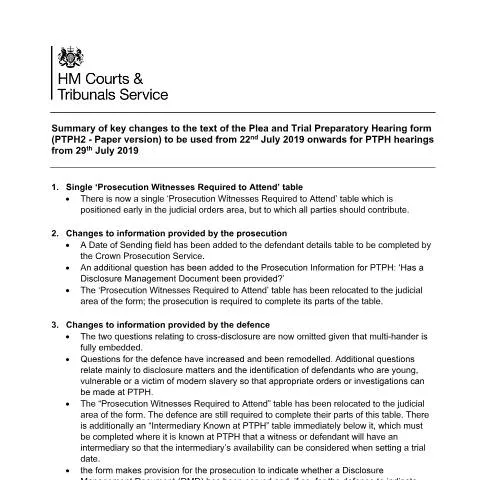
The Evolution of Criminal Case Management Through PTPH Form Updates
When the Criminal Procedure Rule Committee updated the Plea and Trial Preparation Hearing form in July 2019, it marked a significant shift in how criminal cases are managed from charge to trial. This transformation reflects years of learning from court backlogs, disclosure failures, and the growing recognition that vulnerable participants in the criminal justice system require specific protections from the earliest stages of proceedings.
The PTPH2 paper version, effective from 22nd July 2019 for hearings conducted from 29th July onwards, represents far more than administrative housekeeping. It embodies a fundamental reimagining of how prosecution and defence teams collaborate to ensure cases progress efficiently whilst safeguarding the rights of all participants, particularly those who may be young, vulnerable, or victims of modern slavery.
This standardised form serves cases involving one to five defendants, covering the vast majority of Crown Court proceedings. Its structured approach ensures that critical information flows seamlessly between prosecution, defence, and judiciary, preventing the procedural failures that have historically plagued complex criminal cases.
From Disclosure Chaos to Structured Information Exchange
The 2019 updates directly address the disclosure crisis that has affected numerous high-profile criminal cases. The form now includes specific fields requiring the Crown Prosecution Service to confirm whether a Disclosure Management Document (DMD) has been provided, moving beyond simple yes/no responses to require detailed explanations when disclosure is deemed inadequate.
This change reflects recommendations from reviews of disclosure failures, where cases collapsed due to late or incomplete disclosure of evidence. The defence must now specify exactly why they consider a DMD inadequate, creating an audit trail that helps prevent last-minute surprises that can derail trials.
Multi-Handler Case Simplification
Perhaps most significantly, the updated form removes the two questions relating to cross-disclosure between co-defendants. This streamlining acknowledges that multi-hander procedures are now fully embedded in criminal practice, eliminating redundant bureaucracy whilst maintaining essential information flows.
Legal practitioners no longer need to navigate complex cross-referencing requirements between defendants, as the standardised multi-defendant protocols have matured sufficiently to operate without additional form-based oversight.
Protecting Vulnerable Participants Through Early Identification
The form's most progressive innovation lies in its systematic identification of vulnerable participants. New questions specifically target defendants who may be young, vulnerable, or victims of modern slavery, enabling courts to implement appropriate protections from the PTPH stage rather than discovering these needs mid-trial.
| Vulnerability Category | Required Information | Judicial Response |
|---|---|---|
| Young defendants | Age verification and support needs | Youth court considerations and appropriate adult arrangements |
| Vulnerable defendants | Nature of vulnerability and required adjustments | Special measures directions and intermediary appointments |
| Modern slavery victims | Trafficking indicators and exploitation evidence | Competent authority referrals and statutory defences |
Section 28 Categorisation and Special Measures
The updated form categorises Section 28 directions with distinct pathways for vulnerable witnesses and intimidated witnesses. This differentiation ensures that pre-recorded cross-examination and evidence-in-chief procedures are tailored to specific witness needs rather than applying blanket approaches.
The addition of a significant new section for vulnerable defendants represents a landmark development. Courts can now establish comprehensive support frameworks before defendants enter the trial process, potentially preventing the trauma and confusion that vulnerable individuals have historically experienced in criminal proceedings.
Streamlined Witness Management and Intermediary Coordination
The consolidation of witness requirements into a single 'Prosecution Witnesses Required to Attend' table eliminates previous duplication and confusion. Positioned strategically in the judicial orders section, this table requires input from all parties, ensuring comprehensive witness planning from the outset.
Both prosecution and defence teams must complete their respective sections, creating a unified view of witness requirements that enables realistic trial scheduling. This collaborative approach prevents the common scenario where witness availability issues emerge only days before trial, causing costly adjournments.
Intermediary Planning Innovation
The new 'Intermediary Known at PTPH' table represents a significant advancement in supporting vulnerable witnesses and defendants. By identifying intermediary requirements at the PTPH stage, courts can consider intermediary availability when setting trial dates, preventing the delays that occur when specialist support workers are unavailable at short notice.
This forward-planning approach acknowledges the limited pool of qualified intermediaries and the complex coordination required to ensure their availability aligns with court schedules, witness needs, and defendant requirements.
Digital Evidence and Modern Investigation Challenges
Recognising the central role of digital evidence in contemporary criminal cases, the updated form requires defence teams to specify appropriate "levels of extraction" from mobile devices and computers. This provision addresses the exponential growth in digital evidence and the need to balance thorough investigation with proportionality and privacy rights.
Defence solicitors must now engage actively with digital evidence issues from the PTPH stage, identifying reasonable lines of enquiry and challenging prosecution decisions about the scope of digital investigation. This early engagement prevents later disputes about evidence adequacy whilst protecting defendants' privacy rights.
Reasonable Lines of Enquiry Framework
The form's requirement for defence teams to identify reasonable lines of enquiry creates a structured framework for disclosure discussions. Rather than general requests for "unused material," defence representatives must articulate specific investigative avenues, enabling more focused and productive disclosure processes.
This approach aligns with recent Court of Appeal guidance emphasising the defence's duty to engage constructively with disclosure processes rather than adopting blanket challenges to prosecution decisions.
Logical Sequencing and Practical Court Management
The form's restructuring prioritises logical sequencing over traditional administrative hierarchies. Trial dates are now fixed before intermediate hearings, acknowledging that all preparatory work should orient towards the confirmed trial slot rather than hoping trial dates will accommodate completed preparation.
This reordering reflects hard-won experience about court listing pressures and the reality that trial dates drive all other procedural requirements. By establishing the trial fixture first, all parties can work backwards to ensure adequate preparation time whilst avoiding the inefficiencies of multiple adjournments.
Integration with Case Management Protocols
The updated form operates in conjunction with the Criminal Practice Direction and the Better Case Management Handbook 2018, creating a comprehensive framework for case progression. Users must refer to these supplementary documents for detailed guidance on form completion and case management expectations.
This integrated approach ensures that the form operates as part of a broader case management ecosystem rather than as an isolated administrative requirement. The result is more coherent case progression and reduced scope for procedural disputes.
Prosecution Service Adaptations and Date Management
The addition of a Date of Sending field in the defendant details table creates an audit trail for Crown Prosecution Service case management. This seemingly minor addition addresses longstanding concerns about case preparation timelines and enables courts to monitor whether adequate preparation time has been allowed.
The CPS must now demonstrate that defendants have received adequate notice of proceedings, supporting fair trial requirements whilst enabling courts to identify potential disclosure or preparation issues before they affect trial scheduling.
Enhanced Prosecution Information Requirements
Beyond DMD confirmation, the prosecution faces expanded information requirements covering witness availability, special measures needs, and digital evidence parameters. These requirements ensure that prosecution teams engage comprehensively with case management issues rather than leaving problems to emerge during trial preparation.
The collaborative approach requires prosecution and defence to work together on witness planning and evidence management, moving beyond the adversarial model towards cooperative case progression that serves both efficiency and justice interests.
Implementation Timeline and Professional Adaptation
The form's introduction date of 22nd July 2019, with effect for hearings from 29th July onwards, provided minimal transition time, reflecting the urgency of addressing disclosure and case management failures. Legal professionals had to adapt quickly to new requirements whilst maintaining existing caseloads.
This compressed timeline demonstrated the Criminal Procedure Rule Committee's recognition that incremental change was insufficient to address systemic problems in criminal case management. The comprehensive nature of the updates required immediate implementation to prevent further case failures.
Training requirements for court staff, legal representatives, and judicial officers necessitated rapid dissemination of guidance materials and practical workshops. The success of the implementation depended on all participants understanding not just the form's requirements but the underlying case management philosophy it represents.
The form's evolution continues as the criminal justice system adapts to emerging challenges including remote hearings, digital evidence complexity, and evolving understanding of vulnerability and trauma. Regular reviews ensure that administrative processes keep pace with substantive legal and procedural developments, maintaining the balance between efficiency and fairness that effective criminal justice requires.
Multi-Defendant Case Management and Separate Representation
When dealing with PTPH proceedings involving multiple defendants, the court must navigate complex representation arrangements and potential conflicts of interest. Each defendant retains the right to separate legal representation, even when charged with identical or closely related offences arising from the same incident.
The Criminal Procedure Rules 2020 specifically address multi-defendant scenarios through provisions requiring clear identification of each defendant's position during the PTPH. Where defendants share common legal representation, the court must ensure this arrangement genuinely serves each client's best interests rather than merely administrative convenience.
Particular complications arise when one defendant wishes to enter a guilty plea whilst co-defendants maintain their innocence. The judge must carefully manage plea discussions to prevent prejudice, often requiring separate hearings or written submissions rather than open court dialogue. This becomes especially critical in cases involving corporate defendants alongside individual co-conspirators, where different legal standards and disclosure obligations may apply.
The Crown Prosecution Service must indicate whether they seek joint or separate trials during the PTPH. Factors influencing this decision include the strength of evidence against each defendant, potential for prejudicial cross-contamination of evidence, and practical considerations such as courtroom capacity and jury management. Where defendants face substantially different charges despite arising from connected circumstances, severance applications frequently emerge during PTPH proceedings.
Legal aid applications become particularly complex in multi-defendant cases. The Legal Aid Agency applies strict criteria when assessing whether separate representation genuinely serves the interests of justice, particularly where defendants share substantially similar defences. Conflicts of interest assessments must consider not only current proceedings but potential future developments, including the possibility that one defendant might provide evidence against others.
Case management directions often require coordinated disclosure timelines across all defendants. The court typically establishes a single case progression officer to manage communications, though each defence team retains independent obligations regarding their client's specific requirements. This coordination becomes essential when dealing with complex evidential matters such as expert witness reports or technical evidence requiring specialist interpretation.
Judicial Case Management Powers and Sanctions
The Criminal Procedure Rules grant judges extensive case management powers during PTPH hearings, including authority to impose sanctions for non-compliance with directions. These powers extend beyond simple adjournment decisions to encompass substantive case shaping through strategic use of disclosure orders and evidence limitations.
Under Rule 3.5, judges may exclude evidence or draw adverse inferences where parties fail to comply with case management directions without reasonable excuse. This sanction proves particularly powerful during PTPH proceedings, where early identification of evidential disputes allows courts to establish clear parameters for trial preparation. The Court of Appeal has consistently upheld judicial discretion in applying such sanctions, provided procedural safeguards receive proper consideration.
Witness availability often drives PTPH case management decisions. Courts routinely issue witness summons during these hearings, particularly for expert witnesses or overseas witnesses requiring special arrangements. The Proceeds of Crime Act 2002 adds additional complexity where asset restraint orders affect defendants' ability to fund expert evidence, requiring judicial balancing of competing interests during PTPH proceedings.
Technology-assisted case management has transformed PTPH efficiency, with many courts now conducting preliminary administrative matters through digital case management systems. However, substantive plea discussions and contested applications must still occur in person or through approved video links, maintaining the principle that defendants should physically appear for crucial procedural decisions affecting their cases.
The court's power to make binding case management directions creates enforceable obligations extending well beyond the PTPH hearing itself. Defence teams must carefully consider resource implications when agreeing to expert evidence deadlines or disclosure schedules, as subsequent applications to vary directions face increasingly strict judicial scrutiny. The Criminal Costs Practice Direction 2015 specifically addresses cost consequences of unnecessary PTPH adjournments or inadequate preparation.
Judicial monitoring of case progression has intensified following the Criminal Courts Charge Act 2015 reforms. Courts now routinely set review hearings following PTPH proceedings to ensure compliance with established timelines, particularly in cases involving vulnerable witnesses or where custody time limits approach expiration. These monitoring mechanisms create additional pressure points where inadequate case preparation may result in case dismissal or other sanctions.
Vulnerable Defendants and Special Measures Applications
PTPH proceedings must accommodate defendants with mental health conditions, learning disabilities, or other vulnerabilities that may affect their ability to participate meaningfully in proceedings. The Criminal Practice Directions 2015 establish clear protocols for identifying and addressing such vulnerabilities during the earliest stages of case management.
Mental capacity assessments frequently emerge as crucial determinations during PTPH hearings. Where defendants may lack capacity to enter informed pleas, courts must consider whether to order psychiatric reports before proceeding further. The Mental Health Act 1983 provides framework powers for such assessments, though practical implementation often requires careful coordination between court staff, healthcare providers, and secure transportation arrangements.
Youth defendants aged 17 or under require special consideration during PTPH proceedings, even when their cases are committed to the Crown Court for trial. The youth court's welfare-focused approach must be balanced against the Crown Court's emphasis on case management efficiency, often requiring hybrid approaches to accommodate educational commitments and family circumstances alongside legal requirements.
Language barriers create additional complexity during PTPH hearings, particularly where defendants require interpretation services for complex legal concepts rather than simple translation. Courts must ensure interpreters possess appropriate legal terminology knowledge and cultural competency, especially important during plea discussions where subtle distinctions between legal concepts may influence defendants' understanding of their options.
Special measures applications under the Youth Justice and Criminal Evidence Act 1999 often receive initial consideration during PTPH proceedings, though detailed determinations typically occur at subsequent hearings. However, early identification of potential special measures requirements allows courts to factor accommodation needs into trial scheduling and courtroom allocation decisions.
The Equality Act 2010 imposes positive duties on courts to make reasonable adjustments for disabled defendants during PTPH proceedings. This may include modified hearing schedules to accommodate medical treatment regimes, alternative communication methods for defendants with hearing impairments, or physical adaptations to ensure wheelchair accessibility. Such adjustments require advance planning that typically begins during PTPH case management discussions.
Corporate defendants present unique challenges during PTPH proceedings, particularly regarding representation arrangements and the mechanics of plea entry. The Companies Act 2006 governs corporate criminal liability, but practical questions about which individuals may speak for corporate defendants during PTPH hearings often require specific judicial determination based on company constitutional documents and board resolutions.