When Company Names Shed Their Corporate Suffix: The Strategic Removal of "Limited"
For certain private companies limited by guarantee, the mandatory inclusion of "limited" or its Welsh equivalent "cyfyngedig" in their company name can create barriers to public perception and operational effectiveness. Form NE01 represents a specialised route through which eligible companies can formally request exemption from this statutory naming requirement, allowing them to operate under a cleaner, more accessible identity whilst maintaining their corporate structure.
This exemption mechanism, rooted in Section 60 of the Companies Act 2006, serves organisations whose purposes align with charitable, educational, or public benefit objectives. The process involves demonstrating compliance with specific statutory conditions that distinguish these entities from standard commercial enterprises seeking to avoid corporate transparency requirements.
Statutory Framework: Understanding Section 60 Exemptions
The Companies Act 2006 establishes clear parameters for when private companies limited by guarantee may operate without the "limited" suffix. Section 60 exemptions apply exclusively to companies whose objects are restricted to promoting commerce, art, science, education, religion, charity, or any profession, and whose memorandum or articles prohibit the distribution of profits to members.
The legislative intent recognises that certain organisations, whilst maintaining corporate legal structure for practical reasons, function more as public benefit entities than commercial enterprises. These companies often find the "limited" designation counterproductive to their mission, potentially suggesting profit-driven motives to beneficiaries, donors, or service users.
Key statutory conditions include:
- The company's objects must be wholly restricted to permitted purposes
- Constitutional documents must prohibit profit distribution to members
- The company must be a private company limited by guarantee
- All income must be applied solely towards promoting the company's objects
Importantly, this exemption cannot be sought during incorporation – companies must first be established with the standard "limited" designation before applying for removal through the NE01 process.
Eligible Organisations: Beyond Traditional Charities
Whilst charitable organisations represent the most common applicants, Section 60 exemptions extend to various entity types whose purposes align with the statutory criteria. Educational establishments, professional bodies, trade associations, cultural institutions, and research organisations frequently utilise this mechanism.
Consider a professional training institute established as a company limited by guarantee to provide continuing education for healthcare professionals. Despite operating as a corporate entity for legal and practical reasons, the "limited" suffix might undermine credibility with potential students who associate it with commercial training providers rather than professional development bodies.
| Organisation Type | Typical Qualifying Purpose | Common Operational Benefit |
|---|---|---|
| Cultural institutions | Advancement of arts and heritage | Enhanced public trust and funding eligibility |
| Professional bodies | Regulation and advancement of professions | Authoritative positioning with members |
| Research organisations | Advancement of science and education | Academic credibility and collaboration |
| Community groups | Charitable purposes and community benefit | Accessibility to vulnerable populations |
The assessment focuses on substance over form – Companies House evaluates whether the organisation's actual activities and constitutional restrictions align with the exemption criteria, rather than simply reviewing stated objects that might be broadly drafted.
Navigating the Application Process: Form NE01 Requirements
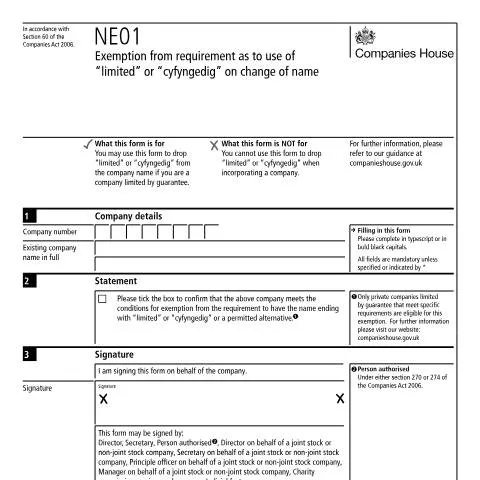
Form NE01 presents a deliberately streamlined application process, reflecting the binary nature of eligibility assessment. The form's brevity, however, masks the importance of ensuring complete compliance with underlying statutory conditions before submission.
Section 1 requires precise company identification details. The existing company name must match exactly with Companies House records, including any punctuation, spacing, or capitalisation. The company number serves as the primary identifier, and any discrepancy between the stated name and registered details will result in form rejection.
The critical element lies in Section 2's statement confirmation. By ticking the declaration box, the signatory affirms that the company meets all conditions for exemption. This represents a formal declaration with potential legal consequences if made incorrectly, as it constitutes a statement to Companies House regarding statutory compliance.
Section 3's signature requirements reflect the formal nature of the application. The form may be signed by various authorised persons under sections 270 or 274 of the Companies Act 2006, including directors, company secretaries, or specifically authorised individuals. For organisations with complex governance structures, determining the appropriate signatory requires careful consideration of corporate authority and delegation arrangements.
The form specifies completion in typescript or bold black capitals, reflecting Companies House's digitisation requirements and ensuring clear reproduction in public records. Handwritten submissions risk rejection or processing delays.
Supporting Documentation and Evidence
Whilst Form NE01 itself requires no supporting documents, Companies House may request additional evidence during assessment, particularly for organisations whose qualifying status isn't immediately apparent from existing filings. This might include:
- Detailed constitutional documents demonstrating profit distribution restrictions
- Evidence of actual activities aligning with stated charitable or public benefit purposes
- Financial statements showing income application towards qualifying objects
- Third-party confirmation of charitable or educational status from relevant regulators
Submission Channels and Processing Considerations
Companies House offers both electronic and postal submission routes for Form NE01, though the digital pathway provides significant advantages in processing speed and confirmation receipt. The electronic filing system integrates directly with company records, reducing the risk of administrative errors that might delay processing.
Electronic submission through the Companies House online service provides immediate confirmation of receipt and typically faster processing times. The system performs initial validation checks, flagging obvious errors before submission completion. This route also maintains an audit trail accessible through the company's online filing history.
Postal submissions must be directed to the appropriate Companies House office, with addresses varying depending on the company's registered jurisdiction within the UK. Welsh companies, for instance, may need to submit to Cardiff offices, whilst English companies typically submit to London or Birmingham processing centres.
Processing timelines vary considerably based on application complexity and current workload. Straightforward applications from clearly qualifying organisations might be processed within several weeks, whilst cases requiring additional scrutiny or documentation could extend to several months. No fees apply for NE01 submissions, distinguishing this process from many other Companies House filing requirements.
Post-Submission Procedures
Upon successful processing, Companies House updates the public register to reflect the company's exemption status and revised name. The organisation can immediately begin operating under its new designation, though practical considerations around banking, contracts, and regulatory notifications require careful coordination.
Rejected applications receive detailed explanations of deficiencies, allowing for resubmission once underlying issues are addressed. Common rejection reasons include incomplete constitutional restrictions on profit distribution or activities extending beyond qualifying purposes.
Operational Impact: Beyond Name Changes
The removal of "limited" or "cyfyngedig" extends beyond cosmetic rebranding, often triggering significant operational and strategic implications. Public perception frequently shifts markedly, with stakeholders viewing the organisation as more mission-focused and less commercially driven.
For organisations seeking funding, particularly from charitable foundations or government sources, the exemption can enhance credibility and eligibility. Many funding bodies specifically favour organisations without commercial designations, viewing them as more aligned with charitable objectives.
Regulatory relationships may also evolve following exemption approval. Charity regulators, professional oversight bodies, and sector-specific authorities often view exempt organisations differently, potentially affecting reporting requirements, compliance expectations, and collaborative opportunities.
Banking and financial service providers require notification of name changes, typically involving account documentation updates and potential credit reference adjustments. Commercial contracts may need amendment, particularly where the company name appears in formal agreements or ongoing service arrangements.
Ongoing Compliance Obligations
Exemption approval doesn't eliminate ongoing compliance requirements. Companies must continue meeting the original qualifying conditions throughout their operational life. Any changes to objects, profit distribution arrangements, or activity scope that compromise exemption eligibility must be promptly addressed.
If circumstances change such that the company no longer qualifies for exemption, it must revert to using "limited" or "cyfyngedig" in its name. This might occur through constitutional changes, activity expansion beyond qualifying purposes, or alterations to profit distribution arrangements.
Strategic Timing and Change Management
The decision to pursue Section 60 exemption requires careful timing consideration, particularly for established organisations with extensive stakeholder relationships and operational commitments. Change management becomes crucial when the organisation has operated under its "limited" designation for extended periods.
Many organisations coordinate the exemption process with broader rebranding initiatives, constitutional reviews, or strategic repositioning efforts. This approach maximises the impact of the name change whilst minimising confusion among stakeholders who must adapt to the new designation.
Consideration of market timing proves particularly important for organisations involved in fundraising cycles, regulatory reviews, or major contract negotiations. The exemption process, once initiated, creates a period of uncertainty that might affect these activities until completion.
Communication strategies should anticipate stakeholder questions about the organisation's continued corporate status and legal obligations. The exemption affects nomenclature rather than fundamental corporate structure, but this distinction often requires explanation to members, beneficiaries, and commercial partners.
For organisations operating across multiple jurisdictions, the UK exemption applies only to the specific company entity and doesn't automatically extend to subsidiary companies or overseas operations. Coordinated naming strategies across corporate groups require separate consideration for each legal entity involved.
Compliance Verification and Long-term Maintenance
Successful exemption approval establishes an ongoing obligation to maintain qualifying status throughout the company's operational life. Regular compliance verification becomes essential, particularly when organisations evolve their activities, governance structures, or strategic focus.
Annual returns and confirmation statements continue as normal filing obligations, but exempt companies must ensure their reported activities consistently align with exemption criteria. Any expansion into commercial activities, changes to profit distribution mechanisms, or constitutional amendments affecting qualifying status require immediate assessment of continued exemption eligibility.
Professional advisers often recommend periodic compliance reviews, particularly following significant organisational changes, new venture launches, or governance restructuring. These assessments help identify potential exemption risks before they compromise the organisation's status or require emergency remedial action.
The public nature of Companies House records means exemption status remains visible to stakeholders, regulators, and potential partners indefinitely. This transparency supports the policy objective of distinguishing genuinely public-benefit organisations from commercial entities, whilst creating accountability for continued compliance with exemption conditions.
Strategic Considerations for Different Business Structures
The decision to seek exemption from using 'limited' or 'cyfyngedig' through form NE01 carries different implications depending on your company's structure and operational model. For subsidiary companies within larger corporate groups, the exemption can present unique challenges around brand consistency and regulatory compliance across jurisdictions. Parent companies operating internationally may find that omitting 'limited' from a UK subsidiary's name creates confusion in markets where limited liability indicators are mandatory or culturally expected.
Professional service companies face particular considerations when pursuing NE01 exemption. Law firms, accounting practices, and consultancies often benefit from the gravitas that comes with dropping 'limited', as it can suggest partnership-level prestige even within a corporate structure. However, these businesses must carefully consider professional indemnity insurance implications—some insurers may require additional disclosures or charge different premiums when the limited liability status isn't immediately apparent from the company name.
For charitable companies limited by guarantee, the NE01 exemption can be particularly valuable in fundraising contexts. Research suggests that donors often respond more favourably to organisations without commercial-sounding suffixes. However, these entities must balance this against transparency requirements under charity law, ensuring that their limited liability status is clearly communicated in contexts where it matters—such as when entering into significant contracts or property leases.
Trading companies in consumer-facing sectors need to evaluate whether the exemption aligns with consumer protection considerations. While dropping 'limited' might create a more approachable brand image, it could also obscure the nature of customer protections available. This is particularly relevant for companies in sectors like travel, financial services, or high-value retail, where consumers' understanding of limited liability can affect their purchasing decisions and complaint procedures.
Companies considering management buyouts or employee ownership transitions should evaluate the timing of NE01 applications carefully. The exemption process typically takes several weeks to complete, and changing a company name during ownership transitions can complicate legal documentation, banking arrangements, and stakeholder communications. It's often advisable to complete the exemption process either well before or after such significant corporate events.
Sector-Specific Compliance and Regulatory Interactions
Financial services companies face the most complex regulatory landscape when pursuing NE01 exemption. The Financial Conduct Authority (FCA) maintains specific guidance on how authorised firms should present their corporate status to consumers. While the exemption itself doesn't breach FCA rules, firms must ensure their marketing materials and client communications maintain appropriate transparency about their corporate structure and regulatory status. This often means including explanatory text in smaller print or ensuring that 'limited company' status is mentioned in key disclosure documents.
Companies in regulated healthcare sectors encounter similar complexities. The Care Quality Commission (CQC) requires clear identification of corporate structures in registration documentation, and dropping 'limited' from trading names can sometimes necessitate additional explanatory documentation during inspection processes. Private healthcare providers often find that the exemption enhances their professional image but must maintain clear audit trails showing their corporate status for regulatory compliance.
Educational institutions operating as companies limited by guarantee frequently pursue NE01 exemption to align with the naming conventions of traditional schools and colleges. However, the Department for Education's funding agreements and Ofsted inspection frameworks require clear identification of corporate status in specific contexts. Independent schools, in particular, must balance the prestige benefits of dropping 'limited' against the need for transparency in parent communications about governance structures and financial protections.
For companies in construction and property development, the exemption can affect interactions with local planning authorities and building control departments. Some councils maintain internal procedures that flag companies without clear limited liability indicators for additional financial scrutiny during major project applications. While this doesn't prevent approval, it can extend processing times and require additional financial guarantees or bond arrangements.
Technology companies seeking to establish credibility with enterprise clients often find NE01 exemption valuable, as it can suggest established corporate maturity rather than startup status. However, these businesses must consider the implications for software licensing agreements, data processing agreements, and cybersecurity insurance policies, where corporate structure identification can affect terms and coverage levels.
Companies operating in import/export sectors should evaluate how the exemption might affect customs documentation and international trade procedures. While HMRC systems accommodate various company name formats, some international partners or customs authorities may require additional documentation to verify corporate status when 'limited' isn't immediately apparent from shipping documentation.
Long-term Strategic Implications and Exit Planning
The NE01 exemption creates lasting implications that extend well beyond immediate branding benefits, particularly for companies contemplating future merger and acquisition activity. Due diligence processes typically involve extensive verification of corporate structures and trading names, and companies with exempted names may face additional scrutiny or documentation requirements. Potential acquirers often prefer clear, unambiguous corporate identification, and the exemption can sometimes complicate valuation processes or legal structure assessments.
For companies planning initial public offerings (IPO), the exemption presents complex considerations around market perception and regulatory compliance. While public companies commonly trade without 'plc' in their marketing materials, the underlying legal structure must remain transparent. Companies that have built brand recognition around an exempted name may need to invest significantly in rebranding communications to ensure market clarity about their public company status post-flotation.
Succession planning in family businesses becomes more complex with NE01 exemption, particularly where the company name closely resembles personal names or family identities. Future generations may find it challenging to distinguish between personal and corporate liabilities in public perception, even though legal protections remain unchanged. Estate planning and inheritance tax considerations may also require additional professional advice to ensure clarity around corporate asset ownership.
The exemption can significantly impact international expansion strategies. Companies seeking to establish overseas subsidiaries or branches may find that their exempted UK name doesn't translate effectively into foreign corporate structures or regulatory frameworks. Some jurisdictions require explicit limited liability indicators for foreign company registration, potentially necessitating different trading names in different markets—a complexity that can dilute brand consistency and increase compliance costs.
Intellectual property protection strategies require careful consideration when companies hold NE01 exemption. Trademark registrations, patent applications, and copyright assignments must clearly identify the corporate entity, and the absence of 'limited' can sometimes complicate enforcement actions or licensing agreements. Companies often need to maintain comprehensive documentation linking their exempted trading name to their formal corporate identity for IP protection purposes.
For companies in cyclical or seasonal industries, the exemption can affect credit facility negotiations and supplier relationship management during challenging periods. Financial institutions and trade creditors may require additional documentation or personal guarantees when limited liability status isn't immediately apparent from company names, particularly during economic downturns when credit risk assessment becomes more stringent.
The digital asset and cryptocurrency sector presents unique considerations for NE01 exemption, as regulatory frameworks continue evolving rapidly. Companies in this space often benefit from the authority that comes with dropping 'limited', but they must balance this against increasing regulatory requirements for corporate transparency in financial promotions and customer onboarding procedures. The Financial Conduct Authority's evolving guidance on crypto asset businesses may require additional corporate structure disclosures that could offset some branding benefits of the exemption.