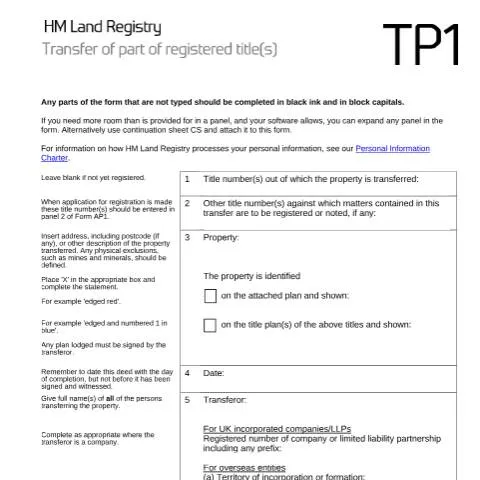
When Property Ownership Changes Hands: Understanding the TP1 Transfer Framework
Property transactions in England and Wales involve a complex web of legal documentation, with the TP1 form serving as the cornerstone document when transferring part of a registered title. Unlike a straightforward whole property sale, part transfers require meticulous attention to boundary definitions, retained rights, and the creation of new title registrations. This official HM Land Registry form transforms what might appear as a simple land division into a legally binding transfer that protects both parties' interests whilst ensuring the Land Register remains accurate and comprehensive.
The TP1 differs fundamentally from other transfer forms in the HM Land Registry suite. Where TR1 forms handle complete property transfers and AS1 forms deal with assents, the TP1 specifically addresses scenarios where only a portion of registered land changes ownership. This distinction matters enormously in practice, as part transfers often involve complex arrangements around shared access, utilities, and ongoing obligations between neighbouring properties.
Identifying When TP1 Application Becomes Necessary
The requirement for a TP1 form arises in several distinct circumstances, each carrying its own procedural nuances. Garden sales represent the most common scenario, where homeowners dispose of part of their garden to developers or neighbours. These transactions frequently involve creating new residential plots whilst retaining rights of way or utility easements.
Commercial property divisions constitute another significant category. Businesses often subdivide premises when restructuring operations, selling off warehouse sections, or creating separate retail units. Industrial estates particularly benefit from TP1 procedures when landlords wish to dispose of individual units to sitting tenants whilst maintaining common areas and shared facilities.
| Transfer Scenario | Typical Considerations | Common Complications |
|---|---|---|
| Residential garden sales | Access rights, boundary walls, utility connections | Ransom strips, planning permissions, covenant restrictions |
| Commercial subdivisions | Service charges, parking allocations, loading bay access | Lease variations, fire safety compliance, separate utilities |
| Agricultural land sales | Water rights, field access, livestock movement | Agricultural tenancy rights, sporting rights, mineral extraction |
| Development site creation | Planning obligations, infrastructure contributions, phasing | Section 106 agreements, adoption procedures, bond requirements |
Family arrangements often trigger TP1 requirements when parents transfer building plots to adult children or when siblings divide inherited property. These transactions, whilst appearing straightforward, frequently involve complex trust arrangements and tax planning considerations that must be properly documented within the form's additional provisions section.
Navigating the Critical Property Identification Requirements
Panel 3 of the TP1 form demands precise property identification that goes far beyond simple address descriptions. The transferred area must be clearly defined through either attached plans or references to existing title plan markings. HM Land Registry requires plans to be signed by the transferor, establishing their agreement to the exact boundaries being transferred.
Physical exclusions deserve particular attention in this section. Mines and minerals frequently remain with the original owner, requiring specific exclusion statements. Similarly, airspace rights, basement areas, or upper floor extensions might be retained, necessitating detailed three-dimensional descriptions that prevent future boundary disputes.
The choice between "edged red" markings on attached plans versus "edged and numbered" references to existing title plans significantly impacts processing timelines. New plans require careful preparation to Ordnance Survey standards, whilst references to existing registrations must accurately correspond to current title documentation. Discrepancies between plan references and actual title plan markings constitute the most common cause of requisitions from HM Land Registry.
Plan Preparation and Boundary Definition Standards
Professional surveyors typically prepare transfer plans, but property owners can create their own provided they meet HM Land Registry's technical requirements. Plans must clearly show the transferred area in relation to retained property, with measurements and boundary features accurately depicted. Ordnance Survey base maps provide the preferred foundation, though other mapping sources may be acceptable in specific circumstances.
Boundary features require careful consideration during plan preparation. Existing walls, fences, hedgerows, and natural features like streams or ditches must be accurately represented. The responsibility for boundary maintenance often transfers with ownership, making precise identification crucial for avoiding future neighbour disputes.
Transferor and Transferee Documentation Complexities
Panels 5 and 6 address the parties involved in the transfer, with recent legislative changes significantly complicating completion requirements. The Economic Crime (Transparency and Enforcement) Act 2022 introduced mandatory overseas entity identification for foreign companies, requiring Companies House-issued entity IDs or explicit statements that such identification isn't required.
UK incorporated companies must provide their registered numbers including any prefixes, whilst limited liability partnerships follow similar identification protocols. Overseas entities face more complex requirements, needing territory of incorporation details alongside UK business registration numbers where applicable. These requirements apply to both transferors and transferees, creating potential delays when international parties are involved.
Individual transferors require full legal names as they appear on existing title registrations. Variations in name formatting, married name changes, or deed poll alterations often necessitate supporting statutory declarations or other evidence to establish identity continuity. Joint owners must all be named, with their respective interests clearly documented.
Corporate Transferee Special Requirements
Corporate transferees face additional documentation burdens beyond basic identification. Overseas companies without existing HM Land Registry arrangements must lodge Form 7 certificates or certified constitutional documents in English or Welsh translation. These requirements can substantially extend transaction timelines, particularly when obtaining certified translations or apostilled documentation from foreign jurisdictions.
Limited liability partnerships and other business structures require careful consideration of their constitutional authority to acquire property. Board resolutions, partnership agreements, or other governance documents may be necessary to demonstrate proper authorisation for the transaction.
Consideration Structures and Tax Implications
Panel 9's consideration section requires careful completion to ensure accurate Stamp Duty Land Tax assessment and proper registration fee calculation. Monetary consideration must be stated in both words and figures, with currency clearly identified if other than sterling. Non-monetary consideration, family gifts, or complex consideration structures require detailed explanations in the additional provisions section.
Part transfers often involve sophisticated consideration arrangements that don't fit standard monetary descriptions. Development overage provisions, where sellers retain rights to additional payments based on future planning permissions or development values, require careful documentation. Similarly, rent charges, ongoing service obligations, or reciprocal rights might constitute part of the overall consideration package.
Transactions "not for money or anything that has a monetary value" still require proper documentation to establish the transfer's legal basis. Family arrangements, corporate restructuring, or charitable gifts all fall within this category, but each requires specific explanation to satisfy HM Land Registry requirements.
Stamp Duty Land Tax Considerations
Part transfers can trigger complex SDLT calculations, particularly when the consideration includes both immediate payments and future obligations. HM Revenue and Customs guidance on part disposals should be consulted, as the interaction between capital gains tax calculations and SDLT assessments can significantly impact the overall transaction cost.
Title Guarantee Provisions and Their Practical Consequences
Panel 10's title guarantee selection carries significant legal implications that extend far beyond the immediate transfer. "Full title guarantee" provides the highest level of protection for transferees, with transferors warranting their right to dispose of the property and guaranteeing against adverse third-party claims. This represents the standard expectation in commercial transactions where transferors have comprehensive knowledge of the property's history.
"Limited title guarantee" offers reduced protection, typically used when transferors have limited knowledge of the property's background or when acting in representative capacities. Executors, administrators, or corporate liquidators often utilise limited guarantee provisions to protect against claims arising from periods before their involvement.
The absence of title guarantee, whilst legally permissible, rarely occurs in practice due to the significant risks imposed on transferees. Such arrangements typically appear only in distressed sales, court-ordered transfers, or where specific statutory provisions override standard guarantee requirements.
Covenant and Restriction Implications
Title guarantee provisions interact closely with existing covenants and restrictions affecting the property. Transferors providing full guarantee effectively warrant that no breaches exist and that all necessary consents have been obtained. This creates potential future liability for covenant breaches, making thorough due diligence essential before guarantee selection.
Trust Declarations and Joint Ownership Structures
Panel 11 addresses trust arrangements when multiple transferees acquire the property, with significant implications for future dealings and succession planning. Joint tenancy arrangements create automatic survivorship rights, meaning the surviving owner automatically inherits the deceased owner's share without probate requirements. This proves particularly valuable for married couples or business partners seeking simplified succession arrangements.
Tenancy in common structures offer greater flexibility but require more complex administration. Equal shares represent the default arrangement, but unequal beneficial interests can be documented in the additional provisions section. These arrangements prove essential when transferees contribute different amounts to the purchase price or when sophisticated tax planning arrangements are involved.
The automatic Form A restriction insertion by HM Land Registry protects purchasers by requiring two trustees' signatures for future disposals, unless specific exemptions apply. Understanding these restriction implications prevents future transaction delays when properties are subsequently sold or refinanced.
| Ownership Structure | Survivorship Rights | Future Sale Requirements | Tax Planning Benefits |
|---|---|---|---|
| Joint tenancy | Automatic survivorship | Both parties must sign | Simplified succession, potential IHT savings |
| Tenancy in common (equal) | Estate inheritance | Two trustees required | Flexible will planning, controlled succession |
| Tenancy in common (unequal) | Proportionate estate inheritance | Two trustees required | Capital contribution recognition, tax efficiency |
| Specific trust terms | As defined in trust deed | According to trust provisions | Sophisticated tax and succession planning |
Additional Provisions: Beyond Standard Transfer Terms
Panel 12 represents the most flexible and potentially complex section of the TP1 form, accommodating arrangements that don't fit within standard transfer provisions. Rights granted or reserved often prove crucial in part transfer scenarios, particularly regarding access, utilities, and ongoing maintenance obligations. These provisions become part of the registered title, binding future owners and requiring careful drafting to avoid ambiguity.
Restrictive covenants frequently appear in part transfers, controlling future development or use of either the transferred or retained property. These might include restrictions on building heights, business use limitations, or architectural approval requirements. The enforceability and practical impact of such covenants require careful legal consideration, particularly regarding their compatibility with planning permissions and building regulations.
Easements and rights of way demand precise definition within this section. Vehicular access rights, pedestrian pathways, utility easements, and drainage rights all require specific documentation that clearly defines their extent, maintenance responsibilities, and future variation procedures. Vague easement definitions frequently lead to expensive boundary disputes years after the initial transfer.
Complex Commercial Arrangements
Commercial part transfers often involve sophisticated arrangements that push Panel 12 to its limits. Service charge arrangements, insurance obligations, and shared facility management require detailed documentation that establishes clear ongoing relationships between retained and transferred properties. These provisions must anticipate future scenarios including property subdivision, change of use, or major refurbishment works.
Development agreements frequently accompany part transfers where the transferee intends immediate development. These might include infrastructure contribution requirements, adoption procedures for new roads, or coordination arrangements for phased development schemes. Such provisions require careful integration with planning obligations and building contract terms.
Submission Procedures and Processing Expectations
TP1 form submission requires coordination with Form AP1 application for first registration of the newly created title. The title numbers being transferred must be entered in AP1 Panel 2, creating the administrative link between the transfer deed and the registration application. This coordination proves crucial for processing efficiency and fee calculation accuracy.
Supporting documentation requirements vary significantly depending on the transfer's complexity. Simple residential part transfers might require only the completed TP1 and appropriate plans, whilst commercial or overseas entity transactions demand extensive additional evidence. Certified copies of corporate documents, overseas entity registrations, and statutory declarations commonly accompany complex applications.
Processing timelines depend heavily on application completeness and complexity. Standard part transfers typically complete within HM Land Registry's published service standards, but applications requiring extensive examination or additional evidence can extend significantly beyond normal timeframes. Requisitions requesting additional information or clarification represent the most common cause of processing delays.
Electronic submission through the Business Gateway portal offers faster processing for qualifying applications, though complex part transfers often require paper submission due to plan requirements or extensive additional provisions. The choice between submission methods should consider the specific transaction requirements and desired processing speed.
Post-completion, HM Land Registry issues official copies of both the retained and newly created titles, confirming the successful registration of the part transfer. These documents provide definitive evidence of the new ownership arrangements and should be carefully reviewed to ensure all transfer provisions have been accurately registered. Any discrepancies require prompt correction through appropriate rectification procedures.