When Court Proceedings Face the Unexpected: The Manchester Administrative Court's Adjournment Process
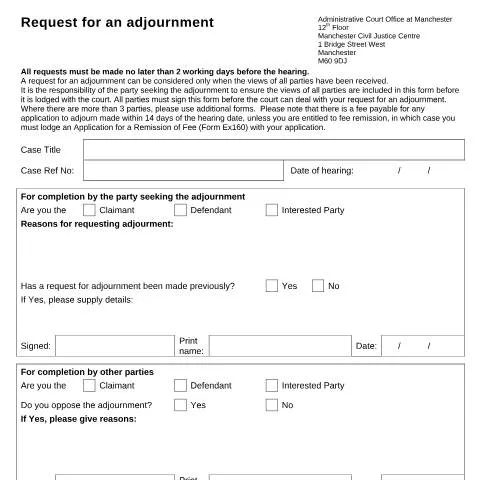
Legal proceedings rarely unfold according to plan. A key witness falls ill on the morning of a judicial review hearing, essential documents arrive late from a government department, or counsel discovers a conflicting commitment that threatens to derail months of preparation. In these moments, Form AC001 becomes the lifeline that prevents procedural disasters from becoming substantive injustices in Manchester's Administrative Court.
The Administrative Court Office at Manchester Civil Justice Centre handles some of the most complex public law disputes in the North West, from immigration appeals to planning challenges and human rights claims. When circumstances beyond a party's control threaten to compromise their ability to present their case effectively, this specialised adjournment form provides the formal mechanism to seek a postponement whilst ensuring all parties' interests are properly considered.
Unlike standard civil proceedings where adjournments might be granted more liberally, administrative law cases often involve urgent matters of public interest, detained individuals, or time-sensitive statutory deadlines. The form's stringent requirements reflect this reality, demanding not just compelling reasons but also the explicit views of every party involved in the proceedings.
Navigating the Two-Working-Day Deadline: Strategic Timing and Emergency Situations
The form's most unforgiving requirement appears deceptively simple: all requests must be made no later than 2 working days before the hearing. However, this deadline creates a complex web of strategic considerations that experienced practitioners navigate with careful planning.
Working days exclude weekends and public holidays, meaning a Tuesday hearing requires submission by the preceding Friday. For Monday hearings following a bank holiday weekend, the deadline could fall as early as the previous Wednesday. This compressed timeframe becomes particularly challenging when dealing with multiple parties across different time zones or when essential information emerges close to the hearing date.
The Manchester Administrative Court Office has developed specific protocols for handling last-minute emergencies that arise within the two-day window. Genuine emergencies—such as sudden serious illness, unexpected disclosure of crucial documents, or the unavailability of essential witnesses due to circumstances beyond anyone's control—may still be considered, but require exceptional justification and often telephone applications directly to the court.
| Hearing Day | Latest Submission (by 4:30pm) | Considerations |
|---|---|---|
| Monday | Wednesday (previous week) | Allow extra time for bank holidays |
| Tuesday | Friday (previous week) | Most common submission day |
| Wednesday | Monday (same week) | Tight turnaround for responses |
| Thursday | Tuesday (same week) | Consider postal delays |
| Friday | Wednesday (same week) | Weekend disruptions possible |
Practitioners often build buffer time into their preparation schedules, recognising that waiting until the last possible moment severely limits options if complications arise. The court's emphasis on advance notice reflects the significant administrative burden of rescheduling hearings, particularly given the complex diary management required for multi-day judicial review cases involving multiple counsel and expert witnesses.
The Unanimous Consent Requirement: Orchestrating Agreement Across Adversarial Proceedings
Form AC001's most distinctive feature lies in its requirement for all parties to sign before the court can deal with the adjournment request. This creates a fascinating dynamic where adversaries must collaborate even whilst maintaining their substantive disputes.
The form provides space for three parties, with additional forms required for more complex multi-party proceedings common in administrative law. Each party must explicitly state whether they oppose the adjournment and provide detailed reasons for any opposition. This transparency serves multiple purposes: it prevents tactical delays, ensures genuine consideration of all perspectives, and provides the court with comprehensive information for decision-making.
Securing unanimous consent often requires delicate negotiation. A claimant seeking an adjournment might offer to agree to an expedited timetable for the rescheduled hearing, whilst defendants might seek assurances about case management directions or cost implications. Interested parties—often central government departments or regulatory bodies—may have their own scheduling constraints that influence their position.
When parties cannot reach agreement, the situation becomes significantly more complex. The court retains ultimate discretion to grant adjournments even over opposition, but will scrutinise the reasons for refusal carefully. Common grounds for legitimate opposition include:
- Prejudice to detained individuals or those facing imminent removal
- Statutory time limits that cannot be extended
- Significant costs already incurred for expert witnesses or counsel
- Previous adjournments granted to the same party
- Evidence of tactical delay or abuse of process
Financial Implications: The Fourteen-Day Fee Threshold and Remission Applications
Administrative justice comes with costs, and Form AC001 incorporates a financial deterrent against last-minute applications. Any adjournment request made within fourteen days of the hearing date triggers a fee, unless the applicant qualifies for fee remission through the submission of Form EX160.
This fee structure reflects the court's legitimate concern about the administrative burden and wasted costs associated with late adjournments. Court staff must reschedule hearings, notify all parties, rearrange judicial diaries, and potentially deal with consequential disruption to other cases. The fourteen-day threshold recognises that late changes become exponentially more disruptive as the hearing date approaches.
Fee remission applications require careful preparation, particularly for litigants in person who may be unfamiliar with the detailed financial disclosure requirements. The EX160 form demands comprehensive information about income, capital, and outgoings, with supporting documentation required for verification. Processing these applications takes time, creating additional pressure on the two-working-day deadline for the underlying adjournment request.
Legal representatives often advise clients about potential fee exposure early in proceedings, particularly where circumstances might necessitate a late adjournment. This might include cases involving vulnerable witnesses, complex expert evidence, or ongoing disclosure disputes that could generate last-minute developments.
Crafting Compelling Reasons: The Art of Persuasive Adjournment Applications
The success of any adjournment application hinges on the quality of reasons provided in the designated section of Form AC001. Administrative Court judges, experienced in managing complex public law cases, can quickly distinguish between genuine necessity and tactical manipulation.
Medical emergencies represent the most straightforward category, but require proper documentation. A brief note stating "solicitor unwell" will not suffice; the court expects medical evidence demonstrating that the illness prevents effective participation. For barristers, the professional obligations around accepting alternative counsel must be explored and explained if continuity is genuinely essential.
Late disclosure creates more complex analytical challenges. Administrative law cases often involve extensive document production from government departments, and genuinely significant late disclosure can fundamentally alter a case's trajectory. However, applicants must demonstrate that the new material could not have been anticipated and that proceeding without proper consideration would cause substantial prejudice.
Witness unavailability requires careful justification of why particular testimony is essential and cannot be provided through alternative means. Expert witnesses command premium fees, and their unavailability can create significant scheduling difficulties, but the court will expect evidence of genuine attempts to find suitable alternatives or to proceed with written evidence where appropriate.
The form's limited space for reasons creates additional pressure for concise, compelling explanations. Experienced practitioners often attach supporting documents as appendices, whilst ensuring the core justification fits within the designated area. The key lies in demonstrating that the circumstances are genuinely beyond the applicant's control and that proceeding as scheduled would compromise the fair administration of justice.
Previous Adjournment History: How Past Requests Shape Current Applications
Form AC001 explicitly requires disclosure of any previous adjournment requests, recognising that patterns of delay can indicate systemic case management problems or potential abuse of process. This historical perspective allows judges to assess current applications within the broader context of how proceedings have been conducted.
First-time adjournment requests generally receive more sympathetic consideration, particularly where genuine emergencies have arisen. However, repeat applications trigger enhanced scrutiny, with courts expecting detailed explanations of what has changed since previous difficulties were resolved.
The form's requirement to "supply details" of previous adjournments demands more than simple acknowledgement. Applicants must explain the circumstances of earlier requests, how they were resolved, and why current circumstances differ materially. This transparency helps prevent tactical delays whilst ensuring legitimate difficulties receive appropriate consideration.
Cases involving multiple previous adjournments often develop specific case management directions designed to prevent further disruption. These might include requirements for regular status updates, fixed timetables that cannot be varied except in exceptional circumstances, or directions that the next hearing will proceed regardless of circumstances short of genuine emergencies.
Operational Mechanics: Submission Procedures and Court Processing
The Manchester Civil Justice Centre's 12th Floor Administrative Court Office operates within strict procedural frameworks that ensure consistent handling of adjournment applications. Form AC001 must be submitted to the specified address, with email submissions generally not accepted unless prior arrangements have been made with court staff.
Processing begins immediately upon receipt, with court staff verifying that all required signatures are present and that any applicable fees have been paid or remission applications submitted. Incomplete forms are typically returned immediately, potentially causing fatal delays if discovered close to the deadline.
The court's decision-making process involves judicial consideration of all submitted materials, including the reasons for seeking adjournment and any opposition from other parties. Decisions are typically communicated to all parties simultaneously, usually within 24 hours of submission where possible, though complex cases or those requiring additional information may take longer.
Urgent applications received outside normal office hours may be considered through the court's emergency procedures, though these are reserved for genuinely exceptional circumstances. The duty judge system ensures that critical applications can be processed even during weekends or holidays, though the threshold for intervention is necessarily high.
When adjournments are granted, the court typically provides directions for case management going forward, including new hearing dates and any specific requirements designed to prevent future delays. These directions become binding court orders, with breach potentially resulting in sanctions or adverse cost consequences.
Strategic Considerations and Professional Best Practice
Experienced administrative law practitioners develop sophisticated approaches to managing adjournment risks throughout case preparation. This involves early identification of potential vulnerabilities, proactive communication with other parties about emerging issues, and careful documentation of circumstances beyond their control.
Professional conduct considerations add another layer of complexity. Solicitors and barristers have obligations to act in their clients' best interests whilst maintaining honesty and transparency with the court. This can create tensions when clients push for tactical delays or when genuine difficulties emerge that might be perceived as convenient timing.
The form's emphasis on securing all parties' views before submission often necessitates extensive correspondence and negotiation. Successful practitioners maintain detailed records of these communications, both to demonstrate good faith efforts at consensus-building and to provide evidence of any unreasonable opposition from other parties.
Risk management strategies often include developing contingency plans for key personnel unavailability, maintaining relationships with alternative counsel who could step in if necessary, and building buffer time into preparation schedules to accommodate unexpected developments. These approaches, whilst requiring additional resources, significantly reduce the likelihood of needing last-minute adjournments.
The Manchester Administrative Court's approach to adjournment applications reflects broader principles of case management efficiency balanced against fair access to justice. Form AC001 serves as both a procedural safeguard and a deterrent against abuse, ensuring that the court's limited resources are deployed effectively whilst protecting parties' fundamental rights to proper preparation and representation. Understanding its requirements and strategic implications remains essential for anyone navigating the complex landscape of administrative law proceedings in one of England's busiest regional centres for public law disputes.
Understanding Valid Grounds for Adjournment Requests
Manchester courts evaluate adjournment applications against established legal criteria, with Form AC001 requiring applicants to demonstrate compelling reasons that justify postponing proceedings. The courts distinguish between acceptable and unacceptable grounds, applying strict scrutiny to prevent unnecessary delays in the justice system.
Medical circumstances constitute the most commonly accepted grounds for adjournment. These include sudden illness of the applicant, key witnesses, or legal representatives that prevents effective participation in proceedings. The court typically requires medical evidence dated within seven days of the hearing, preferably from a registered GP or hospital consultant. Mental health conditions affecting the applicant's capacity to participate meaningfully in their case may also warrant adjournment, though courts increasingly seek expert psychiatric evidence rather than accepting general practitioner certificates alone.
Legal representation issues can justify adjournment in specific circumstances. If your solicitor becomes unavailable due to emergency or professional conflict arising after the hearing date was set, courts may grant postponement. However, difficulties in securing funding for legal representation, or disagreements with your current solicitor, rarely satisfy the threshold for adjournment. The court expects parties to address representation issues well in advance of hearings.
Unavailability of crucial evidence or witnesses represents another valid ground, particularly in complex cases where testimony or documentation is essential to fair determination of the matter. This might include police officers in criminal proceedings, expert witnesses in technical disputes, or documentary evidence held by third parties. The applicant must demonstrate that the missing element is genuinely necessary for their case and that reasonable efforts have been made to secure attendance or production before the hearing date.
Bereavement and family emergencies involving immediate family members are generally viewed sympathetically by Manchester courts, though the relationship between the deceased or affected person and the applicant will influence the court's decision. Death of a spouse, parent, or child typically warrants adjournment, whilst more distant relationships may require additional justification.
Fill in your form directly online
No printing: type your details into the boxes of the official form, tick, then download the PDF ready to send.
- 1Type into the form boxes
- 2Tick in one click
- 3Save and download the PDF
Courts firmly reject certain grounds as insufficient for adjournment. Work commitments, including important business meetings or overseas travel, rarely justify postponement unless the applicant can demonstrate exceptional circumstances that arose after the hearing was listed. Childcare difficulties must be genuine emergencies rather than foreseeable arrangements, as courts expect parties to organize appropriate care when hearing dates are set weeks or months in advance.
Financial hardship preventing attendance at court is not automatically accepted as grounds for adjournment, though courts may consider applications where sudden loss of employment or benefits creates genuine hardship. The key test is whether the circumstances were reasonably foreseeable when the hearing date was set.
Consequences of Denied Applications and Alternative Options
When Manchester courts refuse Form AC001 applications, applicants face several potential consequences that can significantly impact their legal position. Understanding these outcomes and available alternatives is crucial for anyone whose adjournment request has been unsuccessful or appears likely to be denied.
Proceeding without representation represents the most immediate consequence of a denied adjournment request. If your application was based on unavailability of legal representation, you may need to represent yourself at the scheduled hearing. Manchester courts provide limited assistance to litigants in person, including basic procedural guidance and access to court staff for administrative queries. However, court personnel cannot provide legal advice or advocacy services. Consider requesting additional time during the hearing to consult with the duty solicitor scheme if available in your particular court.
Non-attendance penalties can be severe depending on the type of proceedings. In civil cases, courts may proceed in your absence and enter judgment against you, potentially resulting in financial liability for costs and damages. Criminal proceedings may result in arrest warrants if you fail to appear for mandatory hearings. Employment tribunals may strike out claims or defences where applicants fail to attend without valid excuse.
Costs implications frequently follow refused adjournment applications. Courts may order unsuccessful applicants to pay the other party's costs incurred in preparing for the original hearing date, particularly where the application is deemed frivolous or made without sufficient notice. These costs can include solicitor fees, expert witness expenses, and travel costs for out-of-area representatives.
Several alternative strategies may assist applicants whose initial adjournment requests face likely refusal. Requesting a shorter adjournment rather than indefinite postponement increases the likelihood of court approval, particularly where specific dates can be identified when the impediment to attendance will be resolved. For medical grounds, offering to attend via video link or telephone may satisfy court requirements whilst accommodating health limitations.
Negotiating with opposing parties before submitting Form AC001 can strengthen your application significantly. If all parties consent to adjournment, courts are more likely to grant the request, though they retain discretion to refuse even consensual applications where delay prejudices the administration of justice. Document any agreement reached with other parties and include this information prominently in your application.
Seeking urgent medical treatment or assessment may transform a weak application into a compelling one. If your adjournment request relates to health issues, obtaining prompt medical attention and detailed practitioner reports can provide the evidence courts require to grant postponement. Emergency dental treatment, sudden onset of anxiety disorders, or deterioration in existing conditions may justify adjournment if properly documented.
Partial hearing applications offer another alternative where only specific aspects of your case are affected by the circumstances prompting your adjournment request. Courts may agree to hear preliminary issues, procedural applications, or uncontested matters whilst adjourning substantive hearings requiring your full participation. This approach demonstrates willingness to progress proceedings whilst accommodating genuine difficulties.
Post-Submission Procedures and Court Response Timelines
After submitting Form AC001 to Manchester courts, a structured process determines whether your adjournment request will be granted. Understanding these procedures and realistic timelines helps applicants manage expectations and take appropriate action based on court decisions.
Initial administrative processing typically occurs within 24-48 hours of submission for urgent applications, though routine requests may take 3-5 working days. Court administrative staff verify that forms are completed correctly, required fees are paid, and supporting documentation is attached. Incomplete applications are returned to applicants with specific guidance on deficiencies that must be addressed before resubmission.
Judicial review procedures vary depending on the seniority of the allocated judge or district judge. Straightforward applications with clear medical evidence or consensual agreements between parties may receive swift approval from district judges or senior court clerks with delegated authority. Complex applications, those involving significant court resources, or requests affecting multiple hearing days require review by circuit judges or specialist tribunal judges.
Notification methods for court decisions include postal communication to the address provided on Form AC001, email notification where electronic communication has been requested and appropriate technology is available, and telephone contact for urgent applications requiring immediate response. Applicants should monitor all specified communication channels, as courts may attempt contact through multiple methods depending on the urgency of the situation.
Conditional grants represent a common outcome where courts approve adjournment subject to specific requirements. These might include payment of opponents' wasted costs, provision of additional medical evidence by specified dates, or agreement to priority listing for the rescheduled hearing. Failure to comply with conditions attached to conditional grants may result in the adjournment being revoked and the original hearing date being reinstated.
Appeal procedures for refused applications operate under strict time limits and specific procedural requirements. Applications to set aside refusal decisions must typically be made within 7 days of notification, supported by fresh evidence or legal arguments not previously considered. These applications require separate fees and may result in costs orders against unsuccessful appellants.
Rescheduling processes following successful applications can take several weeks or months depending on court availability and case complexity. Priority is typically given to cases with statutory time limits, vulnerable parties, or proceedings involving detained defendants. Applicants may request specific dates or date ranges, though courts retain discretion over final scheduling decisions based on judicial availability and courtroom capacity.
Communication with other parties regarding approved adjournments becomes the applicant's responsibility in many cases. Courts may direct successful applicants to notify opponents, witnesses, and expert advisers of new hearing dates, particularly in civil proceedings where parties bear responsibility for case management. Failure to provide adequate notice may result in further adjournment applications or costs sanctions.
Monitoring and compliance requirements may continue after adjournment is granted, particularly where medical grounds were cited. Courts may require updated medical evidence closer to the new hearing date, progress reports on treatment, or confirmation that circumstances preventing attendance have been resolved. Regular communication with court staff helps ensure compliance with any ongoing requirements attached to the adjournment grant.