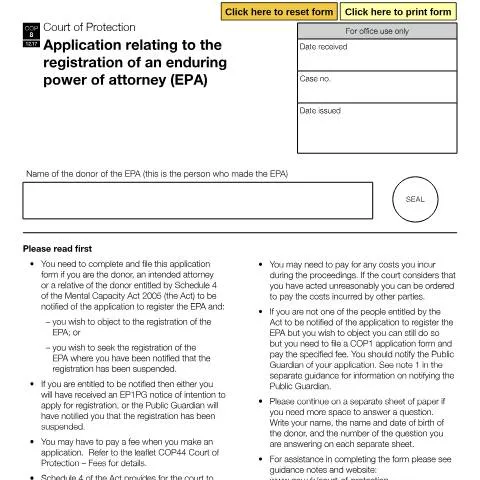
Understanding Form COP8: A Practical Guide to Navigating the Application for an Enduring Power of Attorney
Imagine being in a situation where a loved one is no longer able to manage their financial affairs. In such instances, the importance of having an Enduring Power of Attorney (EPA) becomes clear. However, the registration of an EPA is not a straightforward matter. Form COP8 is a vital document within this framework, enabling individuals to apply for the registration of an EPA. But what does it entail? Who must complete it, and how do they navigate the process effectively? This article provides an in-depth look at Form COP8, covering everything from its purpose to the necessary steps for submission.
The Role of Form COP8 in Empowering Decision-Making
Form COP8 serves as a formal application to the Court of Protection, specifically concerning the registration of an EPA. This legal instrument allows a designated attorney to manage the financial affairs of an individual, known as the donor, who may be unable to do so due to mental incapacity. The significance of this form cannot be overstated; it represents a critical step in ensuring that another individual is legally empowered to act on behalf of someone who can no longer make decisions for themselves.
Who is Required to Submit Form COP8?
- Donor: The person who created the EPA. They may wish to register it themselves or have someone act on their behalf.
- Intended Attorney: Individuals designated in the EPA to act on behalf of the donor.
- Relatives or Entitled Persons: Family members or individuals specified in Schedule 4 of the Mental Capacity Act 2005 who have a legitimate interest in the registration process.
Situations Necessitating the Use of Form COP8
There are specific circumstances under which Form COP8 must be completed. For instance, if the registration of the EPA has been suspended, or if an entitled person wishes to object to the registration, this form must be utilized. Understanding these nuances is crucial, as failing to act promptly may have significant consequences for the donor's autonomy and the authority of the attorney.
Preparation Before Completing Form COP8
Filling out Form COP8 requires careful preparation. Before embarking on this task, consider gathering the following essential documents and information:
Information Needed
- Personal Details: Full names, addresses, and contact details of both the donor and the attorney.
- Documentation of the EPA: The date the EPA was signed and any notifications received regarding its registration.
- Evidence for Your Application: Any supporting documents that substantiate your application or objections, such as witness statements.
Understanding the Grounds for Objection
If you intend to object to the registration of the EPA, you need to be aware of the permissible grounds for objection as outlined in the Mental Capacity Act 2005. These grounds include:
- The EPA is invalid.
- The power no longer exists.
- The donor is not yet mentally incapable.
- There was fraud or undue pressure involved.
- The attorney is unsuitable.
Being clear on these points will assist in crafting a more robust application.
Completing Form COP8: Step-by-Step Guidance
Once you have gathered the necessary information, it's time to dive into the actual completion of Form COP8. This process consists of several sections, each requiring specific inputs:
Section-by-Section Breakdown
| Section | Description |
|---|---|
| 1. Your Details | Provide your name, contact information, and role (donor, attorney, etc.). |
| 2. Details of the EPA | Fill in information about the donor and the intended attorney(s). |
| 3. Your Application | State the directions you are seeking and outline any objections. |
| 4. Attending Court Hearings | Indicate if you require special assistance during court proceedings. |
| 5. Statement of Truth | Sign the document certifying the truthfulness of the application. |
Helpful Tips for Completing the Form
While filling out Form COP8, keep the following points in mind:
- Be precise: Ensure all information is accurate and complete to avoid delays.
- Use additional sheets if necessary: If more space is needed for answers, attach separate sheets, clearly marking them with your details.
- Consult guidance materials: Official guidance notes are available to assist with completing the form.
Submission Channels: Where and How to File Form COP8
Once completed, the next step involves submitting Form COP8 to the appropriate authorities. Understanding your submission options is crucial for a smooth application process.
Filing Options
- Online Submission: If available, this can be the fastest method for submitting your application.
- Postal Submission: You can mail the completed form to the Court of Protection, but be mindful of the time it may take for the application to arrive and be processed.
- In-Person Submission: If preferred, you can submit the form directly at the appropriate court office.
Paying the Required Fee
Be aware that there may be a fee associated with submitting Form COP8. Refer to leaflet COP44 for details on fees applicable to your specific circumstances, as these can vary depending on the nature of the application. Ensure that you have the necessary funds available to avoid processing delays.
What Happens After Submission? Tracking Your Application
After you have submitted Form COP8, it is essential to know what to expect next. The process does not end with submission; understanding the subsequent steps is vital for effective management of the application.
Processing by HM Courts & Tribunals Service
Upon receiving your application, the HM Courts & Tribunals Service will review the information provided. During this stage, they may contact you for additional information or clarification. It is advisable to monitor your application closely:
- Keep Records: Maintain copies of all submitted documents and any correspondence received.
- Follow Up: If you have not received confirmation of receipt within a reasonable timeframe, do not hesitate to contact the court for an update.
Possible Outcomes
The court will either grant or deny the registration of the EPA. If it grants registration, a confirmation will be sent to the relevant parties. However, if objections are raised, the court may schedule a hearing to address these concerns, where all relevant parties will be invited to present their cases.
Legal Implications and Obligations Post-Registration
Once the EPA is registered, it holds significant legal weight. Understanding the implications of this can help prevent potential issues in the future.
Fill in your form directly online
No printing: type your details into the boxes of the official form, tick, then download the PDF ready to send.
- 1Type into the form boxes
- 2Tick in one click
- 3Save and download the PDF
Rights and Responsibilities of the Attorney
Upon registration of the EPA, the attorney has the authority to make financial decisions on behalf of the donor. However, this authority is accompanied by a set of responsibilities:
- Act in the Best Interest: The attorney must always prioritize the donor's best interests when making decisions.
- Keep Accurate Records: Detailed records of all transactions and decisions made should be maintained for accountability.
- Report to the Court: In certain situations, the attorney may need to provide updates or reports to the Court of Protection.
Consequences of Non-Compliance
Failure to adhere to these responsibilities can have serious ramifications, including potential legal action against the attorney. It is vital for attorneys to fully understand their duties and ensure compliance with the law.
Final Thoughts: Navigating the Complexity of Form COP8
Filling out and submitting Form COP8 is an integral step in the process of registering an Enduring Power of Attorney. This form serves as a lifeline for individuals who may be unable to manage their financial affairs due to mental incapacity, ultimately ensuring their rights and needs are upheld. Whether you are a donor, intended attorney, or an interested party, understanding the intricacies of this application is paramount. By being informed and vigilant throughout the process, you can safeguard the well-being and interests of those who matter most.
Understanding Enduring Powers of Attorney (EPA) in the Context of Form COP8
An Enduring Power of Attorney (EPA) allows an individual, known as the donor, to appoint one or more persons, known as attorneys, to make decisions on their behalf regarding their property and financial affairs. This legal instrument is especially crucial in situations where the donor may lose the mental capacity to manage their own affairs. While EPAs were replaced by Lasting Powers of Attorney (LPA) in 2007, those created before that date remain valid, and the process for registering them is still pertinent for many. The application using Form COP8 is essential for ensuring that the EPA is recognized and can be enforced, particularly when the donor becomes incapacitated. Understanding the nuances of an EPA is vital. Unlike an LPA, which has defined scopes and safeguards, an EPA primarily focuses on financial matters. The donor must be mentally capable at the time of creating the EPA, and it comes into effect once the donor loses mental capacity. This means that the attorneys can step in and manage financial affairs without any delays, assuming the proper registration is completed through the COP8 form. Moreover, the registration process serves as a protective measure to ensure that the attorneys act in the best interests of the donor, adhering to the principles laid out in the Mental Capacity Act 2005. It is important to note that the responsibilities of an attorney under an EPA can be significant. They must ensure transparent financial management, keep accurate records, and, importantly, act only within the authority granted by the donor. If an attorney is suspected of mismanagement or acting against the donor's best interests, any interested parties can raise concerns with the Office of the Public Guardian (OPG). These safeguards illustrate the importance of the COP8 form not just as a procedural requirement, but as a crucial tool for protecting vulnerable individuals.
Filling Out Form COP8: Step-by-Step Guidance
Completing Form COP8 for the registration of an enduring power of attorney requires careful attention to detail. It is important to ensure that the information provided is accurate and comprehensive to avoid any delays in the registration process. Below is a step-by-step guide outlining the essential components of the form and common pitfalls to avoid. 1. Personal Details: At the top of Form COP8, you will need to provide personal information about the donor, including their full name, address, and date of birth. Make sure to match the details you provide with formal identification documents to prevent discrepancies. 2. Attorney Information: The next section requires you to list the attorneys appointed under the EPA. Each attorney’s name, address, and date of birth should be included. If there are multiple attorneys, detail their respective responsibilities and any conditions you want to attach to their authority. 3. Capacity Statements: It’s essential to include statements about the donor’s mental capacity. The form may require you to affirm that the donor understands the nature of the EPA and its implications. Gathering medical evidence or assessments that support this claim may be beneficial, especially if there is any prior indication of capacity issues. 4. Additional Information: If relevant, you may need to provide details about any prior EPAs that have been made, any restrictions you wish to impose on the attorney's powers, and details about any other individuals who may have an interest in the application, such as beneficiaries or family members. 5. Submitting the Form: Once completed, double-check all the details for accuracy and completeness. Incomplete applications can delay the registration process. Submit the COP8 form alongside any required fees and supporting documents to the Office of the Public Guardian. Make sure to keep copies of everything submitted for your records. 6. Follow Up: After submission, it’s advisable to follow up with the OPG to ensure that your application is being processed and to address any issues that may arise. Keeping open lines of communication can help in resolving any potential complications quickly. Remember, while the process may seem straightforward, the complexities involved in managing an EPA highlight the need for thoroughness and transparency. Any mistakes could result in significant delays or even rejection of the application.
Legal Implications and Consequences of Not Registering an EPA
Failing to register an Enduring Power of Attorney using Form COP8 can have serious legal implications for both the donor and the appointed attorneys. It is crucial to understand these consequences to ensure that the EPA serves its intended purpose effectively. When an EPA is not registered, the appointed attorneys lose the authority to act on behalf of the donor. This can lead to several complications, especially if the donor experiences a decline in mental capacity. Without registration, attorneys cannot make decisions regarding financial transactions, property management, or other critical financial matters, which can lead to financial instability for the donor. Moreover, any financial decisions made by the attorneys prior to registration may not be legally binding. If the donor becomes incapacitated and no legal authority exists for the attorneys to manage the donor's affairs, the family may need to seek intervention from the Court of Protection. This can result in a lengthy and costly legal process, which could ultimately conflict with the donor’s wishes and create unnecessary distress for loved ones. Additionally, without a registered EPA, the donor’s bank or financial institutions may refuse to recognize the attorneys as authorized representatives, further complicating access to the donor’s funds. It is not uncommon for institutions to have stringent verification processes and policies that require proof of authority, which can only be provided through the registration of the EPA. Lastly, it's vital to consider the emotional toll on both the donor and their family. Not having a registered EPA can lead to family disputes and conflicts, as relatives may disagree on the care or management of the donor's affairs. This can create divisions within the family and result in further psychological strain on the donor, who may wish for a smooth transition of power during a vulnerable time. In conclusion, the registration of an EPA is not merely a bureaucratic hurdle but a fundamental component that ensures the donor’s wishes are honored and that their affairs are managed responsibly and legally. Understanding the ramifications of not completing this process is vital for anyone looking to set up an EPA.