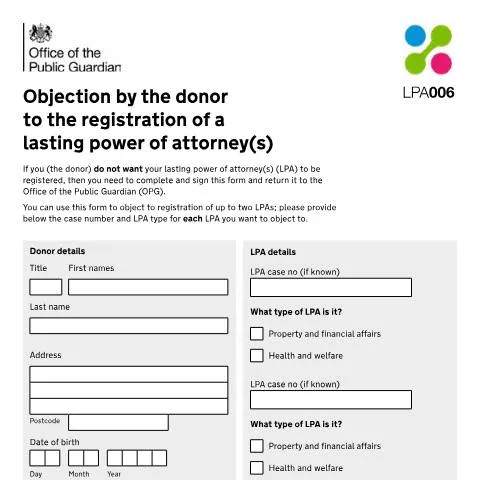
When Lasting Powers of Attorney Take an Unexpected Turn
The moment arrives when you discover your lasting power of attorney is being registered with the Office of the Public Guardian, but something feels fundamentally wrong. Perhaps you never intended the registration to proceed, or circumstances have dramatically changed since you first signed the documents. The LPA006 objection form represents your statutory right to halt this process—but understanding when and how to use it requires navigating a complex web of legal implications that extend far beyond simply ticking a box.
Unlike the standard LPA application process where donors typically initiate registration themselves, objections arise from situations where the donor has lost control over the timing or appropriateness of registration. This might occur when attorneys rush to register during periods of the donor's fluctuating capacity, when family disputes emerge, or when the donor's circumstances have changed so fundamentally that the original LPA no longer serves their interests.
The Office of the Public Guardian processes thousands of LPA registrations annually, yet objections remain relatively rare—making them particularly significant when they do arise. Each objection triggers an immediate suspension that can have profound consequences for everyone involved, from the donor's day-to-day care arrangements to complex financial transactions already in progress.
The Immediate Consequences of Filing Form LPA006
The moment the Office of the Public Guardian receives your completed LPA006 form, your lasting power of attorney enters a state of suspended animation. This suspension is automatic and immediate—there's no grace period, no review process, and no opportunity for attorneys to continue acting under the LPA's authority while your objection is considered.
This immediate suspension creates a legal vacuum that can have far-reaching practical implications. If your attorneys were in the middle of selling property, managing investments, or making healthcare decisions on your behalf, these activities must cease immediately. Banks, healthcare providers, and other institutions will no longer accept instructions from your attorneys, potentially leaving urgent matters in limbo.
The suspension continues until one of two outcomes occurs: either you withdraw your objection, or your attorneys apply to the Court of Protection for an order directing registration to proceed. This court application process typically takes several months and involves significant legal costs, creating a powerful deterrent against frivolous or tactical objections.
| Immediate Effect | Impact on Attorneys | Impact on Third Parties |
|---|---|---|
| LPA authority suspended | Cannot act under LPA provisions | Must refuse attorney instructions |
| Registration process halted | May need Court of Protection application | Existing transactions may be frozen |
| OPG investigation begins | Required to justify registration need | Alternative arrangements needed |
Decoding the Technical Requirements of LPA006
Form LPA006 appears deceptively straightforward, but several technical requirements can trap unwary donors. The form accommodates objections to up to two LPAs simultaneously—a design feature that reflects the reality that many donors create both property and financial affairs LPAs and health and welfare LPAs concurrently.
The LPA case number field presents the first potential stumbling block. While marked "if known," providing this number significantly accelerates processing and reduces the risk of administrative errors. The Office of the Public Guardian assigns case numbers when applications are first submitted, and these appear on all correspondence. If you cannot locate your case number, the combination of your full name, date of birth, and postcode should enable OPG to identify the correct LPA, but this may delay processing.
The attorney details section requires particular attention to accuracy. While the form states these details are needed "if known," incomplete or incorrect attorney information can complicate the suspension process. If your LPA includes multiple attorneys—whether acting jointly, jointly and severally, or in a combination arrangement—all must be listed. The continuation sheet becomes essential for LPAs with more than four attorneys, particularly common in family arrangements where adult children share responsibilities.
Critical Timing Considerations
The effectiveness of form LPA006 depends heavily on timing. If your LPA has already been fully registered and your attorneys are actively using it, an objection may create more problems than it solves. Conversely, if registration is still in progress, your objection can prevent the LPA from taking legal effect.
The Office of the Public Guardian's registration process typically takes 8-10 weeks from receipt of a complete application. During this period, they notify various parties—including the donor—of the pending registration. This notification period represents the optimal window for objections, as it prevents registration from completing while avoiding the complications of suspending an already-active LPA.
Understanding Valid Grounds for Objection
While form LPA006 includes a section for "reasons for your objection," the Office of the Public Guardian doesn't require donors to justify their objections in the same way that third parties must demonstrate specific grounds. As the person who created the LPA, you retain the fundamental right to prevent its registration, regardless of your reasons.
However, understanding the context that typically drives objections can help ensure you're making an informed decision. Changed circumstances represent perhaps the most common underlying factor—situations where your needs, family relationships, or financial position have evolved since you first executed the LPA documents.
Family disputes often precipitate objections, particularly when relationships between donors and chosen attorneys have deteriorated. If you've lost confidence in your attorneys' judgment, discovered conflicts of interest, or experienced family breakdowns, preventing registration may be preferable to allowing a problematic LPA to take effect.
Medical developments can also trigger legitimate objections. If your capacity has improved following a period of illness, or if new treatments have enhanced your decision-making abilities, you might reasonably conclude that you no longer need attorney assistance.
The Question of Mental Capacity
One of the most complex aspects of LPA objections involves the donor's mental capacity at the time of filing form LPA006. By definition, lasting powers of attorney are designed to operate when donors lack capacity to make specific decisions. This creates a potential paradox: if you have capacity to object to registration, do you still need the LPA?
The Office of the Public Guardian doesn't automatically investigate capacity when processing objections, but if attorneys subsequently apply to the Court of Protection, capacity will likely become a central issue. The court may order independent capacity assessments to determine whether your objection reflects a genuine, capacitous decision or results from the very impairment the LPA was designed to address.
Navigating the Aftermath of Your Objection
Once the Office of the Public Guardian processes your objection and suspends the LPA, several potential pathways emerge. The simplest resolution occurs when all parties accept your decision, allowing the LPA to remain unregistered indefinitely. In this scenario, you retain full control over your affairs, and the LPA documents remain available for potential future registration if circumstances change.
More complex situations arise when attorneys believe registration remains necessary and appropriate. They may attempt to negotiate with you directly, potentially involving family members or professional advisors in discussions about your concerns. These conversations can sometimes resolve underlying issues without formal legal intervention.
If informal resolution proves impossible, attorneys face the significant decision of whether to apply to the Court of Protection. This application process requires them to demonstrate both that registration is in your best interests and that your objection should be overridden. The court considers multiple factors, including your expressed wishes and feelings, your values and beliefs, and the views of other interested parties.
Court of Protection Proceedings
Court of Protection applications following LPA objections typically take 4-6 months to resolve, though complex cases can extend much longer. The court may appoint independent experts to assess your capacity, investigate family dynamics, or evaluate the appropriateness of the proposed attorney arrangements.
These proceedings can be emotionally and financially draining for all involved. Legal costs often reach several thousand pounds, and the process can strain family relationships even when conducted with the best intentions. The court's ultimate decision may uphold your objection, order registration to proceed, or impose modified arrangements that address specific concerns.
Strategic Considerations Before Filing
Before completing form LPA006, consider whether your concerns might be addressed through alternative approaches that avoid the complications of formal objection. If your primary worry involves specific attorney decisions or behaviors, direct communication might prove more effective than suspending the entire LPA.
The Office of the Public Guardian's safeguarding team can investigate concerns about attorney conduct without requiring formal objections. If attorneys are acting outside their authority, misusing their position, or failing to respect your wishes, OPG intervention might address these issues while preserving the LPA's availability for appropriate future use.
For donors concerned about timing rather than the LPA itself, remember that registration doesn't automatically activate attorney powers. Even with a registered LPA, attorneys can only act when you lack capacity to make specific decisions. If your capacity remains intact, the registered LPA simply provides a framework for future assistance if needed.
Consider also whether partial solutions might address your concerns. If your objection stems from doubts about particular attorneys, you might explore whether they would agree to disclaim their appointment, allowing remaining attorneys to proceed. If the issue involves specific powers, remember that LPAs can be registered with restrictions that limit attorney authority.
Practical Steps for Form Completion and Submission
When completing form LPA006, accuracy and completeness are essential to avoid processing delays. Begin by gathering all relevant documentation, including your original LPA documents, any correspondence from the Office of the Public Guardian, and complete contact information for all attorneys.
The donor details section requires your information exactly as it appears on the LPA documents. Discrepancies in names, addresses, or dates of birth can cause processing delays while OPG staff verify your identity. If you've moved since creating the LPA, provide your current address but note any address changes in your covering letter.
Your signature must match the signature on your original LPA documents. While handwriting naturally evolves over time, significant variations may prompt identity verification requests. If physical limitations prevent you from signing normally, consider whether someone can assist under your direction, but ensure any assistance complies with the form's requirements.
Post the completed form to the Office of the Public Guardian using recorded delivery or another trackable service. While not legally required, proof of posting protects against disputes about timing and ensures your objection receives proper consideration. The OPG typically acknowledges receipt within 5-10 working days, confirming that suspension has taken effect.
The decision to object to LPA registration represents one of the most significant choices available to lasting power of attorney donors. While form LPA006 provides a straightforward mechanism for exercising this right, the consequences extend far beyond the simple act of form completion. Understanding these implications—both immediate and long-term—ensures that your decision serves your genuine interests rather than creating unintended complications for yourself and those who care about your welfare.
Timeline and Deadlines for Objecting to Registration
The Court of Protection operates within strict timeframes when processing objections to lasting power of attorney registrations, and missing these deadlines can severely impact your ability to challenge the document effectively.
Once the Office of the Public Guardian receives a valid LPA application, they begin a statutory notification period lasting approximately six weeks. During this time, named persons on the application receive formal notice giving them the opportunity to raise concerns. However, this notification window represents just the beginning of a more complex timeline structure.
If you're a named person, your objection must typically reach the Office of the Public Guardian before they complete the registration process. This usually means submitting your concerns within four to six weeks of receiving notification, though the exact deadline depends on when the OPG received the original application and their current processing times.
For those not formally notified but seeking to object on factual grounds, the situation becomes more nuanced. You must demonstrate you have legitimate grounds for involvement—perhaps as a close family member who should have been consulted or someone with evidence of fraud. The Court of Protection may accept late objections in exceptional circumstances, particularly where new evidence emerges or where the original applicant failed to notify appropriate parties.
Once registration completes, your options shift significantly. While you cannot technically "object" to an already-registered LPA, you can apply to the Court of Protection to revoke the power of attorney if you can demonstrate serious concerns about its validity or the attorney's conduct. This process involves different forms, higher court fees, and more stringent evidence requirements.
Fill in your form directly online
No printing: type your details into the boxes of the official form, tick, then download the PDF ready to send.
- 1Type into the form boxes
- 2Tick in one click
- 3Save and download the PDF
The Court of Protection typically aims to resolve straightforward objections within 12 to 16 weeks, though complex cases involving disputed mental capacity assessments or allegations of fraud can extend considerably longer. During this period, the LPA registration remains suspended, meaning the proposed attorney cannot act on the donor's behalf.
If you're considering an objection, act promptly. Even if you're unsure about the strength of your grounds, contacting the Office of the Public Guardian early allows them to explain your options and potentially extend deadlines where appropriate circumstances exist.
Evidence Requirements and Supporting Documentation
Successfully objecting to an LPA registration requires substantially more than expressing concerns or disagreement with the donor's choice of attorney. The Court of Protection demands specific, verifiable evidence that supports your stated grounds for objection.
For fraud allegations, you'll need concrete documentation demonstrating deceptive practices. This might include bank statements showing unusual transactions around the time of LPA creation, correspondence revealing pressure or manipulation, or witness statements from individuals who observed concerning behaviour. Medical records can prove particularly valuable if they show the donor lacked capacity during the signing process, contradicting the certificate provider's assessment.
When challenging mental capacity, expert medical evidence becomes essential. The Court of Protection may require independent psychiatric or psychological assessments, particularly if the original certificate provider's qualifications or assessment methods are questioned. These assessments must demonstrate that the donor could not understand the nature and scope of the LPA at the time of creation, not simply that they have since lost capacity.
Documentary evidence supporting your relationship to the donor helps establish your standing to object. Marriage certificates, birth certificates, or proof of cohabitation can demonstrate family connections, while evidence of caregiving responsibilities or financial involvement may support your interest in the donor's welfare.
Witness statements require careful preparation and should address specific incidents rather than general impressions. Each statement must be signed and dated, with the witness confirming their identity and relationship to the situation. Professional witnesses—such as doctors, social workers, or solicitors—carry particular weight, especially when they can speak to the donor's mental state or understanding during relevant periods.
Financial documentation becomes crucial when alleging attorney misconduct or unsuitability. Bank statements, property deeds, investment records, or evidence of previous financial impropriety can support claims that the proposed attorney poses risks to the donor's interests.
The Court of Protection may request additional evidence during proceedings, and you should be prepared to provide further documentation promptly. Keep original documents safe and provide certified copies where possible, as the court may need to verify authenticity in disputed cases.
Costs, Fees, and Financial Implications
Objecting to LPA registration involves various financial considerations that extend well beyond simple court fees, and understanding these costs helps you prepare appropriately for the process ahead.
The Court of Protection currently charges £371 for applications to object to LPA registration, though this fee may be reduced or waived entirely if you can demonstrate financial hardship through the remissions process. The court assesses remission applications based on your income, capital, and essential outgoings, with those receiving certain benefits typically qualifying for full fee remission.
However, court fees represent just the starting point for potential expenses. If your objection requires expert medical evidence to challenge capacity assessments, psychiatric evaluations can cost between £1,000 and £3,000 depending on complexity and the expert's seniority. Legal representation, while not mandatory, often proves valuable given the technical nature of mental capacity law, with solicitor costs varying significantly based on case complexity and regional rates.
Should your objection prove unsuccessful, you may face liability for the other party's legal costs, particularly if the court considers your challenge unreasonable or lacking merit. This risk makes careful assessment of your evidence and grounds essential before proceeding. Conversely, if you succeed in preventing registration of an invalid LPA, the court may order the applicant to pay your reasonable costs.
Consider the broader financial implications beyond immediate legal costs. If the LPA registration proceeds despite your objection, and you later discover attorney misconduct, pursuing recovery through court proceedings becomes significantly more expensive and complex. Early intervention, though costly, often proves more economical than addressing problems after they've developed.
For those unable to afford legal representation, several options exist. Some solicitors offer initial consultations at reduced rates, Citizens Advice bureaux provide free guidance on court procedures, and the Court of Protection's own staff can explain procedural requirements, though they cannot advise on the merits of your case.
Legal expenses insurance, either standalone or included within household insurance policies, sometimes covers court proceedings involving family disputes or mental capacity issues. Check your policy terms carefully, as coverage often excludes pre-existing disputes or requires notification before proceedings commence.
The financial stakes extend beyond legal costs to the donor's assets themselves. If concerns about attorney suitability prove justified, delayed action could result in significant financial losses that far exceed the cost of timely objection proceedings.