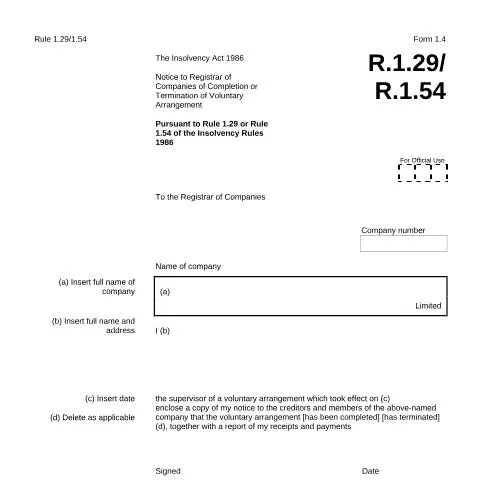
Understanding the Importance of the Voluntary Arrangement Notice
Entering into a voluntary arrangement is a significant step for any company facing financial difficulties. It allows businesses to restructure their debts and manage their financial obligations more effectively. The Notice of Completion or Termination of Voluntary Arrangement, specifically referenced as Rule 1.29 / 1.54 under the Insolvency Act 1986, plays a crucial role once a company has either completed or terminated such an arrangement. This notice is submitted to Companies House and serves as an official announcement regarding the status of the voluntary arrangement.
Key Concepts Surrounding Voluntary Arrangements
To navigate the complexities of corporate restructuring, it's vital to understand several foundational concepts related to voluntary arrangements:
- Voluntary Arrangement (VA): A legally binding agreement between a company and its creditors to pay back part or all of the debts over an agreed period.
- Supervisor: An appointed individual responsible for overseeing the implementation of the voluntary arrangement, ensuring compliance with the terms agreed upon.
- Completion vs. Termination: Completion indicates that the terms have been fulfilled successfully, while termination suggests that the arrangement has ended prematurely, often due to failure to meet the conditions set forth.
Steps to Utilize the Notice Effectively
Utilizing the Notice of Completion or Termination requires careful adherence to specific steps:
- Preparation: Gather all necessary documentation, including the report of receipts and payments as well as a copy of the notice sent to creditors and members.
- Filling Out the Notice: The notice must include pertinent details:
- Company number
- Full name of the company
- Details of the supervisor and the effective date of the arrangement
- Submission: Submit the completed notice to the Registrar of Companies at Companies House. This can be done through postal service or online methods if available.
- Follow Up: After submission, monitor the status of the notice to ensure it has been processed and properly recorded by Companies House.
The Scope and Limitations of the Notice
This notice serves a specific purpose within the framework of insolvency law. However, understanding its limitations is equally important:
- Legal Recognition: While the submission of this notice is mandatory, it does not provide immunity from further claims by creditors if the arrangement was not executed properly.
- Time Constraints: It is crucial to submit the notice promptly after the completion or termination of the arrangement. Delays could result in legal complications or further financial scrutiny.
- Not a Debt Settlement Confirmation: The issuance of the notice does not itself confirm that all debts have been settled, as this relies on adherence to the arrangement’s terms.
Common Procedural Queries
Diving deeper into procedures related to the Notice of Completion or Termination, several core queries often arise:
- What happens if the Notice is not submitted? Failing to submit the notice can lead to miscommunication with creditors and possible legal repercussions, including the inability to discharge debts under the voluntary arrangement.
- Is there a deadline for submission? Yes, it is pivotal to submit the notice as soon as possible after the completion or termination, ideally within statutory timeframes to prevent procedural issues.
- Who is responsible for submitting the notice? The appointed supervisor of the voluntary arrangement is typically responsible for ensuring that this notice is filed correctly.
Avoiding Common Misinterpretations
Misinterpretations can lead to severe repercussions within voluntary arrangements. Here are some frequently misunderstood aspects:
- Misunderstanding Completion: Completing a voluntary arrangement does not mean that all debts have been erased; instead, it indicates that the agreed terms have been satisfied.
- Assuming Automatic Approval: Submission of the notice does not guarantee that it will be accepted without further scrutiny. Companies House may request additional information if necessary.
- Overlooking the Role of Creditors: Creditors must be kept informed throughout the process, and their approval is critical at various stages of the voluntary arrangement.
Practical Insights for Submitting the Notice
When preparing to submit your notice, consider the following practical insights:
- Maintain Records: Keep detailed records of all communications with creditors and relevant documentation regarding the voluntary arrangement. This will facilitate smoother processes with Companies House.
- Consult with Professionals: If there are uncertainties regarding the completion or termination of the arrangement, consider consulting with insolvency practitioners or legal advisors who specialize in corporate finance.
- Use Official Channels: Ensure that the notice is submitted through official channels recognized by Companies House to avoid unnecessary complications.
Conclusion: The Strategic Role of the Notice in Corporate Health
In the grand scheme of corporate health, the Notice of Completion or Termination of Voluntary Arrangement is an essential tool that reflects the company's commitment to resolving financial difficulties. Proper utilization of this notice not only enhances transparency with creditors and stakeholders but also strengthens the overall integrity of the company's financial management practices. As companies navigate the evolving landscape of financial obligations, understanding and effectively utilizing the nuances of such notices is paramount for long-term stability and growth.
Understanding the Implications of a Voluntary Arrangement Termination
When you give notice of completion or termination of a voluntary arrangement, it is crucial to understand the far-reaching implications of such a decision. A voluntary arrangement, commonly known as a Debt Management Plan (DMP) or Individual Voluntary Arrangement (IVA), is an agreement between you and your creditors to manage your debt repayments. Depending on the circumstances of your case, terminating this arrangement prematurely can lead to serious consequences.
First and foremost, if you decide to terminate the arrangement, be aware that your creditors are no longer bound by the terms of the voluntary arrangement. This means that they can pursue you for the outstanding debts, which may include legal action, garnishment of wages, or other recovery methods. Your credit rating can also be adversely affected, as an IVA remains on your credit file for six years from the start date. Therefore, it is advisable to consult with your Insolvency Practitioner (IP) before making a decision to terminate. They can provide insights into the potential repercussions and help you explore suitable alternatives.
Steps to Follow When Giving Notice of Completion or Termination
To ensure that you navigate the process of giving notice of completion or termination of a voluntary arrangement effectively, follow these essential steps:
- Consult Your Insolvency Practitioner: Before initiating any action, have a detailed discussion with your IP. They will assess your current financial situation and advise you on the viability of continuing or terminating the arrangement.
- Prepare Necessary Documentation: Gather all relevant documents that support your decision to terminate the arrangement or confirm its completion. This may include income statements, proof of debt repayment, and correspondence with creditors.
- Draft a Formal Notice: Create a formal notice that clearly states your intention to complete or terminate the voluntary arrangement. Include your name, National Insurance number, the date of the notice, and any relevant details regarding your debts and the arrangement.
- Send the Notice to Relevant Parties: Ensure that the notice is sent to all creditors involved in the arrangement, your Insolvency Practitioner, and any other relevant stakeholders. Keep copies of all correspondence for your records.
- Follow Up: After sending the notice, follow up with creditors and your IP to confirm receipt and understand any further actions required on your part.
By carefully following these steps, you will be in a better position to manage the transition away from your voluntary arrangement, alleviating potential stress and uncertainty associated with the process.
Alternative Options After Termination of a Voluntary Arrangement
If you find yourself contemplating the termination of a voluntary arrangement, it is vital to have a clear understanding of the alternative options available to you. The cessation of an IVA or DMP does not mean that your financial struggles have disappeared; rather, it necessitates a reassessment of your financial management strategies. Here are some viable alternatives:
- Debt Consolidation Loan: If your credit rating allows, consider applying for a debt consolidation loan. This would enable you to combine multiple debts into a single loan with one monthly payment. However, be cautious with this option, as it may lead to higher interest rates if not handled wisely.
- Debt Relief Order (DRO): A DRO is suitable for individuals with low income and minimal assets. This order can provide relief from debts under a certain threshold, allowing you to manage your finances more effectively without the burden of numerous creditors.
- Bankruptcy: If your debts are overwhelming, bankruptcy may be an option worth considering. While this will have significant implications for your financial future, it may provide a clean slate. However, legal advice from a qualified practitioner is essential before pursuing this path.
- Informal Arrangements With Creditors: In some cases, negotiating directly with creditors can yield favorable results. You may be able to arrange for reduced payments or even partial debt forgiveness, depending on your relationship with your creditors and their policies.
Each of these alternatives carries its own set of considerations, and it is crucial to assess your financial situation comprehensively before making any decisions. Seeking guidance from a financial advisor or your Insolvency Practitioner will be invaluable in this regard.
Legal Considerations When Terminating a Voluntary Arrangement
Terminating a voluntary arrangement is not merely a financial decision; it is also a legal one. It is imperative to understand the legal framework governing voluntary arrangements in the UK to avoid pitfalls and ensure compliance. Here are several legal considerations to keep in mind:
- Data Protection: Under the Data Protection Act 2018 and UK GDPR, your personal data should be handled with care throughout this process. Ensure that any sensitive information shared with creditors or your Insolvency Practitioner is protected and used only for necessary purposes.
- Notification Requirements: There are specific legal requirements for notifying creditors of the completion or termination of a voluntary arrangement. Failure to adhere to these requirements could result in legal challenges from creditors, so it is vital to follow the correct protocol.
- Impact on Future Credit: Terminating your voluntary arrangement may affect your ability to secure credit in the future. Be aware that lenders will likely scrutinize your financial history, including any past voluntary arrangements or bankruptcies.
Engaging with legal professionals who specialize in insolvency can provide clarity on these aspects, ensuring you make informed decisions as you navigate the complexities of terminating a voluntary arrangement.