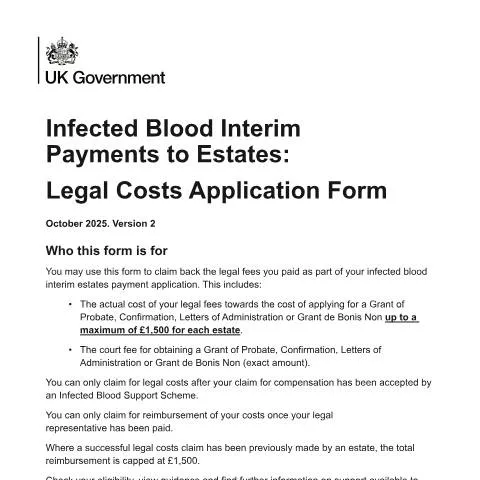
Understanding Legal Cost Recovery After Estate Compensation Awards
When someone dies from infected blood complications, their estate may receive interim compensation payments through one of the UK's dedicated support schemes. However, the process of obtaining the necessary legal documentation—such as Grants of Probate or Letters of Administration—incurs substantial costs that bereaved families must initially bear themselves. The Infected Blood Interim Payments to Estates: Legal Costs Application Form serves as the mechanism through which these expenses can be recovered, providing crucial financial relief during an already challenging period.
This specialised form addresses a gap in the compensation process: whilst estates can receive interim payments, the legal machinery required to access those payments generates its own expenses. The form recognises that obtaining proper legal authority to act on behalf of a deceased person's estate involves both professional fees and court costs, which can create a significant financial burden for grieving families.
Scope and Limitations of Recoverable Legal Expenses
The form operates within carefully defined parameters that applicants must understand before submitting their claim. Legal fees are capped at £1,500 per estate, covering the actual costs of professional services related to obtaining Grants of Probate, Confirmation (in Scotland), Letters of Administration, or Grants de Bonis Non. This ceiling applies regardless of the complexity of the estate or the actual fees charged by legal representatives.
Court fees, however, are recoverable at their exact amount without the £1,500 limitation. These fees vary depending on the estate's value and the specific jurisdiction, but they represent mandatory costs that cannot be avoided when seeking legal authority to administer an estate.
| Expense Type | Recovery Limit | Required Documentation |
|---|---|---|
| Legal representative fees | Maximum £1,500 per estate | Itemised invoice + proof of payment |
| Court fees | Exact amount paid | Receipt of court fee payment |
| Previously claimed expenses | Total cap remains £1,500 | Previous claim history considered |
The form explicitly states that where a successful legal costs claim has previously been made by an estate, the total reimbursement remains capped at £1,500. This prevents multiple claims from exceeding the overall limit, even if different family members or legal representatives submit separate applications.
Prerequisites and Timing Constraints
The application process follows a strict sequence that cannot be circumvented. Claimants can only apply for legal cost recovery after their compensation claim has been accepted by one of the Infected Blood Support Schemes. This creates a chronological dependency where the main compensation decision must precede any attempt to recover associated legal costs.
Additionally, reimbursement can only be sought once the legal representative has actually been paid. This requirement prevents speculative claims and ensures that only genuine, settled expenses are considered. The practical implication is that families may need to fund legal costs upfront and wait through two distinct approval processes before seeing any recovery.
The form requires three essential pieces of supporting documentation before submission:
- Receipt of court fee payment for obtaining the relevant grant or confirmation
- Itemised invoice from the legal representative detailing services provided
- Proof of payment to the legal representative demonstrating that fees have been settled
Navigating the Four-Nations Framework
The UK's devolved administrative structure creates distinct pathways for legal cost recovery, with separate schemes operating across England, Wales, Scotland, and Northern Ireland. Each jurisdiction maintains its own support scheme with dedicated postal addresses and potentially different processing procedures.
Scottish applicants work within the Scottish Infected Blood Support Scheme (SIBSS), where the legal framework refers to Confirmation rather than Probate. Welsh applicants engage with the Welsh Infected Blood Support Scheme (WIBSS), whilst English applicants work through the Infected Blood Interim and Emergency Payments Scheme (IBIEPS). Northern Ireland operates its own distinct scheme (IBPS NI) through the Finance Directorate.
Despite these administrative divisions, the legal costs application form remains standardised across all four nations, though applicants must ensure they submit their completed forms to the correct scheme that originally processed their compensation claim. The form must be sent via 'signed for delivery' to provide proof of submission and protect against potential postal delays or losses.
Professional Registration Requirements and Legal Representative Details
Section Q2 of the form demands comprehensive information about the legal representative who assisted with obtaining the grant or administration. This includes the Professional Registration Number or Roll Number (in Northern Ireland), which serves as verification that the legal services were provided by a properly qualified professional.
The form accommodates situations where multiple legal representatives assisted with a case by requesting details of the primary legal representative. This pragmatic approach recognises that complex estates may involve various legal professionals whilst maintaining clear accountability for the claimed expenses.
Business reference numbers, while requested, can be left blank if unknown. This flexibility acknowledges that not all legal representatives use systematic reference numbering, particularly smaller practices or those handling straightforward probate matters.
Documentation Standards and Evidence Requirements
The supporting documents section (Q3) operates on a dual-track system where applicants can claim for either or both categories of expenses. This modular approach allows for partial claims where, for example, an applicant might seek recovery of court fees but not legal representative fees, or vice versa.
For legal expenses up to £1,500, the form requires both an itemised invoice and confirmation of payment. The itemisation requirement ensures transparency about what services were provided and prevents inflated or non-specific billing. The confirmation of payment requirement typically involves bank statements, receipts, or written confirmation from the legal representative that payment has been received.
Court fee claims require the actual receipt of payment, which should clearly show the amount paid and the purpose of the payment. These receipts are typically issued by the Probate Registry, Sheriff Court (in Scotland), or equivalent court administration, depending on the jurisdiction.
Anti-Fraud Measures and Information Sharing Protocols
The declaration section (Q4) establishes serious consequences for fraudulent applications, including potential criminal prosecution and mandatory repayment of any funds obtained improperly. This reflects the significant public money involved in the infected blood compensation schemes and the need to protect these resources for genuine claimants.
The form explicitly authorises information sharing with the NHS Counter Fraud Authority, NHS Scotland Counter Fraud Services, and HSC Counter Fraud and Probity Service. This multi-agency approach creates robust verification mechanisms whilst ensuring that fraud prevention measures operate consistently across the UK's different health systems.
Information may also be shared with the original Infected Blood Support Schemes for verification purposes, creating a cross-referencing system that helps identify inconsistencies or duplicate claims. This data sharing occurs within the framework of data protection legislation but prioritises the integrity of the compensation process.
Processing Pathways and Post-Submission Considerations
Once submitted, applications enter the processing system of the relevant support scheme, which will assess both the eligibility of the claim and the adequacy of supporting documentation. The schemes may request additional evidence or clarification, particularly where invoices lack sufficient detail or where payment confirmation is unclear.
Successful applications result in direct reimbursement to the claimant, typically via bank transfer or cheque. The processing timeframe depends on the individual scheme's capacity and the complexity of the claim, though straightforward applications with complete documentation generally progress more quickly than those requiring additional verification.
Rejected applications may be reconsidered if additional evidence becomes available or if initial documentation was incomplete rather than fundamentally ineligible. However, the form's strict eligibility criteria mean that applications failing to meet basic requirements—such as attempting to claim before compensation acceptance or exceeding the £1,500 legal fee cap—face definitive rejection.
The requirement for 'signed for delivery' submission provides applicants with proof of submission and delivery, which becomes important if processing delays occur or if the scheme claims not to have received the application. This postal requirement, whilst seemingly old-fashioned, provides security and accountability in a process involving substantial financial claims.
Legal Costs Coverage: Categories and Limitations
The Infected Blood Compensation Authority operates under specific parameters when assessing legal costs applications for interim estates payments. Understanding these boundaries helps executors and administrators prepare realistic applications whilst avoiding unnecessary delays in the assessment process.
Solicitor fees represent the primary category of recoverable costs, typically encompassing initial case assessment, correspondence with the Authority, preparation of supporting documentation, and liaison with medical professionals or other expert witnesses. However, the Authority distinguishes between essential legal work directly related to the compensation claim and broader estate administration activities that would occur regardless of the infected blood matter.
Barrister fees may be recoverable where specialist advocacy or complex legal analysis proves necessary. This might include chambers conferences regarding novel legal points, representation at hearings if the case proceeds to that stage, or detailed written advice on specific aspects of the compensation framework. The Authority expects clear justification for instructing counsel, particularly in straightforward cases where solicitor expertise should suffice.
Expert witness costs face particular scrutiny during the assessment process. Medical experts providing reports on causation or the extent of harm may be recoverable, but the Authority expects proportionality between the complexity of the medical issues and the level of expertise instructed. Multiple expert reports covering similar ground typically face reduction unless clear justification exists for the additional input.
Court fees associated with probate proceedings may be recoverable where the infected blood compensation directly impacts the estate's value or distribution. However, routine probate costs that would arise in any estate administration generally fall outside the scope of recoverable expenses.
Administrative costs including copying, postage, and telephone calls usually attract minimal recovery unless exceptional circumstances apply. The Authority expects legal representatives to absorb routine office overheads within their standard charging structures rather than separately itemising these elements.
Hourly rates face assessment against local market standards rather than premium London rates, unless the case genuinely requires specialist London-based expertise unavailable elsewhere. Regional variations in charging rates receive recognition, but the Authority maintains detailed knowledge of typical fee structures across different geographical areas and practice types.
Assessment Timeline and Authority Decision-Making Process
The Infected Blood Compensation Authority operates a structured assessment timeline for legal costs applications, though this framework allows flexibility for complex cases requiring additional scrutiny or expert input.
Initial acknowledgment typically occurs within five working days of receiving a complete application. This acknowledgment confirms receipt of all required documentation and provides a reference number for future correspondence. Incomplete applications may face immediate return with requests for additional information, effectively restarting the timeline.
Fill in your form directly online
No printing: type your details into the boxes of the official form, tick, then download the PDF ready to send.
- 1Type into the form boxes
- 2Tick in one click
- 3Save and download the PDF
The substantive assessment phase generally spans 28 working days from acknowledgment, though this period may extend where the Authority requires additional information or expert input on specific cost elements. Complex cases involving multiple legal representatives or substantial expert witness costs may require longer assessment periods, with applicants receiving regular updates on progress.
Authority decision-makers apply established assessment criteria whilst maintaining discretion to consider unique circumstances of individual cases. The assessment process involves detailed review of time records, consideration of the reasonableness of work undertaken, and evaluation of charging rates against appropriate benchmarks.
Where the Authority identifies potential issues with specific cost elements, they typically engage in correspondence with the applicant or their legal representatives before reaching final decisions. This dialogue approach aims to clarify any ambiguities and ensure full consideration of relevant factors before determination.
Provisional assessments may be issued in cases where the Authority proposes to allow costs subject to specific reductions or conditions. Applicants receive 14 days to respond with representations before the assessment becomes final, providing opportunity to address any concerns or provide additional supporting information.
Payment processing typically occurs within 10 working days of final assessment, with funds transferred directly to the nominated bank account provided in the original application. The Authority provides detailed breakdown of allowed costs alongside payment confirmation, enabling clear understanding of how the final figure was calculated.
Appeal mechanisms exist for applicants dissatisfied with assessment outcomes, though these should be pursued through the Authority's established procedures rather than external court proceedings in the first instance. The appeal process involves fresh consideration by senior decision-makers not involved in the original assessment.
Documentation Standards and Evidence Requirements
The Infected Blood Compensation Authority maintains rigorous documentation standards for legal costs applications, reflecting both the public nature of the compensation scheme and the need for transparent, accountable decision-making processes.
Time recording requirements demand contemporaneous, detailed records showing the date, duration, fee earner involved, and specific nature of work undertaken. Generic descriptions such as "correspondence" or "file review" typically prove insufficient; the Authority expects clear identification of the purpose and outcome of each activity undertaken.
Attendance notes from meetings, telephone calls, or conferences should demonstrate clear connection to the infected blood compensation matter rather than broader estate administration issues. Where calls or meetings cover multiple matters, apportionment between recoverable and non-recoverable elements must be clearly documented and justified.
Fee earner details require comprehensive presentation, including qualification dates, relevant experience, and appropriate hourly rates for the work undertaken. The Authority expects junior matters to be handled by appropriately qualified staff rather than senior partners, unless the complexity genuinely demands higher-level input.
Supporting documentation should include copies of relevant correspondence, expert reports commissioned, and any court documents filed in connection with the compensation claim. Original documents need not be submitted, but clear, legible copies must be provided with appropriate indexing for ease of reference during assessment.
Medical records or other sensitive documentation require careful handling to ensure compliance with data protection requirements whilst providing sufficient information for proper assessment. Redaction may be appropriate in certain circumstances, but this should not obscure information relevant to the costs assessment process.
Invoices and fee notes must demonstrate clear VAT treatment where applicable, with appropriate VAT registration numbers provided for verification purposes. The Authority requires separate identification of VAT elements to ensure accurate processing and compliance with relevant tax requirements.
Third-party costs such as expert witness fees should be supported by original invoices or fee notes from the relevant providers. The Authority may seek direct confirmation of charges where significant sums are involved or where the reasonableness of charges requires verification.
Bank statements or other payment evidence may be requested to verify that costs have been actually incurred rather than merely estimated. This requirement proves particularly relevant for larger applications or where the timing of payments affects the overall assessment.