When Property Deeds Vanish: The Critical Role of Form ST3 in Land Registration
Picture this: you're preparing to register your property with HM Land Registry for the first time, only to discover that your title deeds have disappeared without a trace. Perhaps they were destroyed in a house fire, lost during a solicitor's office clearance, or simply misplaced over decades of family ownership. In England and Wales, where property ownership traditionally relied on paper deeds stretching back centuries, such scenarios are more common than you might expect.
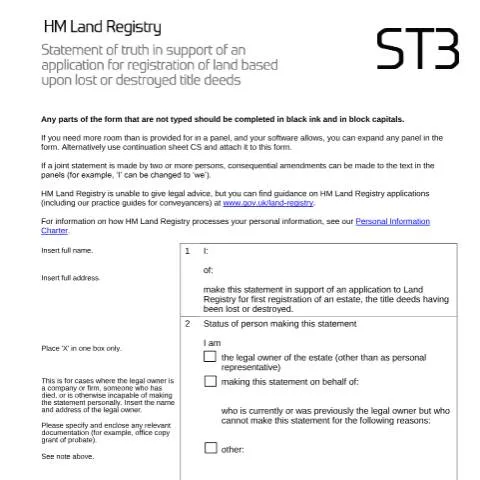
The Lost or destroyed deeds: statement of truth (ST3) serves as your lifeline in these circumstances. This statutory declaration form enables property owners to proceed with first registration at HM Land Registry even when the original title documents have vanished. Without this formal statement, the absence of deeds would typically halt the registration process entirely, leaving properties in legal limbo.
The ST3 form carries significant legal weight because it requires you to make a statement of truth – meaning any false information could result in proceedings for contempt of court. This gravity reflects the fundamental importance of accurate land records in England's property system, where registered title provides security and certainty that has underpinned the economy for over 150 years.
Navigating the Complex Landscape of Missing Title Documentation
Understanding when to use form ST3 requires grasping the broader context of land registration in England and Wales. HM Land Registry has been gradually extending compulsory registration since 1925, but millions of properties remain unregistered, particularly those that haven't changed hands recently. When such properties are sold, transferred, or mortgaged, first registration becomes mandatory – and this is precisely when missing deeds become a critical problem.
The form addresses several distinct scenarios where deeds might be unavailable. Physical destruction represents the most straightforward case: floods, fires, or deliberate destruction create clear circumstances requiring ST3 completion. However, the form also covers more complex situations, such as when deeds have been mislaid during office moves, destroyed during wartime bombing, or lost through institutional failures.
Importantly, ST3 isn't used when deeds are merely temporarily inaccessible. If documents are held by a bank as mortgage security, or locked in a deceased person's safe deposit box awaiting probate, these situations require different approaches. The form specifically addresses permanent loss or destruction where recovery is impossible or highly unlikely.
The Distinction Between Lost and Destroyed Deeds
HM Land Registry draws careful distinctions between different types of deed unavailability. Lost deeds typically involve situations where documents existed but their current whereabouts are unknown – perhaps following a solicitor's retirement, office closure, or family dispute. Destroyed deeds involve confirmed physical damage, whether through natural disasters, deliberate action, or accidental destruction.
This distinction matters because the evidence required differs significantly. For destroyed deeds, you might provide fire brigade reports, insurance claims, or witness statements. For lost deeds, the emphasis shifts to demonstrating exhaustive search efforts and explaining the circumstances of disappearance.
Dissecting the ST3 Form: A Section-by-Section Analysis
The ST3 form follows a logical progression designed to reconstruct the property's ownership history despite the absence of original documentation. Each section builds upon the previous one, creating a comprehensive picture that enables HM Land Registry to assess the application's validity.
Personal Declaration and Status (Sections 1-2)
The opening sections establish who is making the statement and their authority to do so. Section 1 requires your full name and address, while Section 2 addresses your status in relation to the property. This status determination proves crucial because not everyone can make this declaration.
If you're the current legal owner, the process is straightforward. However, complications arise when the legal owner cannot personally complete the form. Personal representatives handling deceased estates must provide additional documentation, typically including office copies of the grant of probate or letters of administration. Company directors or partners making statements on behalf of legal entities need appropriate authorisation documentation.
The "other" category covers various scenarios: attorneys acting under lasting powers of attorney, trustees managing trust property, or court-appointed deputies for individuals lacking mental capacity. Each situation requires specific supporting evidence to establish the declarant's authority.
Property Description and Application Type (Sections 3-4)
Section 3 demands precise property identification, which can prove challenging without original deeds. You must provide either a postal address including postcode or, for land without postal addresses, a clear description such as "land adjoining 2 Acacia Avenue." When the property boundaries aren't clearly shown on Ordnance Survey maps, you must provide a detailed plan showing the land's extent, typically with boundaries "edged red."
Section 4 specifies the registration type sought. Most applications involve freehold estate registration, but leasehold registrations require additional information including the lease term and commencement date. The "other" option covers unusual situations like rentcharge registrations or profit à prendre applications.
| Registration Type | Required Information | Common Complications |
|---|---|---|
| Freehold | Property description, boundaries | Boundary disputes, unclear extents |
| Leasehold | Lease term, commencement date, rent details | Missing lease documents, unclear terms |
| Other interests | Specific to interest type | Complex legal arrangements |
Ownership History and Deed Custody (Sections 5-7)
These sections reconstruct the property's recent ownership history, focusing on how the current owner acquired the estate and who had custody of the missing deeds. Section 5 requires details of when and how the current legal owner acquired the property – through purchase, inheritance, gift, or other means.
Sections 6 and 7 address the crucial question of deed custody. HM Land Registry needs to understand who had the deeds and why, as this affects the credibility of the loss claim. Solicitors commonly hold deeds for safekeeping or as security for unpaid fees. Banks might hold them as mortgage security. Family members often inherit deed custody without formal arrangements.
The circumstances of custody matter significantly. Deeds held for safekeeping create different expectations than those held as security for money owed. If deeds were deposited as security, you must address whether the underlying debt has been satisfied and provide evidence of discharge.
Reconstructing the Paper Trail: Evidence and Documentation Requirements
The heart of any ST3 application lies in sections 8-12, which require detailed accounts of the loss circumstances and efforts to recover the missing documents. This reconstruction process often determines whether HM Land Registry accepts or rejects the application.
Circumstances of Loss or Destruction (Section 8)
Section 8 demands comprehensive details about when, where, and how the deeds disappeared. Precision matters enormously – vague statements like "lost sometime in the 1990s" rarely satisfy HM Land Registry's requirements. You should provide specific dates where possible, exact locations, and detailed circumstances.
For destruction cases, include relevant supporting evidence: fire service incident reports, insurance claim documentation, or statutory declarations from witnesses. For loss cases, explain the last known location and circumstances that led to the disappearance. If deeds were lost during office clearances, provide details of the firm involved, dates of closure, and any successor practices contacted.
Recovery Efforts (Section 9)
This section requires evidence of exhaustive efforts to recover the missing deeds. HM Land Registry expects comprehensive searches before accepting permanent loss claims. Your efforts might include:
- Contacting all solicitors who previously acted in property transactions
- Searching through family papers and safe deposit boxes
- Enquiring with banks that provided mortgages on the property
- Checking with insurance companies for stored documentation
- Contacting the Law Society's records for details of defunct practices
Documentation proves crucial here. Attach copies of correspondence with solicitors, bank responses, or statutory declarations from family members confirming their searches. The more comprehensive your evidence, the stronger your application becomes.
Financial Encumbrances and Security Interests (Section 10)
Section 10 addresses whether any mortgages, charges, or liens affected the property when deeds were lost or destroyed. This information proves vital because such interests might continue to bind the property regardless of deed availability.
If no encumbrances existed, you can simply tick the first box. However, if mortgages or charges were in place, you must provide comprehensive details including creditor names, amounts, and current status. Discharged mortgages require evidence of repayment – bank letters, receipts, or Land Registry discharge forms. Continuing mortgages need creditor cooperation for the registration process.
Demonstrating Ownership Through Occupation and Use
Sections 11a and 11b require detailed evidence of how the property has been possessed and used, creating an alternative ownership narrative when deeds are unavailable. This evidence often proves decisive in HM Land Registry's assessment process.
Evidence of Possession (Section 11a)
For residential properties, possession evidence might include council tax records, utility bills, electoral roll entries, or neighbour testimonials. Commercial properties require business rates documentation, lease agreements with tenants, or trade association records. Agricultural land demands evidence of farming activities, subsidy claims, or livestock records.
The key principle involves demonstrating exclusive possession consistent with ownership rather than mere occupation. Paying property taxes, maintaining boundaries, granting permissions to others, or excluding trespassers all indicate ownership rather than tenancy or license.
Rights Exercised and Third-Party Claims (Section 11b)
This section requires disclosure of any rights exercised over neighbouring land or rights that others might claim over your property. Easements for access, drainage, or utilities need detailed description. Restrictive covenants limiting property use must be acknowledged even without deed evidence.
Third-party claims might include neighbour disputes over boundaries, utility company apparatus, or historical rights of way. Honest disclosure protects against future challenges and demonstrates good faith to HM Land Registry.
Alternative Documentation and Title Reconstruction
Section 12 addresses situations where some documentation remains available despite the loss of original deeds. This partial reconstruction can significantly strengthen your application and reduce HM Land Registry's concerns about title validity.
Sources of Copy Documentation
Copy deeds might be available from various sources, each carrying different evidential weight. Solicitor files often contain photocopies or typed extracts from original deeds. Bank mortgage files typically include copies of documents securing loans. Insurance company records might contain property descriptions from policy applications.
The source's reliability affects the copies' value. Documents from professional practices carry more weight than family photocopies, while contemporaneous copies prove more valuable than reconstructions created years later.
Investigation and Execution Confirmations
The form requires confirmation that title was properly investigated when the current owner acquired the property, and that all transfers and mortgages were correctly executed and stamped. These confirmations address HM Land Registry's concerns about potential defects in the ownership chain.
If you cannot make these confirmations – perhaps because the acquisition occurred decades ago or involved family gifts – you must explain the circumstances. Professional conveyancing provides stronger assurance than family arrangements, but either can support registration with appropriate evidence.
Submission Procedures and Processing Expectations
Completing form ST3 represents only the beginning of the first registration process. Understanding submission requirements and processing procedures helps manage expectations and avoid delays that commonly affect these complex applications.
Supporting Documentation Requirements
ST3 applications typically require extensive supporting documentation beyond the completed form. Essential documents often include:
- Property plans showing boundaries when not clearly defined on Ordnance Survey maps
- Evidence of searches for missing deeds – correspondence, statutory declarations, professional confirmations
- Proof of ownership – council tax records, utility bills, insurance policies, maintenance receipts
- Financial documentation – mortgage discharge evidence, bank statements showing property-related payments
- Authority evidence – probate grants, power of attorney documents, company resolutions where applicable
The quality and comprehensiveness of supporting evidence often determine application success. HM Land Registry's caseworkers exercise considerable discretion in assessing whether the evidence sufficiently establishes ownership despite missing deeds.
Processing Timeframes and Potential Complications
ST3 applications typically take longer to process than standard first registrations due to their complexity and evidence requirements. Initial processing might take several months, with additional delays if HM Land Registry raises requisitions requesting further information or clarification.
Common complications include boundary disputes with neighbours, conflicting ownership claims, or inadequate evidence of deed loss circumstances. Each complication can extend processing times significantly, sometimes requiring legal resolution before registration proceeds.
Post-Submission Procedures
After submission, HM Land Registry conducts detailed examination of your evidence and may raise requisitions requesting additional information. These requests might seek clarification about boundary positions, further evidence of possession, or additional documentation about deed custody.
Responding promptly and comprehensively to requisitions proves crucial for maintaining application momentum. Delays in responses can result in application closure, requiring fresh submission with updated evidence and additional fees.
Strategic Considerations for Complex Property Situations
Certain property types and ownership structures create additional complications when using form ST3, requiring careful strategic planning to achieve successful registration outcomes.
Commercial and Investment Properties
Commercial properties often involve more complex ownership structures and financial arrangements than residential properties. Multiple leases, service charge arrangements, and complex rent reviews create additional evidence requirements when original documentation is missing.
Investment properties with multiple tenancies require comprehensive rent records demonstrating ownership rather than management arrangements. Professional property management often complicates evidence gathering, as management agents might lack access to historical ownership documentation.
Inherited Properties and Family Arrangements
Properties passing through families often involve informal arrangements that complicate ST3 applications. Unregistered transfers between family members, equity sharing arrangements, or informal trusts create challenges in establishing clear ownership chains.
When properties have been in families for generations, establishing the acquisition circumstances for the current owner might require extensive genealogical research and family testimony. Such evidence, while potentially compelling, requires careful presentation to satisfy HM Land Registry's standards.
The ST3 form represents a crucial safety net in England's land registration system, enabling property owners to achieve registered title even when traditional deed evidence has vanished. Success requires meticulous evidence gathering, comprehensive documentation, and patient navigation of HM Land Registry's detailed examination process. While challenging, the process ultimately provides security and certainty that protects property rights for generations to come.