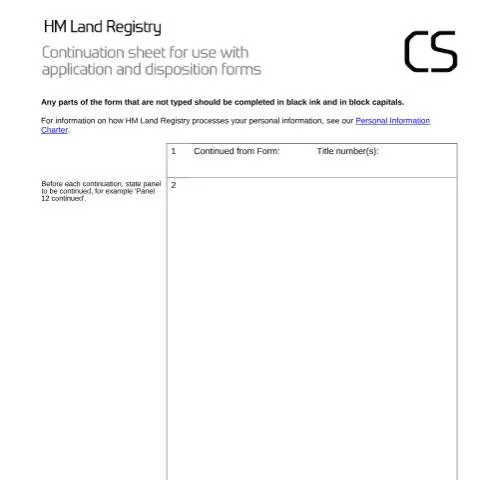
When Standard Land Registry Forms Run Out of Space: The Essential CS Continuation Sheet
Property transactions rarely fit neatly into the boxes provided on standard HM Land Registry forms. Whether you're dealing with a complex commercial development involving multiple titles, a family trust with numerous beneficiaries, or a transfer requiring extensive additional clauses, the continuation sheet (CS) becomes your lifeline when the main application form simply cannot accommodate all the necessary information.
The CS form serves as the official overflow document for any HM Land Registry application or disposition where the standard panels prove insufficient. Unlike informal attachments that might be rejected, this structured continuation sheet maintains the legal integrity of your submission whilst ensuring every crucial detail reaches the Land Registry in the proper format.
Understanding the Continuation Sheet's Role in Complex Property Matters
The CS form operates as an integral extension of your primary Land Registry application, not a separate document. When properly completed, it becomes part of the official record and carries the same legal weight as the information contained in the main form panels.
This continuation mechanism proves particularly valuable in several scenarios. Multi-title transactions frequently require additional space to list all affected property references, especially in portfolio sales or development schemes. Similarly, transfers involving multiple parties—such as family arrangements where property passes to several children simultaneously—often exceed the capacity of standard beneficiary panels.
Corporate transactions present another common use case. When a company restructure involves complex charging arrangements or multiple lenders, the standard security panels may prove woefully inadequate. The CS form allows you to maintain the precise legal language required whilst ensuring nothing gets abbreviated or omitted due to space constraints.
Integration with Primary Application Forms
The continuation sheet links directly to specific panels on your main form through its referencing system. Panel 1 requires you to identify both the primary form type and the title numbers involved, creating an unambiguous connection between documents. This cross-referencing prevents the administrative nightmare of orphaned continuation sheets that cannot be matched to their parent applications.
Before each section of continued information, you must clearly state which panel you're extending—for example, "Panel 12 continued" or "Panel 8.2 additional parties". This systematic approach allows Land Registry staff to process your application efficiently whilst maintaining the logical flow of information across multiple pages.
Navigating the Technical Requirements for Professional Presentation
HM Land Registry maintains strict formatting standards for continuation sheets, reflecting the document's status as part of the official property register. All handwritten entries must use black ink and appear in block capitals, ensuring legibility for both immediate processing and long-term archive storage.
The requirement for block capitals extends beyond mere preference—it's a practical necessity given the volume of applications processed daily. Registry staff must be able to read entries quickly and accurately, particularly when dealing with property addresses, personal names, and legal descriptions that could cause significant problems if misinterpreted.
| Information Type | Formatting Requirement | Common Pitfalls |
|---|---|---|
| Property addresses | Block capitals, black ink | Using abbreviations, unclear postcodes |
| Personal names | Full names in block capitals | Inconsistent spelling across documents |
| Legal descriptions | Precise terminology maintained | Paraphrasing technical clauses |
| Title numbers | Complete reference including prefix | Omitting county codes or digits |
When typing portions of the form, ensure consistency with any handwritten sections. Mixed formatting—where some information appears typed whilst related details are handwritten—can create confusion during processing and potentially delay your application whilst clarification is sought.
Managing Multiple Continuation Sheets
Complex applications may require several continuation sheets, each properly numbered and cross-referenced. When using multiple CS forms, maintain a clear sequence by numbering each sheet (CS1, CS2, etc.) and ensuring the title number appears on every page. This systematic approach prevents pages becoming separated during processing whilst allowing registry staff to reconstruct the complete application if necessary.
Professional Scenarios Requiring Continuation Sheet Support
Solicitors and licensed conveyancers frequently encounter situations where standard form panels cannot accommodate the complexity of modern property transactions. Development schemes involving phased releases often require extensive additional documentation that far exceeds normal panel capacity.
Consider a residential development where the original freehold gets divided into 50 individual plots, each requiring separate title numbers whilst maintaining certain shared obligations. The standard transfer forms simply cannot list all the necessary cross-references, restrictive covenants, and easement arrangements within their allocated space.
Commercial lease assignments present another challenging scenario. When a business lease transfers between corporate entities with complex group structures, the parties' panel may need to accommodate parent companies, guarantors, and subsidiary relationships that require precise legal identification. The CS form allows you to maintain the accuracy essential for commercial transactions whilst ensuring all relevant entities are properly recorded.
Trust and Estate Applications
Trust arrangements frequently generate the most complex continuation sheet requirements. When property passes into a discretionary trust with multiple trustees, potential beneficiaries, and detailed powers provisions, the standard panels prove entirely inadequate. The CS form becomes essential for recording the complete trust structure whilst maintaining the precision required for future dealings.
Probate applications involving multiple properties across different counties create similar challenges. Each property may have different title numbers, varying encumbrances, and distinct beneficiary arrangements under the will. The continuation sheet allows you to maintain the systematic approach required whilst ensuring no property gets overlooked or inadequately described.
Data Protection Considerations in Extended Applications
The CS form falls under the same data protection framework as all HM Land Registry documents, governed by the Data Protection Act 2018 and UK GDPR requirements. The Personal Information Charter referenced on the form explains how the Land Registry processes and stores the personal information you provide across all application documents.
When continuation sheets contain sensitive personal information—such as details about family arrangements, financial circumstances, or business relationships—this information becomes part of the public register unless specifically protected. The form's warning about public inspection applies equally to continuation sheets, meaning any information you include may be accessible to future researchers or interested parties.
For applications involving prejudicial information—such as details about family disputes, financial difficulties, or sensitive commercial arrangements—you may need to consider applying for exemption using Form EX1 under rule 136 of the Land Registration Rules 2003. This process allows certain information to remain on the register for legal purposes whilst being withheld from public inspection.
Managing Confidential Commercial Information
Business transactions often involve information that parties prefer to keep confidential whilst still meeting Land Registry requirements. Purchase prices, financing arrangements, and corporate restructuring details all become part of the public record unless properly managed through the exemption process.
When preparing continuation sheets for commercial applications, consider whether the additional information you're providing could disadvantage your client if made publicly available. Financial details, strategic business information, and competitive arrangements may all warrant protection through the EX1 exemption process.
Avoiding Critical Errors That Compromise Legal Protection
The warning section of the CS form emphasises two distinct but equally serious risks: fraud penalties and loss of legal protection. Understanding these risks helps ensure your continuation sheet enhances rather than undermines your client's position.
The Fraud Act 2006 provisions apply with full force to continuation sheets. Any dishonest information provided with intent to gain advantage or cause loss can result in up to 10 years' imprisonment or unlimited fines. This extends beyond obvious fraud to include situations where information might be misleading even if not entirely false.
The second risk—loss of protection under the Land Registration Act 2002—relates to careless completion rather than deliberate dishonesty. If mistakes in your continuation sheet cause errors in the register, your client may lose the protection normally afforded to registered proprietors. This could prove catastrophic in disputes involving boundaries, easements, or charges.
Quality Control Measures for Complex Applications
Professional firms handling complex applications requiring continuation sheets should implement systematic quality control measures. Cross-checking information between the main form and continuation sheets prevents inconsistencies that could trigger registry queries or, worse, register errors.
Always verify that names, addresses, and title numbers appear identically across all documents. A single digit error in a title number or inconsistent spelling of a party's name can cause processing delays that may prove costly in time-sensitive transactions.
Consider preparing a checklist that covers the connection between main form panels and continuation sheet sections, ensuring every continued panel is properly identified and that no information appears in both places with different wording.
Strategic Timing and Submission Considerations
The CS form must accompany your primary application—it cannot be submitted separately or added retrospectively without potentially restarting the entire process. This timing requirement makes careful planning essential, particularly for complex transactions with multiple moving parts.
When dealing with chain transactions where several related applications will be submitted simultaneously, ensure your continuation sheets properly cross-reference related applications where appropriate. This helps registry staff understand the connections between applications whilst preventing processing delays caused by apparent inconsistencies.
Electronic submission through the Land Registry portal requires particular attention to continuation sheet formatting. While the CS form itself may be submitted as a PDF attachment, ensure the electronic version maintains the same formatting standards as paper submissions. Poorly scanned or illegible electronic continuation sheets can cause processing delays that may prove difficult to resolve quickly.
Priority Application Strategies
For urgent applications requiring continuation sheets, the additional documentation can complicate priority processing requests. Registry staff must review all documentation—including continuation sheets—before applications can receive priority treatment. Ensure your continuation sheets are particularly well-prepared when seeking expedited processing, as any queries about the additional information will delay the entire application.
When preparing priority applications with continuation sheets, consider whether the additional information is truly essential or whether the transaction could proceed with a more streamlined approach. Sometimes, restructuring the transaction to fit standard form panels proves more efficient than creating complex continuation sheet arrangements that may trigger additional registry queries.
Integration with Modern Conveyancing Practice
Contemporary property transactions increasingly require the flexibility that continuation sheets provide. As property ownership structures become more sophisticated and commercial arrangements more complex, the CS form has evolved from an occasional necessity to a regular tool in professional practice.
Digital case management systems should account for continuation sheet requirements from the outset of complex transactions. Rather than discovering space limitations when preparing final applications, experienced practitioners identify potential continuation sheet needs during initial instruction review, allowing proper time for document preparation and quality checking.
The rise of alternative property investment structures—including property companies, unit trusts, and sophisticated partnership arrangements—means continuation sheets frequently become necessary for transactions that would have fitted standard forms a generation ago. Modern conveyancing practice must accommodate this complexity whilst maintaining the accuracy and efficiency that clients expect.
Professional development in this area requires understanding not just how to complete continuation sheets, but when their use becomes essential for protecting client interests. The CS form represents a crucial tool for ensuring that complex legal arrangements receive proper registration protection whilst maintaining the systematic approach that underpins the land registration system's reliability.
CS Forms for Different Property Categories and Complex Transactions
The application of continuation sheets varies significantly depending on the property type and transaction complexity involved in your Land Registry application. Understanding these variations ensures you select the appropriate CS form and complete it correctly for your specific circumstances.
Residential Property Transactions
For standard residential properties, continuation sheets most commonly arise when dealing with multiple ownership arrangements or complex charging structures. When purchasing a property with more than four joint owners, you'll need CS forms to record all proprietor details that cannot fit within the standard application form's designated sections.
Leasehold properties often require continuation sheets when the lease contains numerous covenants, restrictions, or service charge arrangements that exceed the space provided on the primary form. This is particularly common with converted flats where the original lease may contain extensive maintenance obligations or shared facility arrangements that must be fully recorded on the register.
Right to Buy applications frequently necessitate continuation sheets due to the complex discount calculations and statutory requirements that must be detailed. The preserved right to buy provisions, in particular, often require additional documentation space to properly record the qualifying criteria and discount entitlements that transfer with the property.
Commercial and Industrial Properties
Commercial property transactions typically involve more complex continuation sheet requirements due to the nature of business premises and their associated rights and obligations. Industrial estates, retail parks, and office complexes often have intricate easement arrangements for shared services, access rights, and maintenance responsibilities that require detailed recording.
When dealing with commercial leases, continuation sheets become essential for recording complex rent review clauses, break options, and tenant improvement obligations that cannot be adequately summarised in the standard form sections. Service charge provisions in commercial properties are often particularly detailed, requiring comprehensive documentation of the calculation methods, review procedures, and tenant obligations.
Development sites present unique challenges requiring continuation sheets to record planning obligations, Section 106 agreements, and community infrastructure levy arrangements. These legal requirements often involve multiple local authority conditions and developer obligations that must be precisely recorded to ensure future enforceability.
Agricultural and Rural Properties
Rural properties frequently require continuation sheets due to the complex web of rights and obligations associated with agricultural land use. Agricultural tenancies, whether under the Agricultural Holdings Act 1986 or the Agricultural Tenancies Act 1995, often involve detailed succession rights, compensation provisions, and land use restrictions that exceed standard form capacity.
Sporting rights present particular complexity, as they may be severed from the land ownership and held by different parties. Shooting rights, fishing rights, and mineral extraction rights each carry specific legal frameworks that require detailed recording on continuation sheets to ensure proper registration and future enforceability.
Common land registrations involve statutory requirements under the Commons Act 2006 that often necessitate continuation sheets to record commoners' rights, management schemes, and conservation obligations. The registration of village greens similarly requires detailed documentation of the qualifying use and community rights that must be preserved.
Electronic Submission Systems and Digital CS Processing
The Land Registry's digital transformation has significantly impacted how continuation sheets are prepared, submitted, and processed, creating new opportunities and requirements for applicants and their representatives.
Portal Submission Requirements
When submitting applications through the Land Registry portal, continuation sheets must be prepared in specific digital formats to ensure compatibility with the electronic processing systems. PDF documents are the preferred format, with specific requirements for resolution, file size, and text recognition capabilities that enable automated processing.
The portal system includes validation checks that automatically identify when continuation sheets may be required based on the information entered in the primary application form. These prompts help prevent incomplete submissions and reduce the likelihood of requisitions, but applicants must still ensure that all necessary information is included across both the main form and any continuation sheets.
Digital signatures on continuation sheets must comply with the Land Registry's electronic signature standards, which may differ from standard commercial e-signature solutions. The authentication requirements ensure the integrity of the application while maintaining the legal validity of the submitted documents.
Integration with Case Management Systems
Professional users operating case management systems must ensure their software generates continuation sheets that integrate seamlessly with Land Registry processing requirements. This includes maintaining consistent reference numbering, proper cross-referencing between documents, and adherence to the prescribed formatting standards.
The API connections available to high-volume users enable automated generation of continuation sheets based on transaction data, but these systems require careful configuration to ensure compliance with current Land Registry standards and requirements. Regular updates to the integration protocols may affect how continuation sheets are generated and submitted.
Quality assurance processes within digital systems should include checks for continuation sheet completeness, proper sequencing, and accurate cross-referencing to prevent processing delays or rejection of applications.
Hybrid Processing Considerations
Many applications involve a combination of digital and paper elements, particularly when dealing with historical documents or third-party certifications that cannot be digitally reproduced. Understanding how continuation sheets fit within these hybrid processing arrangements is crucial for successful application completion.
When paper continuation sheets accompany digital applications, specific packaging and labelling requirements apply to ensure proper association with the electronic submission. The Land Registry provides detailed guidance on maintaining document integrity across different submission methods.
Processing timeframes may vary depending on whether continuation sheets are submitted digitally or in paper format, with digital submissions generally receiving faster processing. However, the complexity of the information contained within continuation sheets may affect processing times regardless of the submission method.
Specialist Applications and Unique CS Requirements
Certain categories of Land Registry applications involve specialised continuation sheet requirements that differ significantly from standard property transactions, requiring specific knowledge and careful attention to regulatory requirements.
Charity and Public Body Registrations
Charitable organisations registering property ownership face unique continuation sheet requirements related to their constitutional documents, trustee arrangements, and regulatory compliance obligations. The Charity Commission registration details, governing document provisions, and trustee appointment procedures often require detailed recording that exceeds standard form capacity.
Public bodies, including local authorities, NHS trusts, and government departments, must include specific statutory authority references and compliance confirmations on continuation sheets. The legal framework governing public body property ownership often involves complex statutory procedures and approval requirements that must be comprehensively documented.
Community Interest Companies and Community Benefit Societies have particular asset lock provisions and community benefit requirements that must be recorded on continuation sheets to ensure proper registration and future compliance monitoring.
Insolvency and Restructuring Transactions
Property transactions arising from insolvency proceedings require continuation sheets to record the statutory framework, court approvals, and creditor notification procedures that validate the transaction. Licensed insolvency practitioners must ensure that all regulatory requirements and statutory time limits are properly documented.
Corporate restructuring involving property transfers often necessitates continuation sheets to record the commercial rationale, director resolutions, and shareholder approvals that support the transaction. Group reorganisations may involve multiple related transactions requiring coordinated continuation sheet preparation to ensure consistency across all applications.
Scheme of arrangement approvals under the Companies Act 2006 require detailed documentation of the court sanction process, creditor meeting outcomes, and implementation procedures that typically exceed standard form capacity.
International and Cross-Border Elements
Applications involving overseas entities or international transaction elements require continuation sheets to address additional regulatory requirements and documentation standards. Foreign company registrations, overseas trust structures, and international financing arrangements each present unique documentation challenges.
Anti-money laundering compliance for international transactions often requires enhanced due diligence documentation that must be referenced and summarised on continuation sheets. The source of funds verification and beneficial ownership identification procedures may involve extensive documentation that requires careful organisation and cross-referencing.
Tax residence confirmations, double taxation treaty provisions, and withholding tax arrangements frequently require detailed explanation on continuation sheets to ensure proper registration and future compliance monitoring. These requirements may change based on evolving international tax regulations and bilateral agreements.
Specialist Security Arrangements
Complex security structures involving multiple lenders, intercreditor arrangements, and security sharing agreements often require extensive continuation sheet documentation to ensure proper registration priority and enforcement rights. Syndicated lending arrangements, mezzanine financing, and development funding structures each present unique registration challenges.
Islamic finance arrangements, including Murabaha, Ijara, and Diminishing Musharaka structures, require continuation sheets to explain the Sharia-compliant transaction mechanics and ensure proper registration of the resulting property rights and obligations.
Government-backed lending schemes, including Help to Buy equity loans and shared ownership arrangements, involve specific statutory requirements and regulatory compliance obligations that must be comprehensively documented on continuation sheets to ensure proper registration and future enforceability.