Understanding Home Rights Protection Through Land Registry Notices
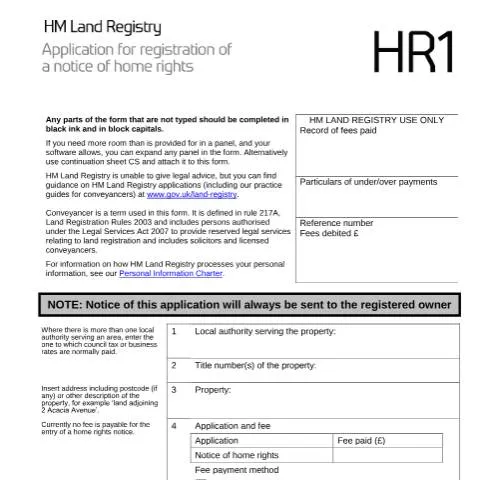
When a marriage or civil partnership ends or becomes strained, securing continued occupation rights in the family home becomes a pressing concern for the non-owning spouse or partner. The HR1 notice represents a crucial legal mechanism that allows individuals to protect their statutory home rights by registering a formal notice against the property's title at HM Land Registry. This registration creates a public record that alerts potential purchasers and lenders to the existence of these rights, effectively preventing the property owner from selling or mortgaging without the knowledge of their spouse or civil partner.
The significance of this protection cannot be overstated. Without proper registration, a spouse who lacks legal ownership of the matrimonial home could find themselves facing eviction if their partner decides to sell the property or defaults on mortgage payments. The HR1 notice transforms what might otherwise be invisible rights into a tangible legal safeguard recorded against the property's official title.
Navigating the Legal Framework Behind Home Rights Registration
The HR1 notice operates within a complex web of legislation, primarily governed by sections 31 and 32 of the Family Law Act 1996, working in conjunction with the Land Registration Act 2002. Understanding this legal foundation proves essential for anyone considering this protective measure.
Under section 31(2) and 31(5) of the Family Law Act 1996, a spouse or civil partner who does not hold legal title to the matrimonial home automatically acquires certain occupation rights. These statutory rights include the right to remain in occupation if already living there, or the right to enter and occupy if excluded. However, these rights remain vulnerable unless properly protected through registration.
The registration process transforms these personal rights into what lawyers term a registrable charge against the property. Once registered, this charge appears on the property's title at HM Land Registry, making it visible to anyone conducting searches before purchasing or lending against the property. This visibility serves as the primary protective mechanism, as most purchasers and mortgage lenders will refuse to proceed with transactions when unresolved home rights notices appear on title.
Interaction with Court Orders and Existing Protections
The HR1 process becomes more nuanced when court orders under section 33(5) of the Family Law Act 1996 exist. These orders typically arise during matrimonial proceedings and may regulate occupation rights or transfer property interests. When such an order has been made, applicants must either enclose an office copy with their HR1 application or, if represented by a conveyancer, provide a certificate confirming they hold the relevant court order.
This requirement reflects the law's recognition that court orders may have already addressed home rights issues, and the Land Registry needs to understand how any new registration request relates to existing judicial decisions.
Decoding the Technical Requirements and Property Identification
Successfully completing an HR1 application requires precise attention to technical details that often prove challenging for applicants unfamiliar with property law conventions. The application demands specific information about the property, local authority details, and existing registrations that must be provided accurately to avoid delays or rejection.
Property Description and Title Number Specifications
Panel 2 requires the title number(s) of the property, which can be found on official Land Registry documents such as title deeds or through online title searches. For properties with multiple titles—common in cases involving both house and garden registered separately, or leasehold properties with associated parking spaces—all relevant title numbers must be included.
The property description in panel 3 must match Land Registry records exactly. While a full postal address including postcode suffices for most residential properties, some situations require more detailed descriptions. Properties without conventional addresses, such as agricultural land or newly constructed homes, may need descriptions like "land adjoining 15 Oak Street" or reference to Ordnance Survey plot numbers.
| Property Type | Description Requirements | Common Issues |
|---|---|---|
| Standard residential | Full address with postcode | Incorrect postcode or house number |
| Leasehold flat | Flat number, building name, full address | Missing flat number or incorrect building reference |
| Rural property | Property name, nearest road, parish, postcode | Insufficient location detail for identification |
| Commercial premises | Business address or "land at" description | Using trading name instead of property address |
Local Authority Identification Challenges
Panel 1 requires identification of the local authority serving the property, specifically the one to which council tax or business rates are normally paid. This seemingly straightforward requirement can create complications in areas where multiple authorities provide different services. For example, some areas have separate district councils collecting council tax while county councils provide other services.
The guidance emphasises selecting the authority that collects council tax or business rates because this represents the primary administrative relationship for property purposes. In areas of local government reorganisation or boundary changes, applicants should verify current arrangements through council tax bills or contact the relevant authorities directly.
Managing Existing Registrations and Potential Conflicts
One of the most complex aspects of HR1 applications involves managing situations where home rights charges may already be registered against other properties. The Family Law Act 1996 permits only one home rights charge per marriage or civil partnership at any given time, creating a system that requires careful navigation when couples own multiple properties or have moved between homes.
The Single Registration Principle
Panel 9 addresses this limitation directly by requiring applicants to declare whether a home rights charge already exists against any other dwelling-house in respect of the same marriage or civil partnership. This declaration triggers different procedural pathways depending on the circumstances.
When an existing registration exists, applicants must provide either the Land Charges registration number and date (for unregistered land) or the title number against which the charge appears (for registered land). The new HR1 application, if successful, will automatically cancel the previous registration under section 32 of the Family Law Act 1996.
This automatic cancellation mechanism prevents the accumulation of multiple home rights charges while ensuring continuous protection as couples move between properties. However, it also creates timing risks—if the new application fails for technical reasons, applicants may find themselves temporarily without protection on either property.
Coordination Between Land Registry and Land Charges Systems
The dual system of property registration in England and Wales adds complexity to home rights protection. While most properties now appear on the Land Registry system, some remain unregistered and fall under the Land Charges system administered by HM Land Registry's Land Charges Department.
When existing home rights charges appear in the Land Charges register, applicants must provide the registration number and date from that system. This information appears on Land Charges search results and official copies. The HR1 process effectively transfers protection from the Land Charges system to the Land Registration system, reflecting the gradual migration of all property interests toward unified Land Registry records.
Professional Representation and Self-Application Considerations
The HR1 process accommodates both professionally represented applicants and those acting in person, though each approach carries distinct advantages and requirements. Understanding these differences helps applicants make informed decisions about representation while ensuring compliance with procedural requirements.
Conveyancer Involvement and Certification Powers
When conveyancers act for applicants, they gain access to streamlined procedures that can expedite processing. Most significantly, conveyancers can provide certificates confirming they hold court orders rather than submitting office copies with applications. This certification power, available only to qualified legal professionals, reduces paperwork while maintaining evidential standards.
The definition of "conveyancer" extends beyond traditional solicitors to include licensed conveyancers and other professionals authorised under the Legal Services Act 2007 to provide reserved legal services relating to land registration. This broad definition ensures access to professional services while maintaining quality standards.
Professional representation also provides access to Land Registry's direct debit payment system and key number facilities, which can streamline communications and fee management. However, these conveniences must be weighed against professional costs, particularly given that HR1 applications currently carry no Land Registry fee.
Self-Representation Requirements and Limitations
Applicants acting without professional representation face additional documentary requirements, particularly regarding court orders. While conveyancers can certify they hold relevant court orders, self-represented applicants must submit office copies with their applications.
This requirement reflects Land Registry's need for documentary evidence while recognising that professional representation provides additional assurance of document authenticity. Self-represented applicants should ensure court orders are properly certified as office copies by the issuing court, as informal copies or printouts may not satisfy Land Registry requirements.
Fill in your form directly online
No printing: type your details into the boxes of the official form, tick, then download the PDF ready to send.
- 1Type into the form boxes
- 2Tick in one click
- 3Save and download the PDF
Service Addresses and Communication Management
Panel 7 of the HR1 form addresses service of documents and ongoing communication, creating obligations that extend well beyond the initial application. The addresses provided become part of the official register and determine how Land Registry and other parties communicate about the home rights charge throughout its existence.
Multiple Address Options and Strategic Considerations
The system permits up to three service addresses, offering flexibility to accommodate changing circumstances. One address must be a postal address (which may be outside the UK), while others can include UK DX box numbers or email addresses. This flexibility proves particularly valuable for applicants who may move frequently or prefer electronic communication.
Email addresses receive priority for most Land Registry communications, including requisitions and correspondence. However, warning of cancellation letters to conveyancers are only sent if email addresses are provided, making electronic communication essential for professional representatives seeking to maintain continuous monitoring of registered charges.
Strategic address selection should consider long-term stability and accessibility. Using temporary addresses or those likely to change may create communication problems that could jeopardise the protection offered by the home rights charge.
Safeguards, Warnings and Legal Consequences
The HR1 process includes significant legal safeguards designed to prevent abuse while protecting legitimate interests. Understanding these protections and their implications helps applicants navigate the system responsibly while avoiding potential legal consequences.
The Reasonable Cause Standard
Section 77 of the Land Registration Act 2002 imposes a duty not to apply for notice registration without reasonable cause, with potential damages liability for anyone causing loss through inappropriate applications. This standard requires applicants to have genuine grounds for believing they possess home rights warranting protection.
Reasonable cause typically exists when applicants are married to or in civil partnership with the registered proprietor and the property serves as their matrimonial home. However, situations involving separated couples, properties not used as primary residences, or relationships that have legally ended may require careful consideration of whether reasonable cause exists.
The damages provision creates real financial risk for applicants who register notices inappropriately. Property owners who suffer loss—such as failed sales or increased borrowing costs—may pursue compensation from applicants who registered notices without proper justification.
Fraud Prevention and Criminal Sanctions
The application includes stern warnings about providing false information, reflecting serious criminal penalties for fraudulent applications. The fraud provisions target dishonest information provision intended to gain advantage or cause loss, with potential prosecution under general fraud legislation.
This emphasis on accuracy extends beyond obvious falsehoods to include misleading statements or omissions that could affect Land Registry decisions. Applicants should ensure all information provided is complete, accurate, and supportable by available evidence.
The automatic notification system provides additional protection by ensuring registered proprietors always receive notice of HR1 applications against their properties. This notification enables property owners to challenge inappropriate applications before registration occurs, reducing the risk of fraudulent or mistaken entries affecting property titles.