When Professional Executorship Becomes a Burden: Understanding Corporate Renunciation
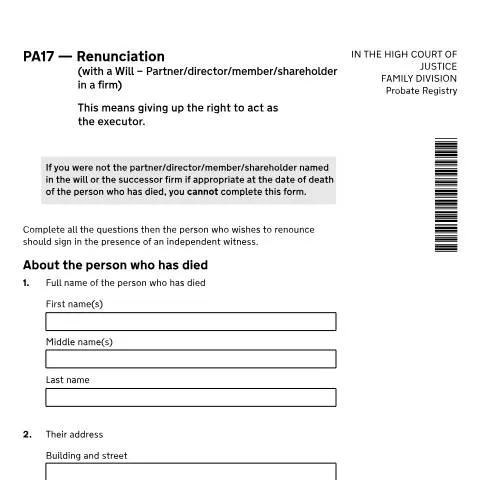
In the complex landscape of estate administration, professional firms occasionally find themselves appointed as executors in wills, only to discover that circumstances have changed dramatically by the time of death. The PA17 form serves as the formal mechanism through which partners, directors, members, or shareholders in professional firms can collectively renounce their executor duties when they were named in their professional capacity rather than as individuals.
This specialized renunciation process addresses a particular scenario where the deceased appointed a firm—perhaps their solicitors, accountants, or financial advisers—to handle their estate administration. However, when death occurs, the firm may no longer exist in its original form, key personnel may have departed, or the surviving partners may simply lack the capacity or expertise to fulfil these duties effectively.
The PA17 distinguishes itself from individual executor renunciations by requiring collective authority from the firm's leadership and establishing that no member of the firm has already begun intermeddling with the deceased's estate. This prevents partial administration followed by abandonment, which could leave estates in legal limbo.
Corporate Succession and the Continuity Challenge
One of the most intricate aspects of the PA17 process involves determining whether the firm named in the will still exists in a legally recognisable form. Professional practices frequently undergo restructuring, mergers, or name changes over the years between will-making and death.
The form specifically requires confirmation that the firm named in question 7 succeeded to and carried on the practice of the firm named in the will at the date of death. This succession principle recognises that businesses evolve whilst maintaining legal continuity. A solicitors' firm that began as "Smith & Associates" might have become "Smith, Jones & Partners LLP" through partnership changes, yet still retain the same client base and professional obligations.
| Succession Scenario | PA17 Eligibility | Key Requirement |
|---|---|---|
| Partnership expansion with name change | Eligible if practice continued | Demonstrate business continuity |
| Corporate restructuring (LLP formation) | Usually eligible | Same partners/directors involved |
| Complete sale to unrelated firm | Not eligible | No succession relationship |
| Merger creating new entity | Potentially eligible | Depends on continuation of practice |
Where succession cannot be established, the form cannot be completed, leaving the estate administration in the hands of the Public Trustee or requiring court intervention to appoint alternative administrators.
The Intermeddling Prohibition and Its Practical Implications
Central to the PA17 renunciation is the sworn declaration that no member of the firm has intermeddled with the estate. This legal concept extends beyond mere asset collection to encompass any actions that could be construed as accepting executor responsibilities.
Intermeddling might include arranging the funeral, securing property, collecting rents, paying bills from estate funds, or even providing detailed advice to beneficiaries about their inheritance. The prohibition exists because executor duties, once partially accepted, cannot typically be abandoned without court permission.
However, certain preliminary actions remain permissible before renunciation. These include:
- Preserving assets from immediate risk of loss or damage
- Securing important documents such as property deeds or insurance policies
- Notifying relevant authorities of the death where legally required
- Providing basic information to family members about the renunciation process
The distinction often lies in whether actions demonstrate an intention to act as executor rather than merely fulfilling professional obligations or preventing immediate harm to estate assets.
Navigating the Witness Requirements and Execution Formalities
The PA17 requires execution as a deed, demanding specific formalities that distinguish it from simple administrative forms. Each renouncing partner, director, member, or shareholder must sign in the presence of an independent witness who has no interest in the estate and no relationship to the renouncing party.
This independence requirement excludes not only family members but also professional colleagues, clients with potential estate interests, and anyone who might benefit from the estate administration. The witness must be present during the actual signing and cannot simply verify a signature after the fact.
Professional firms often struggle with the witness requirement, particularly where the renunciation involves multiple partners in small practices where most potential witnesses have some professional connection. Suitable witnesses might include:
- Local magistrates or court officials
- Officers from unconnected professional bodies
- Bank managers from institutions not handling estate funds
- Retired professionals with no current practice connections
Each signature requires its own witness, meaning that if two partners are renouncing, two separate independent witnesses must be available, or the same witness must observe both signatures on the same occasion.
Collective Authority and Internal Firm Dynamics
The PA17's opening declaration states that renunciation occurs "with the authority of the other partners/directors/members/shareholders in the said firm". This collective authority requirement recognises that professional executor appointments often reflect the firm's reputation and expertise rather than individual capabilities.
Obtaining this authority can prove complex in larger firms where partnership agreements may specify different voting thresholds for various decisions. Some firms require unanimous consent for matters affecting professional liability, whilst others operate on majority rule principles.
The form does not specify how this authority should be documented, but prudent firms typically maintain:
- Partnership meeting minutes recording the renunciation decision
- Written consents from partners unable to attend meetings
- Professional indemnity insurer notification of the intended renunciation
- Client file documentation explaining the decision rationale
Where internal disagreement exists about renunciation, the form cannot be properly completed, potentially requiring individual partners to seek court guidance about their executor obligations.
Submission Pathways and Registry Processing
Completed PA17 forms must be submitted to the appropriate Probate Registry serving the area where the deceased was domiciled at death. Unlike many HM Courts & Tribunals Service processes, probate registries maintain significant regional variations in processing times and administrative preferences.
The form should be accompanied by:
- The original will and any codicils
- Certified copies of firm succession documentation if applicable
- Death certificate (original or certified copy)
- Covering letter explaining any complex succession arrangements
Processing typically takes 4-6 weeks, though complex succession cases may require additional correspondence. The registry may request supplementary evidence about firm continuity or seek clarification about the scope of any preliminary actions taken by firm members.
Once accepted, the renunciation becomes irrevocable. The registry will note the renunciation against the estate file and typically contact any other named executors about proceeding with probate applications. Where all named executors renounce, the registry will provide guidance about alternative administration routes.
Strategic Considerations for Professional Practices
The decision to renounce executor duties extends beyond immediate administrative convenience to encompass longer-term professional and commercial considerations. Firms must weigh their professional obligations to deceased clients against practical capacity constraints and potential liability exposure.
Professional executor appointments often arise from long-standing client relationships where the firm provided comprehensive legal or financial services over many years. Renunciation might disappoint family expectations and potentially affect the firm's reputation within their professional community.
However, several factors commonly justify renunciation:
- Insufficient expertise in estate administration compared to specialist practitioners
- Conflict of interests arising from other professional relationships
- Resource constraints preventing proper attention to estate duties
- Geographic inconvenience where firm location makes administration impractical
- Professional indemnity concerns about liability for estate administration errors
Many firms now include standard clauses in their client engagement letters clarifying that executor appointments should be reviewed periodically and that renunciation remains possible if circumstances change significantly.
Alternative Administration Routes Following Renunciation
PA17 renunciation does not terminate estate administration but rather redirects it through alternative channels. Understanding these pathways helps firms advise families appropriately about post-renunciation options.
Where other executors remain after firm renunciation, those individuals may proceed with standard probate applications using form PA1P. However, they should consider whether they possess sufficient expertise to handle complex estates that prompted professional executor appointments originally.
If all named executors renounce, administration typically passes to the principal beneficiaries under intestacy rules or will provisions. These individuals must apply for letters of administration with will annexed, a process that can prove more complex than straightforward probate applications.
In cases where no suitable family administrators exist, the Public Trustee may assume responsibility, though this option typically involves significant costs and standardised administration approaches that may not reflect the deceased's specific intentions or family circumstances.
Professional firms completing PA17 renunciations often provide transitional support by recommending specialist probate practitioners, preparing comprehensive file notes for successor administrators, and ensuring secure transfer of any estate documents in their possession. This approach maintains professional standards whilst enabling effective administration transfer.
Understanding the Legal Implications of Renouncing Executor Rights
When contemplating the use of Form PA17, it's crucial to understand that renouncing executor rights carries significant legal consequences that cannot be easily reversed. The Administration of Estates Act 1925 and subsequent legislation establish that once you formally renounce probate, you effectively surrender your legal authority to administer the deceased's estate permanently.
The renunciation becomes legally binding once the Probate Registry accepts your Form PA17. Unlike some administrative decisions that can be appealed or reconsidered, renunciation of executor rights is typically irrevocable. This finality exists to provide certainty for beneficiaries, creditors, and other interested parties who need to know definitively who has legal authority over the estate.
Partial vs Complete Renunciation
Form PA17 allows for complete renunciation of all executor duties, but the law also recognises situations where an executor might wish to renounce only specific aspects of their role. However, partial renunciation is not possible through Form PA17 – you cannot, for instance, renounce responsibility for dealing with property whilst retaining authority over financial accounts.
If you're concerned about specific aspects of estate administration, consider whether seeking professional assistance might be more appropriate than complete renunciation. Many executors successfully fulfil their duties with support from solicitors, accountants, or probate practitioners, allowing them to maintain their legal position whilst receiving expert guidance.
Impact on Inheritance Tax Obligations
Renouncing executor rights through Form PA17 doesn't automatically transfer Inheritance Tax (IHT) responsibilities to the remaining executors. If you've already engaged with HMRC regarding the estate's IHT position, you may remain liable for providing information or attending meetings, even after renunciation.
The Inheritance Tax Act 1984 places specific obligations on persons who have intermeddled with the estate or taken steps toward administration. If you've already begun dealing with the deceased's affairs – perhaps by contacting banks, arranging the funeral, or communicating with HMRC – these actions might create continuing obligations regardless of subsequent renunciation.
Alternatives to Formal Renunciation: Exploring Your Options
Before proceeding with Form PA17, executors should carefully consider whether complete renunciation is truly necessary or whether alternative arrangements might better serve their needs and the estate's interests.
Power Reserved Applications
One significant alternative to renunciation is applying for power to be reserved. This mechanism allows an executor to step back from immediate involvement in estate administration whilst preserving their legal right to act later if circumstances change. Unlike renunciation, power reserved arrangements are not permanent and can be activated if the other executors become unable or unwilling to continue.
Power reserved applications are particularly valuable when an executor faces temporary constraints – such as serious illness, overseas residence, or demanding professional commitments – but may wish to resume their role later. The Probate Registry will typically grant power reserved requests where there are multiple executors and at least one is willing and able to proceed immediately.
Delegation and Professional Appointment
The Trustee Act 2000 provides executors with significant powers to delegate specific functions whilst retaining overall responsibility. Rather than renouncing completely, you might delegate investment management, property sales, or other complex tasks to qualified professionals whilst maintaining your legal position as executor.
Professional delegation allows you to ensure the estate receives expert attention in specialised areas whilst you focus on aspects of administration that you're comfortable handling. This approach often proves more cost-effective than wholesale renunciation, as professional fees apply only to delegated functions rather than entire estate administration.
Appointing Additional Executors
Where the will names insufficient executors or where existing executors feel overwhelmed by their responsibilities, the court has power under Section 50 of the Administration of Justice Act 1985 to appoint additional executors. This process allows the estate to benefit from additional expertise without requiring existing executors to renounce their positions.
Additional executor appointments are particularly valuable in complex estates involving business interests, overseas property, or substantial investment portfolios. The court will typically appoint qualified professionals – such as solicitors or chartered accountants – who can work alongside family executors to ensure proper estate administration.
Practical Considerations for Probate Practitioners Receiving Renunciations
From the perspective of probate practitioners who may benefit from executor renunciations, understanding the practical implications of Form PA17 submissions is essential for effective estate administration and client service.
Due Diligence Requirements
When an executor renounces in favour of a probate practitioner, the practitioner assumes significant legal responsibilities that require thorough due diligence. The Solicitors Regulation Authority (SRA) Standards and Regulations require solicitors to ensure they have adequate expertise and resources to handle the estate properly.
Practitioners should conduct comprehensive initial assessments covering the estate's size, complexity, potential disputes, and any unusual assets or liabilities. This assessment should include reviewing the deceased's financial records, identifying all beneficiaries, and evaluating potential claims against the estate. Anti-money laundering regulations under the Proceeds of Crime Act 2002 also require practitioners to verify the identity of all parties and assess the source of estate assets.
Client Care and Cost Transparency
The SRA Code of Conduct mandates clear communication about costs and services when probate practitioners take on executor roles following renunciations. Practitioners must provide detailed cost estimates, explain their charging structure, and outline the scope of services to be provided.
Best practice involves providing written terms of engagement that clearly distinguish between the practitioner's role as executor (a fiduciary position) and any additional services provided as a legal advisor. This distinction is crucial because executors owe specific duties to beneficiaries that may sometimes conflict with commercial interests.
Managing Conflicts of Interest
Probate practitioners accepting executor appointments following Form PA17 renunciations must carefully manage potential conflicts of interest. Professional conduct rules prohibit practitioners from acting where their interests conflict with those of the estate or its beneficiaries.
Common conflict scenarios include situations where the practitioner's firm previously advised the deceased, where beneficiaries have competing interests requiring separate representation, or where the practitioner has personal relationships with parties connected to the estate. The SRA Guidance on Conflicts of Interest provides detailed frameworks for identifying and managing these situations appropriately.
Record Keeping and Accountability
Practitioners assuming executor roles following renunciations must maintain comprehensive records demonstrating proper estate administration. The Trustee Act 2000 requires trustees and executors to maintain accurate accounts and provide regular updates to beneficiaries.
Professional standards typically exceed minimum legal requirements, with practitioners expected to maintain detailed time records, comprehensive file notes, and regular financial reports. These records serve multiple purposes: demonstrating proper stewardship to beneficiaries, supporting fee applications, and providing evidence of appropriate professional conduct if complaints arise.
Modern estate administration increasingly involves digital assets, online accounts, and complex investment structures that require specialised knowledge and careful documentation. Practitioners should ensure their systems and procedures adequately address these contemporary challenges whilst maintaining traditional standards of professional excellence.