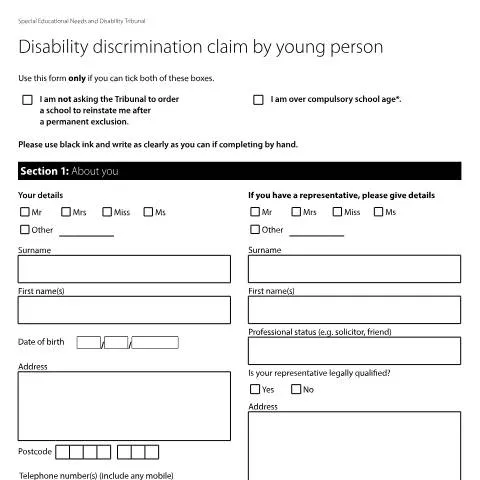
When Schools Fall Short: Understanding Form SEND4B for Young People Facing Discrimination
The classroom should be a place of learning and growth for every student, yet for some young people with disabilities, the educational environment becomes a source of exclusion and unfair treatment. When a school's actions cross the line from poor practice into discrimination, Form SEND4B provides a crucial pathway to justice through the Special Educational Needs and Disability Tribunal.
This specialised claim form addresses a specific but significant gap in the educational landscape – it's designed exclusively for young people who have moved beyond compulsory school age yet continue to face disability discrimination in their educational setting. Unlike standard complaints procedures or appeals processes, Form SEND4B opens the door to formal tribunal proceedings that can result in binding orders against schools, academies, or independent institutions.
The form's very existence reflects the reality that discrimination doesn't simply vanish when students reach 16. Whether pursuing A-levels, vocational qualifications, or other post-16 education, young people with disabilities may encounter barriers that fundamentally undermine their right to equal treatment. From exclusions based on misunderstood behaviours to failures in providing reasonable adjustments, the scope of potential discrimination remains broad and impactful.
Eligibility Thresholds: The Critical Age and Exclusion Boundaries
Form SEND4B operates within carefully defined parameters that distinguish it from other tribunal processes. The compulsory school age threshold represents a pivotal factor – claimants must have passed beyond this point, which occurs on the last Friday in June of the academic year they turn 16. This timing mechanism ensures the form serves post-16 students who might otherwise fall between different legal frameworks.
Equally significant is what this form cannot address. Young people seeking reinstatement following a permanent exclusion must pursue alternative routes, as Form SEND4B explicitly excludes these cases. This boundary prevents overlap with other tribunal jurisdictions whilst maintaining focus on discrimination claims rather than exclusion appeals.
| Student Status | Age Requirement | Exclusion Status | Form SEND4B Eligibility |
|---|---|---|---|
| Year 11 student | Under compulsory school age | Any status | Not eligible |
| Sixth form student | Over compulsory school age | No permanent exclusion claim | Eligible |
| College student (16+) | Over compulsory school age | Seeking reinstatement | Not eligible |
| Adult learner (18+) | Over compulsory school age | Discrimination claim only | Eligible |
The form accommodates various educational settings including maintained schools under local authority control, academies, free schools, and private institutions. This breadth reflects the diverse landscape of post-16 education where discrimination might occur across different governance structures and funding arrangements.
Unpacking the Discrimination Categories: From Fixed-Term Exclusions to Reasonable Adjustments
Section 4 of Form SEND4B reveals the multifaceted nature of disability discrimination in educational settings. The form systematically captures four distinct categories of discriminatory treatment, each requiring specific evidence and documentation approaches.
Fixed-Term Exclusions: Pattern Recognition and Proportionality
Fixed-term exclusions represent one of the most documented forms of discrimination, yet their discriminatory nature often lies in patterns rather than individual incidents. The form requires claimants to detail start and end dates alongside the school's stated reasons, creating a foundation for demonstrating whether exclusions disproportionately affect students with particular disabilities or stem from misunderstood disability-related behaviours.
For instance, a student with autism spectrum conditions might face repeated exclusions for behaviours that manifest their disability – such as sensory overload responses or communication difficulties – without the school recognising these as disability-related rather than wilful misconduct. The tribunal will examine whether the school considered the student's disability when imposing sanctions and whether alternative approaches might have been more appropriate.
Educational Exclusions: Trips, Activities, and Participation Barriers
School trips and extracurricular activities form integral parts of educational experience, yet students with disabilities often face exclusion from these opportunities through direct refusal or indirect barriers. Form SEND4B captures these exclusions by requiring descriptions of specific trips or events alongside decision dates, enabling the tribunal to assess whether schools properly considered reasonable adjustments or simply defaulted to exclusion.
Common scenarios include residential trips where schools claim they cannot accommodate medical needs, sports activities deemed "too risky" for students with certain conditions, or cultural events where accessibility hasn't been considered. The tribunal will examine whether schools engaged in meaningful consultation with students and families, explored alternative arrangements, or simply applied blanket exclusions based on disability assumptions.
Unfavourable Treatment: The Spectrum of Daily Discrimination
The "unfavourable treatment" category encompasses the broader spectrum of discriminatory actions that might not fit neatly into exclusion categories but nonetheless create hostile or disadvantageous educational environments. This section requires careful documentation of specific incidents with precise dating, as the cumulative effect of multiple smaller incidents can demonstrate systematic discrimination.
Examples might include consistently harsher punishments for disability-related behaviours, isolation practices that exacerbate mental health conditions, or academic penalties that fail to account for disability impacts. The tribunal will assess whether treatment was proportionate, whether disability was a factor in decision-making, and whether similar non-disabled students would have received different treatment in comparable circumstances.
Reasonable Adjustments: Identifying Failures and Their Consequences
The reasonable adjustments section requires particularly detailed analysis, as claimants must demonstrate not only that adjustments were needed but that their absence created substantial disadvantage. This involves identifying specific adjustments that should have been implemented, establishing when they should have been in place, and evidencing what the school did instead.
Successful claims often involve clear documentation of communication about needed adjustments, evidence that adjustments were reasonable and practical, and demonstration of the disadvantage caused by their absence. This might include academic underperformance linked to accessibility barriers, social isolation resulting from communication support failures, or health deterioration caused by environmental factors the school could have addressed.
Navigating the Six-Month Time Limit: Understanding Late Claims and Exceptional Circumstances
The tribunal's six-month time limit represents one of the most challenging aspects of Form SEND4B, yet understanding its nuances can make the difference between a successful claim and an inadmissible one. The clock starts ticking from the date of discrimination – not when the student recognised it as discrimination, but when the discriminatory act occurred or when a school decided not to take action it should have taken.
For series of connected acts, the time limit runs from the most recent incident, potentially allowing older incidents to be included if they form part of an ongoing pattern. This provision proves particularly valuable in educational discrimination cases, where problems often escalate over time rather than occurring as isolated incidents.
Building a Case for Late Acceptance
Section 7 provides space for explaining late claims, but successful applications require more than simple apologies for delay. The tribunal considers both why the claim is late and why it should nonetheless be accepted, weighing factors such as:
- The claimant's age and understanding of their rights at the time of discrimination
- Attempts to resolve matters through school complaints procedures or other channels
- Medical or psychological factors that prevented earlier action
- The strength of the underlying discrimination claim
- Whether delay has prejudiced the school's ability to respond effectively
Young people with certain disabilities may have particularly strong grounds for late acceptance, especially where their condition affected their ability to understand or respond to discrimination at the time it occurred. Mental health conditions, learning disabilities, or autism spectrum conditions might all provide relevant context for explaining delays in formal action.
The Representative Framework: Legal Support and Advocacy Arrangements
Form SEND4B recognises that young people facing discrimination may need support in navigating tribunal proceedings through its comprehensive representative framework. The distinction between legally qualified and non-legally qualified representatives reflects the reality that effective advocacy can come from various sources, from solicitors specialising in education law to family members or disability advocates with deep understanding of specific conditions.
When appointing a representative, the form requires clear identification of professional status and legal qualifications, enabling the tribunal to understand the nature of support being provided. This transparency helps establish appropriate communication channels and ensures all parties understand the representative's role and authority.
Choosing Between Self-Representation and Professional Support
The decision whether to engage professional representation often depends on case complexity, the young person's confidence in advocacy, and available resources. While tribunal proceedings are designed to be accessible to unrepresented claimants, discrimination cases frequently involve complex legal concepts around reasonable adjustments, proportionality, and justification that benefit from specialist knowledge.
Non-legally qualified representatives might include parents, carers, disability rights advocates, or support workers with relevant experience. Their involvement can provide crucial emotional support and practical assistance whilst maintaining the young person's direct engagement with proceedings. However, such representatives cannot provide legal advice or appear in certain capacities that require professional qualification.
Evidence Architecture: Building Your Case Through Documentation
Section 9 of Form SEND4B outlines the documentary foundation essential for successful discrimination claims, yet the form's requirements represent minimum rather than comprehensive evidence needs. Understanding how different document types contribute to building a compelling case can significantly strengthen a young person's position before the tribunal.
School Decision Documents: Capturing Institutional Reasoning
Documents setting out school decisions form the backbone of most discrimination claims, as they reveal the institution's reasoning and decision-making processes. Exclusion letters, meeting minutes, and policy documents often contain crucial evidence about whether disability was properly considered, whether alternatives were explored, and whether decisions were proportionate.
These documents frequently reveal more than schools intend – casual references to "challenging behaviour" without acknowledging disability context, assumptions about student capabilities, or failures to engage with reasonable adjustment requests. Careful analysis of language and omissions can demonstrate discriminatory attitudes or approaches even where explicit bias isn't stated.
Medical and Educational Assessments: Establishing Disability and Impact
Disability-related documentation serves dual purposes in tribunal proceedings – establishing that the claimant has a qualifying disability under the Equality Act 2010 and evidencing how that disability affects their daily activities and educational participation. Statements of special educational needs, medical reports, and professional assessments provide this foundation, but their presentation requires careful consideration.
The tribunal needs to understand not just the medical diagnosis but its practical implications for school life. A psychological assessment might detail attention difficulties, but the claim benefits from connecting these to specific educational disadvantages – inability to process verbal instructions in noisy environments, need for written rather than oral feedback, or requirement for movement breaks during long lessons.
Correspondence Records: Demonstrating Communication and Response
Email chains, letters, and meeting records between families and schools often provide the most revealing evidence about institutional attitudes and responses to disability-related concerns. These documents can demonstrate whether schools engaged constructively with adjustment requests, how they responded to concerns about discriminatory treatment, and whether they showed understanding of their legal obligations.
Successful claims often hinge on demonstrating that schools were clearly informed about disability-related needs yet failed to respond appropriately despite having reasonable opportunities to address concerns.
Remedy Expectations: Understanding Tribunal Powers and Practical Outcomes
Section 8's focus on "putting things right" requires careful consideration of what the Special Educational Needs and Disability Tribunal can actually achieve. Unlike employment tribunals or county courts, this specialist tribunal cannot award financial compensation to individuals – a limitation that fundamentally shapes both claim strategy and realistic outcome expectations.
The tribunal's orders target the responsible body – typically the governing body of maintained schools or proprietors of independent institutions – rather than individual staff members. This institutional focus means remedies must address systemic issues rather than personal accountability, steering claimants toward solutions that prevent future discrimination rather than punishing past wrongs.
Constructive Remedy Approaches
Effective remedy requests often combine immediate practical changes with longer-term systemic improvements. A student excluded from residential trips might seek an order requiring the school to develop comprehensive accessibility policies for all future trips, alongside specific arrangements for their own participation in upcoming events.
Training requirements represent another powerful remedy option, particularly where discrimination stems from staff misunderstanding rather than deliberate bias. Orders might require disability awareness training for relevant staff, development of specific protocols for supporting students with particular conditions, or establishment of clear procedures for reasonable adjustment requests.
Policy development orders can address institutional gaps that enabled discrimination, requiring schools to establish or revise policies around behaviour management, exclusion procedures, or accessibility planning. These systemic changes often provide more lasting protection than individual accommodations alone.
Strategic Timing and Procedural Navigation
The journey from completing Form SEND4B to tribunal hearing involves several critical stages where strategic decisions can significantly impact outcomes. Understanding these procedural elements helps young people and their representatives navigate the system effectively whilst maintaining focus on the substantive discrimination issues.
Upon receiving Form SEND4B, the tribunal undertakes an initial registration assessment, examining whether basic eligibility criteria are met and whether the claim falls within the six-month time limit. Claims failing these preliminary tests face rejection without substantive consideration, making careful attention to eligibility requirements essential from the outset.
School Response Dynamics
Once registered, claims trigger formal response requirements from schools, creating the first opportunity for resolution without full hearing proceedings. School responses often reveal additional evidence or provide clarification of their position that might influence claim development or settlement discussions.
The response phase also allows schools to raise preliminary objections – challenging jurisdiction, disputing facts, or arguing that claims should be dismissed without hearing. Understanding these potential challenges helps claimants prepare robust initial submissions that anticipate and address likely school arguments.
Some cases benefit from early case management discussions where procedural issues, evidence requirements, and hearing logistics can be addressed efficiently. These preliminary stages often prove decisive in shaping final outcomes, making early strategic thinking and thorough preparation essential components of successful claims.
Form SEND4B ultimately represents more than a mere administrative requirement – it provides a structured pathway for young people to assert their fundamental right to equal treatment in education. While the tribunal process requires careful navigation and realistic expectations about available remedies, it offers genuine opportunities to address discrimination and create positive change that extends beyond individual cases to benefit future students facing similar challenges.