When Justice Takes a Digital Turn: The Criminal Appeal Office Form NG Conviction Easy Read
In the labyrinthine corridors of criminal justice, where every form carries the weight of someone's freedom, the Criminal Appeal Office Form NG Conviction Easy Read stands as a crucial gateway between conviction and potential vindication. This specialised document, developed by the Criminal Procedure Rule Committee under the Ministry of Justice, transforms the complex world of criminal appeals into accessible language for those who need it most—defendants, their families, and supporters who may struggle with standard legal terminology.
The form's genesis lies in a fundamental recognition: justice denied through incomprehension is justice denied altogether. When the Court of Appeal Criminal Division receives thousands of applications annually, many from unrepresented appellants or those with learning difficulties, the traditional Form NG (Conviction) often proved an insurmountable barrier. The Easy Read version emerged as a response to equality legislation and the courts' duty to ensure meaningful access to justice for all citizens, regardless of their literacy levels or cognitive abilities.
Revolutionary Changes in Criminal Appeal Procedures Since October 2018
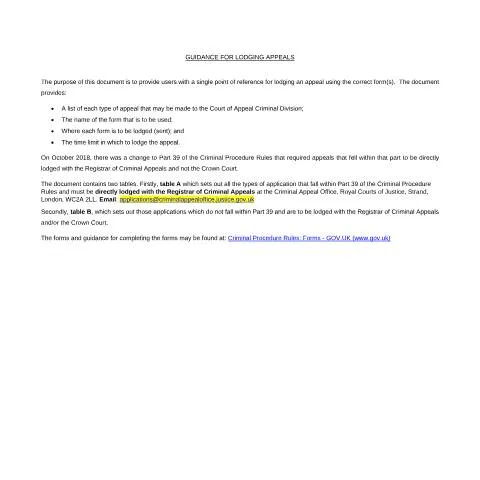
The landscape of criminal appeals underwent a seismic shift in October 2018 when Part 39 of the Criminal Procedure Rules was amended, fundamentally altering how appeals reach the Court of Appeal. Previously, many applications meandered through the Crown Court system before finding their way to the Criminal Appeal Office. The new direct lodgement system swept away this cumbersome process, establishing the Registrar of Criminal Appeals at the Royal Courts of Justice as the primary destination for conviction appeals.
This transformation created two distinct pathways: applications falling under Part 39, which must be lodged directly with the Criminal Appeal Office at the Royal Courts of Justice, Strand, London, WC2A 2LL, and those outside Part 39's scope, which continue to follow the traditional Crown Court route. The Form NG Conviction Easy Read sits firmly within the first category, reflecting the Ministry of Justice's commitment to streamlining the most common type of criminal appeal.
The [email protected] email address now serves as a digital lifeline for appellants seeking clarification on their applications. This electronic gateway has proved particularly valuable during periods when physical access to the Royal Courts of Justice has been restricted, ensuring that the wheels of justice continue turning regardless of external circumstances.
Understanding the 28-Day Window
The clock begins ticking from the moment of conviction or sentencing, creating a rigid 28-day timeframe that brooks no casual delays. This period represents more than mere administrative convenience—it balances the appellant's right to challenge their conviction against the justice system's need for finality and the practical requirements of court scheduling.
Within this compressed timeframe, appellants must not only complete the Form NG Conviction Easy Read but also gather supporting documentation, potentially secure legal representation, and formulate cogent grounds for appeal. The Easy Read format acknowledges these pressures by presenting information in digestible chunks, using clear headings and straightforward language that reduces the cognitive load on already stressed individuals.
Demystifying the Easy Read Approach: Beyond Simple Language
The Easy Read methodology extends far beyond merely simplifying vocabulary. It represents a comprehensive reimagining of how legal documents can communicate with diverse audiences. The form employs visual cues, structured layouts, and progressive disclosure techniques that guide users through complex legal concepts without overwhelming them.
Each section builds upon the previous one, creating a logical progression from basic case details to more nuanced legal arguments. The form recognises that many appellants may be completing it without legal assistance, potentially in stressful environments such as prison cells or while dealing with the emotional aftermath of conviction.
| Standard Form Element | Easy Read Adaptation | Practical Benefit |
|---|---|---|
| Legal terminology | Plain English explanations | Reduces misunderstanding and incomplete applications |
| Dense paragraph text | Bullet points and short sentences | Improves comprehension for dyslexic users |
| Complex instructions | Step-by-step guidance | Minimises procedural errors |
| Legal precedent references | Everyday examples | Makes abstract concepts tangible |
The form's design philosophy acknowledges that conviction appeals often involve individuals from disadvantaged backgrounds, those with mental health challenges, or people for whom English is not their first language. By removing linguistic barriers, the Easy Read version ensures that the strength of an appeal rests on its legal merits rather than the appellant's ability to navigate complex bureaucratic language.
Navigating the Conviction Appeal Ecosystem: Where Form NG Fits
Within the broader constellation of criminal appeal forms, the Form NG (Conviction) Easy Read occupies a unique position. While its standard counterpart, Form NG (Conviction), serves legally represented appellants and those comfortable with formal legal language, the Easy Read version addresses a previously underserved population. This dual-track approach reflects the Criminal Procedure Rule Committee's recognition that one size fits none when it comes to access to justice.
The form specifically covers appeals against convictions, including several specialised scenarios that many appellants might not immediately recognise as appealable. These encompass findings of contempt of court, references from the Criminal Cases Review Commission (CCRC), findings of unfitness to plead coupled with determinations that the defendant committed the alleged act, and verdicts of not guilty by reason of insanity.
Each of these scenarios carries distinct legal implications and procedural requirements. The Easy Read format explains these nuances without drowning appellants in legal theory, focusing instead on practical consequences and required actions. For instance, when dealing with CCRC references, the form clarifies that while the Commission has already conducted an extensive review, the appellant still bears responsibility for presenting their case effectively to the Court of Appeal.
The Prison Context: Special Considerations
A significant proportion of Form NG (Conviction) Easy Read applications originate from prison establishments across England and Wales. This context presents unique challenges: limited access to legal resources, restricted communication channels, and the psychological pressure of incarceration while pursuing an appeal. The form's design acknowledges these constraints by minimising the need for external research or complex legal analysis.
Prison law libraries, where they exist, often contain outdated materials or focus on general legal principles rather than specific procedural requirements. The Easy Read form bridges this gap by incorporating essential guidance directly into the document, reducing appellants' dependence on external resources that may be unavailable or inaccessible within the prison environment.
Technical Precision in Accessible Packaging
Despite its simplified presentation, the Form NG (Conviction) Easy Read maintains the technical precision required by the Court of Appeal Criminal Division. Every section corresponds to specific legal requirements established through decades of appellate jurisprudence and statutory development. The challenge lies in presenting these requirements in accessible language without sacrificing legal accuracy or completeness.
The form must capture essential case details: the original court, conviction date, sentence imposed, and the specific grounds for appeal. Each piece of information serves a distinct purpose in the appellate process. The conviction date determines whether the 28-day deadline has been met, while the original court information enables the Criminal Appeal Office to retrieve case files and transcripts necessary for the appeal's consideration.
Grounds for appeal represent the most intellectually demanding section of the form. Appellants must articulate why their conviction is unsafe, drawing upon legal principles such as procedural irregularities, fresh evidence, or errors in law or fact. The Easy Read version provides frameworks and examples that guide appellants through this analytical process without prescribing specific arguments or suggesting particular outcomes.
Quality Control and Completeness Checks
The Criminal Appeal Office operates sophisticated screening procedures to identify incomplete or deficient applications before they reach the Court of Appeal judges. These quality control measures have evolved in response to the Easy Read initiative, recognising that traditional markers of application quality—such as formal legal language or citation of authorities—may be absent from otherwise meritorious appeals.
Administrative staff now focus on substance over style, evaluating whether applications contain sufficient factual detail and legal reasoning to enable judicial consideration, regardless of their linguistic sophistication. This shift has required extensive training and cultural change within the Criminal Appeal Office, moving from a gatekeeping function towards a facilitative role that supports access to justice.
Digital Integration and Future-Proofing Appeal Processes
The Form NG (Conviction) Easy Read exists within an increasingly digital justice ecosystem. While the form itself may be completed on paper, its submission often involves electronic transmission, and supporting documents may be provided digitally. This hybrid approach recognises that while digital literacy varies significantly among appellants, electronic communication offers speed and reliability advantages that benefit all parties.
Fill in your form directly online
No printing: type your details into the boxes of the official form, tick, then download the PDF ready to send.
- 1Type into the form boxes
- 2Tick in one click
- 3Save and download the PDF
The [email protected] email address serves as more than a contact point—it represents the Criminal Appeal Office's commitment to responsive communication with appellants and their representatives. Queries about form completion, deadline calculations, or procedural requirements receive prompt responses, often preventing application deficiencies that would otherwise delay proceedings.
Looking ahead, the Ministry of Justice continues exploring technological solutions that could further enhance accessibility. Voice-to-text capabilities, multilingual support, and interactive guidance systems all feature in long-term planning discussions. However, these developments must balance innovation with the fundamental requirement that appellants understand and control their submissions to the court.
Training and Support Networks
The successful implementation of the Form NG (Conviction) Easy Read has required extensive training across the criminal justice system. Prison staff, Citizens Advice Bureau volunteers, and legal aid solicitors all needed familiarisation with the new format and its underlying philosophy. This training emphasises that accessibility does not mean oversimplification—the Easy Read approach requires sophisticated understanding of how different populations process information and make decisions under stress.
Support networks have emerged organically around the Easy Read initiative. Prison wing representatives often become informal experts in form completion, while family members and friends increasingly serve as assisted completion facilitators. These developments highlight the form's success in democratising access to the appeals process while maintaining procedural integrity.
Measuring Success: Outcomes and Impact Assessment
The Ministry of Justice continuously monitors the effectiveness of the Form NG (Conviction) Easy Read through multiple metrics. Application completion rates have improved significantly since the form's introduction, with fewer applications rejected for administrative deficiencies or incompleteness. More importantly, the quality of grounds for appeal has remained consistent, suggesting that accessibility improvements have not compromised substantive legal analysis.
Demographic analysis reveals that the Easy Read version has particularly benefited appellants from ethnic minority backgrounds, those with declared learning difficulties, and unrepresented individuals. These groups previously faced disproportionate barriers in accessing appellate procedures, often resulting in meritorious appeals being lost due to procedural failures rather than substantive weaknesses.
The Court of Appeal Criminal Division has noted improved case management efficiency, with fewer applications requiring clarification or amendment before judicial consideration. This streamlining effect benefits all court users by reducing delays and administrative burden, creating capacity for more thorough consideration of substantive legal issues.
Perhaps most significantly, the Easy Read initiative has influenced broader thinking about court forms and procedures across the justice system. Family courts, civil courts, and tribunals are all exploring similar accessibility measures, recognising that the principles underlying the Form NG (Conviction) Easy Read have universal application wherever citizens interact with legal institutions.
The form represents more than administrative efficiency—it embodies the justice system's evolving understanding of its responsibilities to all citizens, regardless of their educational background, cognitive abilities, or familiarity with legal processes. In this light, the Form NG (Conviction) Easy Read stands as both a practical tool and a symbol of the ongoing transformation towards truly accessible justice.