When Court Money Becomes Yours: Navigating the CH60 Identity Verification Process
Money held in civil court accounts across England and Wales represents unclaimed awards, settlements, and deposits that have remained dormant for years. Whether from a forgotten personal injury claim, an old property dispute, or inheritance proceedings that never reached their intended recipient, these funds accumulate in court coffers awaiting rightful claimants. The CH60 Evidence of identity and declaration form serves as your gateway to recovering such money, but success depends entirely on proving you are who you claim to be and that your entitlement is genuine.
This verification process operates within the Business and Property Courts framework, where substantial sums often sit unclaimed due to outdated contact details, name changes following marriage or divorce, or simply because beneficiaries remain unaware of their entitlement. The CH60 form bridges this gap by establishing your identity conclusively and requiring you to declare under penalty of contempt that no competing claims exist.
The Three-Pillar Identity Framework: Documents That Open Court Vaults
The CH60 form structures identity verification around three distinct evidence categories, each addressing different aspects of proving your entitlement to court-held funds. Understanding what constitutes acceptable evidence within each pillar prevents delays and rejection of your application.
Core Identity Documentation
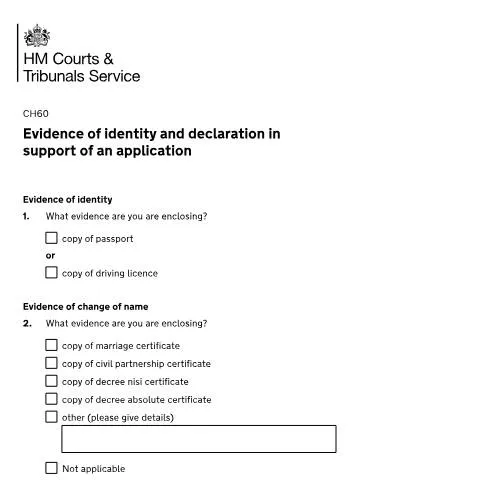
Your primary identity evidence must be either a copy of passport or a copy of driving licence. The form provides no alternative options, making these documents mandatory rather than preferred. This rigid requirement reflects the court's need for government-issued identification that includes both photographic evidence and official verification of your legal name.
Driving licences must be current UK photocard licences; the old paper counterparts discontinued in 2015 will not suffice. For passport copies, ensure all relevant pages are included, particularly those showing your photograph, personal details, and any official amendments or endorsements.
Name Change Verification
If your current legal name differs from that associated with the original court proceedings, you must provide documentary evidence of the change. The CH60 accepts several forms of evidence:
- Marriage certificate copies for name changes following marriage
- Civil partnership certificate copies for those entering civil partnerships
- Decree nisi certificate copies showing interim divorce orders
- Decree absolute certificate copies confirming final divorce orders
- Other evidence with detailed explanation required
The "other evidence" category accommodates deed polls, statutory declarations, or court orders authorising name changes outside marriage or divorce contexts. However, you must provide comprehensive details explaining the nature and legal basis of any alternative documentation.
Address Verification Requirements
Current address verification accepts only two document types: utility bills dated within the last three months, or council tax bills. The three-month currency requirement for utility bills ensures your address evidence reflects recent residence, while council tax bills typically carry longer validity periods due to their annual assessment cycle.
Acceptable utility bills include gas, electricity, water, or landline telephone statements. Mobile phone bills, internet service statements, or subscription services generally fall outside the utility definition for court purposes.
The Declaration's Legal Weight: Understanding Contempt Consequences
The CH60's declaration section carries significant legal implications that extend far beyond simple form completion. By signing this declaration, you place yourself under potential contempt of court liability, making false statements a criminal offence punishable by imprisonment.
Scope of Your Declaration
Your declaration confirms that "no one else (including any surviving shareholders) has any claim to the money or any part of it" and that you "know of no other pending applications." This sweeping statement requires careful consideration of all potential claimants, including:
- Other beneficiaries under wills or intestacy rules
- Surviving spouses or civil partners with potential claims
- Business partners or company shareholders
- Creditors with outstanding judgments
- Legal representatives acting for other parties
The reference to "surviving shareholders" particularly applies to money held from dissolved company proceedings, where former shareholders might retain entitlements despite the company's demise.
Consequences of Misleading the Court
The form explicitly warns that misleading the court triggers two potential consequences: contempt of court proceedings against you personally, and civil liability to return money plus potential damages to rightful claimants. Contempt proceedings can result in substantial fines or imprisonment, while civil liability may exceed the original sum claimed if legal costs and interest accumulate.
| Consequence Type | Potential Outcomes | Initiated By |
|---|---|---|
| Contempt of Court | Fine, imprisonment, costs order | Court's own motion |
| Civil Liability | Money repayment, damages, legal costs | Rightful claimant |
| Criminal Prosecution | Fine, imprisonment, criminal record | Crown Prosecution Service |
Banking Details: Ensuring Successful Payment Transfer
The CH60's banking section requires comprehensive account details to facilitate direct payment transfer once your application succeeds. Incomplete or incorrect banking information represents the most common cause of payment delays, even after successful identity verification.
Essential Banking Information
You must provide complete banking details including bank name, full branch address with postcode, account holder name exactly as it appears on your account, six-digit sort code, and eight-digit account number. The sort code format requires careful attention: write "010203" rather than "01-02-03" to ensure electronic processing compatibility.
Account holder names must match your proven identity exactly. If your account remains in a previous name following marriage or other name changes, you must either update your banking details before submitting the CH60 or provide additional documentation explaining the discrepancy.
International Payment Considerations
For international payments, including those to Republic of Ireland and Channel Islands accounts, you must provide IBAN and SWIFT/BIC codes alongside standard UK banking details. This requirement reflects the court's ability to transfer funds globally, but international transfers often incur additional fees and extended processing times.
Channel Islands and Isle of Man accounts, while geographically close, require international payment protocols due to their distinct banking jurisdictions outside the UK clearing system.
Submission Pathways: Digital Filing Versus Traditional Post
The CH60 application process offers two distinct submission routes, each carrying different advantages and requirements depending on your representation status and technical capabilities.
E-Filing for Legal Representatives and Commercial Firms
Legal representatives and professional beneficiary tracing firms must use the HMCTS E-Filing service for all CH60 submissions. This mandatory requirement streamlines processing for high-volume users while ensuring secure document transmission and automatic fee payment processing.
The E-Filing system accepts the standard £61 application fee through various electronic payment methods, providing immediate confirmation of successful submission and fee payment. Professional users benefit from case tracking capabilities and direct communication channels with court staff.
Flexible Options for Personal Applicants
Individuals representing themselves enjoy greater flexibility in submission methods. While the E-Filing service remains available and offers the quickest processing route, personal applicants may alternatively submit applications by post to:
The Business & Property Courts of England & Wales HMCTS (Chancery Division, Miscellaneous Payments Team) 7 The Rolls Building Fetter Lane London EC4A 1NL
Postal submissions require payment by postal order, banker's draft, or cheque made payable to 'HM Courts & Tribunals Service'. Cash payments cannot be accepted due to security and audit trail requirements.
Fee Structure and Financial Considerations
The £61 application fee applies per individual CH60 submission, regardless of the money amount sought or the complexity of your claim. This non-refundable fee structure means unsuccessful applications result in total loss of the fee, while successful applications may still yield less than the fee cost if the court-held sum proves smaller than anticipated.
Cost-Benefit Analysis
Before submitting your CH60, carefully consider whether the potential recovery justifies the £61 fee plus any additional costs for obtaining required documentation. Court records may indicate approximate sums held, but exact amounts often remain uncertain until full verification occurs.
Additional costs might include:
- Certificate copies from registry offices (£11-£35 each)
- Passport or driving licence replacement fees if originals are unavailable
- Solicitor fees if professional assistance becomes necessary
- International transfer charges for overseas accounts
Multiple Application Scenarios
If court records suggest money held under several different case references or name variations, separate CH60 applications may be required for each distinct claim. The £61 fee multiplies accordingly, making comprehensive preliminary research essential before proceeding.
Processing Timeline and Follow-Up Procedures
CH60 applications enter a verification process managed by the Chancery Division's Miscellaneous Payments Team, where processing times vary significantly based on application complexity and the clarity of supporting evidence provided.
Standard Processing Expectations
Straightforward applications with complete documentation typically process within 6-8 weeks from receipt, while complex cases involving name changes, international addresses, or disputed entitlements may require 12-16 weeks or longer. The court provides no guaranteed processing timeframes due to the individual verification requirements each case demands.
During processing, court staff may request additional documentation or clarification. Prompt response to such requests prevents unnecessary delays and demonstrates your commitment to providing accurate information.
Tracking Your Application Progress
E-filed applications benefit from online tracking capabilities through the HMCTS portal, while postal submissions require telephone or written enquiries to the Miscellaneous Payments Team. When making enquiries, reference your application date, full name as submitted, and any reference numbers provided in acknowledgment correspondence.
Avoid premature enquiries; allow at least eight weeks from submission before requesting status updates unless urgent circumstances apply or the court has specifically requested additional information.
When Applications Face Rejection: Understanding Refusal Grounds
CH60 applications face rejection for various reasons, from insufficient identity evidence to competing claims that emerge during verification. Understanding common refusal grounds helps you address deficiencies before resubmission or appeals.
Documentation Deficiencies
The most frequent rejection reasons involve inadequate or unclear supporting documentation. Illegible photocopies, expired identification documents, or utility bills exceeding the three-month currency requirement trigger automatic refusal without detailed review of your underlying entitlement.
Name change documentation must clearly link your current identity to the name under which money was originally held. Gaps in the documentary chain, such as missing intermediate name changes through multiple marriages, require additional certificates to establish the complete connection.
Competing Claims and Legal Disputes
More complex rejections arise when court records reveal competing claims or ongoing legal disputes affecting the money's ownership. These situations may require formal legal proceedings to resolve entitlement questions before any CH60 application can succeed.
If your application reveals previously unknown competing claimants, the court may require all potential beneficiaries to submit evidence and potentially attend hearings to determine rightful entitlement. Such proceedings extend resolution timeframes considerably and may require legal representation.
The CH60 form represents just one component of a broader framework for recovering court-held money, where success depends on meticulous preparation, honest declaration, and patience throughout the verification process. Your commitment to providing complete and accurate information ultimately determines whether dormant court funds return to your possession or remain indefinitely held pending further clarification.
Understanding the Legal Framework Behind CH60 Claims
The CH60 form operates within a complex legal framework that governs how civil courts handle unclaimed funds. Under the Court Funds Rules 2009, when money is paid into court but remains unclaimed for extended periods, specific procedures must be followed to ensure rightful claimants can recover their funds whilst protecting against fraudulent claims.
The legal basis for these procedures stems from the Administration of Justice Act 1982 and subsequent amendments, which established the Court Funds Office as the central repository for court-held funds. When you submit a CH60 form, you're essentially invoking statutory rights under these provisions, which require the court to verify your identity and entitlement before releasing funds.
Different types of court proceedings generate different categories of held funds, each with distinct legal implications. Money arising from personal injury settlements, for instance, may be subject to additional safeguards under the Damages Act 1996, particularly where protected parties (children or those lacking mental capacity) are involved. Commercial dispute settlements might involve funds held pending appeal periods or compliance with specific court orders.
The Data Protection Act 2018 and UK GDPR significantly impact how courts process CH60 forms, as they must balance transparency in fund recovery with privacy protection. Courts maintain detailed records of all transactions but must ensure that sensitive personal information is only disclosed to verified claimants. This creates additional verification layers that can extend processing times but provide crucial protection against identity theft.
Scottish and Northern Irish courts operate under slightly different statutory frameworks, though they generally recognise CH60 claims from English and Welsh courts. However, if your funds originated from proceedings in Scotland (governed by the Sheriff Courts (Scotland) Act 1971) or Northern Ireland (under the Judicature (Northern Ireland) Act 1978), you may need to follow jurisdiction-specific procedures or provide additional documentation.
The Limitation Act 1980 doesn't typically apply to court-held funds, meaning there's generally no time limit for claiming money held by civil courts. However, practical considerations such as record retention policies and the availability of supporting documentation may affect older claims. Courts typically maintain comprehensive records, but accessing detailed information about funds held for decades may require additional administrative steps.
Special Circumstances and Complex Claim Scenarios
Certain situations require modified approaches to CH60 submissions, reflecting the diverse nature of civil court proceedings and the varied circumstances under which funds may be held. Understanding these special circumstances can significantly impact your claim's success and processing speed.
When claiming funds on behalf of deceased individuals, the CH60 process intersects with probate law requirements. Executors or administrators must provide grant of probate or letters of administration alongside their CH60 form. Where the deceased's estate is small and no grant has been obtained, courts may accept alternative evidence such as a statutory declaration of next of kin, but this varies depending on the fund amount and court discretion. Beneficiaries claiming inherited funds must demonstrate both their relationship to the deceased and the legal basis for their entitlement.
Corporate claimants face particular challenges when companies have undergone structural changes since the original court proceedings. If your company has changed names, merged with another entity, or been acquired, you'll need to provide a complete corporate history through Companies House records. Dissolved companies present the most complex scenario – typically requiring restoration to the register before funds can be released, involving additional procedures under the Companies Act 2006.
Trust-related claims require careful documentation of trust deeds and trustee appointments. Where original trustees are no longer available or have died, successor trustees must provide evidence of their lawful appointment. Court-appointed trustees in particular must demonstrate their continued authority, as some appointments may have specific time limits or conditions that affect their ability to claim funds.
International claimants encounter additional verification requirements, particularly regarding identity documentation. Foreign identity documents must often be apostilled under the Hague Convention or undergo equivalent authentication processes. Translation requirements apply to non-English documents, and translations must typically be certified by qualified translators or embassy officials. Processing times for international claims are invariably longer due to these additional verification steps.
Claims involving protected parties (individuals lacking mental capacity) require court approval even for fund recovery. Deputies appointed under the Mental Capacity Act 2005 must demonstrate their ongoing authority and may need to seek specific court orders authorising fund recovery. This process can extend claim timescales significantly but ensures appropriate protection for vulnerable individuals.
Multiple claimant scenarios arise when several parties have potential entitlement to the same funds. Courts may require all potential claimants to be notified before releasing funds, or may hold funds pending resolution of competing claims. In some cases, courts may order funds to be paid into a separate account pending determination of rightful entitlement through additional legal proceedings.
Practical Strategies for Expediting Your CH60 Claim
While court processes necessarily involve careful verification procedures, understanding practical strategies can help ensure your CH60 claim progresses as smoothly and quickly as possible. These approaches focus on preparation, documentation quality, and proactive communication with court staff.
Document preparation represents the single most critical factor in claim processing speed. Beyond the basic requirements, consider providing supplementary evidence that anticipates potential queries. For identity verification, include multiple forms of identification even if only one is strictly required. Utility bills, bank statements, and council tax documents from different periods can help establish continuous identity, particularly useful if there have been name changes or address moves since the original proceedings.
When dealing with older claims, proactive research can prevent delays. Contact the original solicitors involved in the case, even if the firm has since merged or closed – successor firms often retain historic files. Court hearing records, available through the court's administrative offices, can provide crucial details about why funds were originally paid in. Local newspaper archives sometimes contain reports of significant cases that can help establish the context and parties involved.
For complex claims involving multiple parties or jurisdictions, consider engaging with the Court Funds Office before submitting your CH60 form. While they cannot provide legal advice, administrative staff can often clarify procedural requirements and highlight potential complications early in the process. This preliminary contact can identify additional documentation needs or procedural steps that might otherwise cause delays.
Timing your submission strategically can also impact processing speed. Court administrative offices typically experience increased workloads at certain times of year, particularly around the end of the financial year (March) and following major court holidays. Submitting during quieter periods, such as late spring or early autumn, may result in faster processing, though this should never delay legitimate claims unnecessarily.
Maintaining detailed records throughout the process proves invaluable, particularly for complex claims that may require multiple submissions or additional evidence. Create a comprehensive file including copies of all correspondence, submission receipts, and any verbal communications with court staff (noting dates, times, and staff names). This documentation becomes crucial if queries arise or if you need to escalate concerns about processing delays.
Understanding the internal court processes can help set realistic expectations and identify appropriate contact points. The Court Funds Office operates with specific procedures for different claim types, and knowing whether your claim falls into standard or exceptional categories helps predict likely timescales. Standard claims with complete documentation typically process within 6-8 weeks, while complex cases involving multiple verification steps may take several months.
Consider the impact of concurrent legal proceedings on your claim. If related litigation is ongoing, courts may defer fund release pending resolution of those proceedings. In such cases, providing updates on the status of related cases can help demonstrate that obstacles to fund release have been resolved. Similarly, if you're aware of potential competing claims, addressing these proactively in your initial submission can prevent later complications.
For high-value claims or those involving significant complexity, engaging specialist legal assistance may prove cost-effective despite the additional expense. Solicitors experienced in court fund recovery understand the intricacies of the process and can often anticipate and address potential complications before they cause delays. They also have established relationships with court administrative staff that can facilitate communication and problem-resolution.