When a Landlord's Forfeiture Notice Threatens Your Tenancy
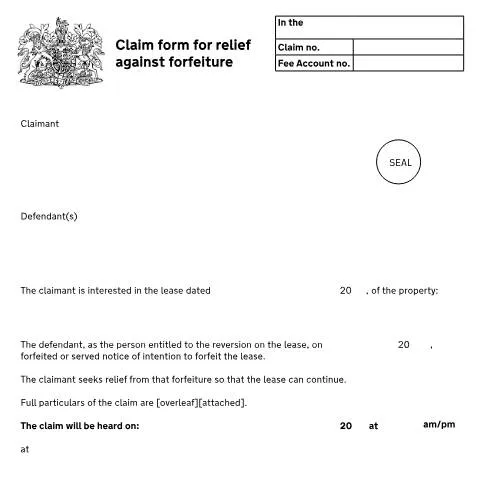
The moment a landlord serves notice of forfeiture or takes action to terminate a lease, tenants and other parties with interests in the property face an urgent legal challenge. Form N5A represents a crucial lifeline in English property law – it's the formal mechanism through which affected parties can petition the court to restore a forfeited lease and prevent the devastating loss of their tenancy rights.
This specialised claim form operates within a narrow but critical window of opportunity. Unlike standard possession proceedings, forfeiture represents an immediate threat to a lease's continuation, often triggered by rent arrears or breach of covenant. The N5A form acknowledges that forfeiture can sometimes be disproportionate or that circumstances justify the lease's restoration, particularly where third parties hold legitimate interests in the property.
The form's significance extends beyond simple tenant protection. Subtenants, mortgagees, and other parties with derivative interests may find their rights extinguished by a head lease forfeiture, making the N5A their essential tool for legal survival in complex property arrangements.
Understanding the Legal Framework Behind Relief Applications
Relief against forfeiture operates under both common law and statutory provisions, creating a sophisticated legal framework that the N5A form must navigate. The Law of Property Act 1925 and subsequent housing legislation establish the court's discretion to grant relief where forfeiture would be unconscionable or where parties can remedy their breaches.
The court's approach varies significantly depending on whether the forfeiture stems from rent arrears or other covenant breaches. For rent arrears, relief is often more readily available, provided the claimant can demonstrate their ability to pay outstanding amounts and future rent. However, breaches of other covenants require more nuanced consideration, with courts examining factors such as the breach's severity, any prejudice to the landlord, and the claimant's conduct.
Time limits present another crucial dimension. While there's no absolute statutory deadline for seeking relief, delay can prove fatal to applications. Courts expect claimants to act promptly upon discovering the forfeiture, with particular urgency required where the landlord has re-let the property or granted new interests to third parties.
Statutory Protections for Different Property Types
The relief framework operates differently across various tenancy types:
- Commercial leases: Governed primarily by common law principles with court discretion paramount
- Residential tenancies: Additional statutory protections under housing legislation may apply
- Long leases: Special considerations for leaseholders with substantial investments in property improvements
- Agricultural holdings: Specific statutory frameworks that may override general forfeiture rules
Identifying Parties Entitled to Seek Relief
The N5A form serves a broader constituency than many assume. While the original tenant holds the most obvious claim to relief, the form's utility extends to various parties whose interests derive from the forfeited lease. Understanding these categories proves essential for determining standing and crafting appropriate relief applications.
Original tenants retain rights to seek relief even after assignment, provided they remain liable under the original lease terms. This continuing liability, while potentially burdensome, preserves their standing to apply for relief where current occupiers fail to act or lack the resources to pursue proceedings.
Assignees and current tenants hold primary responsibility for maintaining lease compliance, making them natural candidates for relief applications. However, their success often depends on demonstrating both the ability to remedy breaches and maintain future compliance with lease obligations.
Third Party Interests and Derivative Rights
The most complex applications often involve parties whose interests derive from the original lease:
| Party Type | Interest Protected | Key Considerations |
|---|---|---|
| Subtenants | Sublease continuation | Must demonstrate independent breach was not their fault |
| Mortgagees | Security interest in lease | Financial capacity to remedy breaches and manage ongoing obligations |
| Guarantors | Limitation of ongoing liability | Relief may prevent extended guarantee obligations |
| Beneficial owners | Equitable interests in property | Must establish sufficient interest to justify court intervention |
Each category faces distinct challenges in establishing their entitlement to relief and demonstrating their capacity to ensure future lease compliance.
Navigating the Form's Technical Requirements
The N5A's structure reflects its specialised purpose, requiring specific information that differs markedly from standard claim forms. The form's opening section demands precise details about the original lease, including its date, parties, and the property's full description. This information establishes the court's jurisdiction and the legal foundation for relief proceedings.
Describing the forfeiture action requires careful attention to chronology and legal terminology. Claimants must specify whether the defendant actually forfeited the lease through re-entry or merely served notice of intention to forfeit. This distinction carries significant legal implications, as actual forfeiture creates more urgent timescales and may limit available relief options.
The "particulars of claim" section, whether completed on the form's reverse or in attached documents, represents the application's substantive heart. Here, claimants must articulate their legal basis for relief, demonstrate their interest in the lease's continuation, and address any breaches that triggered the forfeiture proceedings.
Crafting Effective Particulars of Claim
Successful particulars typically address several key elements systematically:
- Legal standing: Establishing the claimant's right to seek relief
- Breach acknowledgment: Honest assessment of any covenant breaches
- Remedial action: Steps taken or proposed to address breaches
- Prejudice analysis: Demonstrating that continued forfeiture would be disproportionate
- Future compliance: Evidence of capacity to maintain lease obligations
The statement of truth requirement demands particular attention, as false statements can result in contempt proceedings. Claimants must ensure all factual assertions can be substantiated through documentary evidence or witness testimony.
Strategic Considerations in Relief Applications
Timing represents perhaps the most critical strategic element in relief applications. Courts expect claimants to act with utmost promptness upon discovering forfeiture proceedings, and delay can prove fatal even to otherwise meritorious applications. The form's effectiveness often depends more on when it's filed than on its technical perfection.
The relationship between relief applications and the underlying dispute requires careful navigation. Where forfeiture stems from rent arrears, claimants typically must demonstrate their ability to pay both outstanding amounts and future rent. However, merely offering payment may not suffice if the court questions the claimant's long-term viability as a tenant.
For breaches of other covenants, the strategic focus shifts toward demonstrating that the breach can be remedied and that continued forfeiture would be disproportionate to any harm suffered by the landlord. This often requires detailed evidence about the breach's nature, its impact on the property or other tenants, and the claimant's efforts to address the underlying issues.
Coordinating with Parallel Proceedings
Relief applications frequently coincide with other legal proceedings, creating complex procedural challenges:
- Possession claims: Landlords may pursue both forfeiture and possession simultaneously
- Debt recovery: Outstanding rent arrears may be subject to separate collection proceedings
- Injunctive relief: Urgent applications to prevent landlord re-entry during proceedings
- Third party claims: Multiple parties may seek relief with potentially conflicting interests
Court Procedures and Hearing Preparation
Once filed, the N5A triggers specific court procedures that differ from standard civil litigation. The court will typically list the matter for an early hearing, recognising the urgent nature of forfeiture disputes and their potential impact on property rights. This expedited timeline demands careful preparation and prompt action from all parties.
Service requirements follow standard Civil Procedure Rules, but the urgency of forfeiture proceedings may justify applications for alternative service methods where defendants prove difficult to locate. The defendant landlord must receive proper notice of the relief application, as they hold the right to oppose relief and present evidence about the claimant's suitability for continued tenancy.
Evidence preparation requires particular attention to financial capacity and future compliance prospects. Courts scrutinise claimants' ability to maintain lease obligations, often requiring detailed financial disclosure and business plans for commercial tenancies. Residential cases may involve less extensive financial evidence but still require demonstration of the claimant's capacity to maintain rent payments and property care.
Common Hearing Outcomes and Conditional Relief
Courts possess broad discretion in relief applications, leading to varied outcomes tailored to specific circumstances. Unconditional relief, while possible, remains relatively rare. More commonly, courts impose conditions designed to address the underlying breach and protect the landlord's interests.
Typical conditions might include:
- Payment of outstanding rent and legal costs within specified timeframes
- Provision of security deposits or guarantees for future compliance
- Agreement to modified lease terms addressing the breach's underlying causes
- Regular reporting requirements to demonstrate ongoing compliance
Financial Implications and Cost Management
Relief applications carry significant financial implications beyond the basic court fee. Successful claimants typically face liability for the landlord's legal costs in addition to their own expenses, making cost-benefit analysis crucial in marginal cases. The form itself indicates spaces for legal representative costs, highlighting the expectation that professional assistance will often be necessary.
The cost structure creates particular challenges for residential tenants and small businesses, who may lack resources for extensive legal proceedings. However, the alternative – losing valuable property rights through forfeiture – often justifies significant legal expenditure. Courts may consider proportionality when making cost orders, particularly where landlord conduct has been unreasonable.
Financial planning must extend beyond immediate legal costs to encompass the ongoing obligations that relief will restore. Courts assess claimants' capacity to meet future rent payments and maintain property standards, making realistic financial projections essential to successful applications.
Security Requirements and Guarantee Provisions
Many successful relief applications result in enhanced security requirements, reflecting the court's concern about future compliance. These may include:
| Security Type | Typical Application | Duration |
|---|---|---|
| Rent deposits | Chronic rent arrears cases | Often permanent lease modification |
| Personal guarantees | Corporate tenant reliability concerns | Usually for remaining lease term |
| Bank guarantees | High-value commercial properties | Renewable periods with regular review |
| Property improvements | Maintenance breach cases | Specific completion deadlines |
Long-term Consequences of Successful Relief
Obtaining relief against forfeiture represents more than temporary reprieve – it fundamentally alters the ongoing landlord-tenant relationship and may have lasting implications for property management and lease administration. The relief process often results in modified lease terms that address the underlying issues that led to forfeiture proceedings.
Future landlord-tenant relations typically operate under heightened scrutiny following relief proceedings. Landlords may adopt more rigorous monitoring procedures, while tenants face reduced tolerance for future breaches. This dynamic can create either improved property management through increased accountability or ongoing tension that undermines the tenancy's long-term viability.
The relief precedent also affects the property's broader legal landscape. Future assignments or sublettings may require disclosure of the forfeiture history, potentially affecting the lease's marketability and the tenant's negotiating position in rent reviews or lease renewals.
For properties with multiple interests, successful relief can restore complex legal relationships between head tenants, subtenants, and other parties. However, the disruption caused by forfeiture proceedings may have lasting effects on these relationships, requiring ongoing management and potential further legal clarification of respective rights and obligations.
Understanding the Legal Framework Behind Form N5A Relief Applications
Form N5A operates within a complex legal framework that balances the rights of landlords to enforce lease terms against tenants' legitimate expectations of proportionate remedies. The statutory foundation for relief against forfeiture stems from the Law of Property Act 1925, specifically sections 146 and 147, which establish the court's discretionary powers to grant relief in cases of non-payment of rent or breach of other lease covenants.
The court's jurisdiction extends beyond simple rent arrears cases. Under section 146 of the Law of Property Act 1925, relief may be granted for breaches of other lease conditions, provided the landlord has served the requisite notice under section 146 and the tenant can demonstrate they have remedied the breach or are willing to do so. This creates a two-tier system where different procedural requirements apply depending on whether the forfeiture relates to rent or other covenant breaches.
For residential properties, additional protections exist under the Protection from Eviction Act 1977, which requires landlords to obtain a court order before re-entering premises. This statutory overlay means that Form N5A applications in residential contexts often involve more complex considerations around the tenant's right to remain in occupation and the proportionality of forfeiture as a remedy.
The Housing Act 1988 introduces further nuances for assured and assured shorthold tenancies, where the court must consider whether it is reasonable to make a possession order. This reasonableness test creates an additional hurdle that Form N5A applicants must navigate, particularly where the breach relates to rent arrears that may be covered by Housing Benefit or Universal Credit delays.
Fill in your form directly online
No printing: type your details into the boxes of the official form, tick, then download the PDF ready to send.
- 1Type into the form boxes
- 2Tick in one click
- 3Save and download the PDF
Recent case law has refined the application of these statutory provisions. The Court of Appeal's decision in Pineport Ltd v Grangeglen Ltd established that the court's discretion to grant relief is not limited by the landlord's motives for forfeiture, but must consider all relevant circumstances including the conduct of both parties and the consequences of forfeiture for each side.
For commercial leases, the Landlord and Tenant Act 1927 provides additional grounds for relief where the breach relates to repair obligations or user covenants. The Act allows courts to consider whether the landlord would be adequately compensated by damages rather than forfeiture, creating scope for Form N5A applications even where breaches are admitted.
Strategic Considerations for Different Property Types and Lease Structures
The approach to Form N5A applications varies significantly depending on the type of property and lease arrangement involved. Residential tenancies benefit from enhanced procedural protections, with courts generally more willing to grant relief where tenants can demonstrate genuine hardship or where the breach results from circumstances beyond their control.
For assured shorthold tenancies, the interaction between Form N5A relief and the landlord's right to serve notice under section 21 of the Housing Act 1988 creates particular tactical considerations. While relief against forfeiture may be granted, landlords retain the ability to serve no-fault notices, potentially limiting the long-term benefit of successful relief applications.
Social housing tenancies present unique challenges, as housing associations and local authorities must balance their duties as social landlords against their obligations to manage housing stock effectively. Courts often take a more interventionist approach in these cases, particularly where vulnerable tenants are involved or where the breach relates to benefit payment delays.
In the commercial sector, retail leases with turnover rents or percentage rent provisions require careful analysis of whether alleged breaches of trading obligations justify forfeiture. Form N5A applications in these contexts often involve detailed financial evidence about trading performance and market conditions that may have contributed to covenant breaches.
Industrial and warehouse leases frequently involve environmental compliance issues, where breaches may relate to waste disposal, emissions, or health and safety requirements. Relief applications must address not only the tenant's ability to remedy past breaches but also their capacity to maintain ongoing compliance with regulatory requirements.
For office leases, particularly in the post-pandemic era, disputes often centre on rent payment difficulties arising from changed working patterns and reduced space requirements. Form N5A applications may need to address fundamental questions about lease viability and the commercial relationship between the parties.
Mixed-use developments create additional complexity where forfeiture of one unit may affect the landlord's obligations to other tenants or the overall development strategy. Courts will consider these wider implications when determining whether relief should be granted and on what terms.
Leases with personal guarantees introduce another layer of complexity, as guarantors may have independent rights to seek relief or may be joined as parties to the proceedings. The financial position of guarantors and their willingness to support ongoing compliance often influences the court's decision on relief applications.
Post-Application Procedures and Enforcement Mechanisms
Once Form N5A has been submitted and the court process initiated, several procedural pathways may develop depending on the landlord's response and the complexity of the underlying dispute. Immediate applications for interim relief may be necessary where the landlord has already re-entered the premises or is threatening to do so before the main hearing.
The court's case management powers under the Civil Procedure Rules allow for various directions to be made, including orders for the tenant to pay rent into court as a condition of maintaining their application. These interim payment orders serve multiple purposes: they demonstrate the tenant's commitment to meeting ongoing obligations while providing some protection for the landlord's rental income during the relief proceedings.
Expert evidence may be required in complex cases, particularly where the dispute involves technical breaches such as building regulation compliance or environmental issues. The court may direct joint expert instruction to avoid duplication of costs and ensure objective assessment of technical matters.
Where relief is granted, the court's order will typically specify conditions that must be met to maintain the tenancy. These may include payment of arrears by instalments, compliance with specific lease covenants, or implementation of management procedures to prevent future breaches. Failure to comply with court-ordered conditions may result in the relief being set aside, potentially without further opportunity for the tenant to seek additional relief.
The enforcement of relief orders requires careful monitoring by both parties. Landlords retain the right to apply for possession if conditions are breached, while tenants may need to return to court if circumstances change or if they require variations to the relief conditions.
In cases where relief is refused, tenants face immediate consequences including loss of possession and potential liability for the landlord's costs. However, appeal rights exist to the Court of Appeal, though permission is required and must be sought promptly. The grounds for appeal are limited to errors of law or procedure, as the court's discretionary decision on relief is rarely overturned on appeal.
Costs implications represent a significant consideration in Form N5A proceedings. The general rule that costs follow the event means unsuccessful applicants may face substantial liability for the landlord's legal costs in addition to losing their tenancy. However, courts have discretion to make different costs orders where the circumstances justify departure from the general rule.
For tenants who successfully obtain relief, the question of costs recovery depends on various factors including the reasons for the original breach and the conduct of both parties during the proceedings. Where forfeiture proceedings were commenced unreasonably or without proper notice, tenants may recover their costs even if relief is granted on terms that require some payment to the landlord.