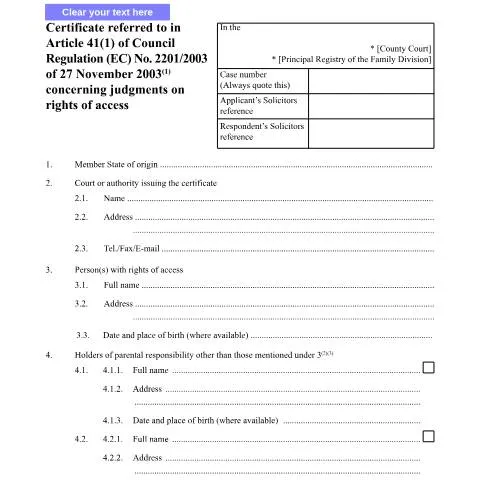
Understanding the Certificate Referred to in Article 41(1) of Council Regulation (EC) No. 2201/2003
The Certificate referred to in Article 41(1) of Council Regulation (EC) No. 2201/2003 is an official document used within the context of cross-border family law matters, specifically concerning judgments on rights of access. This regulation, commonly known as the Brussels IIa Regulation, aims to facilitate cooperation and the recognition of judicial decisions related to parental responsibility and access rights across European Union member states. Despite the UK's departure from the EU, certain transitional provisions and ongoing legal processes continue to reference this regulation, particularly in relation to ongoing cases or specific legal instruments issued prior to Brexit.
Purpose and Scope of the Certificate
The primary purpose of this certificate is to provide a formal, standardized record that confirms the existence, content, and enforceability of a judgment concerning rights of access to children. It serves as an official attestation that a court decision made in one member state is recognized and can be enforced in another. This certificate is particularly relevant in cases where parental rights or custody arrangements are contested, and legal clarity is needed for enforcement purposes across different jurisdictions.
This document is issued by the court or authority that delivered the judgment, typically a County Court or the Family Division of the High Court in the UK. It contains essential details about the case, the parties involved, and the judicial decision, ensuring that all relevant information is clearly documented for legal proceedings or enforcement actions.
Key Components of the Certificate
The certificate includes several critical sections:
- Member State of origin: The country where the original judgment was made.
- Issuing Court or Authority: Details of the court that issued the certificate, including name, address, and contact information.
- Parties involved: Names, addresses, and birth details of persons with rights of access and other relevant individuals holding parental responsibility.
- Judgment details: Information about the court that delivered the judgment, including date, reference number, and the children involved.
- Enforceability: Whether the judgment is recognized and enforceable in the Member State of origin.
- Additional legal considerations: Notes on service, opportunity to be heard, and other procedural aspects relevant to enforcement and recognition.
Legal and Practical Significance for Users
For legal practitioners, family law professionals, and individuals involved in cross-border parental disputes, this certificate provides a clear, legally recognized record of a child's access rights judgment. It streamlines the process of enforcement and recognition across jurisdictions, reducing delays and uncertainties that can arise in international legal proceedings.
Importantly, the certificate ensures that all parties are aware of the existence and content of the judgment, and confirms its enforceability, which is essential for safeguarding children's rights and parental responsibilities in a transnational context.
Procedural Aspects and Usage
The process of obtaining this certificate involves the court or authority that issued the original judgment. It typically requires a formal application, which may be initiated by any party interested in enforcing or acknowledging the judgment's provisions. The certificate must then be issued in accordance with the legal standards specified by the regulation and relevant UK law.
Once issued, the certificate can be used as an official document in legal proceedings or enforcement actions in other member states or jurisdictions that recognize the regulation's provisions. It provides a standardized format that facilitates international cooperation in family law matters.
Conclusion
The Certificate referred to in Article 41(1) of Council Regulation (EC) No. 2201/2003 is a vital legal instrument designed to promote clarity, recognition, and enforcement of parental access rights judgments across borders. While its use is rooted in EU law, its principles continue to influence international family law practices, ensuring that children's rights and parental responsibilities are upheld consistently in a global context.