Understanding the COP1B Form for Personal Welfare Decisions in the UK
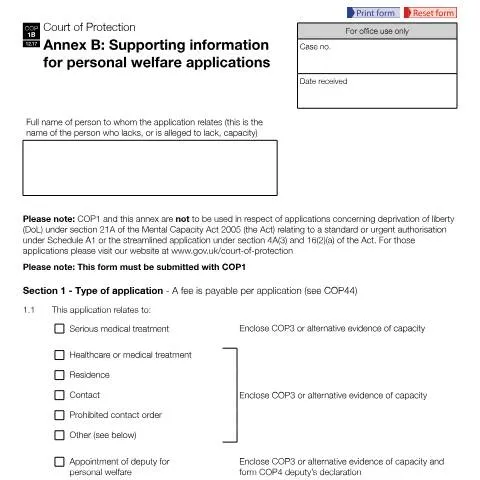
The Application to Make Personal Welfare Decisions on Someone's Behalf using the Form COP1B is an official process managed by the HM Courts & Tribunals Service (HMCTS) in England and Wales. This form is essential for individuals or organisations seeking legal authority to make decisions related to the personal welfare of someone who lacks, or is alleged to lack, mental capacity. This guide provides an overview of the purpose, scope, and key considerations involved in submitting a COP1B application.
Scope and Purpose of the COP1B Form
The COP1B form is designed for applications related to personal welfare matters, such as healthcare, medical treatment, residence, or contact arrangements. It is used primarily to request the Court of Protection to appoint a deputy, granting legal authority to make decisions on behalf of a person who cannot do so themselves due to mental incapacity. Notably, this form does not apply to applications concerning deprivation of liberty under section 21A of the Mental Capacity Act 2005; such applications require a different process and are not covered by COP1B.
The form is part of the legal framework established under the Mental Capacity Act 2005, which aims to protect individuals who lack the capacity to make certain decisions. It ensures that decisions affecting their welfare are made in their best interests, with oversight from the court system.
Who Should Complete the COP1B?
The COP1B is typically completed by:
- Family members or friends seeking to act on behalf of the individual
- Legal representatives or solicitors acting on behalf of applicants
- Local authority social workers or healthcare professionals involved in the person’s care
The applicant must demonstrate that the individual in question lacks the capacity to make specific personal welfare decisions. Supporting evidence, such as medical reports or capacity assessments, must be enclosed with the application.
Key Sections and Information Required
Type of Application
Applicants must specify the nature of their request, such as:
- Appointment of a deputy for personal welfare
- Decisions regarding healthcare or medical treatment
- Residence or contact arrangements
- Prohibited contact orders
Additional sections allow applicants to specify if the application is urgent or requires interim orders, which can expedite the process in cases of immediate risk or concern.
Applicant Details
Information about the individual submitting the application, including their full name and relationship to the person in question, is required. If there are multiple applicants, details for each must be provided.
Details of the Person to Whom the Application Relates
This section captures information about the individual lacking capacity, such as:
- Frequency of visits by the applicant and others
- Details of healthcare providers, local authorities, and social services involved
- Any advance decisions or lasting powers of attorney already in place
These details help the court assess the context and the support network surrounding the individual.
Supporting Evidence and Legal Considerations
Applicants must enclose relevant evidence to support their case, including:
- Medical reports or capacity assessments (COP3 or equivalent)
- Registered Lasting Power of Attorney documentation for health and welfare
- Any existing guardianship arrangements under the Mental Health Act 1983
The form also asks whether there are any existing legal guardianship or authority arrangements that might influence the application.
Fill in your form directly online
No printing: type your details into the boxes of the official form, tick, then download the PDF ready to send.
- 1Type into the form boxes
- 2Tick in one click
- 3Save and download the PDF
Legal Process and Next Steps
Once completed, the COP1B form must be submitted alongside the main application form, COP1. The court reviews the application to determine whether the criteria are met and whether the appointment or decision is in the best interests of the individual. The court may schedule hearings, and applicants should be prepared to attend and provide additional evidence or clarification.
In cases of urgent need, applicants can request expedited consideration and interim orders, which require specific justification and may involve additional court directions.
References and Further Guidance
For detailed guidance on completing the COP1B form, applicants should consult the official Guidance Notes on Supporting Information for Personal Welfare Applications provided by HMCTS. This ensures all necessary information is included, and the application adheres to legal requirements.
It is important to remember that this process is governed by the Mental Capacity Act 2005 and the Data Protection Act 2018, which protect the confidentiality and rights of individuals involved.