Understanding the Official Guide for Applying to Make Decisions on Someone’s Behalf as a Deputy Using Form COP1
The process of appointing a deputy to make decisions on behalf of an individual who lacks the capacity to do so themselves is a significant legal procedure governed by the Court of Protection, part of the HM Courts & Tribunals Service in the United Kingdom. This guide aims to clarify the purpose, scope, and key steps involved in submitting an application using the official form COP1, which is essential for those seeking to become a deputy for property and affairs or personal welfare.
Scope and Purpose of Form COP1
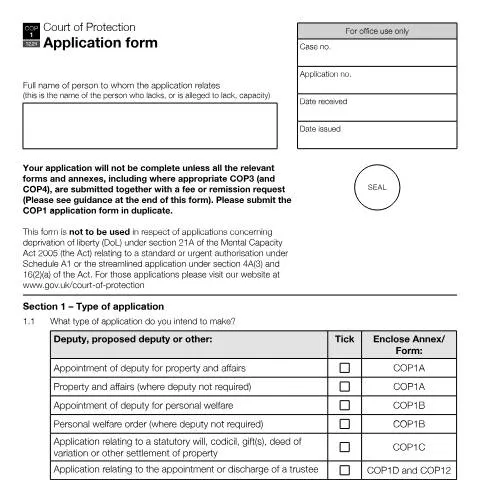
Form COP1 is the primary official document used to initiate applications for deputyship orders under the Mental Capacity Act 2005. It covers a variety of applications, including:
- Appointment of a deputy for property and affairs (using COP1A)
- Application for a deputy for personal welfare (using COP1B)
- Other related applications, such as those concerning statutory wills, trusts, or trusteeship
This form is designed to assist the Court of Protection in assessing whether the applicant should be granted authority to act on behalf of an individual who cannot manage their own affairs due to lack of mental capacity. It is not used for applications related to deprivation of liberty or urgent cases, which are subject to different procedures detailed on the official government website.
Who Should Use Form COP1?
The form is intended for individuals or organizations wishing to apply for legal authority to manage the personal or financial affairs of someone who is deemed to lack capacity. This includes:
- Family members, such as parents, siblings, or spouses
- Legal representatives or professionals acting on behalf of the individual
- Other interested parties seeking to be appointed as a deputy
Applicants must demonstrate their relationship to the person concerned and their suitability to undertake the role, ensuring that the court's decision prioritizes the best interests of the individual lacking capacity.
The Application Process and Key Sections of Form COP1
Completing the Application
Applicants are required to submit the COP1 form in duplicate along with all relevant annexes and the applicable fee or a request for remission. The form must be filled out comprehensively, covering details such as:
- The applicant’s personal details and relationship to the individual
- Details about the person to whom the application relates, including their name, address, date of birth, and current living arrangements
- The specific type of deputyship sought, whether for property and affairs or personal welfare
- Any previous court proceedings concerning the individual
Notification and Service
Part of the application process involves notifying relevant parties, including the individual concerned and other interested persons. The form includes sections to confirm who has been notified and how, ensuring transparency and compliance with legal requirements. The applicant must also specify who will receive official correspondence during the process.
Legal and Procedural Considerations
It is important to note that the application must include all necessary documentation, such as annexes and, where applicable, a fee or a request for exemption. Failure to provide complete documentation may delay the process or result in rejection.
Fill in your form directly online
No printing: type your details into the boxes of the official form, tick, then download the PDF ready to send.
- 1Type into the form boxes
- 2Tick in one click
- 3Save and download the PDF
Applicants should be aware that the Court of Protection will review the application to determine whether the proposed deputy is suitable, and whether the appointment aligns with the best interests of the individual who lacks capacity. The court may request additional information or conduct hearings if necessary.
References and Further Guidance
For detailed instructions, legal guidance, and access to the official application forms, applicants are advised to consult the official government website at www.gov.uk/court-of-protection. This resource provides comprehensive information on the procedures, legal criteria, and support available throughout the application process.
In summary, Form COP1 is a vital legal instrument for those seeking to act as deputies for individuals who cannot manage their own affairs. Proper completion and submission of this form, along with adherence to procedural requirements, are essential steps in ensuring that the rights and best interests of the individual are protected under UK law.