Understanding the Application to Recall Order in Scottish Courts and Tribunals Service
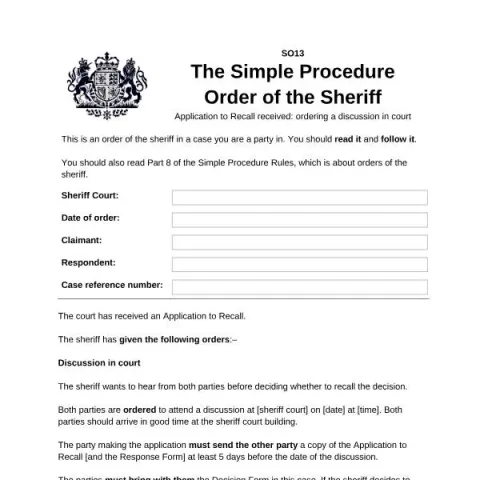
The Application to Recall received form issued by the Scottish Courts and Tribunals Service (SCTS) is a formal document used within the context of the Scottish legal system, specifically under the Simple Procedure. This procedure allows parties involved in a case to request the court to reconsider or "recall" a decision previously made by the sheriff. This article explains the purpose of this form, who should complete it, and the steps involved in the process.
Purpose and Scope of the Application to Recall Form
The primary purpose of the Application to Recall form is to formally request the sheriff to revisit a decision made in a case. This might be necessary if a party believes that the decision was made in error, based on new evidence, or if there has been a procedural mistake. The application triggers a court discussion where both parties can present their views on whether the decision should be recalled.
This form is relevant for cases within the Simple Procedure, which is designed to resolve straightforward civil disputes efficiently. The form ensures that the application is officially recorded and provides a structured way for parties to communicate their request to the court.
Who Should Complete the Application to Recall Form?
The form should be completed and submitted by the party seeking to have the court reconsider its previous decision. Typically, this could be the claimant or respondent involved in the case. The applicant must ensure that the form is filled out accurately and in accordance with the court's instructions, as incomplete or incorrect submissions may delay the process.
Additionally, the applicant is responsible for notifying the other party of the application by sending them a copy of the completed form and the Response Form at least 5 days before the scheduled court discussion. This ensures transparency and fairness in the proceedings.
Step-by-Step Procedure for Filling Out the Form
1. Identification of the Case
- Fill in the case reference number, claimant, and respondent.
- Include the date of the order and the name of the sheriff court.
2. Details of the Application
- Clearly state that this is an Application to Recall the previous decision.
- Provide reasons why the recall is being requested, referencing any new evidence or procedural issues.
3. Submission and Notification
- Sign and date the form, confirming the accuracy of the information provided.
- Ensure the other party receives a copy of the application and the Response Form at least 5 days before the court discussion.
Attending the Court Discussion
Once the application is submitted, both parties are required to attend a scheduled discussion at the sheriff court on the specified date and time. The purpose of this hearing is for the sheriff to hear from both parties regarding the application to recall the decision.
Parties should arrive promptly and bring the Decision Form related to the case. During the discussion, the sheriff will consider whether the decision should be recalled and what the next steps should be if the decision is overturned.
Important Considerations and Legal Framework
Parties should be aware that the sheriff may decide on the application even if one party is absent or unprepared. The sheriff's decision can be made based on the information presented during the discussion, and the decision must be formally recorded.
Fill in your form directly online
No printing: type your details into the boxes of the official form, tick, then download the PDF ready to send.
- 1Type into the form boxes
- 2Tick in one click
- 3Save and download the PDF
It is also important to note that the enforcement of the original decision is suspended until the sheriff makes a ruling on the application to recall.
Conclusion
The Application to Recall form is a vital procedural document within the Scottish civil justice system, allowing parties to seek reconsideration of decisions in straightforward cases. Proper completion and timely notification are essential to ensure a fair and efficient process. Parties involved should carefully prepare for the court discussion, understanding that the sheriff's decision will determine the case's next phase.