Understanding the Additional Orders Application to Recover Documents in Scottish Courts and Tribunals
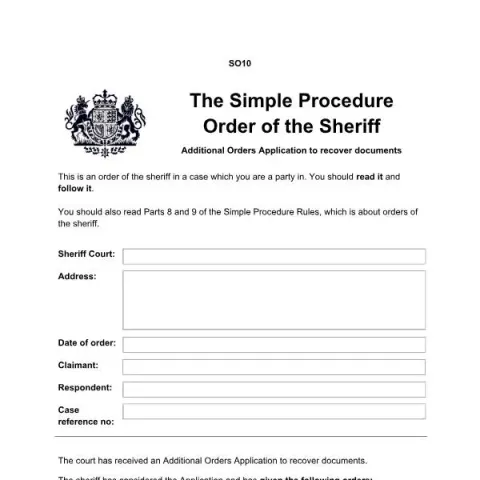
The Scottish Courts and Tribunals Service has issued a standard form known as the Order of the Sheriff for Additional Orders Application to Recover Documents. This official document is used within the context of civil proceedings under the Simple Procedure rules, primarily to facilitate the recovery of relevant documents from parties involved in a case. This article aims to clarify the purpose, eligibility, and procedures associated with this form, providing guidance for parties involved in such legal processes.
Purpose and Scope of the Form
The Additional Orders Application to Recover Documents form is designed to be used when a party (the applicant) seeks a court order to obtain specific documents from another party (the respondent) involved in a legal case. It is part of the sheriff’s authority to manage evidence and ensure that relevant documentation is accessible for the resolution of disputes. The form can be used in different scenarios, including:
- When the sheriff has decided to grant an application to recover documents without a court discussion.
- When the sheriff refuses an application to recover documents without a court hearing.
- When the sheriff considers that a discussion in court is necessary before making a decision.
Particularly, the form provides a structured way to request specific documents and to specify deadlines for their submission, ensuring clarity and efficiency in the legal process.
Eligibility and Conditions for Use
This form is applicable in civil cases managed under the Simple Procedure rules, which are designed to simplify and expedite legal proceedings in Scotland. Both the applicant and respondent must be parties to the case, with the applicant seeking to recover documents relevant to the dispute. The sheriff’s decision to grant or refuse the application depends on factors such as the relevance of the documents, the respondent’s willingness to produce them, and whether the request aligns with legal standards.
Step-by-Step Procedure for Filling Out the Form
1. Identifying the Case and Court Details
Start by filling in the sheriff court’s name and address, along with the date of the order, the names of the claimant and respondent, and the case reference number. This information ensures the order is correctly linked to the ongoing proceedings.
2. Completing the Orders Section
Depending on the sheriff’s decision, the form will include one of the following orders:
- Order to recover documents: The sheriff orders the respondent to send specified documents to the court within a set number of days after service.
- Refusal to make an order: The sheriff declines to order document recovery, indicating that the application is not granted.
- Discussion in court: The sheriff schedules a hearing to consider the application further, requiring both parties to attend.
3. Respondent’s Reply and Declaration
If an order to recover documents is granted, the respondent must complete the Reply section:
- Provide their full name and capacity (if representing a business or other entity).
- Declare how they have complied with the order—either by enclosing the relevant documents or stating that they do not possess such documents.
- Optional: Provide additional information about other relevant documents not in their possession.
- Declare whether any of the documents are confidential, and if so, how they should be handled (e.g., marking as “CONFIDENTIAL”).
Deadlines and Aftercare
The form specifies the number of days within which the respondent must send the documents to the court and return the completed reply. These deadlines are crucial to ensure the swift progression of the case. Once the documents are submitted, the court reviews the response and determines whether further action or hearings are necessary.
Fill in your form directly online
No printing: type your details into the boxes of the official form, tick, then download the PDF ready to send.
- 1Type into the form boxes
- 2Tick in one click
- 3Save and download the PDF
Important Considerations
Parties should be aware that the sheriff’s decision can be made with or without a court discussion, depending on the circumstances. If a discussion is scheduled, both parties are expected to attend and be prepared to argue their position. Failure to attend may result in the case being decided in the absence of a party.
In cases where confidentiality is claimed, the respondent must take additional steps, such as sealing the documents and marking them “CONFIDENTIAL,” before submission. The court will then decide whether the confidentiality claim is justified.
Conclusion
The Additional Orders Application to Recover Documents form is a vital procedural tool that helps parties in Scottish civil cases obtain relevant evidence efficiently. Understanding its proper use, deadlines, and the importance of accurate and complete information can facilitate a smoother legal process and ensure that justice is served effectively.