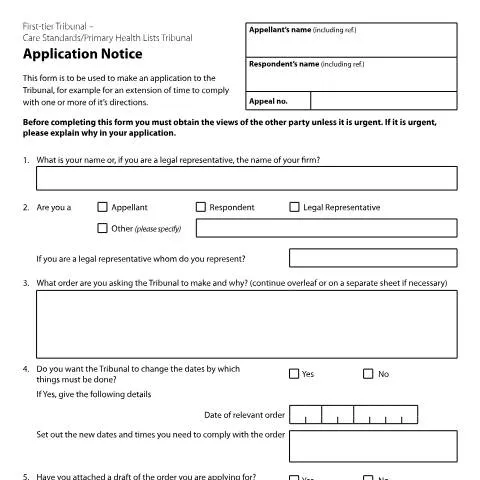
Navigating Tribunal Applications: Understanding the T109 Process
When proceedings before the Care Standards or Primary Health Lists Tribunal take an unexpected turn, practitioners and parties often find themselves needing to seek specific orders from the tribunal. The T109 Application Notice serves as the formal gateway for these requests, whether seeking extensions of time, variations to directions, or other procedural orders that can significantly impact the trajectory of a case.
This specialised application process operates within the First-tier Tribunal system, where decisions affecting care standards and primary healthcare providers are scrutinised. The stakes are invariably high—professional registrations, business licences, and regulatory compliance all hang in the balance. Understanding how to properly utilise the T109 becomes crucial when standard procedural timelines prove unworkable or when circumstances demand tribunal intervention.
The Strategic Landscape of Tribunal Applications
The T109 application notice exists within a carefully structured procedural framework where timing and precision matter enormously. Unlike general correspondence with the tribunal, this formal application triggers specific procedural requirements and potential costs implications. The document serves multiple functions: it's simultaneously a request mechanism, a case management tool, and a formal record of procedural applications.
Most commonly, practitioners encounter the need for T109 applications when facing time-critical situations. Perhaps expert evidence has been delayed, key witnesses have become unavailable, or new regulatory guidance has emerged that affects the case fundamentals. The tribunal's case management powers are extensive, but they must be formally invoked through proper application procedures.
The application process requires careful consideration of the other party's position before submission. This isn't merely procedural courtesy—it reflects the tribunal's emphasis on collaborative case management and can significantly influence the outcome. Tribunals view favourably applications that demonstrate genuine attempts at agreement between parties.
Timing Considerations and Urgency Thresholds
The T109 framework recognises that some applications cannot await the standard consultation process. Urgent applications may proceed without prior consultation with other parties, but this exception comes with heightened scrutiny. The applicant must provide compelling justification for bypassing normal consultation requirements.
Common urgent scenarios include situations where delay would render the main appeal meaningless, where regulatory deadlines create immovable constraints, or where new evidence emerges that fundamentally alters the case landscape. However, poor planning or routine scheduling conflicts rarely constitute genuine urgency in the tribunal's assessment.
Procedural Architecture: From Application to Determination
The T109 process follows a structured pathway that balances efficiency with fairness. Once submitted, applications enter the tribunal's case management system where they're assessed against established criteria. The tribunal considers factors including the merits of the underlying appeal, prejudice to other parties, the public interest implications, and the overall justice of the situation.
| Application Type | Typical Processing Time | Consultation Required | Common Outcomes |
|---|---|---|---|
| Extension of time | 5-10 working days | Yes (unless urgent) | Conditional grant with revised timetable |
| Direction variations | 7-14 working days | Yes | Modified directions or case management hearing |
| Urgent procedural orders | 24-48 hours | No | Interim order with full hearing to follow |
| Hearing date changes | Variable | Yes | Depends on tribunal availability and case urgency |
The tribunal's approach to T109 applications reflects broader case management philosophies. Proportionality remains paramount—extensive procedural applications in straightforward cases may attract adverse costs attention. Conversely, complex regulatory appeals often require sophisticated case management that the T109 process facilitates effectively.
Evidence and Supporting Documentation
Successful T109 applications typically demonstrate clear evidential foundations for the relief sought. The tribunal expects applicants to provide concrete information supporting their requests, whether through witness statements, expert reports, or documentary evidence. Vague assertions about difficulties or general requests for more time rarely succeed.
When seeking extensions of time, effective applications identify specific obstacles that have arisen, demonstrate steps taken to overcome them, and propose realistic revised timescales. The tribunal particularly values applications that show consideration for other parties' positions and the overall case timeline.
Consultation Requirements and Inter-Party Dynamics
The mandatory consultation requirement before submitting T109 applications reflects the tribunal's commitment to collaborative case management. This process often reveals areas of agreement that can streamline proceedings and identifies genuine points of dispute that require tribunal determination.
Effective consultation involves more than simply notifying other parties of intended applications. Best practice includes sharing draft applications, seeking specific feedback on proposed orders, and exploring alternative solutions that might meet everyone's needs. Many potential applications resolve themselves during this consultation phase, saving time and costs for all involved.
When other parties oppose applications, their objections must be fairly represented in the T109 submission. The tribunal expects to see genuine engagement with opposing views, not dismissive treatment of legitimate concerns. This approach often leads to more nuanced orders that address multiple parties' interests.
Managing Opposed Applications
Where consultation reveals fundamental disagreement, the T109 process provides structured mechanisms for resolution. The tribunal may determine applications on paper submissions, convene telephone hearings for brief oral argument, or incorporate application decisions into broader case management hearings.
Opposed applications require particularly careful preparation. The tribunal scrutinises both the substantive merits and the procedural history leading to the dispute. Applications that demonstrate reasonable attempts at compromise often receive more sympathetic consideration than those suggesting inflexible positioning.
Hearing Formats and Determination Methods
The T109 framework offers flexible hearing arrangements tailored to application complexity and party preferences. Paper determinations suit straightforward applications where facts aren't disputed and legal principles are clear. This approach offers speed and cost-effectiveness, particularly for routine procedural matters.
Telephone hearings provide middle-ground options where some oral argument assists tribunal understanding without requiring physical attendance. These prove particularly valuable for applications involving technical procedural points or where brief clarification resolves apparent disputes.
Full oral hearings remain available for complex applications where detailed argument and cross-examination prove necessary. However, the tribunal expects proportionality—extensive oral hearings for minor procedural applications may attract adverse costs consequences.
Time Estimation and Hearing Management
Accurate time estimation for T109 hearings demonstrates professional competence and assists tribunal scheduling. Unrealistic estimates—whether too optimistic or excessively cautious—can disrupt case management and affect other cases in the tribunal list.
When estimating hearing time, effective practitioners consider not only their own submissions but also potential tribunal questions, opposing arguments, and time required for tribunal deliberation. Agreement between parties on time estimates signals mature case management and often influences tribunal scheduling decisions favourably.
Draft Orders and Practical Implementation
The T109 process encourages submission of draft orders in Microsoft Word format, reflecting modern case management practices. Well-crafted draft orders demonstrate clear thinking about desired outcomes and assist tribunal efficiency by providing concrete starting points for consideration.
Effective draft orders specify precise timescales, identify responsible parties for each action, and address practical implementation details. Vague or aspirational drafting often leads to further applications when parties disagree about interpretation or implementation requirements.
The tribunal may adopt submitted drafts entirely, modify them to address specific concerns, or craft entirely different orders that better serve case management objectives. Understanding this flexibility helps applicants focus on substantive outcomes rather than precise wording preferences.
Costs Implications and Strategic Considerations
While T109 applications don't automatically trigger costs consequences, they form part of the overall procedural history that tribunals consider when making costs decisions. Excessive or poorly-founded applications may support costs applications by opposing parties, particularly in cases where professional parties should reasonably have anticipated procedural requirements.
Conversely, reasonable applications that facilitate effective case management often enhance applicants' positions in subsequent costs arguments. The tribunal recognises that complex regulatory appeals require sophisticated case management, and appropriate T109 applications demonstrate professional competence rather than procedural failure.
Integration with Broader Case Management
The T109 application process operates within the tribunal's broader case management framework, connecting with directions orders, case management hearings, and substantive appeal procedures. Understanding these connections proves crucial for effective utilisation of the T109 process.
Many T109 applications arise from difficulties complying with earlier tribunal directions. When seeking variations, effective applications acknowledge the original rationale for directions while demonstrating changed circumstances that justify modification. This approach shows respect for tribunal authority while advocating for necessary changes.
The statement of truth requirement emphasises the formal nature of T109 applications and the potential consequences of inaccurate or misleading submissions. This isn't merely procedural formality—it reflects the tribunal's reliance on accurate information for effective case management and the serious consequences that can flow from procedural decisions.
Successfully navigating the T109 process requires understanding both its technical requirements and its place within broader tribunal procedures. When properly utilised, it provides powerful tools for managing complex cases while maintaining procedural fairness and efficiency. The key lies in recognising when applications are genuinely necessary, preparing them thoroughly, and engaging constructively with other parties throughout the process.
Specialist Legal Representation and Advocacy Before Care Standards Tribunals
The complexity of care standards and primary health lists tribunal proceedings often necessitates specialist legal representation, particularly given the professional and regulatory implications of adverse decisions. Form T109 applications frequently involve matters where practitioners' livelihoods and professional standing are at stake, making the choice of legal representation a critical strategic decision.
Solicitors specialising in healthcare and social care law typically possess deep understanding of the regulatory frameworks governing different professional groups. For care home operators facing CQC enforcement action, legal representatives familiar with the Health and Social Care Act 2008 and associated regulations can identify procedural defects in the regulator's decision-making process. Similarly, healthcare professionals challenging NHS England decisions regarding primary care contracts benefit from solicitors experienced in NHS contractual arrangements and the complexities of medical partnership law.
Barristers with expertise in regulatory and professional discipline matters often handle the advocacy at tribunal hearings. Their role extends beyond courtroom representation to include strategic advice on evidence gathering, witness preparation, and the tactical aspects of case presentation. In cases involving clinical governance failures or safeguarding concerns, barristers may work closely with expert witnesses to present technical evidence in a manner accessible to tribunal members who, while legally qualified, may not possess specialist healthcare knowledge.
The tribunal's composition itself influences representation strategies. Care Standards Tribunal panels typically include a legally qualified chairman alongside specialist members with relevant professional backgrounds in healthcare or social care. This mixed composition requires advocates to balance legal argument with practical understanding of professional standards and operational realities within care settings.
Legal aid is not generally available for tribunal representation, meaning applicants must fund their own legal costs. However, the tribunal has discretion to award costs in exceptional circumstances, particularly where one party has acted unreasonably. This cost consideration often influences the level of representation sought, with some applicants opting for direct access barristers to reduce overall legal expenses while maintaining specialist advocacy.
Professional indemnity insurance may cover legal representation costs in certain circumstances, particularly for healthcare professionals facing regulatory challenges arising from their clinical practice. However, coverage varies significantly between policies and professional groups, making early clarification of insurance position essential when considering legal representation options.
Case Management Directions and Pre-Hearing Procedures
Following submission of Form T109 and the tribunal's acceptance of jurisdiction, the case management process commences with the tribunal issuing standard directions for the conduct of proceedings. These directions establish the framework for evidence disclosure, witness statements, and hearing preparation, with strict adherence to prescribed timescales being essential for maintaining procedural compliance.
The initial case management conference, whether conducted by telephone, video link, or in person, serves multiple purposes beyond mere procedural housekeeping. Tribunal judges use these conferences to identify the key issues in dispute, assess the likely duration of the hearing, and determine whether specialist expert evidence will be required. For complex cases involving multiple regulatory failures or technical clinical matters, judges may direct that expert witnesses confer before the hearing to identify areas of agreement and narrow the scope of disputed evidence.
Discovery and disclosure obligations in tribunal proceedings differ markedly from those in civil litigation. The tribunal has broad powers to direct production of documents from both parties and, importantly, from third parties who may hold relevant evidence. In care standards cases, this might include requesting inspection reports from CQC covering extended periods, or directing NHS England to disclose correspondence relating to contract performance concerns that preceded the disputed decision.
Witness statement directions typically require statements to be exchanged simultaneously to prevent one party tailoring their evidence in response to the other's case. The tribunal's approach to witness evidence reflects the inquisitorial elements of administrative law, with judges taking an active role in exploring factual matrices rather than simply adjudicating between competing adversarial presentations.
Bundle preparation represents a critical aspect of pre-hearing case management, particularly in document-heavy regulatory cases. The tribunal's practice directions specify requirements for chronological organisation, cross-referencing, and pagination that facilitate efficient hearing conduct. Electronic bundles are increasingly standard, requiring parties to collaborate on agreed document sets while preserving their right to include disputed materials subject to relevance objections.
Case management also encompasses consideration of reasonable adjustments for parties or witnesses with disabilities, language interpretation requirements, and special measures for vulnerable witnesses. The tribunal's duty to ensure fair proceedings may require creative solutions, such as permitting evidence by video link for witnesses unable to travel, or scheduling hearing breaks to accommodate medical conditions affecting concentration or stamina.
Post-Decision Procedures and Enforcement Mechanisms
Tribunal decisions in care standards and primary health lists matters carry significant legal weight, but the post-decision landscape involves complex enforcement mechanisms and potential further proceedings that applicants must navigate carefully. Understanding these procedures is essential for planning compliance strategies and assessing options for challenging unfavourable outcomes.
When tribunals uphold regulatory decisions, the original enforcement measures typically remain in place or are implemented according to the regulator's intended timeline. However, tribunals frequently exercise their discretion to modify enforcement terms, perhaps extending compliance deadlines or requiring specific remedial actions before sanctions take effect. These modifications create legally binding obligations that differ from the regulator's original proposals, requiring careful analysis of the tribunal's specific directions.
For care home operators, tribunal decisions upholding CQC enforcement action may trigger cascading consequences beyond the immediate regulatory measures. Local authority commissioning decisions, insurance coverage assessments, and banking covenant compliance may all be affected by adverse tribunal outcomes. Operators must therefore develop comprehensive response strategies addressing not only direct regulatory compliance but also these secondary commercial implications.
Healthcare professionals facing tribunal decisions that confirm regulatory sanctions must consider the broader professional consequences extending beyond the immediate dispute. General Medical Council, Nursing and Midwifery Council, or other professional body proceedings may be influenced by tribunal findings, particularly where clinical competence or professional conduct issues have been examined in detail during tribunal proceedings.
The appeals process from tribunal decisions involves the Upper Tribunal (Administrative Appeals Chamber), but appeals are limited to points of law rather than factual disputes or merits reassessment. This restriction means that appeals focus on procedural fairness, legal interpretation, or whether the tribunal's factual findings were supported by adequate evidence. The permission to appeal stage requires demonstration that the proposed appeal has a realistic prospect of success or raises matters of general public importance.
Compliance monitoring following tribunal decisions often involves ongoing regulatory oversight with enhanced scrutiny. CQC may implement more frequent inspection cycles for care providers who have been subject to tribunal proceedings, while NHS England may impose additional contract monitoring requirements for primary care providers. This heightened oversight creates ongoing compliance burdens that extend well beyond the tribunal process itself.
Enforcement of tribunal decisions may ultimately require further legal proceedings if parties fail to comply with tribunal directions. Contempt of court proceedings, although rare, remain available for serious non-compliance with tribunal orders. More commonly, regulators may initiate fresh enforcement action for ongoing failures to meet tribunal-imposed requirements, creating potential for cyclical regulatory processes unless underlying compliance issues are comprehensively addressed.