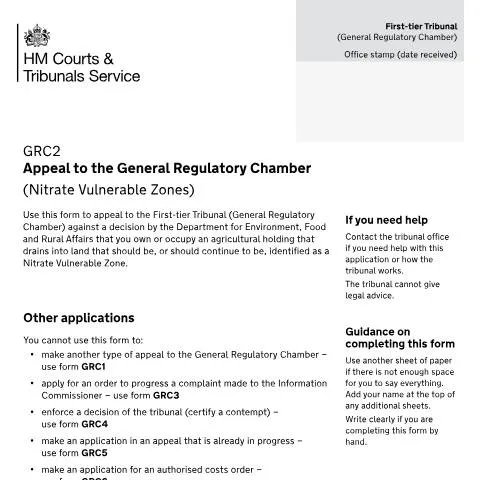
Understanding the Appeal Process for Nitrate Vulnerable Zones
When dealing with agricultural land, the designation of Nitrate Vulnerable Zones (NVZs) holds significant implications for farmers and landowners. If you have received a decision from the Department for Environment, Food and Rural Affairs (Defra) regarding your land's classification as being within an NVZ, and you believe this decision is incorrect, you can challenge it. The GRC2 Appeal to the General Regulatory Chamber is your formal route to appeal against this decision.
Decoding the GRC2 Form: A Step-by-Step Guide
The GRC2 form is structured to collect essential information about your appeal. Let's break down its sections and what information you will need to provide.
Section 1: Your Information
This section requires your personal information, which can be either an individual or an organisation. Here’s what you need to include:
- Name: Provide your full name or the name of your organisation.
- Address: Include the complete address, ensuring it’s the one where you wish to receive correspondence, rather than the subject land.
- Contact Details: A phone number and email address to facilitate communication.
- Multiple Appellants: If more than one person is appealing, indicate this and provide their details on a separate sheet.
Section 2: Representative Information
If you have appointed a representative to manage your appeal, their details must be provided. If you choose not to, simply indicate that there is no representative.
Section 3: Details of the Decision You're Contesting
The heart of your appeal lies in this section, where you'll need to detail the decision you're appealing against.
- Land Details: Clearly describe the land involved, using references such as postal addresses or map grid references.
- Single Business Identifier: This identifier, found on your initial decision document, links your appeal to the correct records.
- Nitrate Vulnerable Zone ID: Similarly, include the NVZ ID number provided in the decision notice.
- Date of Decision: Accurate dating is crucial for processing your appeal within the stipulated timeframe.
Section 4: Information About the Regulator
This section captures the details of the regulatory body that issued the decision. Make sure to provide the correct name and address of Defra, as inaccuracies here can jeopardize your appeal.
Section 5: Handling Late Appeals
In cases where your appeal is submitted after the 28-day deadline, a valid explanation must be presented. This section allows for a brief rationale and requires any supporting evidence to demonstrate why the appeal is late. The tribunal will only consider late appeals if valid reasons are provided.
Section 6: Grounds for Your Appeal
You must select one or more grounds for your appeal; these might include:
- The land does not drain into the water identified by Defra.
- Defra should not identify the water as polluted.
- Defra should not designate the water as at risk of pollution.
This section also inquires whether your appeal pertains to all or just part of the land in question, which should be articulated clearly.
Section 7: Supporting Evidence and Justifications
One critical aspect of your appeal will be the evidence accompanying your application. Gather documents, images, or any other materials that support your claim. The tribunal values robust evidence to review decisions, so the more detailed your submission, the better.
Navigating the Appeal Submission Channels
Your completed GRC2 form can be submitted through various channels, each with its unique considerations. Here’s a comparative look:
| Submission Method | Advantages | Considerations |
|---|---|---|
| Online Submission | Fast processing, instant confirmation | Requires a valid email address |
| Postal Submission | Can include physical supporting documents | Longer processing time, potential for delays |
| In-person Submission | Immediate feedback from tribunal staff | Limited to business hours, potential queues |
Addressing Potential Issues: Missing Information and Corrections
During the appeal process, you may encounter various issues such as missing information or the need to correct errors. If an aspect of your appeal is incomplete, promptly address it by submitting an addition or clarification. The tribunal appreciates clear communication and timely resolutions to potential misunderstandings.
When You Face a Refusal
If your appeal is not upheld, you may feel uncertain about the next steps. Understanding the potential routes forward is essential:
- Seeking Legal Advice: While the tribunal cannot provide legal advice, consulting with a lawyer who specializes in environmental law may give you further options.
- Grounds for Further Appeal: If there are substantial new facts or errors in law, you could consider escalating your appeal to the Upper Tribunal, using the GRC7 form.
Unique Situations: What If You’re a Non-UK Citizen or Under 18?
Special circumstances exist for non-UK citizens or minors. If you are not a UK citizen, ensure that your identity and rights to appeal are clearly established. For minors, parental consent and representation may be necessary, which should be reflected in the details provided on the GRC2 form.
Preparing for a Hearing: What to Expect
If your appeal is scheduled for a hearing, knowing what to expect can alleviate anxiety. The tribunal will typically provide notifications regarding the hearing date and venue well in advance. Prepare by reviewing your appeal materials and gathering any additional evidence you wish to present.
- Presentation of Evidence: You will have the opportunity to present your case, explain your arguments, and submit further documentation.
- Questions from the Tribunal: Be ready to answer questions from tribunal members; clarity and honesty in your responses are critical.
Final Thoughts: The Importance of Accuracy and Detail
Completing the GRC2 form requires careful attention to detail and an understanding of the implications of your appeal. Gathering supporting evidence and ensuring that every section is completed accurately will significantly enhance your chances of a successful appeal.
Always remember, while the tribunal cannot provide legal advice, they are there to facilitate the process and ensure that every appeal is heard fairly. Engaging effectively with the system could lead to a resolution that benefits both your agricultural practices and the environmental regulations in place.
Understanding Nitrate Vulnerable Zones (NVZ) and Their Importance
Nitrate Vulnerable Zones (NVZs) are designated areas in England where the concentration of nitrates from agricultural sources poses a significant risk to water quality and the environment. These zones are established under the European Nitrates Directive, aimed at reducing water pollution caused by nitrates originating from agricultural activities. The presence of nitrates in water bodies can lead to harmful algal blooms, which negatively affect aquatic ecosystems and drinking water quality.
Fill in your form directly online
No printing: type your details into the boxes of the official form, tick, then download the PDF ready to send.
- 1Type into the form boxes
- 2Tick in one click
- 3Save and download the PDF
In NVZs, stricter regulations apply to farming practices to mitigate the risk of nitrate pollution. Key measures include controlling the application of fertilisers, managing livestock manure, and implementing crop rotation strategies. Farmers operating within these zones must adhere to specific guidelines to maintain compliance, which are regularly reviewed and updated based on environmental assessments conducted by agencies such as the Environment Agency and Natural England.
Understanding the implications of being located in an NVZ is crucial for landowners and farmers alike. Violations of NVZ regulations can result in penalties and impact the sustainability of farming operations. Hence, if a landowner believes that their land has been incorrectly designated as part of an NVZ, they have the right to appeal that decision through the General Regulatory Chamber, using Form GRC2.
Filing an Appeal: Step-by-Step Guidance
When you decide to appeal against the classification of your land as part of an NVZ, it is critical to follow the correct procedures to ensure your appeal is valid and considered by the General Regulatory Chamber. Here’s a detailed breakdown of the steps involved:
- Review the Notification: Upon receiving a notification regarding your land's classification, carefully review the details and criteria used to determine the NVZ designation. This will help you identify specific grounds for your appeal.
- Gather Evidence: Collect any supporting evidence that demonstrates why your land should not be classified as an NVZ. This might include soil analysis reports, farm management practices, or environmental assessments that contradict the basis for the NVZ designation.
- Complete Form GRC2: Fill out Form GRC2 accurately and comprehensively. Ensure that you address all required sections and articulate your reasons for the appeal clearly. Incomplete or poorly articulated forms may lead to delays or rejection of your appeal.
- Submit Your Appeal: Send your completed Form GRC2 to the appropriate address as indicated in the guidance document. Ensure that you keep a copy of your submission for your records.
- Await Acknowledgment: After submission, you will receive an acknowledgment of your appeal. This document is important as it confirms that your appeal has been duly received and is being processed.
- Follow Up: If you do not receive further communication within a reasonable timeframe, it is advisable to follow up with the General Regulatory Chamber to check on the status of your appeal. Maintaining open lines of communication can be beneficial.
By following these steps meticulously, you can enhance the chances of a successful outcome in your appeal process. It is essential to approach this process with diligence and patience, as appeals can take time to resolve depending on the complexity of the case and the volume of appeals being processed.
Potential Outcomes of Your Appeal
Once you have submitted your appeal using Form GRC2, it's important to understand the potential outcomes that may arise from the review by the General Regulatory Chamber. The decision made can significantly impact your farming operations and land management practices. Here are the possible outcomes:
- Successful Appeal: If your appeal is upheld, the General Regulatory Chamber may decide to revoke the NVZ designation on your land. This outcome allows you greater flexibility in managing your land without the constraints imposed by NVZ regulations.
- Partial Success: In some instances, the chamber may find merit in specific aspects of your appeal but may maintain certain regulations. This outcome could lead to a modification of the NVZ boundaries or conditions that still require compliance but are less stringent than initially imposed.
- Unsuccessful Appeal: If the appeal is denied, you will receive a detailed explanation outlining the reasoning behind the decision. It’s crucial to understand the implications of this outcome, as you may be required to adhere to NVZ regulations, which could affect your farming practices and financial planning.
In case of an unsuccessful appeal, you may still have options to contest the decision further. It is advisable to consult with environmental law experts or agricultural advisors who can guide you on the next steps, which may include judicial review or alternative dispute resolution mechanisms.
Ultimately, understanding the appeal process and potential outcomes empowers landowners to make informed decisions about their rights and responsibilities concerning NVZ designations. The ongoing dialogue with regulatory bodies not only helps in maintaining agricultural viability but also contributes to broader environmental objectives.