The Complexities of Family Reunification: Navigating Appendix 1 for Settlement Applications
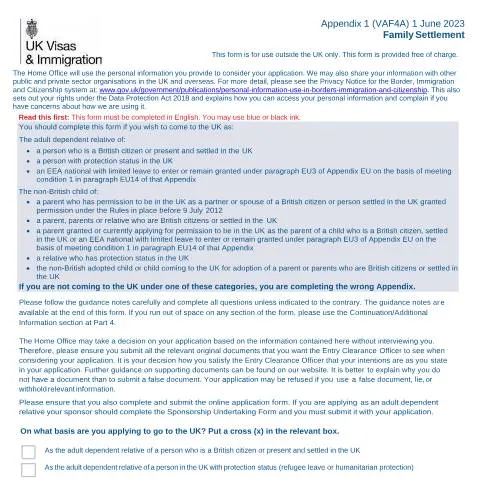
When families are separated by international borders, the bureaucratic maze of immigration law can feel overwhelming. The Appendix 1 for form VAF4A represents a critical gateway for specific categories of family members seeking to join relatives in the United Kingdom. This supplementary document, updated in June 2023, serves as the detailed questionnaire that accompanies the main VAF4A application for family settlement visas.
Unlike standard visitor visa applications, this appendix addresses the intricate personal circumstances that define dependency relationships and family ties. The form recognises that family structures vary dramatically across cultures and situations, requiring nuanced information about living arrangements, financial support networks, and care responsibilities that determine eligibility for settlement.
The document's scope extends beyond simple family reunion cases. It encompasses adult dependent relatives of British citizens, non-British children of settled parents, and even complex scenarios involving EEA nationals with specific types of limited leave. Each category carries distinct requirements and evidential standards that must be meticulously documented.
Decoding the Eight Pathways to Family Settlement
The opening section of Appendix 1 presents eight distinct categories, each representing a different legal pathway to UK family settlement. These categories reflect the evolution of immigration rules and the recognition of various family structures within British society.
Adult Dependent Relative Categories
The first three categories target adult dependent relatives, but with significantly different sponsor requirements. The British citizen or settled person pathway represents the most straightforward route, requiring sponsors to demonstrate both their status and their ability to support dependents without recourse to public funds.
The protection status pathway acknowledges that refugees and those with humanitarian protection may need to bring dependent relatives to the UK. This category recognises the particular vulnerabilities faced by families fleeing persecution or conflict.
The EEA national pathway addresses the complex post-Brexit landscape, specifically covering EEA nationals who obtained limited leave under paragraph EU3 of Appendix EU. This category requires meeting condition 1 in paragraph EU14, which relates to continuous qualifying residence requirements.
Non-British Child Categories
The remaining five categories focus on non-British children in various family configurations. The partner/spouse legacy category specifically references rules in place before 9 July 2012, highlighting how immigration law changes can create different pathways for similar situations depending on when applications were made.
The British citizen or settled relative category covers the broadest range of child applications, including those seeking to join parents, grandparents, or other relatives who have established their lives in the UK.
| Application Category | Key Requirements | Typical Applicants |
|---|---|---|
| Adult Dependent Relative | Demonstrate dependency and care needs | Elderly parents, disabled siblings |
| Non-British Child | Prove family relationship and best interests | Children of mixed-nationality couples |
| Adoption Cases | Legal adoption or pending adoption orders | International adoption arrangements |
The Critical Personal Circumstances Section: Beyond Basic Demographics
Part 1 of the appendix delves deep into personal circumstances, requiring information that goes far beyond standard biographical details. This section recognises that dependency isn't simply about age or legal status—it's about the practical realities of daily life and support networks.
Living Arrangements and Dependency Mapping
Questions 1.1 through 1.3 create a comprehensive picture of current living situations. The distinction between living alone and living with others isn't merely administrative—it directly impacts assessments of dependency and care needs. Home ownership questions reveal financial relationships and potential sources of ongoing support or obligation.
The form recognises that in many cultures, multi-generational living arrangements are normal, and property ownership may be held collectively or through complex family trusts. Entry clearance officers use this information to understand whether applicants have genuine dependency relationships or are part of self-sufficient family units.
Financial Support Networks
Question 1.4 addresses financial dependency directly, requiring detailed information about who provides financial support and the nature of that relationship. This goes beyond simple monetary support to include in-kind contributions such as housing, food, medical care, or other essential services.
The form's approach acknowledges that financial dependency can be complex, particularly in developing countries where formal employment may be limited, and family support networks operate through informal arrangements. Documentation of these relationships becomes crucial for successful applications.
Medical Conditions and Care Requirements: The Dependency Assessment Framework
Questions 1.7 and 1.8 form the cornerstone of dependency assessments for adult relative applications. These questions aren't merely medical inquiries—they're designed to establish whether applicants require long-term personal care that can only be provided by their UK-based relatives.
Daily Living Capabilities
The specific reference to washing, dressing, and food preparation reflects established criteria for assessing care needs. These activities of daily living form the basis for determining whether someone requires ongoing assistance that goes beyond normal family support.
The form's structure recognises that care needs exist on a spectrum. Some applicants may be completely unable to perform these tasks, while others may manage with assistance. The detailed information requested allows entry clearance officers to make nuanced assessments about the level of care required and whether it can reasonably be provided in the applicant's home country.
Medical evidence supporting claims of care needs must be comprehensive and from recognised medical practitioners. The UK Visas and Immigration guidance emphasises that general statements about poor health aren't sufficient—specific functional impairments must be documented with reference to their impact on daily living.
Strategic Completion: Avoiding Common Pitfalls in Complex Applications
The appendix's instructions emphasise several critical points that can make or break an application. The requirement to complete the form in English using blue or black ink may seem trivial, but reflects the importance of following instructions precisely in immigration applications.
Documentation Strategy
The form explicitly states that decisions may be made without interviews, placing enormous weight on the documentary evidence submitted. This creates a strategic imperative to provide comprehensive supporting documentation rather than relying on the opportunity to explain circumstances in person.
The guidance's warning that "it is better to explain why you do not have a document than to submit a false document" reflects the reality that many applicants from developing countries may struggle to obtain standard documentary evidence. The key is providing credible explanations for missing documents rather than attempting to create substitute documentation.
Coordination with Online Applications
The requirement to complete both the online application form and this appendix creates coordination challenges. Information must be consistent across both platforms, and any discrepancies can raise concerns about application credibility.
For adult dependent relative applications, the additional requirement for sponsors to complete a Sponsorship Undertaking Form adds another layer of complexity. This form commits sponsors to financial responsibility for their relatives, creating legal obligations that extend beyond the immigration application process.
Processing Realities: What Happens After Submission
Once submitted, Appendix 1 applications enter a complex assessment process that varies significantly depending on the category and circumstances. Entry clearance officers must balance immigration rules with human rights considerations, particularly in cases involving family separation.
Assessment Timelines and Variations
Processing times for family settlement applications typically range from several months to over a year, depending on the complexity of the case and the country of application. Applications requiring extensive medical assessments or complex dependency evaluations naturally take longer than straightforward child applications.
The Home Office's commitment to making decisions without interviews in many cases means that the written application carries enormous weight. However, complex dependency cases or applications raising credibility concerns may still result in interview requests.
Appeal Rights and Recourse
Unsuccessful applicants generally have limited appeal rights for family visit visas, but settlement applications often carry stronger appeal provisions. The specific appeal rights depend on the category of application and the grounds for refusal.
Administrative review options may be available for certain types of refusal, particularly where entry clearance officers have made clear factual errors or failed to consider relevant evidence properly.
The Evolving Landscape of Family Immigration Policy
The June 2023 version of Appendix 1 reflects ongoing changes in UK immigration policy, particularly the post-Brexit adjustments affecting EEA nationals and their family members. The specific references to Appendix EU and the complex conditions attached to EEA national pathways demonstrate how Brexit continues to reshape family immigration options.
The inclusion of protection status pathways acknowledges the UK's ongoing commitments under international refugee law, while the various child categories reflect the government's recognition that children's welfare considerations often outweigh strict immigration controls.
Future changes to family immigration rules will likely continue to be reflected in updated versions of this appendix. The form's detailed structure provides flexibility for policy makers to adjust requirements without completely restructuring the application process, but applicants must ensure they're using the most current version of all forms.
Understanding Appendix 1's requirements and completing it effectively requires careful attention to the specific circumstances of each case. The form's complexity reflects the genuine difficulty of assessing family relationships and dependency across different cultures and legal systems, but thorough preparation and honest disclosure remain the foundation of successful applications.
Document Verification Requirements and Authentication Procedures
When submitting Appendix 1 alongside your VAF4A application, the authentication of supporting documents represents a critical component that can significantly influence your application's success. UK Visas and Immigration operates stringent verification protocols to ensure document authenticity, particularly given the sensitive nature of family settlement claims.
Original documents must be submitted wherever possible, though certified copies are acceptable in specific circumstances. For documents issued outside the UK, you'll typically need to provide certified translations by a qualified translator who is a member of a recognised translation body. The translator must include their credentials, contact details, and a declaration that the translation is accurate and complete.
Birth certificates, marriage certificates, and death certificates require particular attention to authentication requirements. Documents from certain countries may need to undergo a process of legalisation or apostille certification before submission. This applies especially to documents from countries that are not party to the Hague Apostille Convention, where a more complex legalisation process through the relevant embassy or consulate becomes necessary.
Financial documents present unique verification challenges. Bank statements must typically cover a continuous period and show consistent account activity. HMRC documentation, such as P60 certificates or Self Assessment tax returns (SA100), carries particular weight as evidence of UK-based sponsors' financial circumstances. However, these documents must be recent—generally within the last tax year ending 5 April—to maintain their evidential value.
Medical evidence requires careful handling, particularly for adult dependent relative applications where health conditions form part of the dependency claim. Medical reports must come from registered practitioners, include specific details about conditions and prognosis, and demonstrate how these conditions create dependency requirements that cannot reasonably be met in the applicant's current country of residence.
Digital submissions have become increasingly common, but original document requirements persist for certain categories. When digital copies are submitted, they must be clear, complete, and show all relevant details including any security features present on the original documents. Partial documents or poor-quality scans frequently result in requests for additional evidence, potentially delaying your application.
Common Application Pitfalls and How to Navigate Them
Understanding frequent application errors can significantly improve your chances of success with the VAF4A and Appendix 1 submission. Immigration practitioners consistently observe recurring patterns of mistakes that applicants make, many of which are entirely preventable with proper preparation and attention to detail.
Inconsistent information across different sections of your application represents one of the most serious risks to application success. Entry clearance officers scrutinise applications for internal consistency, comparing details provided in the main VAF4A form with information contained within Appendix 1. Discrepancies in dates, relationships, financial information, or personal circumstances immediately raise red flags and can lead to refusal based on credibility concerns.
Inadequate explanation of relationship breakdown or family separation often undermines applications. Many applicants fail to provide sufficient context for why family members became separated or why reunion in the UK represents the most appropriate solution. This is particularly relevant for adult dependent relative applications, where you must demonstrate that care needs cannot reasonably be met in the applicant's current location.
Financial evidence frequently falls short of Immigration Rules requirements, not necessarily due to insufficient funds, but through poor presentation or incomplete documentation. Sponsors often submit bank statements that show large, unexplained deposits shortly before application submission, which can raise concerns about the source and sustainability of funds. Similarly, failing to account for regular outgoings or providing evidence that doesn't cover the required time periods can undermine otherwise strong applications.
Cultural assumptions about family relationships can create problems when these don't align with UK Immigration Rules requirements. Extended family caring arrangements that are commonplace in many cultures may not satisfy the specific dependency criteria outlined in the Immigration Rules. Applicants must clearly demonstrate that dependency relationships meet the legal definitions rather than assuming that cultural norms will be automatically understood or accepted.
Timing issues frequently compromise applications, particularly regarding the maintenance and accommodation requirements. Many sponsors begin gathering evidence too late in the process, resulting in bank statements or tenancy agreements that don't cover the full required period. Planning your evidence gathering strategy well in advance of submission ensures you can demonstrate the required period of financial stability and suitable accommodation arrangements.
Language and presentation problems can obscure otherwise strong applications. Overly emotional appeals, while understandable given the personal nature of family separation, can detract from the legal and factual basis of your application. Focus on clear, factual presentation of evidence rather than emotional arguments, though genuine hardship circumstances should still be appropriately documented and explained.
Post-Submission Process and Managing Your Application Journey
Once you've submitted your VAF4A application with Appendix 1, understanding the subsequent process helps manage expectations and prepare for potential additional requirements. The application journey involves several distinct phases, each with specific timelines and potential intervention points that applicants should understand.
Initial processing begins with administrative checks to ensure your application is complete and all required fees have been paid. During this phase, UK Visas and Immigration may contact you regarding missing documents or clarification of submitted information. Response times for such requests are typically strict—usually 10 working days—and failure to respond adequately can result in application refusal based on insufficient evidence.
The substantive assessment phase involves detailed examination of your application against the relevant Immigration Rules. Entry clearance officers review all submitted evidence, conduct background checks, and may initiate additional verification procedures. This might include contact with educational institutions, employers, or other organisations referenced in your application to verify claims made.
Interview requirements vary depending on your specific circumstances and the strength of your submitted evidence. While not all VAF4A applications require interviews, complex cases or those where additional clarification is needed may result in interview requests. Interviews typically focus on relationship evidence, financial circumstances, and future intentions, requiring thorough preparation and consistent testimony that aligns with your written application.
Biometric data collection forms part of the process for most applicants, involving fingerprinting and digital photography at designated application centres. This information integrates with UK immigration databases and security systems, contributing to identity verification and background checking procedures.
Processing timeframes vary significantly based on your country of application, time of year, and individual case complexity. Standard processing times published by UK Visas and Immigration provide guidance, but complex family settlement cases often require additional time for thorough assessment. Priority or super priority services may be available in some locations, though these come with additional fees and don't guarantee positive outcomes.
During the waiting period, maintaining your circumstances becomes crucial. Significant changes to your situation—such as changes in employment, accommodation, or family circumstances—should be reported to UK Visas and Immigration promptly. Failure to disclose material changes can undermine your application's credibility and may constitute grounds for refusal.
Communication with UK Visas and Immigration during processing requires careful consideration. While you can submit additional evidence if circumstances change, excessive or unnecessary contact can slow processing times. Focus communication on genuinely material updates or responses to specific requests for information rather than general enquiries about application status.