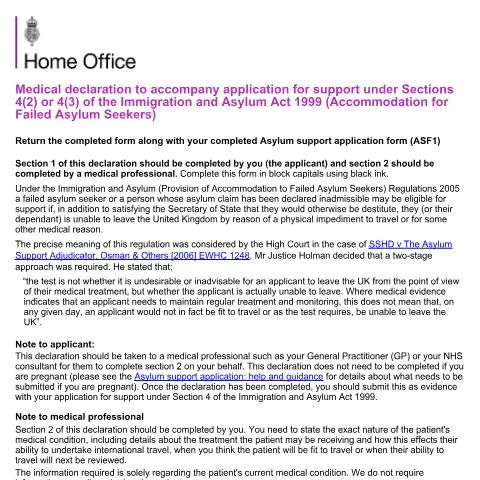
When Medical Conditions Prevent Departure: The Section 4(2) Declaration Framework
Failed asylum seekers facing destitution whilst being medically unable to leave the United Kingdom find themselves caught between immigration enforcement and healthcare necessities. The Section 4(2) medical declaration serves as the crucial bridge between these competing pressures, providing a formal mechanism for documenting genuine medical impediments to travel under the Immigration and Asylum Act 1999.
This declaration operates within a tightly defined legal framework established by the Immigration and Asylum (Provision of Accommodation to Failed Asylum Seekers) Regulations 2005. Unlike standard medical reports, this document must demonstrate not merely that treatment would be beneficial in the UK, but that the individual is actually unable to leave due to their medical condition—a distinction that has proven pivotal in numerous legal challenges.
The form's two-section structure reflects this dual responsibility: applicants provide identifying information in Section 1, whilst qualified medical professionals complete the clinical assessment in Section 2. This collaborative approach ensures both administrative accuracy and clinical integrity whilst maintaining clear accountability for each element of the declaration.
Judicial Interpretation and the Osman Standard
The landmark case of SSHD v The Asylum Support Adjudicator, Osman & Others [2006] EWHC 1248 fundamentally shaped how medical declarations are assessed. Mr Justice Holman's judgment established the two-stage approach that continues to govern decision-making today.
The first stage examines whether the applicant would otherwise be destitute—a separate assessment conducted through the main ASF1 application form. The second stage focuses exclusively on medical incapacity to travel, requiring evidence that goes beyond mere inconvenience or medical preference.
"The test is not whether it is undesirable or inadvisable for an applicant to leave the UK from the point of view of their medical treatment, but whether the applicant is actually unable to leave."
This judicial interpretation means that ongoing treatment requirements alone do not automatically qualify for support. The medical professional must demonstrate that the patient's condition creates a genuine physical impediment to international travel, not simply that departure would interrupt beneficial care.
Practical Implications of the Osman Test
Medical professionals completing Section 2 must carefully distinguish between conditions that render travel impossible versus those that make travel inadvisable. A patient requiring regular dialysis might be unable to travel on specific days, but this doesn't automatically mean they're unable to leave the UK. Conversely, someone in the acute phase of a psychiatric crisis or recovering from major surgery might genuinely be unable to undertake international travel.
The declaration requires precise timing assessments: when will the patient next be fit to travel, or when will their capacity be reviewed? These temporal elements prove crucial for Home Office decision-makers determining support duration and review schedules.
Completing Section 1: Applicant Responsibilities and Common Pitfalls
Section 1 appears straightforward but contains several technical requirements that can derail applications if mishandled. The name fields must match current passport or travel documents exactly, including any variations in transliteration from non-Latin scripts.
The reference number section (1.4) proves particularly important for tracking purposes. Applicants should provide their Home Office reference number if available, along with any Compliance and Enforcement Person reference (CEPR) or existing asylum support reference. These identifiers help prevent delays and ensure proper case linkage within Home Office systems.
| Reference Type | Format | When Available |
|---|---|---|
| Home Office reference | Varies by case type | Following initial asylum claim |
| CEPR number | Enforcement-specific | During removal proceedings |
| Asylum support reference | ASR prefix typical | Previous support applications |
Name Variations and Historical Identities
The form specifically requires disclosure of all names ever used, including professional aliases, married names, and cultural variations. This extends beyond legal name changes to include any identity by which the applicant has been known. Failure to disclose previous names can result in application delays or credibility questions during assessment.
For applicants from cultures with different naming conventions, careful explanation may be necessary. Patronymic systems, tribal names, or religious names should all be disclosed if they appear in any official documentation or if the applicant has used them in UK proceedings.
Medical Professional Requirements: Beyond Standard Clinical Documentation
Section 2 places specific obligations on medical professionals that extend beyond typical clinical documentation. The declaration requires assessment of travel fitness rather than general health status—a distinction many practitioners initially overlook.
NHS GPs and consultants completing these declarations must address four core elements: the exact nature of the medical condition, current treatment regimens, specific impacts on travel capacity, and projected timelines for fitness assessment or review.
Clinical Assessment Parameters
The medical professional must evaluate whether the patient can physically undertake international travel, considering factors such as:
- Ability to sit for extended periods during flights
- Capacity to manage medical needs during transit
- Risk of medical emergencies at altitude or during travel
- Requirements for specialist equipment unavailable during travel
- Cognitive capacity to navigate international travel procedures
Importantly, the assessment should not address whether treatment is available in the destination country or whether UK treatment would be preferable. The Home Office explicitly states that such considerations fall outside this declaration's scope.
Treatment Duration and Review Schedules
Medical professionals must provide realistic timelines for when travel fitness will be reviewed or achieved. Vague statements like "ongoing treatment required" prove insufficient. Instead, specific review dates or measurable milestones should be identified: "Patient will be assessed for travel fitness following completion of chemotherapy course in approximately 16 weeks" or "Mobility assessment scheduled for [specific date] will determine travel capacity."
Pregnancy Exemptions and Alternative Documentation Routes
The declaration explicitly excludes pregnancy cases, directing applicants to alternative documentation pathways outlined in the asylum support guidance. This exemption recognises that pregnancy creates well-established travel restrictions without requiring individual medical assessment.
Pregnant applicants should instead focus on the standard ASF1 application process, providing evidence of pregnancy through routine NHS documentation such as MATB1 certificates or antenatal appointment records. The medical declaration becomes relevant only if pregnancy complications create additional travel impediments beyond normal pregnancy restrictions.
Postpartum Considerations
Following delivery, new mothers may require the medical declaration if caesarean sections, complications, or newborn health issues prevent travel. The timing proves crucial: routine postnatal care doesn't automatically prevent travel, but specific medical complications might qualify for Section 4(2) support.
Integration with ASF1 Applications and Supporting Evidence
The medical declaration cannot standalone—it must accompany a completed ASF1 asylum support application form. This integration ensures both destitution and medical incapacity criteria receive proper assessment within a single application process.
Timing coordination proves essential. Medical assessments have limited validity periods, so applicants should ensure their clinical evaluation remains current when submitting the complete application package. Outdated medical declarations may prompt requests for updated assessments, delaying decision-making.
Evidence Hierarchy and Supporting Documentation
Beyond the declaration itself, applicants should compile supporting medical evidence including hospital discharge summaries, specialist referral letters, and treatment schedules. This additional documentation provides context for the declaration's conclusions whilst demonstrating ongoing medical engagement.
The strength of supporting evidence often determines application success. A declaration stating "patient unfit to travel" carries more weight when supported by detailed hospital records, specialist assessments, and clear treatment protocols.
Data Protection Framework and Information Sharing Protocols
The declaration operates within the UK's data protection framework, specifically referencing the Data Protection Act 2018 and UK GDPR requirements. Both applicants and medical professionals should understand how their information will be processed and shared.
The Home Office privacy notice for the Border, Immigration and Citizenship system governs information use, including potential sharing with other UK public bodies and international agencies. Medical professionals should ensure patients understand these implications before completing clinical assessments.
Professional Obligations and Confidentiality
Medical professionals face potential tension between patient confidentiality and immigration reporting requirements. The declaration provides a structured framework for sharing necessary medical information whilst maintaining appropriate clinical boundaries.
Practitioners should document their assessment rationale thoroughly, both for immigration purposes and to meet professional standards. This documentation proves valuable if decisions face legal challenge or if patients require ongoing medical support during the application process.
Assessment Outcomes and Ongoing Review Mechanisms
Successful medical declarations typically result in temporary Section 4(2) support pending medical improvement or successful departure arrangements. This support includes basic accommodation and essential living expenses, but remains subject to ongoing medical review.
The Home Office may request updated medical assessments at intervals determined by the original declaration's timeline projections. Applicants should maintain regular medical engagement to support any necessary review processes and ensure continued eligibility.
Failed applications often result from insufficient medical evidence or assessments that address treatment desirability rather than travel incapacity. The appeals process through the First-tier Tribunal provides recourse, but requires fresh medical evidence addressing the specific legal test established in the Osman judgment.
Understanding these review mechanisms helps applicants maintain compliance with ongoing obligations whilst ensuring their medical needs receive appropriate consideration within the immigration system's constraints. The declaration thus serves not merely as a one-time application tool, but as part of an ongoing dialogue between medical needs and immigration enforcement priorities.
Complex Medical Scenarios and Section 4(2) Implications
The Section 4(2) medical declaration encompasses a broad spectrum of health conditions, each requiring careful consideration of how they impact driving capability. Mental health conditions present particular complexity, as their effects can fluctuate significantly. Conditions such as severe depression, bipolar disorder, or anxiety disorders may qualify under Section 4(2) if they substantially impair judgement, concentration, or reaction times whilst driving.
Neurological conditions form another major category requiring declaration. Beyond the obvious cases of epilepsy or stroke, conditions like multiple sclerosis, Parkinson's disease, or chronic fatigue syndrome may necessitate reporting depending on their severity and progression. The DVLA medical advisers assess not just the current state but the likely trajectory of progressive conditions, potentially imposing review periods or specific licence restrictions.
Cardiovascular conditions present unique challenges for Section 4(2) assessment. Whilst a minor heart murmur might not require declaration, conditions like severe angina, recent heart attacks, or implanted cardiac devices often trigger mandatory reporting requirements. The timing becomes crucial—someone recovering from cardiac surgery may face temporary licence suspension followed by conditional reinstatement based on medical evidence of recovery.
Substance dependency issues, whether alcohol or drug-related, fall squarely within Section 4(2) scope. However, the declaration requirement extends beyond active dependency to include periods of recovery. Individuals in rehabilitation programmes or those with historical dependency issues may need to provide ongoing medical evidence of their fitness to drive, including regular monitoring reports from healthcare professionals.
Diabetes presents a particularly nuanced area for Section 4(2) declarations. Type 1 diabetes automatically requires declaration, whilst Type 2 diabetes may require reporting depending on treatment methods and hypoglycaemic episodes. The distinction between insulin-dependent and non-insulin-dependent cases becomes crucial, with different medical standards applying to each category.
Documentation Requirements and Medical Evidence Standards
The Section 4(2) declaration process demands comprehensive medical documentation that meets specific DVLA standards. Medical reports must originate from registered healthcare professionals with direct knowledge of the applicant's condition, typically requiring examination within the preceding three months. Generic letters or brief summaries rarely suffice—the DVLA requires detailed assessments addressing functional capacity rather than diagnostic labels alone.
Specialist medical reports carry particular weight in Section 4(2) assessments. Consultants in relevant specialties—such as cardiologists for heart conditions or neurologists for brain-related disorders—provide authoritative opinions on driving capability. These reports must address specific functional areas: cognitive capacity, physical coordination, reaction times, and the likelihood of sudden incapacitation whilst driving.
Ongoing monitoring requirements often accompany Section 4(2) declarations, particularly for progressive or fluctuating conditions. Medical professionals may need to provide regular updates, sometimes annually or bi-annually, confirming continued fitness to drive. These review periods create ongoing obligations for both the licence holder and their medical team, requiring advance planning to ensure licence continuity.
The format and content of medical evidence must align with DVLA specifications. Reports should quantify functional limitations where possible, describe treatment responses, and provide prognosis assessments. Vague statements about "general health" or "stable condition" typically prove insufficient—medical advisers require specific details about driving-relevant capabilities and any recommended restrictions or adaptations.
Independent medical examinations may supplement existing medical records, particularly where conflicting opinions exist or additional assessment seems necessary. These examinations, conducted by DVLA-approved medical practitioners, focus specifically on driving-related capabilities rather than general health status. The costs of such examinations typically fall to the applicant, representing an additional consideration in the Section 4(2) process.
Appeals, Reviews, and Licence Modification Options
When DVLA medical advisers reach unfavourable decisions regarding Section 4(2) declarations, several recourse options exist for applicants. The initial step involves requesting reconsideration, providing additional medical evidence that addresses specific concerns raised in the original decision. This process requires understanding exactly why the application was refused—whether due to insufficient evidence, concerns about specific functional capabilities, or questions about treatment effectiveness.
Formal appeals through the Magistrates' Court represent the most robust challenge mechanism for Section 4(2) decisions. These proceedings require legal representation in most cases, as the technical medical evidence and complex regulatory framework exceed typical lay understanding. Court appeals focus on whether DVLA decisions were reasonable based on available evidence, rather than conducting fresh medical assessments.
The timing of appeals becomes crucial, as strict deadlines apply for challenging DVLA decisions. Applicants typically have six months from the decision date to initiate formal appeal proceedings, though earlier engagement often proves more effective. During appeal periods, driving privileges may remain suspended, creating practical challenges for individuals dependent on driving for employment or essential activities.
Licence modification options provide alternative pathways for individuals who cannot meet standard licensing requirements. Short-period licences, valid for one to three years with mandatory medical reviews, accommodate conditions with uncertain prognoses or those requiring ongoing monitoring. These arrangements allow continued driving whilst ensuring regular reassessment of medical fitness.
Restricted licences offer another modification option, limiting driving to specific circumstances, vehicle types, or geographical areas. Common restrictions include daylight-only driving, automatic transmission requirements, or prohibition from motorway use. These modifications enable continued mobility whilst addressing specific safety concerns identified through the Section 4(2) assessment process.
Provisional licence conversions may apply where full licence privileges cannot be maintained but some driving capability remains. This option requires retesting but allows individuals to maintain driving skills whilst working towards full licence reinstatement. The process acknowledges that some medical conditions may temporarily impair driving ability without permanently disqualifying individuals from future licensing.
Regular review mechanisms ensure that licence modifications remain appropriate as medical conditions evolve. Improvement in health status may justify licence upgrade applications, whilst deterioration might necessitate additional restrictions or licence withdrawal. These ongoing assessments balance individual mobility needs against public safety requirements, recognising that medical conditions rarely remain static over time.