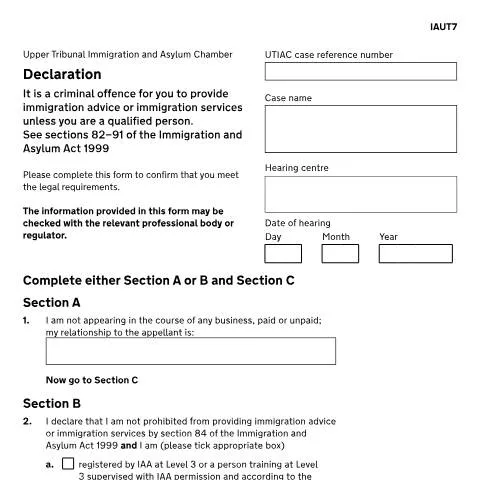
Understanding the Implications of Form IAUT7 in Immigration Services
In the realm of immigration advice and services, the necessity to comply with legal requirements is paramount. Form IAUT7, officially known as the Declaration that you're qualified to provide immigration advice or immigration services, serves a crucial role in this regulatory framework. Its primary objective is to ensure that individuals providing immigration-related services meet the specific qualifications mandated by law. The implications of not adhering to these regulations can be severe, including criminal charges, which reinforces the importance of understanding this document fully.
The Legal Framework Behind Form IAUT7
Form IAUT7 is embedded within a broader legal context established by the Immigration and Asylum Act 1999. This act delineates the legal boundaries for who can provide immigration advice and services, thereby protecting the interests of clients seeking assistance in navigating the complexities of immigration law. Key sections, notably sections 82 to 91, outline the criteria for being deemed a "qualified person." Violating these stipulations can lead to criminal prosecution, underscoring the form's importance.
The Role of Professional Bodies
Several professional bodies are involved in the regulation of immigration advice, including:
- The Law Society - Regulates solicitors and immigration practitioners.
- The Institute of Legal Executives (CILEX) - Authorizes specific immigration practitioners.
- The General Council of the Bar - Recognizes barristers qualified to provide immigration services.
The competence and integrity of these professionals are verified through their registration with respective bodies, and Form IAUT7 is the vehicle through which they can declare their qualification status at the Upper Tribunal Immigration and Asylum Chamber.
Timeline: Submission and What Happens Next
The process of submitting Form IAUT7 must be timed appropriately to ensure compliance with court requirements. Here’s a breakdown of the timeline:
- Preparation: Gather all necessary information and evidence of qualifications.
- Submission: Complete the form, ensuring either Section A or B—along with Section C—is filled out correctly.
- Delivery: The completed form must be submitted before the hearing date, either via CE-File, email, or in-person to the court clerk.
- Confirmation: Upon submission, check for confirmation from the court regarding the acceptance of your declaration.
It is imperative to submit this form no later than the start of your hearing to avoid complications or delays in your case.
Distinguishing Form IAUT7 from Similar Documents
Form IAUT7 might be confused with other documents related to immigration, such as applications for leave to remain or other immigration-related appeals. However, it serves a distinctly different purpose. While those forms pertain to specific immigration applications, IAUT7 is solely focused on declaring qualifications to provide immigration services.
To clarify:
| Form | Purpose | Who Completes It |
|---|---|---|
| IAUT7 | Declare qualifications for providing immigration advice | Individuals or organisations providing immigration services |
| FLR(M) | Application for Leave to Remain as a Partner | Applicants seeking to remain in the UK |
| Form IAFT-1 | Appeal against a refusal of an immigration decision | Individuals appealing to the tribunal |
Crucial Consequences of Non-Compliance
Filling out Form IAUT7 is not merely an administrative step; it carries significant implications. Failure to adhere to the requirements could result in various repercussions:
- Criminal Charges: Providing immigration advice without proper qualifications can lead to fines and imprisonment.
- Loss of Reputation: Your professional standing can be severely damaged, affecting future opportunities in the legal field.
- Legal Penalties: The Upper Tribunal may impose penalties for non-compliance, affecting your ability to represent clients in the future.
Understanding these consequences underscores the importance of thoroughness and accuracy when completing and submitting Form IAUT7.
Unique Considerations for Specific Demographics
Different categories of individuals may face unique challenges when filling out Form IAUT7. For instance:
Foreign Nationals
Individuals from outside the UK who wish to provide immigration advice must ensure they meet the additional eligibility criteria set forth by their respective regulatory bodies. This may involve:
- Demonstrating proficiency in UK immigration law.
- Securing supervision or mentorship from a qualified professional.
Minors and Vulnerable Persons
Those under the age of 18 or vulnerable individuals must navigate additional legal complexities. In such cases, it is advisable to have a guardian or legally appointed representative assist in the completion of Form IAUT7.
Preparing Supporting Evidence and Documentation
To support your declaration on Form IAUT7, appropriate documentation must be gathered and prepared:
- Proof of Qualification: This may include certificates or letters from regulatory bodies confirming your status as a qualified immigration adviser.
- Professional References: Testimonials from colleagues or clients that confirm your experience and competence.
- Identification: A valid National Insurance number or other identification to substantiate your identity and qualifications.
Being organized and thorough in your preparation will facilitate a smoother submission process.
After Submission: Monitoring Your Application Status
Once Form IAUT7 is submitted, you may wonder how to track the status of your declaration. Here are steps you can take:
- Stay in Touch: Regularly communicate with the court clerk or designated contact to inquire about your submission status.
- Be Proactive: If you do not receive acknowledgment within a reasonable timeframe, follow up with a phone call or email.
- Document Everything: Keep records of all communications and submissions for your reference.
Maintaining communication lines open will help mitigate any delays and keep your case on track.
Conclusion: The Importance of Compliance and Diligence
The necessity of completing Form IAUT7 cannot be overstated. Every individual who interacts with immigration law must recognize their responsibilities and the weight of their declarations. As the landscape of immigration law evolves, the regulatory environment surrounding it requires constant diligence. By ensuring that the IAUT7 form is filled out accurately and submitted punctually, you not only protect yourself legally but also uphold the integrity of immigration advice as a whole.
Understanding the Immigration Advice Qualification Process
When you're looking to provide immigration advice or services in the UK, it’s essential to understand the qualifications required under the Immigration and Asylum Act 1999. Form IAUT7 is a critical component of this process, and it serves to formally declare your qualifications. The first step involves demonstrating that you have the necessary training and skills required to provide accurate and competent advice.
To qualify, you need to establish that you either possess the requisite legal qualifications, such as a relevant law degree, or that you have undergone specific training regarding immigration law. This can include accredited courses offered by various educational institutions or professional bodies recognized in the UK. In this context, you might consider certifications from organizations like the Immigration Law Practitioners' Association (ILPA), which can bolster your qualifications and provide credibility.
Bear in mind that once you submit Form IAUT7, it’s essential to keep your qualifications up to date. Changes in immigration laws or practices may necessitate additional training or coursework to ensure that you remain compliant with the requirements outlined by the Office of the Immigration Services Commissioner (OISC). Moreover, it is also your responsibility to ensure that your knowledge reflects the latest changes in immigration policy, as this can significantly impact the advice you provide to clients.
Completing Form IAUT7: A Step-by-Step Guide
Filling out Form IAUT7 can seem daunting, but following a structured approach can simplify the process. The form is divided into several sections, each aimed at gathering detailed information about your qualifications and the services you intend to provide. Here’s a step-by-step breakdown:
- Personal Information: Start by entering your name, contact details, and address. Ensure this information is accurate as it’s critical for official correspondence.
- Qualifications: In this section, list your qualifications related to immigration advice. Include the names of institutions where you studied and the courses completed. It’s advisable to attach copies of your certificates to substantiate your claims.
- Details of Services Offered: Clearly outline the types of immigration advice or services you plan to provide. This section is crucial, as it defines the scope of your practice and helps the OISC assess whether your qualifications align with the services you intend to offer.
- Compliance Information: You will need to provide information about your understanding of compliance obligations under the Immigration and Asylum Act and other relevant regulations. Highlight any previous experience in similar roles, as it can enhance your application.
- Declaration: Upon completing the form, you must declare that the information provided is accurate to the best of your knowledge. This declaration is a legal commitment, so ensure everything is truthful and supported by evidence.
After completing these steps, review the form thoroughly before submission. Any errors or omissions can lead to delays in processing your application or even rejection. Once you’re confident that your Form IAUT7 is correctly filled out, submit it to the OISC along with any required documentation. Be mindful that processing times may vary, so consider following up if you do not receive confirmation in a timely manner.
Common Pitfalls and How to Avoid Them
When declaring your qualifications through Form IAUT7, there are several common pitfalls that applicants face. Being aware of these can help ensure that your submission is as robust as possible.
- Insufficient Evidence of Qualifications: One major error is failing to provide adequate documentation to support your qualifications. Always ensure you include copies of relevant certificates and training completion letters. Inadequate evidence can lead to delays or rejection of your application.
- Ambiguous Service Descriptions: Another frequent issue is providing vague descriptions of the services you intend to offer. Be specific and clear—detailing the exact nature and scope of your services not only helps the OISC assess your application but also sets clear expectations for your clients.
- Neglecting Compliance Obligations: It’s crucial to demonstrate your understanding of compliance requirements. Many applicants do not adequately prepare for this section, which could indicate a lack of experience or knowledge. Familiarize yourself with the relevant legal frameworks and clearly articulate your commitment to compliance in your application.
- Not Updating Qualifications: Once qualified, individuals often forget the importance of continuing professional development (CPD). Ensure that you remain informed about changes in immigration law and invest time in further training to keep your skills current. This will not only benefit your clients but also reflect positively on your professional reputation.
By proactively addressing these potential pitfalls, not only can you improve your chances of a successful application, but you also position yourself as a knowledgeable and responsible adviser in the immigration sector. Always remember that the goal is not just to pass the formality of Form IAUT7, but to genuinely prepare yourself to assist clients in navigating what can often be complex immigration landscapes.