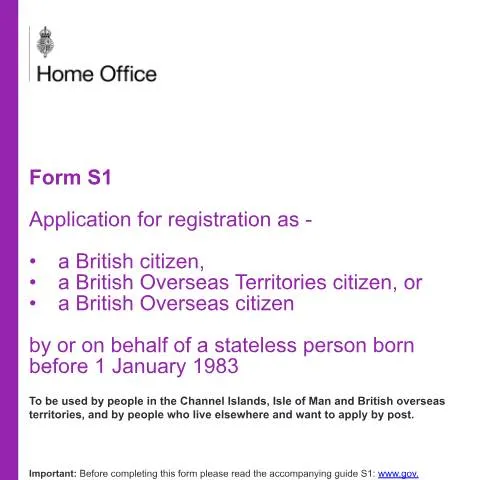
Stateless Before 1983: The Complex Path to British Citizenship Registration
For individuals born stateless before 1 January 1983, the journey to British citizenship follows a unique legal pathway established under historic nationality laws. Form S1 serves as the gateway for these specific cases, where conventional citizenship acquisition through birth or descent wasn't possible due to complex circumstances surrounding statelessness at birth. This registration process acknowledges the particular vulnerabilities faced by stateless persons whilst requiring detailed documentation of family connections and residence patterns.
The form addresses three distinct categories of British nationality: British citizen, British Overseas Territories citizen, or British Overseas citizen status. Each pathway depends on intricate relationships between the applicant's birth circumstances, parental nationality status before 1983, and specific residence requirements that vary considerably based on the qualifying parent's legal status under pre-1983 nationality legislation.
Decoding the Statelessness Requirement and Historical Context
The fundamental prerequisite for using Form S1 centres on establishing genuine statelessness from birth, combined with birth occurring before the pivotal date of 1 January 1983. This date marks the implementation of the British Nationality Act 1981, which fundamentally restructured British nationality law and created new pathways for citizenship acquisition.
Section 1.19 of the form demands a comprehensive explanation of why the applicant remained stateless from birth. This isn't merely a formality—UK Visas and Immigration scrutinises these circumstances carefully. Common scenarios include:
- Parents holding different nationalities where neither country's laws granted citizenship to children born abroad
- Birth in territories where jus soli (right of the soil) didn't apply and parental nationality laws excluded the child
- Complex colonial-era situations where British protected persons or British subjects without citizenship couldn't transmit nationality
- Cases involving foundlings or children of unknown parentage in specific jurisdictions
The historical complexity stems from the layered nature of British nationality legislation between 1948 and 1983, when various categories of British subject existed alongside Citizens of the United Kingdom and Colonies, each with different rights of transmission to children.
Proving Continuous Statelessness
Demonstrating statelessness requires negative proof—showing what citizenship was not acquired rather than what was obtained. This involves providing evidence that:
- No country granted citizenship at birth through jus soli or jus sanguinis principles
- Subsequent naturalisation or registration never occurred in any jurisdiction
- Parents' nationality status at birth didn't enable transmission of citizenship
Navigating Parental Nationality Categories Under Pre-1983 Law
Section 2 of Form S1 delves into the qualifying parent's nationality status immediately before 1 January 1983—a crucial determination that shapes the entire application. The form presents several distinct categories, each corresponding to different sections of the accompanying guidance and carrying specific implications for the applicant's eligibility.
| Parental Status Category | Key Characteristics | Typical Qualifying Scenarios |
|---|---|---|
| Citizen of the United Kingdom and Colonies | Full citizenship rights pre-1983 | Birth in UK or colonies, naturalisation, registration through marriage |
| British subject without citizenship | Status but no specific country citizenship | Certain Commonwealth connections, specific historical circumstances |
| British subject under section 2 of the British Nationality Act 1948 | Retained status from earlier legislation | Pre-1948 British subjects maintaining status |
| British subject by registration under section 1 of the British Nationality Act 1965 | Specific registration pathway | Women who lost British subject status through marriage |
Each category requires different supporting documentation. For naturalisation or registration cases, applicants must provide certificate numbers, dates, and places of the original proceedings. This information often requires archival research, as records from this period may be held in various repositories including The National Archives or relevant colonial archives.
The Marriage Factor and Legitimacy Considerations
The form specifically requests parents' marriage details, reflecting the legal significance of legitimacy under pre-1983 nationality law. Children born outside marriage faced different rules for citizenship transmission, and in many cases, only the mother's nationality status was relevant for determining the child's potential citizenship claims.
This historical discrimination has been partially addressed through subsequent legislation, but for Form S1 purposes, the original legal framework at the time of birth remains determinative.
Residence Requirements and the Three-Year Address History
Ordinary residence requirements vary significantly depending on the qualifying parent's nationality category, with some applications requiring no residence period whilst others demand substantial UK connections. Section 2.18 requires a comprehensive three-year address history within the UK or relevant overseas territory, but this only applies to specific qualifying routes outlined in the guidance sections.
The residence requirement serves multiple purposes beyond simple eligibility verification. UK Visas and Immigration uses this information to:
- Verify continuous residence where required by the specific qualifying route
- Cross-reference against other government databases for consistency checks
- Assess the applicant's integration and connection to the UK
- Identify any periods of absence that might affect eligibility
Documentation Challenges for Historical Residence
Proving residence for periods potentially spanning decades presents practical difficulties. Acceptable evidence typically includes:
- Official records: Council tax records, NHS registration, electoral roll entries
- Educational documentation: School records, university transcripts, examination certificates
- Employment evidence: P60 certificates, payslips, employer references
- Financial records: Bank statements, mortgage documents, insurance policies
- Utility and municipal records: Gas, electricity, water bills, library registrations
The key challenge lies in assembling documentation spanning potentially several decades, particularly for applicants who may have had irregular status or limited access to formal services during their residence.
The Referee System and Identity Verification Process
Form S1 employs a dual-referee system designed to verify both identity and character, with specific professional standing requirements that reflect the gravity of citizenship registration. The referee requirements demonstrate UK Visas and Immigration's approach to combating identity fraud whilst ensuring applications receive proper scrutiny from credible sources.
The first referee must possess professional standing—ministers of religion, civil servants, or members of professional bodies such as accountants or solicitors not representing the applicant. This requirement ensures access to individuals with established reputations who understand the significance of their endorsement.
The second referee faces more stringent requirements: they must normally hold a British citizen passport and either possess professional qualifications or be over 25 years of age. This dual requirement reflects both maturity expectations and the practical need for referees who understand British civic responsibilities.
Referee Responsibilities and Verification Checks
Both referees must declare they are not relatives, solicitors, or agents of the applicant, ensuring independence in their assessment. They must also confirm they are not employed by the Home Office, preventing conflicts of interest in the decision-making process.
UK Visas and Immigration conducts verification checks on referees, potentially including:
- Professional body membership verification for qualified referees
- Passport validity checks for British citizen referees
- Direct contact to confirm their endorsement and knowledge of the applicant
- Cross-referencing against internal databases to identify any previous issues
Geographic Scope and Application Channels
Form S1 serves specific geographic constituencies, primarily those in the Channel Islands, Isle of Man, British overseas territories, and individuals living elsewhere who must apply by post. This geographic limitation reflects the complex administrative arrangements between different parts of the British family of nations and territories.
The postal application requirement for overseas residents acknowledges practical limitations in accessing UK-based application centres whilst maintaining security through documented submission processes. Applications from these locations face additional processing considerations, including:
- Extended processing times due to international mail and verification requirements
- Additional authentication requirements for foreign-issued supporting documents
- Potential need for apostille certification or consular authentication
- Currency conversion considerations for application fees
Channel Islands and Isle of Man Considerations
Applicants from the Channel Islands and Isle of Man operate under special constitutional arrangements with the UK. Their use of Form S1 reflects the unique position of these Crown Dependencies, where residents may have complex nationality situations despite close UK connections.
These jurisdictions maintain their own immigration controls and nationality concepts, but residents often qualify for British citizenship through various historical connections, making the stateless person provisions particularly relevant for individuals caught between different legal systems.
Processing Timeline and Post-Application Procedures
Form S1 applications enter a specialised processing stream within UK Visas and Immigration, reflecting the complex legal and historical research required to evaluate statelessness claims and parental nationality status. Unlike straightforward naturalisation applications, these cases often require archival research and consultation with legal specialists familiar with pre-1983 nationality law.
The processing involves several distinct phases:
- Initial completeness check: Verification that all required sections are completed and supporting documents provided
- Referee verification: Confirmation of referee credentials and direct contact where necessary
- Historical research phase: Investigation of parental nationality claims, often involving archival records
- Statelessness assessment: Detailed analysis of why citizenship wasn't acquired at birth or subsequently
- Legal determination: Final decision on eligibility under the relevant statutory provisions
Applicants should expect processing times significantly longer than standard naturalisation cases, particularly where historical research proves complex or where foreign government records require verification.
Potential Outcomes and Next Steps
Successful applications result in registration as a British citizen, British Overseas Territories citizen, or British Overseas citizen, depending on the qualifying parent's status and the specific route used. Registration generates a certificate of registration, which serves as definitive proof of British nationality status.
Unsuccessful applications may be reconsidered if additional evidence becomes available, particularly where historical records initially unavailable can subsequently be located. The complex nature of these cases means that initial refusals don't necessarily indicate fundamental ineligibility—often they reflect documentation gaps that can be addressed through further research.
For successful applicants, registration opens access to British passport applications, consular protection, and the full range of citizenship rights. However, the specific type of British nationality acquired affects certain rights, particularly regarding onward transmission to children and residence rights in the UK itself.
Documentation Requirements and Evidence Standards
Submitting a successful Form S1 application hinges on providing comprehensive documentary evidence that meets the Home Office's exacting standards. The burden of proof lies entirely with the applicant to demonstrate both their stateless status and their eligibility under the specific provisions for those born before 1 January 1983.
For establishing statelessness, you must provide evidence from every country where you might reasonably be expected to hold citizenship. This typically includes your country of birth, your parents' countries of nationality, and any country where you've held long-term residence. The evidence required varies significantly depending on the country in question and may include:
- Formal certificates of non-nationality issued by relevant embassies or consulates
- Written confirmations from foreign ministries or citizenship departments stating you are not recognised as a citizen
- Correspondence demonstrating unsuccessful attempts to obtain citizenship or travel documents
- Legal opinions from qualified lawyers in the relevant jurisdictions explaining why citizenship cannot be acquired
The Home Office recognises that obtaining such documentation can be extremely challenging, particularly from countries experiencing political instability or those that don't routinely issue certificates of non-nationality. In such circumstances, you should provide a detailed written explanation of the steps you've taken to obtain evidence, including dates of contact with relevant authorities and copies of any correspondence received.
Birth documentation presents particular complexities for pre-1983 cases. If you were born in the UK, you'll need your full birth certificate showing both parents' details. However, many applicants face situations where birth registration was delayed, incomplete, or where records have been lost. The Home Office may accept alternative evidence such as:
- Hospital records or medical certificates from the time of birth
- Baptismal certificates or religious records created shortly after birth
- Early school records showing place of birth
- Statutory declarations from individuals with personal knowledge of the birth circumstances
Parental documentation requirements extend beyond simple birth or marriage certificates. You must demonstrate your parents' immigration status in the UK at the time of your birth, which may require obtaining Home Office records through Subject Access Requests. This process can take several months, so it's advisable to initiate this well before submitting your Form S1 application.
For evidence of continuous residence, the Home Office expects a comprehensive chronological account supported by contemporaneous documentation. Acceptable evidence includes tenancy agreements, utility bills, employment records, NHS registration documents, and educational certificates. Gaps in documentation must be explained, and the Home Office may request additional evidence or conduct interviews to verify residence claims.
Complex Family Scenarios and Succession Rights
The pre-1983 provisions for stateless persons often involve intricate family situations that require careful legal analysis. Understanding how citizenship rights pass between generations, particularly in cases involving adoption, legitimation, or complex parental relationships, is crucial for determining eligibility under Form S1.
Adoption presents one of the most complex scenarios. If you were adopted before 1 January 1983, your citizenship entitlement depends on several factors including the date of adoption, the citizenship status of your adoptive parents, and whether the adoption was recognised under UK law. Court adoption orders from England, Wales, Scotland, or Northern Ireland generally confer the same rights as if you were the natural child of the adoptive parents. However, foreign adoption orders require individual assessment to determine their recognition under UK law at the time they were made.
The situation becomes particularly complex with de facto adoptions – informal arrangements where you were raised by individuals who weren't your biological parents but never formally adopted you. The Home Office may recognise such arrangements if there's compelling evidence of a genuine parent-child relationship established in infancy, but each case requires detailed examination of the specific circumstances.
Legitimation – the process by which children born outside marriage acquire the same status as those born within marriage – also affects citizenship entitlement. Under pre-1983 law, legitimation could occur through the subsequent marriage of parents or through formal legal processes in certain jurisdictions. The timing of legitimation relative to your birth and your parents' citizenship acquisition can significantly impact your eligibility.
Cases involving foundlings – children whose parentage cannot be established – present unique challenges. While UK law contains provisions for foundlings discovered in the UK to be treated as British citizens, these don't automatically apply to stateless foundlings. Such cases require individual assessment, often involving detailed investigation into the circumstances of discovery and any attempts to establish parentage.
Multiple nationality scenarios add another layer of complexity. Even if one parent held British citizenship, you may still be eligible for stateless person registration if circumstances prevented the transmission of that citizenship. This might occur where:
- The British parent was themselves naturalised and subject to restrictions on passing citizenship to children born abroad
- Registration requirements weren't met within specified timeframes
- The birth wasn't registered with British consular authorities when required
- Gender-based restrictions prevented citizenship transmission through the mother
The Home Office maintains detailed guidance on how pre-1983 citizenship law applied in various scenarios, but individual cases often require expert legal analysis to determine the correct application of historical provisions.
Alternative Routes and Strategic Considerations
While Form S1 represents the primary route for stateless persons born before 1983, understanding alternative pathways and their relative advantages is essential for making informed decisions about your citizenship application strategy.
The most significant alternative is naturalisation as a British citizen under section 6 of the British Nationality Act 1981. This route requires five years' continuous residence (or three years if married to a British citizen), demonstrated knowledge of English and life in the UK, and payment of significantly higher fees. However, naturalisation offers certain advantages including greater discretion for the Home Office to overlook minor residence gaps and clearer processing timeframes.
For those with complex residence histories, naturalisation might prove more straightforward than demonstrating entitlement under the stateless person provisions. The residence requirements for naturalisation are well-established and don't require the detailed historical analysis needed for Form S1 applications. Additionally, the "good character" requirement, while potentially challenging, provides clearer guidance than the somewhat subjective assessments involved in historical citizenship entitlement.
Registration under section 4B offers another potential route for individuals who can demonstrate British citizenship entitlement but face technical barriers to proving that entitlement. This provision allows registration where an individual would have been a British citizen but for historical injustices, administrative errors, or legislative gaps. The fees are generally lower than naturalisation, though the evidential requirements can be substantial.
EU Settlement Scheme applications may also be relevant for stateless persons who were resident in the UK before 31 December 2020 and held EU citizenship or were family members of EU citizens. While this doesn't lead directly to British citizenship, it provides secure immigration status from which naturalisation applications can later be made.
Strategic timing considerations play a crucial role in choosing between routes. Form S1 applications have no statutory processing timeframe, and complex cases can take 18 months or more to resolve. If you're approaching naturalisation eligibility, it may be worth considering whether to proceed with Form S1 or wait to apply for naturalisation, particularly if your residence documentation is stronger for recent years than for historical periods.
The fee differential between routes is substantial. Form S1 applications cost significantly less than naturalisation, making them attractive for applicants facing financial constraints. However, the potential for lengthy processing times and requests for additional evidence should factor into cost-benefit analyses.
Some applicants may benefit from a dual approach – submitting a Form S1 application while simultaneously preparing for naturalisation eligibility. This allows withdrawal of the Form S1 application if circumstances change or if naturalisation becomes a more attractive option. However, this strategy requires careful consideration of the implications of having multiple applications in progress.
Legal representation becomes particularly valuable when navigating between different routes. Solicitors specialising in British nationality law can provide detailed analysis of your specific circumstances and advise on the optimal strategy. The complexity of pre-1983 citizenship law, combined with the high stakes of citizenship applications, often justifies professional legal advice despite the additional cost involved.