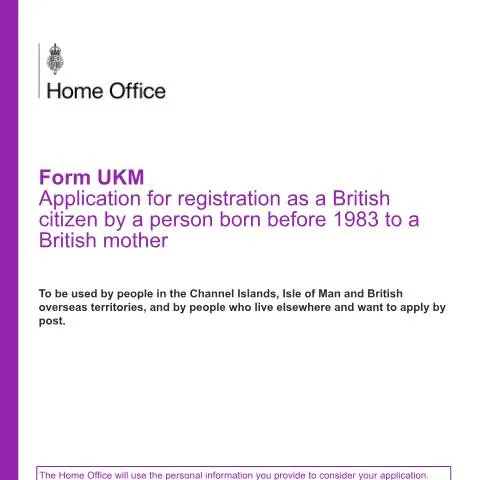
The Historical Context Behind Form UKM: Addressing a Legacy of Gender Discrimination
Before 1983, British nationality law contained a significant inequity that affected thousands of people worldwide. While children born to British fathers abroad could automatically claim British citizenship, those born to British mothers faced far greater obstacles. This discrimination reflected the legal doctrine of jus sanguinis through the paternal line only, leaving many individuals with legitimate claims to British citizenship unable to access their rights.
Form UKM emerged as the administrative remedy to this historical injustice following the British Nationality Act 1981, which came into force on 1 January 1983. The legislation established new pathways for registration as a British citizen, specifically targeting those born before 1983 to British mothers who were previously denied citizenship rights. This form represents more than a bureaucratic process—it's a mechanism for restoring citizenship rights that should have been available from birth.
The form's significance extends beyond individual applications. It addresses cases involving British women who served overseas in colonial administrations, married foreign nationals, or lived abroad during periods when their citizenship could not be transmitted to their children. Many applicants discover their eligibility decades later, often when researching family history or encountering passport renewal difficulties that reveal gaps in their citizenship status.
Eligibility Requirements and Qualifying Circumstances
Form UKM specifically targets individuals born before 1 January 1983 whose mothers were British citizens or Citizens of the United Kingdom and Colonies (CUKC) at the time of birth. However, the eligibility criteria extend beyond this basic requirement, encompassing several distinct scenarios that reflect the complex evolution of British nationality law.
Primary eligibility categories include:
- Individuals born to British mothers who were married to foreign nationals
- Children of British mothers born in countries where jus soli (birthright citizenship) did not apply
- Descendants of British women who lost their citizenship upon marriage to foreign nationals under pre-1949 legislation
- Those whose mothers acquired British status through their own British mothers (maternal grandmother route)
The form also accommodates women who married British men before 1983 and acquired the right of abode but never formally registered as British citizens. This provision recognises that marriage to a British citizen before 1983 conferred certain rights that can now be converted into full citizenship.
Settlement status plays a crucial role for certain applicants. Those who were settled in the UK before 1983 and maintained ordinary residence for at least five years may qualify under specific provisions. The concept of "settled status" refers to indefinite leave to enter or remain, a status that must be clearly documented with precise dates.
Complex Genealogical Requirements
Unlike straightforward naturalisation applications, Form UKM often requires extensive genealogical research spanning multiple generations. Applicants must trace their maternal lineage and, in some cases, provide detailed information about maternal grandparents. This requirement stems from the various ways British citizenship could be acquired, lost, and restored throughout the 20th century.
The form distinguishes between different types of British status: citizenship by birth, registration, naturalisation, and acquisition through colonial connections. Each pathway requires specific documentation and affects the strength of the citizenship claim differently.
Navigating the Documentary Evidence Maze
Form UKM demands comprehensive documentary proof spanning potentially decades of family history. The Home Office requires original documents or certified copies, and the quality of evidence directly impacts processing times and success rates. Understanding which documents carry the most weight can significantly strengthen an application.
| Document Type | Primary Purpose | Acceptable Alternatives |
|---|---|---|
| Mother's birth certificate | Prove British birth or colonial connection | Baptismal records, colonial registration documents |
| Parents' marriage certificate | Establish legitimacy and maternal status | Church records, consular registration |
| Mother's passport | Confirm British citizenship status | Certificate of naturalisation, registration certificate |
| Applicant's birth certificate | Establish identity and parentage | Hospital records, adoption certificates |
Challenging documentation scenarios frequently arise in UKM applications. Colonial records may have been lost during independence transitions, wartime destruction affected many registry offices, and frequent relocations can scatter family documents across multiple countries. The Home Office maintains some flexibility for exceptional circumstances but requires detailed explanations for missing documents.
Certified translations become necessary for documents issued in languages other than English. The Home Office accepts translations from qualified translators, embassy officials, or notarised translations meeting specific standards. Poor translations can delay applications significantly, making professional translation services worthwhile for complex documents.
Proving Continuous Residence and Settlement
For applicants claiming settlement before 1983, documentary proof becomes particularly challenging. The Home Office requires evidence of both the date settlement was granted and continuous residence periods. Acceptable evidence includes old passport stamps, employment records, tax documents, school records, and medical registration documents.
The five-year ordinary residence requirement must be demonstrated through consistent presence in the UK, not merely legal permission to stay. Brief absences for holidays or work assignments don't disqualify applicants, but extended periods abroad require careful explanation and additional supporting evidence.
Completing Form UKM: Section-by-Section Analysis
Form UKM's structure reflects the complexity of pre-1983 nationality law, requiring careful attention to seemingly minor details that can significantly impact processing outcomes. The current version (02/26) spans twelve pages and demands precision in every field, as errors or omissions frequently result in delays or requests for additional information.
Personal Information Accuracy
Section 1 establishes the applicant's identity and current status. The surname field carries particular importance as it will appear exactly as written on the citizenship certificate. Discrepancies between the form and supporting documents must be explained thoroughly, whether due to marriage, deed poll changes, or transliteration variations from non-Latin scripts.
The National Insurance number requirement can pose challenges for overseas applicants who never worked in the UK. While not always mandatory, providing an NI number when available helps verify identity and residence periods. The Home Office can process applications without NI numbers but may require additional identity verification steps.
Address history over five years serves multiple purposes beyond simple contact information. It helps establish residence patterns, demonstrates stability, and provides context for other aspects of the application. Gaps or frequent moves require explanation, and overseas addresses must be complete and verifiable.
Parental Details and Genealogical Connections
The parental information sections form the core of most UKM applications. Maternal details receive primary focus, requiring comprehensive information about the mother's birth, nationality acquisition, and citizenship status at the applicant's birth. The distinction between different types of British status becomes crucial here—Citizens of the United Kingdom and Colonies, British subjects, and British citizens all carry different implications for transmission rights.
Certificate numbers for naturalisation or registration must be provided when available. These numbers allow the Home Office to verify records directly and can significantly accelerate processing. When certificate numbers are unknown, applicants should provide as much detail as possible about when and where the naturalisation or registration occurred.
Paternal information, while seemingly secondary in maternal transmission cases, can still influence the application outcome. Some provisions require that the father was not British, while others may offer alternative pathways through paternal connections. Complete and accurate paternal information prevents potential complications during assessment.
Grandparental Information Requirements
The grandparental sections apply when citizenship claims trace through maternal grandmothers—a common scenario for children of British women who married foreign nationals. These sections require the same level of detail as parental information but often prove more challenging to complete due to the passage of time and limited record-keeping in earlier eras.
Understanding when grandparental information becomes relevant requires careful analysis of nationality law changes. The form's guidance notes provide some direction, but complex cases may benefit from preliminary legal advice before submission to avoid incomplete applications.
Processing Pathways and Administrative Handling
UK Visas and Immigration processes Form UKM applications through specialised teams familiar with historical nationality legislation and colonial-era documentation. The complexity of these cases means processing times vary significantly based on the clarity of documentation, the complexity of the citizenship claim, and current caseload volumes.
Initial processing involves document verification and eligibility assessment against historical nationality provisions. Caseworkers must interpret legislation spanning multiple decades and consider various colonial arrangements that affected citizenship transmission. This requires expertise beyond standard immigration applications and contributes to extended processing periods.
The assessment process typically follows these stages:
- Document completeness and authenticity verification
- Genealogical chain validation through historical records
- Nationality law interpretation for the specific circumstances
- Cross-referencing with Home Office historical databases
- Decision formulation and certificate preparation
Successful applications result in a certificate of registration as a British citizen, which serves as proof of citizenship status for passport applications and other purposes. The certificate includes the registration date and reference number for future verification needs.
Handling Complex or Disputed Cases
Applications involving disputed parentage, missing documentation, or conflicting records receive additional scrutiny. The Home Office may request DNA testing, witness statements, or expert genealogical reports to establish facts essential to the citizenship determination. These requirements can extend processing times considerably but ensure accurate decisions.
Appeals processes apply to refused applications, though the grounds for refusal in UKM cases typically relate to insufficient evidence rather than discretionary decisions. Resubmission with additional documentation often proves more effective than formal appeals when the core eligibility criteria appear to be met.
Geographic Scope and Submission Arrangements
Form UKM serves applicants across diverse geographic locations, reflecting the global nature of pre-1983 British communities and their descendants. The form explicitly covers residents of the Channel Islands, Isle of Man, and British Overseas Territories, as well as applicants worldwide who must submit by post.
Postal submission requirements create unique challenges for international applicants dealing with valuable original documents and varying postal reliability. The Home Office provides specific guidance on secure document transmission and accepts certain digital submissions in exceptional circumstances, though original documents remain the preferred standard.
Regional considerations affect applications in several ways:
- Document authentication requirements vary by country
- Postal services and delivery timeframes differ significantly
- Currency conversion affects fee payments
- Time zone differences impact communication with the Home Office
British Overseas Territories present particular complexities due to their unique constitutional relationships with the UK. Citizens of these territories may have different pathways to British citizenship, and Form UKM applications must carefully consider the specific territory's status and relevant legislation.
Citizenship Ceremony Arrangements
Successful UKM applicants must complete a citizenship ceremony to finalise their British citizenship. The form includes provisions for ceremony location preferences, recognising that applicants may live far from major urban centres or have mobility constraints affecting venue accessibility.
Overseas applicants face additional ceremony logistics, as ceremonies typically occur in the UK unless exceptional circumstances apply. Planning travel for ceremony attendance should factor into application timing, particularly for applicants with urgent passport or travel requirements.
Data Protection and Privacy Considerations
Form UKM processing involves extensive personal data collection spanning multiple family members and potentially sensitive information about immigration status, residence patterns, and family relationships. The Home Office operates under strict data protection obligations outlined in the Data Protection Act 2018 and UK GDPR requirements.
Information sharing arrangements extend beyond the Home Office to include other government departments, overseas authorities, and private sector organisations involved in document verification. The privacy notice referenced in the form provides detailed information about these sharing arrangements and individual rights regarding personal data.
Key privacy protections include:
- Right to access personal data held by the Home Office
- Correction rights for inaccurate information
- Data retention limitations aligned with operational requirements
- Security measures protecting sensitive personal information
Applicants concerned about data handling can request detailed information about how their personal data will be processed and stored. The Home Office maintains specific procedures for handling sensitive cases involving personal safety concerns or confidential circumstances requiring additional protection measures.
The international nature of UKM applications often involves cross-border data transfers for verification purposes. These transfers operate under appropriate safeguards ensuring continued protection of personal information when shared with overseas authorities or verification services.