When Council Tenants Dream of Ownership: The RTB1 Gateway to Property Purchase
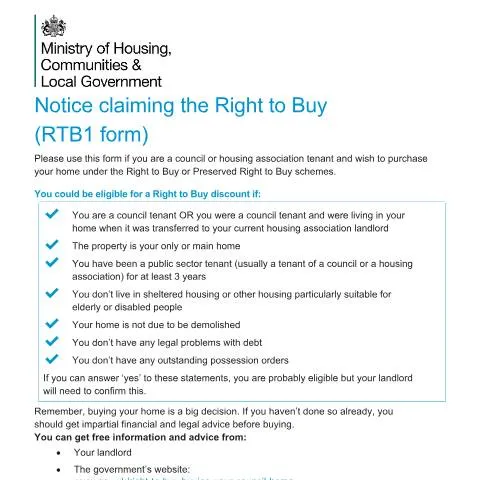
For millions of council and housing association tenants across England, the idea of owning their own home remains a powerful aspiration. The RTB1 form represents the crucial first step in transforming that dream into reality under the Right to Buy scheme. This official notice, formally titled "Notice claiming the Right to Buy", serves as your legal declaration of intent to purchase the property you've been renting from a public sector landlord.
The Right to Buy scheme has enabled over two million households to purchase their homes since its introduction in 1980. Yet despite its long history, many eligible tenants remain unaware of the process or hesitant about taking that initial step. The RTB1 form cuts through the complexity by establishing your eligibility, calculating potential discounts, and formally notifying your landlord of your purchase intentions.
What makes this form particularly significant is its role as a protective mechanism for tenants. Once your landlord receives your completed RTB1, they cannot simply ignore your request or delay indefinitely. The law requires them to respond within specific timeframes, either confirming your right to buy or explaining why you don't qualify. This creates a structured pathway that prevents landlords from blocking legitimate purchase attempts.
Decoding Eligibility: The Three-Year Rule and Beyond
The foundation of any Right to Buy application rests on meeting specific eligibility criteria, with the three-year public sector tenancy requirement being the most critical. However, this rule contains several nuances that many applicants overlook.
Your three years don't need to be consecutive or with the same landlord. If you've moved between different council properties, or from a council to a housing association when your property was transferred, these periods typically count towards your qualifying time. The form specifically requests details of all previous tenancies, recognising that modern housing careers often involve multiple moves.
Particularly important is the treatment of relationship-based qualifying periods. If you're married or in a civil partnership, your partner's previous public sector tenancies can contribute to your qualifying period. This provision extends even further in certain circumstances – if your current partner's deceased spouse was a public sector tenant, those tenancy periods may also count towards your qualification.
| Tenant Category | Key Requirements | Common Complications |
|---|---|---|
| Secure Council Tenant | 3+ years public sector tenancy; property as main home | Joint tenants must agree or sign Part F |
| Preserved Right to Buy | Former council tenant; property transferred to housing association | Must prove continuous residence through transfer |
| Joint Applicants | Up to 3 family members can join; only one needs property as main home | Family members need 12 months' residence as main home |
The "only or main home" criterion deserves particular attention. You cannot use Right to Buy to purchase an investment property or second home. However, if you're applying jointly with family members, only one applicant needs to satisfy this requirement. This flexibility allows adult children living elsewhere to join their parents' application, or enables couples where one partner maintains a separate address for work purposes.
Navigating Family Inclusion and Joint Applications
One of the RTB1 form's most complex sections involves determining who can participate in your Right to Buy application. The legislation allows up to three family members to join you, but the definition of "family member" extends well beyond immediate relatives.
Eligible family members include spouses, civil partners, children, parents, grandparents, grandchildren, siblings, uncles, aunts, nephews, and nieces. Crucially, they must have lived in the property as their main home for at least 12 months before your application. This residency requirement aims to prevent speculative applications where distant relatives suddenly claim involvement.
The form's design acknowledges real-world family complexity. If a family member hasn't met the 12-month residency requirement, you can still request their inclusion, though your landlord has discretion to refuse. This provision proves valuable in situations involving recent family reunifications, caring arrangements, or relationship changes.
Joint applications carry significant implications for ownership structure and future responsibilities. All named applicants become joint owners of the property, with equal rights and obligations. This includes responsibility for mortgage payments, maintenance costs, and compliance with any Right to Buy conditions. The form requires explicit confirmation that each family member wishes to participate, preventing unwilling inclusion in property purchases.
When existing tenants don't wish to participate in the purchase, they must sign Part F of the form, formally agreeing to the termination of their tenancy rights. This protects all parties by ensuring clear legal transition from rental to ownership status.
Discount Calculations: Maximising Your Financial Advantage
The Right to Buy discount represents the scheme's most compelling financial incentive, potentially saving tens of thousands of pounds on your property purchase. The RTB1 form initiates the formal assessment process that determines your exact discount entitlement.
Current discount rates begin at 35% for houses and 50% for flats after three years of qualifying public sector tenancy. These percentages increase annually – by 1% for houses and 2% for flats – up to maximum discount caps. The caps vary by region, reflecting local property values, with higher limits in areas where property prices have increased significantly.
Your qualifying period calculation encompasses not just your current tenancy, but all previous public sector tenancies. This includes periods with different councils, housing associations, and even certain armed forces accommodation. The form's detailed tenancy history sections ensure no qualifying period gets overlooked, potentially adding years to your calculation and increasing your discount substantially.
Preserved Right to Buy tenants often benefit from particularly generous discount calculations. If your property transferred from council to housing association ownership while you remained as tenant, your qualifying period typically includes your entire council tenancy, even if that extends back decades. This can result in maximum discount entitlements for long-term tenants.
The form also captures joint qualifying periods, where married couples or civil partners can combine their public sector tenancy histories. This provision proves especially valuable when one partner has extensive qualifying periods while the other has been in private sector accommodation.
Submission Strategies and Legal Safeguards
The RTB1 form's submission creates immediate legal obligations for your landlord, making the delivery method and timing crucial considerations. The form explicitly recommends either hand delivery with receipt request or recorded delivery postal submission, reflecting the legal significance of establishing your application date.
Your application date determines several critical timelines. Landlords must acknowledge receipt within five working days and provide their formal response within eight weeks for most applications, or twelve weeks if they need to verify your tenancy history with previous landlords. These statutory deadlines prevent indefinite delays and provide clear expectations for all parties.
The recorded delivery requirement isn't mere bureaucracy – it provides essential legal protection. If disputes arise about whether you submitted your application, or when you submitted it, postal tracking records provide definitive evidence. Hand delivery requires securing a dated, signed receipt from your landlord's office, creating equivalent proof of submission.
Retention of copies proves equally important. The form instructions emphasise keeping your completed form copy, as this becomes your primary evidence of the application details you submitted. Landlords occasionally claim they received incomplete applications or dispute specific details, making your retained copy crucial for resolving such disagreements.
Some tenants attempt informal approaches before submitting their RTB1, hoping to gauge their landlord's attitude or negotiate better terms. However, formal legal protections only begin when your landlord receives the completed RTB1 form. Until that point, landlords face no obligation to provide information about your potential discount or property valuation.
Understanding Landlord Responses and Next Steps
Once your landlord receives your RTB1 form, they must follow a structured response process governed by specific legal requirements. Understanding these obligations helps you monitor progress and identify when delays become unreasonable.
The initial acknowledgement should arrive within five working days, confirming receipt of your application and providing contact details for future correspondence. This acknowledgement doesn't indicate approval or rejection – it simply establishes that your application is being processed.
Within eight weeks, your landlord must provide their substantive response through either an RTB2 form (admitting your right to buy) or an RTB3 form (denying your right to buy). The RTB2 includes crucial information about your property's market value, your discount calculation, and the proposed purchase price. This valuation, conducted by qualified surveyors, forms the basis for your purchase decision.
RTB3 responses must specify exactly why your application has been rejected, referencing relevant legislation and providing evidence for their decision. Common rejection reasons include insufficient qualifying periods, property exemptions (such as rural locations or recent construction), or outstanding legal issues like possession proceedings.
If your landlord fails to respond within the statutory timeframe, you can apply to the County Court for an order compelling their response. This legal remedy ensures landlords cannot simply ignore RTB1 applications, though court proceedings obviously extend your overall timeline.
- Week 1: Acknowledgement of receipt expected
- Weeks 2-8: Landlord investigation and valuation process
- Week 8: RTB2 (approval) or RTB3 (rejection) response due
- Weeks 9-12: Extended deadline if previous landlord verification needed
- Beyond Week 12: County Court intervention available for non-response
Common Complications and Resolution Pathways
Right to Buy applications frequently encounter complications that the RTB1 form helps identify early in the process. Understanding these potential issues enables better preparation and smoother progression through the purchase process.
Tenancy verification challenges represent the most common complication. When you've had multiple previous tenancies, especially with different landlords, verification can become complex and time-consuming. Some housing associations or councils may have incomplete records, particularly for tenancies from decades ago. The form's "Authority to Disclose" section helps address this by providing formal consent for information sharing between landlords.
Joint tenancy situations often create complications when not all tenants wish to participate in the purchase. The RTB1 form addresses this through Part F, where non-participating tenants formally consent to the sale. However, securing these signatures can prove challenging if relationships between joint tenants have deteriorated or if some tenants cannot be contacted.
Property exemptions sometimes emerge after submission, particularly for properties in rural areas subject to special protections or buildings with historical significance. While landlords should identify these exemptions quickly, some cases require detailed investigation that extends response timeframes.
Financial complications can arise when tenants have outstanding rent arrears, service charge debts, or other obligations to their landlord. The RTB1 form doesn't directly address these issues, but they can affect your Right to Buy eligibility. Most landlords will require debt clearance before proceeding with sales.
Valuation disputes represent another common complication. If you disagree with the property valuation provided in your landlord's RTB2 response, you can request an independent valuation by the District Valuer. This process adds several weeks to your timeline but ensures fair market pricing.
When complications arise, maintaining detailed records of all correspondence becomes crucial. The RTB1 form establishes your application baseline, but subsequent negotiations, requests for additional information, and dispute resolution all build upon this foundation. Organised documentation helps resolve complications more efficiently and provides evidence for any formal appeals or court proceedings that might become necessary.
Strategic Timing and Market Considerations
The timing of your RTB1 submission can significantly impact your purchase experience, though many tenants overlook these strategic considerations. Understanding market dynamics, administrative cycles, and personal circumstances helps optimise your application timing.
Property market conditions influence both valuation outcomes and your financing options. During periods of rapid price growth, delaying your application might result in higher valuations and reduced effective discounts. Conversely, stable or declining markets might favour later applications, though Right to Buy discounts often offset market variations.
Administrative capacity varies throughout the year, with many council and housing association teams experiencing higher workloads during specific periods. School holiday periods often see increased Right to Buy activity as families plan major life changes around academic calendars. Submitting during quieter periods might result in faster processing and more attention to your application details.
Personal financial planning should align with your RTB1 submission timing. The statutory timescales mean you'll typically need mortgage arrangements within 10-12 weeks of receiving your RTB2 approval. Preparing mortgage applications before submitting your RTB1 can accelerate this process, though property valuations obviously cannot be completed until your landlord provides pricing information.
Some tenants benefit from coordinating their RTB1 submission with family members' circumstances. If adult children plan to join the application, ensuring their 12-month residency requirement is satisfied before submission prevents unnecessary delays or complications.
The form's emphasis on seeking independent financial and legal advice reflects the complexity of property purchases and the long-term implications of homeownership. Many tenants find that consulting with mortgage brokers, solicitors, or financial advisers before completing their RTB1 helps identify potential complications early and ensures smoother progression through the entire Right to Buy process.