When Accommodation Becomes a Legal Barrier: Understanding England's Permission to Rent Requirements
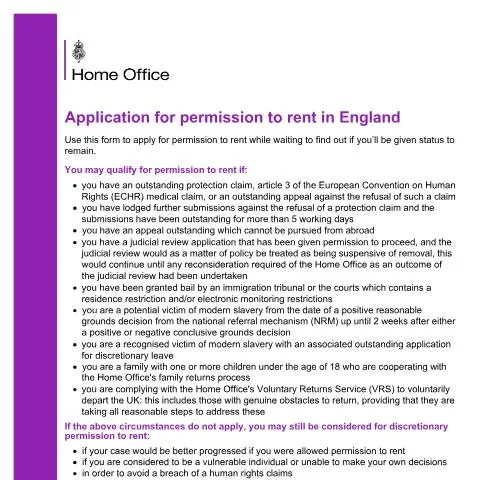
For thousands of individuals navigating the UK immigration system, securing housing represents far more than finding somewhere to live—it can become an insurmountable legal obstacle. The Application for permission to rent in England form addresses a critical gap in immigration law, providing a pathway for those caught between having no legal status and needing basic accommodation whilst their cases remain unresolved.
This Home Office document serves as a lifeline for people whose immigration circumstances prevent them from accessing rental accommodation under the Right to Rent scheme, yet who cannot realistically be expected to live without shelter whilst lengthy legal processes unfold. The form recognises that certain categories of individuals, despite lacking conventional immigration status, should not be rendered homeless whilst pursuing legitimate claims or appeals.
The application process reflects the complex intersection between immigration control, human rights obligations, and practical necessity. Unlike standard visa applications, this form acknowledges exceptional circumstances where the normal rules must bend to prevent destitution or human rights breaches.
Qualifying Circumstances: The Eight Pathways to Temporary Housing Rights
The Home Office has established eight distinct categories of individuals who may qualify for permission to rent, each reflecting different stages or complications within the immigration system.
Protection Claims and Medical Grounds
Individuals with outstanding protection claims represent the largest category of applicants. This encompasses asylum seekers whose initial claims remain under consideration, as well as those pursuing Article 3 ECHR medical claims—typically involving individuals who would face serious health consequences if removed from the UK. The form also covers those with outstanding appeals against refusals of such claims, recognising that the appeals process can extend for months or even years.
A particularly important provision covers situations where further submissions have been lodged against protection claim refusals. Once these submissions have been outstanding for more than five working days, the individual becomes eligible to apply. This timeframe acknowledges the Home Office's own processing delays whilst preventing abuse of the system.
Appeals That Cannot Be Pursued Abroad
Some immigration appeals carry in-country rights, meaning the individual cannot be removed whilst the appeal is pending. These cases often involve complex legal arguments about why removal would be inappropriate or unlawful, and the accommodation needs during these periods can be substantial.
Judicial Review and Legal Challenges
When judicial review applications receive permission to proceed and would be treated as suspensive of removal under Home Office policy, applicants gain access to the permission to rent process. This continues throughout any subsequent reconsideration period that the Home Office must undertake following the judicial review outcome.
Immigration Detention and Bail Conditions
Those granted immigration bail by tribunals or courts often face residence restrictions and electronic monitoring requirements. These individuals need stable accommodation to comply with their bail conditions, yet their lack of conventional status creates barriers to accessing housing through normal channels.
Modern Slavery Survivors: Specialised Protections and Timeframes
The form incorporates specific provisions for modern slavery survivors, reflecting the UK's obligations under anti-trafficking legislation and the unique vulnerabilities these individuals face.
Potential victims who receive a positive reasonable grounds decision through the National Referral Mechanism (NRM) gain immediate access to permission to rent applications. This protection continues until two weeks after either a positive or negative conclusive grounds decision, providing stability during the most critical phase of their recovery and legal processes.
For recognised victims with associated outstanding applications for discretionary leave, the permission to rent pathway remains open, acknowledging that their cases often involve complex trauma-related considerations that require extended processing times.
Family Cases and Voluntary Returns
Families with children under 18 who are cooperating with the family returns process receive special consideration. The Home Office recognises that maintaining stable accommodation becomes particularly crucial when children's welfare is involved, and that voluntary cooperation with removal processes should not result in immediate homelessness.
Similarly, those engaging with the Voluntary Returns Service (VRS) can access permission to rent whilst arranging their departure. This includes individuals with genuine obstacles to return, provided they are taking all reasonable steps to address these obstacles.
Discretionary Considerations: When Standard Categories Don't Apply
Beyond the eight defined categories, the form acknowledges that discretionary permission to rent may be appropriate in exceptional circumstances. This flexibility reflects the Home Office's recognition that immigration cases can involve unique complications that don't fit standard categories.
Three key discretionary grounds emerge from the guidance:
- Case progression benefits: Where allowing accommodation access would facilitate better case management or resolution
- Vulnerability assessments: For individuals considered vulnerable or unable to make their own decisions
- Human rights compliance: To avoid breaches of human rights obligations
These discretionary provisions require careful evidencing and typically involve more detailed casework consideration than standard category applications.
Navigating the Personal Details Section: Critical Information Requirements
Section 1 of the form demands comprehensive personal information that extends far beyond basic identification details. The name requirements prove particularly important, as applicants must provide their name exactly as shown in current passports or travel documents, alongside any alternative names they have used.
The form specifically requires disclosure of all names an individual has been known by, including married names, professional names, and aliases. This comprehensive approach reflects the Home Office's need to cross-reference information across multiple systems and previous applications.
Reference Numbers and Case Tracking
Question 1.2 requests various reference numbers that may help identify the applicant, including Unique Application Numbers (UAN), Home Office references, and Port references. These identifiers prove crucial for linking the permission to rent application with existing immigration records and avoiding processing delays.
| Reference Type | Format | Where to Find |
|---|---|---|
| UAN | Numeric sequence | Previous application acknowledgments |
| Home Office Reference | Alphanumeric code | Correspondence letters |
| Port Reference | Location-specific code | Entry/detention documents |
Family Unit Complications
The family details section (1.7) requires information about each individual within the family unit, with provision for more than ten family members through additional pages. Each family member needs their full name, date of birth, nationality, and any existing Home Office reference numbers.
This comprehensive family mapping serves multiple purposes: ensuring all eligible family members can benefit from any permission granted, cross-referencing with existing cases, and identifying potential complications where family members have different immigration statuses.
Documentation Requirements and Identification Challenges
The identification section presents one of the most challenging aspects of the application process. The form primarily requires either an Application Residence Card (ARC) or an Immigration Bail letter as proof of identity and current immigration circumstances.
However, the form acknowledges that many applicants may not possess these documents. Question 1.14 provides alternative pathways for those unable to provide standard identification, though the specific requirements for these alternatives are not detailed in the available excerpt.
Digital Submission Considerations
For email applications, the form accommodates digital file uploads in common image formats (.jpg, .gif, .png, .tif). This digital pathway can significantly accelerate processing times compared to postal submissions, though applicants must ensure document quality meets Home Office standards for digital processing.
The contact preference section (1.10) explicitly warns that choosing postal communication can slow application processing, emphasising the advantages of email-based correspondence for urgent accommodation needs.
Current Immigration Status: Navigating Complex Legal Positions
Questions 1.11 and 1.12 address the applicant's current immigration status, including any existing permission to stay and visa validity dates. These questions prove particularly complex for permission to rent applicants, as many may have expired visas or complicated legal positions.
The form requires precise dates in dd/mm/yyyy format, reflecting the Home Office's need for exact chronological information to assess eligibility and avoid conflicts with existing immigration conditions.
For individuals whose visas have expired but who remain in the UK pursuing appeals or further submissions, these questions help establish the exact legal timeline and identify any gaps in lawful residence that might affect the application.
Submission Process and Administrative Considerations
The completed form must be submitted to [email protected], indicating processing by a specialised unit within the Home Office structure. This centralised approach suggests dedicated expertise in handling these complex cases, though it may also indicate limited processing capacity.
The May 2025 revision date indicates recent updates to the form, likely reflecting policy changes or operational improvements based on processing experience. Applicants should ensure they use the most current version to avoid processing delays or rejections based on outdated requirements.
Data Protection and Information Sharing
The form's opening section addresses data protection concerns comprehensively, referencing the Data Protection Act 2018 and explaining how personal information may be shared with other public and private sector organisations both within the UK and overseas. This transparency reflects post-GDPR requirements whilst acknowledging the international nature of immigration enforcement.
The Privacy Notice for the Border, Immigration and Citizenship system provides detailed information about data rights and complaint procedures, essential reading for applicants concerned about information security or potential impacts on future immigration applications.
Understanding these data sharing arrangements proves particularly important for individuals whose cases may involve sensitive circumstances or who have concerns about information being shared with authorities in their countries of origin.
Documentation Requirements for Different Tenant Categories
The documentation you need to provide varies significantly depending on your immigration status and nationality. British and Irish citizens have the most straightforward requirements, whilst non-EEA nationals face more complex verification procedures.
British and Irish Citizens can demonstrate their right to rent using a current UK or Irish passport, or alternatively a birth certificate issued in the UK, Channel Islands, or Isle of Man alongside an official document showing their National Insurance number. If you're using a birth certificate, acceptable supporting documents include a P45, P60, or recent payslip from HMRC records.
EEA Nationals and Their Family Members who arrived before 31 December 2020 may still rely on their settled or pre-settled status under the EU Settlement Scheme. You'll need to provide your share code from the Home Office online system, which landlords can verify digitally. Those with pre-settled status should monitor their application deadlines, as this status typically expires after five years.
Non-EEA Nationals face the most detailed scrutiny. Current visa holders must present their biometric residence permit (BRP) or passport with valid entry clearance. The landlord will photograph these documents and may conduct additional verification through the Home Office Landlord Checking Service. If your immigration status includes conditions such as "no recourse to public funds," this won't typically affect your rental application, though some landlords may misunderstand these restrictions.
Students from overseas often encounter particular challenges. Your Tier 4 or Student visa documentation must clearly show you're permitted to rent accommodation. Some institutions provide additional letters confirming your enrollment status, which can strengthen your application. If you're in a shared tenancy, ensure each occupant over 18 provides their own documentation – the landlord cannot rely on one person's status to cover others.
Those with time-limited immigration status should be prepared to provide updated documentation when their current permission expires. Landlords are required to conduct follow-up checks, typically within 12 months of the initial verification or before your current status expires, whichever comes first.
Understanding Landlord Obligations and Your Rights During Verification
Landlords operate under strict legal obligations when conducting Right to Rent checks, and understanding these requirements protects you from discrimination whilst ensuring compliance with immigration law.
The verification process must occur before you move in, but landlords cannot discriminate based on nationality or immigration status when initially advertising properties or conducting viewings. They're prohibited from applying different rental terms or requesting additional security deposits solely because of your nationality or accent. If a landlord refuses to proceed with your application before seeing your documents, this may constitute unlawful discrimination.
During document examination, landlords must accept original documents only – they cannot insist on certified copies or additional authentication beyond what's legally required. The examination should occur in your presence, and you're entitled to retain your documents immediately afterward. Landlords may take photographs for their records, but they cannot retain original documents.
The Home Office provides specific guidance on acceptable document combinations. For instance, if your passport has expired but you hold valid immigration documents, the landlord should accept the combination rather than demanding passport renewal. Similarly, documents in foreign languages are acceptable if they're official immigration documents issued by the Home Office or UK Visas and Immigration.
Landlords who fail to conduct proper checks face civil penalties starting at £80 for first offences, escalating to £500 for subsequent breaches per occupant. However, these penalties don't transfer to you as the tenant – they remain the landlord's responsibility. If you discover your landlord hasn't conducted required checks, you cannot be penalised for their oversight.
Some landlords may attempt to outsource verification to letting agents or property management companies. Whilst this is permissible, the landlord remains ultimately responsible for ensuring checks are conducted properly. The person conducting the check must be satisfied that the documents belong to you and haven't been tampered with.
You have the right to request evidence that your check has been properly recorded. Landlords must retain copies of documents and check records for the duration of your tenancy plus 12 months afterward. They should be able to demonstrate when checks were conducted and by whom.
Navigating Complex Situations and Special Circumstances
Certain situations require additional consideration beyond standard Right to Rent procedures, particularly for those with changing immigration status or unusual documentation circumstances.
Pending Immigration Applications create particular complexity. If you've submitted an application to extend your current status before it expires, you typically maintain your previous rights whilst awaiting a decision. However, landlords may be unfamiliar with these provisions. The Home Office issues continuation letters or provides online verification systems for pending applications. Ensure you obtain this documentation promptly, as delays can complicate your rental arrangements.
Those appealing negative immigration decisions face additional challenges. Whilst appeal rights are pending, your accommodation rights may continue under specific circumstances. However, not all appeals provide this protection, and landlords may be reluctant to proceed without clear guidance. Contact the immigration advice sector or relevant support organisations for clarification on your specific situation.
Diplomatic and International Organisation Staff often hold specialised documentation that standard landlords rarely encounter. Diplomatic identity cards, UN laissez-passer documents, or similar international credentials may be valid for Right to Rent purposes, but verification procedures can be complex. The Foreign, Commonwealth & Development Office may provide additional guidance for unusual diplomatic situations.
Asylum Seekers and Refugees require careful navigation of documentation requirements. Those with refugee status or humanitarian protection hold clear rights to rent, evidenced by their biometric residence permits. However, asylum seekers awaiting decisions typically cannot access private rental accommodation, though exceptions exist for those receiving certain types of support or with permission to work.
Family Members of British Citizens sometimes face confusion regarding their status. Spouses, partners, or children of British citizens don't automatically acquire rental rights – their individual immigration status determines their eligibility. Recent changes to immigration rules may affect long-term residents who previously assumed their connection to British family members provided automatic rights.
Those experiencing domestic violence or family breakdown may find themselves in precarious situations regarding accommodation rights. If your immigration status depends on a relationship that has ended, seek immediate advice regarding your continued right to rent. Some provisions protect victims of domestic violence, but these require specific applications and evidence.
Shared Accommodation presents particular challenges when occupants have different immigration statuses. Each adult occupant requires individual verification, regardless of relationships between tenants. If one person's status changes or expires, this doesn't automatically affect others' rights, but landlords may need to conduct additional checks or modify tenancy arrangements.
Corporate tenancies, where employers arrange accommodation for employees, don't eliminate individual Right to Rent requirements. Both the company and individual employees may need to provide documentation, depending on the specific tenancy structure. International companies posting employees to the UK should ensure they understand these individual obligations beyond corporate guarantees.