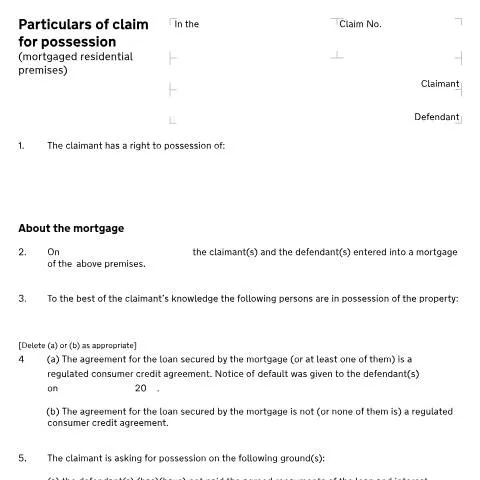
When Mortgage Payments Fail: The Legal Pathway to Property Repossession
Behind every mortgage possession case lies a story of financial distress, missed payments, and the stark reality that a family home may be lost. Form N120 serves as the formal legal document that transforms a lender's concerns about unpaid mortgage instalments into a court-sanctioned claim for possession of residential property. This particular version specifically addresses mortgaged residential premises, distinguishing it from commercial property or tenanted property possession claims.
The form represents a critical juncture where informal recovery attempts give way to formal legal proceedings. Unlike standard debt recovery, mortgage possession cases carry unique complexities due to the secured nature of the debt and the fundamental right to housing that courts must carefully balance against lenders' legitimate interests.
The Mortgage Lender's Perspective: Building a Watertight Legal Case
Mortgage lenders, building societies, and other secured creditors initiate possession proceedings through Form N120 when borrowers fall into arrears and informal recovery methods have been exhausted. The form serves as the particulars of claim - essentially the detailed legal argument explaining why the court should grant possession of the mortgaged property.
The claimant must demonstrate several key elements through the form. Firstly, they must establish their legal right to possession by providing details of the original mortgage agreement, including the date it was entered into and the parties involved. This foundational information proves the contractual relationship that gives rise to the right to seek possession.
Crucially, the form requires detailed financial information that goes far beyond simply stating that payments have been missed. Section 6 demands comprehensive disclosure including the original loan amount, current repayment terms, the total amount required to discharge the mortgage as of a specific date (no more than 14 days after the claim was issued), and any additional charges such as solicitor's costs and administration fees.
Regulated vs Unregulated Agreements: A Critical Distinction
One of the most significant aspects of Form N120 is the distinction between regulated and unregulated consumer credit agreements. This classification, governed by the Consumer Credit Act 1974, determines the procedural requirements that must be satisfied before possession proceedings can commence.
For regulated agreements - typically residential mortgages where the borrower is an individual and the loan was used to purchase or improve residential property - the lender must have served a formal notice of default before initiating court proceedings. The form requires the claimant to specify when this notice was given, as failure to serve proper notice can result in the claim being struck out.
For unregulated agreements - which might include commercial mortgages or certain buy-to-let arrangements - no default notice is required, but the claimant must clearly state that the agreement falls outside the regulated category.
Occupancy Details and Third Party Rights: Protecting All Interested Parties
Form N120 requires meticulous attention to who actually occupies the mortgaged property, as this directly impacts both the court's approach and the practical enforcement of any possession order. The form demands that claimants identify all persons believed to be in possession of the property, not just the named defendants.
This requirement reflects the court's obligation to ensure that anyone with a legitimate interest in remaining in the property has an opportunity to participate in the proceedings. Occupiers might include family members, lodgers, or other individuals who moved in after the mortgage was granted but who may have acquired certain rights through extended residence.
Family Law Act Protections and Matrimonial Rights
Section 9 of the form addresses one of the most complex areas of possession law: the rights of spouses and civil partners under family legislation. The Family Law Act 1996 and its predecessors granted certain individuals the right to register their interest in the matrimonial home, even if they are not named on the mortgage deed.
Where such registrations exist, these individuals must be given formal notice of the possession proceedings and have the right to participate in defending the claim. The court cannot make a possession order without considering their position, and they may be able to take over mortgage payments to preserve their right to remain in the property.
This protection extends beyond formal marriages to include civil partnerships and, in some circumstances, cohabiting partners who can demonstrate a beneficial interest in the property. The form requires claimants to make careful enquiries to identify any such interests, as failure to notify interested parties can result in the possession order being set aside at a later date.
Tenancy Complications: When Borrowers Become Landlords
Section 10 of Form N120 addresses a frequently overlooked but potentially crucial issue: whether the borrower has granted any tenancy over the mortgaged property. This situation commonly arises when borrowers, facing financial difficulties, attempt to generate rental income by letting rooms or the entire property to tenants.
The critical distinction lies between tenancies granted with the mortgagee's consent and those granted without such authorisation. Where a tenancy was created with the lender's permission, the tenant's rights are generally preserved even if possession proceedings succeed against the borrower. The incoming mortgagee effectively steps into the shoes of the landlord.
However, where tenancies were created without the mortgagee's consent - which is often the case when borrowers are in financial distress - the legal position becomes more complex. Such tenancies may be binding against the borrower but not against the mortgagee, potentially leaving tenants with limited protection once a possession order is granted.
| Tenancy Status | Lender's Consent | Tenant's Position Post-Possession |
|---|---|---|
| Authorised tenancy | Given before grant | Rights generally preserved |
| Unauthorised tenancy | Not obtained | Limited protection available |
| Assured shorthold | Varies by circumstances | Depends on original consent |
Financial Transparency Requirements: Beyond Simple Arrears Calculations
The financial sections of Form N120 demand a level of detail that goes far beyond stating that payments have been missed. This comprehensive approach reflects the court's need to understand the full financial picture before making decisions that could result in families losing their homes.
Section 6 requires disclosure of the original loan amount, current repayment terms, and the total sum needed to discharge the mortgage entirely. This latter figure must be calculated as of a date no more than 14 days before the claim was issued, ensuring the information remains current throughout the early stages of proceedings.
Interest Rate Disclosures and Historical Context
The form demands transparency about interest rate changes throughout the mortgage term. Claimants must disclose the initial interest rate, the rate immediately before arrears began to accrue, and the current rate at the time of issuing proceedings. This information helps the court understand whether changing interest rates contributed to the borrower's financial difficulties.
Variable rate mortgages, in particular, can create situations where borrowers who were comfortably meeting payments suddenly find themselves in arrears following interest rate increases. The court may take this context into account when considering whether to grant immediate possession or allow time for the borrower to address the arrears.
Additionally, the form requires disclosure of any additional charges under the mortgage terms, such as insurance premiums, maintenance fees, or ground rent where applicable. These amounts must be clearly separated between those included in the total redemption figure and those that represent separate arrears.
Pre-Action Protocols and Recovery Steps: Demonstrating Reasonable Conduct
Section 7 of Form N120 requires claimants to detail the steps already taken to recover the outstanding mortgage debt. This requirement reflects the court's expectation that possession proceedings should be a last resort, pursued only after reasonable attempts to resolve the situation have been exhausted.
The Pre-Action Protocol for Possession Claims Based on Mortgage or Home Purchase Plan Arrears sets out specific requirements that lenders must follow before issuing proceedings. These include providing clear information about the arrears, discussing possible repayment arrangements, and considering whether the borrower might be eligible for government assistance schemes.
Lenders must demonstrate that they have given borrowers a reasonable opportunity to seek debt advice from qualified advisers. This might involve providing contact details for Citizens Advice, StepChange Debt Charity, or other recognised debt counselling services. The court may be critical of lenders who rush to possession proceedings without allowing adequate time for professional advice to be obtained.
Exploring Alternatives to Possession
The form indirectly encourages consideration of alternatives to outright possession. These might include:
- Extended repayment arrangements where arrears are spread over the remaining mortgage term
- Capitalisation of arrears where outstanding amounts are added to the principal debt
- Interest-only periods to reduce monthly payments temporarily
- Partial possession orders allowing sale of part of large properties
- Voluntary sale arrangements where borrowers market the property themselves
Courts have wide discretionary powers to adjourn proceedings, suspend possession orders, or impose conditions that give borrowers opportunities to address their financial difficulties while protecting the lender's legitimate interests.
The Defendant's Circumstances: Social Security and Vulnerability Factors
Section 8 of Form N120 requires claimants to disclose what they know about the defendant's personal circumstances, with particular emphasis on receipt of social security benefits and any direct payments being made to the mortgagee. This information is crucial for the court's assessment of the borrower's ability to address the arrears and maintain future payments.
Where defendants receive benefits such as Universal Credit, Income Support, or Employment and Support Allowance, they may be eligible for Support for Mortgage Interest (SMI). This government scheme can provide assistance with mortgage interest payments, though it operates as a loan that must eventually be repaid when the property is sold.
The form also captures information about any direct payments already being made from benefits to the mortgage lender. Such arrangements, typically made through the Department for Work and Pensions, demonstrate that some effort is being made to address the mortgage debt, even if the amounts are insufficient to cover the full contractual payments.
Vulnerable Borrowers and Additional Protections
Courts are increasingly conscious of the need to provide additional protections for vulnerable borrowers. This might include individuals with mental health conditions, learning disabilities, serious physical illnesses, or those experiencing domestic violence. While Form N120 does not explicitly require disclosure of such circumstances, claimants are expected to bring relevant information to the court's attention.
The Equality Act 2010 requires courts to make reasonable adjustments for disabled participants in legal proceedings. This might involve allowing additional time for responses, accepting alternative forms of communication, or ensuring that court facilities are accessible. Lenders who are aware of such circumstances should flag them in their particulars of claim to ensure appropriate arrangements are made.
Court Orders and Legal Remedies: What Success Means for Lenders
Section 11 of Form N120 sets out the specific orders that the claimant is asking the court to make. In mortgage possession cases, this typically includes both an order for possession of the property and a money judgment for the outstanding debt under the mortgage.
The possession order gives the lender the legal right to take control of the property and, if necessary, to instruct bailiffs to remove any occupiers who refuse to leave voluntarily. However, courts have discretion over the terms of possession orders, and may suspend them on conditions such as payment of current instalments plus a contribution towards arrears.
The money judgment preserves the lender's right to pursue the borrower for any shortfall that remains after the property is sold. Given the decline in property values in some areas and the costs associated with forced sales, this shortfall can be substantial. The money judgment ensures that borrowers remain liable for these amounts even after losing their home.
Suspended Possession Orders and Conditional Arrangements
Many mortgage possession cases result in suspended possession orders rather than immediate eviction. These orders allow borrowers to remain in their homes provided they comply with specific conditions, typically involving payment of current mortgage instalments plus an agreed contribution towards reducing the arrears.
The advantage of suspended orders is that they provide a structured framework for addressing the debt while avoiding the trauma and expense of forced eviction. However, they also place borrowers in a precarious position, as any breach of the conditions can result in the lender applying for immediate possession without the need for fresh proceedings.
Courts will consider the borrower's ability to comply with proposed conditions, taking into account their income, essential expenditure, and any changes in circumstances that might affect their ability to maintain payments. Unrealistic conditions that set borrowers up to fail are generally avoided in favour of arrangements that provide a genuine opportunity for rehabilitation.
Statement of Truth and Legal Accountability
Form N120 concludes with a formal Statement of Truth, which represents far more than a mere procedural requirement. This statement, signed by the claimant or their legal representative, creates personal legal liability for the accuracy of all information contained within the form.
The warning about contempt of court proceedings is not merely ceremonial. Courts take a serious view of false or misleading statements in formal legal documents, and individuals who knowingly provide incorrect information can face significant penalties including fines and imprisonment. This requirement ensures that claimants carefully verify all financial figures and factual assertions before submitting their claim.
For corporate lenders, the statement must be signed by an individual with appropriate authority and knowledge of the case. This might be a senior manager in the collections department, a qualified solicitor, or another person who has direct access to the mortgage account details and can verify their accuracy. The signatory's name and position must be clearly stated, creating a clear audit trail for any subsequent challenges to the information provided.
Legal representatives signing on behalf of clients must ensure they have proper instructions and have taken reasonable steps to verify the information provided by their client. The professional conduct rules for solicitors and barristers impose additional obligations to ensure accuracy and completeness in court documents, with potential regulatory consequences for failures in this area.
Form N120 thus represents both the beginning of formal legal proceedings and a comprehensive record of the circumstances that have led to a mortgage relationship breaking down. Its detailed requirements reflect the serious consequences that flow from possession proceedings and the court's responsibility to ensure that all relevant factors are properly considered before families lose their homes. The form serves not just as a legal document, but as a safeguard ensuring that the powerful remedy of possession is only granted where the evidence clearly justifies such a drastic step.