When Landlords and Lenders Take Legal Action: Understanding the N5 Possession Claim
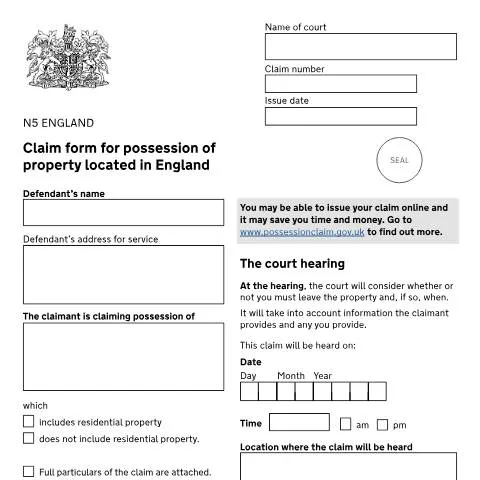
The relationship between property owners and occupiers can deteriorate rapidly when rent payments cease, mortgage obligations go unmet, or tenancy agreements are breached. In England, the Form N5 claim for possession represents the formal legal mechanism through which landlords, mortgage lenders, and other property owners can seek court orders to reclaim their properties. This isn't simply a notice or warning—it's the commencement of actual court proceedings that could result in occupiers losing their homes.
Unlike Scotland or Northern Ireland, which operate under different legal frameworks, England's possession claim process follows specific Civil Procedure Rules that govern everything from the initial application through to the final hearing. The N5 form serves as the foundation document that sets these legal wheels in motion, requiring precision in completion and comprehensive supporting evidence.
What distinguishes the N5 from other housing-related forms is its dual nature: it simultaneously initiates court proceedings and provides defendants with crucial information about upcoming hearings. The form's design reflects this balance, combining sections for claimant details with clear instructions for defendants about their rights and the steps they must take to defend their position.
Distinguishing N5 Claims from Other Housing Enforcement Procedures
Property disputes in England involve various legal instruments, and understanding where the N5 fits within this landscape prevents costly procedural errors. The N5 possession claim differs fundamentally from section 21 notices (no-fault evictions under assured shorthold tenancies) and section 8 notices (fault-based notices), which are preliminary steps that may eventually lead to N5 proceedings if tenants don't vacate voluntarily.
Mortgage lenders often confuse N5 claims with enforcement proceedings under the Administration of Justice Acts, which provide different remedies and timescales. The N5 is specifically designed for straightforward possession claims where the primary remedy sought is recovery of the property itself, rather than complex financial restructuring or suspended possession orders with detailed payment terms.
| Document Type | Purpose | Court Involvement | Typical Timeframe |
|---|---|---|---|
| Section 21 Notice | No-fault eviction notice | None initially | 2 months minimum |
| Section 8 Notice | Fault-based eviction notice | None initially | 2 weeks to 2 months |
| N5 Possession Claim | Court proceedings for possession | Full court process | 4-8 weeks to hearing |
| Warrant of Possession | Enforcement of court order | Court bailiff action | 2-6 weeks post-order |
The N5 also handles trespass cases where no formal tenancy exists, making it broader in scope than tenancy-specific procedures. This flexibility means the same form covers situations ranging from commercial lease forfeitures to unauthorised occupation of residential properties.
Navigating the Claimant and Defendant Information Sections
The opening sections of the N5 form demand meticulous attention to detail, as errors in party identification can derail entire proceedings. The claimant sections accommodate up to three parties, recognising that modern property ownership often involves multiple individuals, companies, or trustees. Each claimant must be identified with full legal names—trading names or abbreviations won't suffice for court purposes.
For corporate claimants, the registered company name must match exactly with Companies House records, including any limited company designation. Partnerships require all partners to be named unless proceedings are brought in the firm name under specific partnership rules. Property management companies frequently make the error of listing themselves as claimants when they're merely agents—only the actual property owner or mortgage lender has standing to bring possession claims.
The defendant identification presents different challenges, particularly in cases involving subletting, relationship breakdowns, or unauthorised occupiers. The form requires "service addresses" which may differ from the property address if defendants have moved elsewhere but retain legal interests in the property. In joint tenancy situations, all tenants must be named as defendants even if only one has breached the tenancy terms.
Unknown occupiers present special procedural requirements. While the N5 can accommodate "persons unknown" as defendants, claimants must demonstrate through witness statements that they've made reasonable efforts to identify all occupiers. This might involve door-to-door enquiries, checking electoral registers, or obtaining information from neighbours.
Address Complexities and Service Requirements
Service addresses carry legal significance beyond mere correspondence. The Civil Procedure Rules specify that defendants must receive court documents at addresses where service is most likely to be effective. For tenants who've abandoned properties but haven't formally surrendered their tenancies, claimants may need to serve documents at both the property address and any known forwarding address.
Multiple property addresses also create complications. If defendants occupy several properties under different arrangements, each property requiring possession must be clearly identified. The form's checkbox system for residential versus non-residential properties affects court fees and procedural timelines, making accurate classification essential.
Decoding Grounds for Possession and Legal Strategy
Section 3 of the N5 form requires claimants to specify their legal grounds for seeking possession, and this selection determines the entire trajectory of the case. The form's checkbox system might appear straightforward, but each ground carries distinct evidential requirements and potential defences that defendants can raise.
Rent arrears claims benefit from online filing options but require comprehensive rent accounts showing exactly which payments were missed, when demands were served, and what efforts were made to recover arrears before court action. The form doesn't ask for specific arrears amounts—these appear in attached particulars—but claimants must ensure their calculations include only contractual rent, not disputed service charges or other fees that might be challenged.
Mortgage arrears follow similar principles but involve additional considerations around pre-action protocols that require lenders to demonstrate forbearance and alternative resolution attempts. The Financial Conduct Authority's mortgage conduct rules impose specific obligations that courts will scrutinise, making incomplete pre-action compliance a common defence strategy.
Forfeiture and Breach of Tenancy Grounds
Lease forfeiture represents one of the most complex areas of possession law, requiring claimants to navigate waiver rules, section 146 notices, and relief from forfeiture applications. The N5 form's simple "forfeiture of the lease" checkbox belies the sophisticated legal framework underlying these claims, where technical procedural errors can be fatal to a claimant's case.
Other tenancy breaches encompass everything from subletting violations to property damage, each requiring specific evidence and, often, prior notices to tenants. The form's structure doesn't distinguish between material and minor breaches, but courts will certainly make this distinction when considering proportionality and relief applications.
Anti-social behaviour allegations trigger additional disclosure requirements under section 3.2 of the form. Claimants must identify whether they're alleging actual incidents or merely threatening behaviour, as this affects the standard of evidence required and the availability of interim remedies like injunctions.
Human Rights Considerations and Modern Possession Law
Section 3.5's question about Human Rights Act 1998 issues reflects the evolution of possession law following landmark cases like Manchester City Council v Pinnock and Hounslow LBC v Powell. These decisions established that courts must consider the proportionality of possession orders, particularly where defendants' Article 8 rights to family and private life are engaged.
The checkbox appears simple, but claimants who answer "yes" must be prepared to address proportionality arguments in their evidence. This might involve demonstrating that possession is necessary to protect other tenants, that alternative accommodation is available, or that the defendant's conduct justifies the interference with their home rights.
Conversely, defendants who identify potential human rights issues must articulate specific grounds—general assertions about losing one's home aren't sufficient. Effective human rights defences typically involve vulnerable occupiers, children's welfare, disability discrimination, or situations where possession would breach the defendant's right to family life.
Demotion and Right to Buy Suspensions
The form's questions about tenancy demotion and right to buy suspensions apply primarily to social housing cases. Demotion orders convert secure or assured tenancies into less secure arrangements, typically following anti-social behaviour. These applications require evidence meeting specific statutory criteria and often involve parallel proceedings for anti-social behaviour orders.
Right to buy suspensions affect tenants' statutory rights to purchase their council or housing association homes. Claimants seeking these orders must demonstrate that possession proceedings relate to conduct that would justify suspension under the Housing Act 1985, creating an additional evidential burden beyond the basic possession claim.
Financial Aspects: Court Fees and Cost Recovery
The N5 form's fee section reflects HM Courts & Tribunals Service's move toward risk-based pricing and online service delivery. Possession claim fees vary significantly depending on the property type, claim value, and filing method chosen. Online filing through the Possession Claim Online service typically costs less than paper applications and offers faster processing times.
Current fee structures distinguish between residential and commercial properties, with additional charges for money claims that exceed specific thresholds. The form requires claimants to specify total claim amounts including court fees and legal costs, as this determines the appropriate fee band and potential cost recovery if the claim succeeds.
| Claim Type | Base Fee Range | Additional Considerations | Online Availability |
|---|---|---|---|
| Rent arrears (residential) | £325-£770 | Hearing fee may apply | Yes |
| Mortgage possession | £308-£770 | Based on property value | Yes |
| Commercial possession | £308-£1,090 | Higher value bands | Limited |
| Trespass claims | £308-£616 | No money claim element | No |
Help with Fees and Payment Options
The form's Help with Fees section provides crucial access to justice protections for claimants with limited financial resources. The EX160 application process considers savings, income, and benefit entitlement to determine fee remission eligibility. Successful applications can reduce fees by up to 100%, making legal action accessible to landlords and lenders who might otherwise be unable to afford court proceedings.
Professional users benefit from Payment by Account (PBA) arrangements that streamline the payment process and provide consolidated billing. These accounts require advance credit arrangements with HM Courts & Tribunals Service but eliminate the need for individual payment processing with each application.
Statement of Truth and Legal Consequences
The final section of the N5 form contains the statement of truth, which carries serious legal consequences that extend far beyond the immediate possession proceedings. This isn't merely an administrative requirement—it's a formal declaration that subjects signatories to contempt of court proceedings if they make false statements without honest belief in their accuracy.
The form provides different signature options depending on who's making the application. Individual claimants must sign personally unless they're children or protected parties requiring litigation friends. Legal representatives can sign on behalf of clients but must confirm their authority and professional capacity.
Corporate claimants face particular challenges in determining appropriate signatories. Company directors, authorised officers, or legal representatives can sign, but they must have sufficient knowledge of the facts stated in the claim. This often requires internal coordination to ensure that whoever signs has reviewed the evidence and can honestly verify its accuracy.
Professional and Personal Liability
Solicitors and other legal professionals who sign statements of truth assume personal responsibility for the accuracy of factual assertions, not merely the legal arguments presented. This creates potential professional conduct issues if firms don't maintain adequate systems for verifying client instructions and supporting evidence.
The consequences of false statements extend beyond contempt proceedings to include wasted costs orders, professional disciplinary action, and potential criminal liability in cases involving deliberate fraud. Recent court decisions have emphasised that statements of truth require active verification, not passive reliance on client instructions.
Post-Filing Procedures and Case Management
Once the N5 form is filed and accepted by the court, the case enters the formal litigation system with specific procedural requirements and timelines. The court will issue the claim and serve copies on defendants, typically allowing 14 days for acknowledgment of service or defence filing. This period can be extended in certain circumstances, but claimants should expect defendants to use available time to seek legal advice and prepare their response.
The form's front page provides defendants with clear information about hearing dates and locations, but these details are added by court staff after the claim is processed. Claimants don't select hearing dates—these are allocated based on court availability and case complexity. Standard possession claims typically receive hearing dates within 4-8 weeks of issue, while complex cases involving multiple defendants or disputed facts may take longer.
Case management between filing and hearing involves potential defendant responses including acknowledgment of service, defence submissions, and counterclaim applications. Claimants must monitor their cases actively, as defendant responses can significantly alter the procedural landscape and hearing requirements.
The hearing itself represents the culmination of the N5 process, where district judges will consider all evidence presented by both parties before deciding whether to grant possession orders, dismiss claims, or make alternative orders such as suspended possession with payment terms. The form's role continues even after filing, as courts may require amendments or additional information before final resolution.