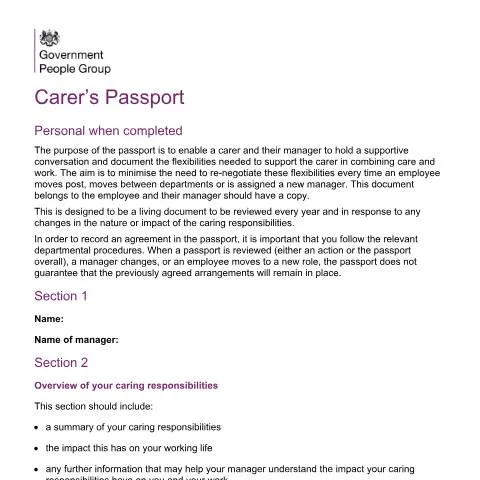
When Work and Care Collide: Understanding the Carer's Passport Framework
Across government departments, millions of civil servants juggle professional responsibilities with caring duties for family members, partners, or friends. The Carer's Passport, developed by the Cabinet Office's Government People Group, represents a significant shift from ad-hoc arrangements to structured support for employee-carers. This living document creates a formal framework for conversations between employees and managers, moving beyond the traditional "muddle through" approach that has historically characterised workplace caring support.
The passport emerges from recognition that unpaid carers—those supporting individuals with illness, disability, mental health conditions, or addiction—often face career penalties when their circumstances remain invisible to management. Unlike statutory frameworks such as flexible working requests under the Employment Rights Act 1996, the Carer's Passport operates as an internal government initiative, designed to complement existing policies rather than replace them.
What distinguishes this approach is its emphasis on portability. Traditional workplace adjustments typically reset when employees change roles or managers, forcing carers to repeatedly justify their needs. The passport aims to eliminate this bureaucratic burden whilst maintaining necessary flexibility for operational requirements.
The Architecture of Caring Conversations
The Carer's Passport structures itself around six core sections, each designed to capture different dimensions of the caring-work intersection. Section 1 establishes basic identification details, whilst Section 2 requires employees to articulate their caring responsibilities and their impact on working life. This isn't merely administrative box-ticking; it's about translating often complex, emotionally charged situations into workplace-relevant information.
Section 3 focuses on role and team context, recognising that caring flexibilities must align with operational realities. A passport holder working in a customer-facing role will face different constraints compared to someone in policy development or analytical work. The document acknowledges this by requiring explicit consideration of how caring needs intersect with specific job requirements.
Sections 4 and 5 represent the passport's operational heart, distinguishing between flexibilities that would be helpful and those actually agreed. This separation prevents unrealistic expectations whilst maintaining space for aspirational discussions. Section 6 captures broader support actions, potentially including referrals to employee assistance programmes, local authority carer assessments, or The Charity for Civil Servants.
"The passport relies on sensitivity, leaving it ultimately down to the carer themselves to determine how much personal information they wish to share."
Navigating the Voluntary Disclosure Dilemma
One of the passport's most nuanced aspects concerns voluntary disclosure. Employees retain complete control over content and form ownership, but this creates inherent tensions. Insufficient detail may limit management understanding and support options, whilst excessive disclosure might feel intrusive or professionally risky.
The guidance acknowledges this delicate balance, emphasising that completion remains entirely voluntary. However, it also recognises that many carers struggle with disclosure decisions, particularly where caring responsibilities involve sensitive health conditions or family dynamics. The passport framework attempts to create a "safe space" for these conversations, though the extent to which this succeeds will largely depend on individual management relationships and departmental cultures.
For employees considering passport completion, the key lies in strategic disclosure—providing sufficient detail to enable meaningful support whilst maintaining appropriate professional boundaries. This might involve describing care patterns and time commitments without detailing specific medical conditions, or outlining flexibility needs without extensive personal backstory.
Documentation and Evidence Considerations
Unlike formal flexible working applications, the Carer's Passport doesn't require supporting evidence or medical documentation. This reduces administrative burden but potentially creates ambiguity around verification. Managers must balance trust-based approaches with legitimate operational concerns, particularly where significant workplace adjustments are requested.
The passport's guidance suggests focusing on impact rather than diagnosis, encouraging conversations about how caring responsibilities affect work patterns rather than detailed medical information. This approach aligns with disability discrimination legislation whilst maintaining employee privacy.
Implementation Mechanics and Review Cycles
The passport operates as a living document requiring annual reviews, with additional updates triggered by significant changes in caring circumstances. This review structure recognises that caring responsibilities rarely remain static—conditions may deteriorate or improve, care arrangements may change, and workplace demands may evolve.
| Review Trigger | Timeline | Key Considerations |
|---|---|---|
| Annual review | 12 months from agreement | Assess continued relevance and effectiveness of arrangements |
| Role change | Before or shortly after transition | Evaluate compatibility with new responsibilities |
| Manager change | During handover period | Ensure continuity whilst allowing renegotiation |
| Care circumstances change | As soon as practicable | Adjust arrangements to reflect new realities |
Critically, the passport includes explicit warnings that previously agreed arrangements don't guarantee continuation under new managers or roles. This clause protects organisational flexibility whilst potentially undermining the document's portability promise. Employees should understand that passport agreements represent starting points for new conversations rather than binding commitments.
The Conversation Framework
The passport guidance provides structured conversation prompts, encouraging discussion around questions such as communication preferences during care crises, team impact considerations, and potential occupational health referrals. These prompts help managers unfamiliar with caring issues to conduct meaningful discussions whilst ensuring consistent approaches across departments.
Effective passport conversations typically require multiple meetings rather than single sessions, allowing both parties time to consider implications and explore creative solutions. The initial meeting might focus on understanding and documenting current circumstances, with follow-up sessions addressing specific flexibility proposals and implementation details.
Operational Flexibilities and Workplace Adjustments
While the passport doesn't prescribe specific flexibility types, it operates within existing departmental policies covering areas such as flexible working arrangements, special leave provisions, and reasonable adjustments. Common flexibilities discussed through passport processes include modified working hours, remote working arrangements, emergency leave protocols, and adjusted travel or overtime expectations.
The passport's strength lies in enabling proactive rather than reactive flexibility discussions. Instead of waiting for care crises to disrupt work patterns, it encourages forward planning and contingency development. This approach benefits both employees and organisations by reducing last-minute disruption and enabling better resource planning.
However, flexibility agreements must remain within legal and policy boundaries. The passport cannot override statutory entitlements or departmental policies, though it may facilitate more generous interpretations where discretion exists. Managers should ensure they understand relevant policy frameworks before making commitments through passport processes.
Integration with Existing Support Systems
The passport explicitly references broader support ecosystems, including employee assistance programmes, local authority carer assessments, and charitable support through The Charity for Civil Servants. This integration reflects recognition that workplace flexibility alone may be insufficient for employees managing complex caring situations.
Effective passport implementation often involves signposting to external resources, particularly where employees lack awareness of available support. Managers should familiarise themselves with key referral pathways, though they shouldn't attempt to provide specialist advice outside their competence areas.
Departmental Variations and Cultural Considerations
While the Cabinet Office provides the passport framework, individual departments retain responsibility for implementation within their specific contexts. This creates potential for significant variation in how passports operate across government, reflecting different organisational cultures, operational requirements, and management approaches.
Some departments may integrate passport processes with existing wellbeing or diversity initiatives, whilst others might treat them as standalone HR tools. The guidance emphasises the importance of following "relevant departmental procedures" when recording passport agreements, acknowledging this implementation diversity.
Cultural factors play crucial roles in passport effectiveness. Departments with strong command-and-control cultures may struggle with the document's collaborative approach, whilst those emphasising employee wellbeing may embrace it enthusiastically. Success often depends on senior leadership commitment and middle management buy-in rather than just policy existence.
Training and Support Requirements
The passport's effectiveness relies heavily on manager capability to conduct sensitive conversations and identify appropriate flexibility solutions. However, the guidance provides limited detail about training requirements or support for managers unfamiliar with caring issues.
Best practice implementations typically include manager briefings covering legal frameworks, available flexibilities, conversation techniques, and referral pathways. Without such support, well-intentioned managers may make inappropriate commitments or miss opportunities to provide meaningful assistance.
Strategic Implications for Career Development
One of the passport's most significant but under-discussed aspects concerns its potential impact on career progression. While designed to support employee-carers, the document creates permanent records of caring responsibilities and workplace adjustments that may influence future opportunities.
The guidance emphasises employee control over disclosure, but once passport agreements are established, they become part of HR records and management discussions. Employees should consider long-term career implications when deciding disclosure levels and flexibility requests.
Conversely, the passport may provide protection against career penalties by formally documenting legitimate caring needs and agreed arrangements. This documentation could prove valuable if employees face discrimination allegations or need to justify performance variations related to caring responsibilities.
The annual review cycle offers opportunities to adjust arrangements as caring circumstances or career aspirations evolve. Employees whose caring responsibilities reduce may wish to modify or withdraw passport agreements to avoid unnecessary limitations on future opportunities.
Data Protection and Confidentiality Safeguards
Given the sensitive personal information potentially contained within passports, data protection considerations become paramount. The document requires explicit employee consent for management retention of copies, aligning with Data Protection Act 2018 and UK GDPR requirements.
However, the guidance provides limited detail about information sharing protocols, retention periods, or access controls. Departments implementing passport processes should establish clear data handling procedures, particularly regarding information sharing during role transitions or organisational restructuring.
Employees should understand their rights regarding passport information, including modification, withdrawal, and deletion options. The document's "living" nature means information should be regularly updated rather than indefinitely retained in outdated forms.
Transitioning Between Different Care Responsibilities
The Carer's Passport proves particularly valuable when your caring responsibilities evolve or change focus. Many carers find themselves supporting multiple family members simultaneously or transitioning from caring for an elderly parent to supporting a disabled child reaching adulthood. The passport framework accommodates these complex scenarios through its flexible documentation approach.
When caring for someone who moves between different care settings—perhaps alternating between home care and respite services—the passport maintains continuity of information. Social workers and care coordinators can update relevant sections without requiring entirely new assessments. This proves especially beneficial for carers supporting individuals with fluctuating conditions like multiple sclerosis or bipolar disorder, where care needs vary significantly over time.
For carers managing end-of-life care, the passport takes on additional significance. Palliative care teams often work with shortened timescales, making rapid access to comprehensive carer information crucial. The passport can document advance decisions about care preferences, contact details for specialist nurses, and arrangements for emergency support when the carer needs respite during particularly intensive periods.
Young carers transitioning to adult services face particular challenges that the passport helps address. When someone under 18 has been caring for a family member, their support needs change dramatically upon reaching adulthood. The passport provides continuity between children's services and adult social care, ensuring that established support networks and assessments transfer smoothly rather than requiring complete restart of the process.
Carers supporting someone moving into residential care don't necessarily see their caring role end entirely. The passport can be updated to reflect this changed relationship while maintaining records of the carer's ongoing involvement and any continuing support they might need. This proves particularly relevant for carers who continue visiting regularly and coordinating aspects of their relative's care even after residential placement.
Legal Protections and Rights Documentation
The Carer's Passport serves as crucial documentation for various legal protections available to carers under UK legislation. The Care Act 2014 established specific rights for carers, including entitlement to assessment and support services. Having a recognised passport strengthens your position when requesting these statutory assessments from local authorities.
Employment rights represent a significant area where passport documentation proves valuable. The Employment Rights Act 1996 provides carers with rights to request flexible working arrangements, but employers may require evidence of caring responsibilities. The passport offers formal documentation that supports such requests, particularly when combined with medical evidence about the person you care for.
Carers also have rights to emergency leave under employment law when care arrangements break down unexpectedly. The passport can provide employers with context about your caring responsibilities, helping them understand the legitimate nature of such requests. Some employers have developed specific policies recognising Carer's Passport holders, offering additional flexibility or support measures.
Data protection considerations become particularly important when multiple agencies access your passport information. Under UK GDPR and the Data Protection Act 2018, you maintain rights over how your personal information is processed and shared. The passport framework typically includes clear consent mechanisms, allowing you to specify which organisations can access different sections of information.
Mental Capacity Act provisions may also intersect with passport usage, particularly if you hold lasting power of attorney for the person you care for. The passport can document these legal arrangements, ensuring that healthcare professionals and social services understand your authority to make decisions on behalf of the cared-for person when they lack capacity.
Some local authorities have developed specific protocols ensuring that Carer's Passport holders receive priority consideration for certain services. While not a legal requirement, these arrangements recognise the formal assessment and documentation that passport status represents, potentially expediting access to respite care or emergency support services.
Integration with Digital Health and Social Care Systems
Modern healthcare increasingly relies on digital systems for information sharing, and Carer's Passport schemes are evolving to integrate with these platforms. NHS Digital initiatives like the Personal Health Record allow carers to maintain comprehensive digital records that link with their passport documentation, creating a more complete picture of care arrangements.
GP practices using digital patient record systems can often flag Carer's Passport holders, ensuring that reception staff and healthcare professionals recognise your caring role during appointments. This integration helps prevent situations where carers struggle to obtain information about the person they support due to confidentiality restrictions that don't account for established caring relationships.
Social care management systems used by local authorities increasingly incorporate carer passport data, allowing social workers to access comprehensive information quickly during assessments or crisis situations. This digital integration reduces the need for carers to repeatedly provide the same information to different departments or workers within the same authority.
Telehealth and remote monitoring systems present new opportunities for passport integration. When the person you care for uses digital health monitoring devices or participates in virtual healthcare appointments, your passport status can ensure you're included in communications and have appropriate access to relevant information about their condition and treatment.
Emergency services are beginning to develop protocols that recognise digital carer credentials linked to passport schemes. When ambulance crews or emergency department staff encounter someone with complex care needs, they may be able to quickly identify and contact their primary carer through integrated systems, improving coordination during medical emergencies.
However, digital integration also presents challenges around data security and privacy. Carers must understand what information is shared digitally, with whom, and under what circumstances. Most schemes provide clear privacy notices explaining how digital integration works and what controls carers have over their information sharing preferences.
The future development of integrated care systems across England may further enhance passport utility, creating seamless information sharing between health services, social care, housing, and voluntary sector organisations. This evolution could transform the passport from a primarily local tool into a comprehensive credential recognised across different regions and service providers.