When Your Health Becomes Your Professional Asset
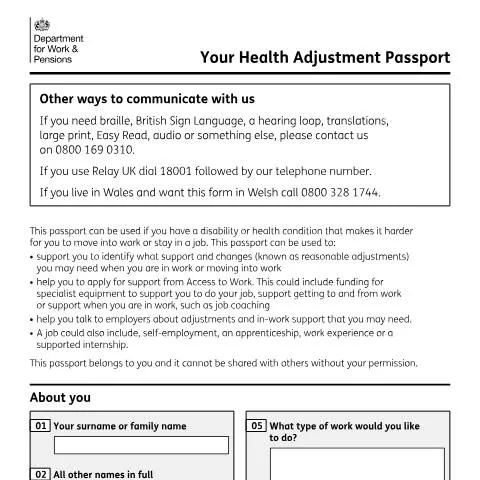
Living with a disability or health condition whilst navigating the employment landscape presents unique challenges that the Department for Work and Pensions recognises through the Health Adjustment Passport. This six-page document serves as your personal roadmap for workplace success, capturing the precise support mechanisms you require to thrive professionally rather than merely survive.
Unlike traditional benefit applications that focus on what you cannot do, this passport takes a fundamentally different approach. It documents your capabilities, preferences, and the specific adjustments that transform potential workplace barriers into manageable elements of your professional life. The document belongs to you entirely—a crucial distinction that empowers you to control when, how, and with whom this sensitive information is shared.
The passport's strategic value lies in its forward-thinking design. Rather than waiting for workplace difficulties to emerge, it proactively identifies solutions before problems arise. This approach proves particularly valuable when transitioning between roles, as your documented needs travel with you, eliminating the need to repeatedly explain your requirements to new employers or support services.
Mapping Your Professional Identity Beyond Medical Limitations
The passport's opening section focuses on your professional aspirations rather than your medical history. Questions about preferred working hours, desired locations, and career goals establish your employment objectives first, with health considerations woven throughout rather than dominating the narrative.
This sequence proves strategically important. By articulating your professional goals upfront—whether you're seeking full-time employment, part-time opportunities, or exploring self-employment—you frame subsequent health-related discussions within the context of career advancement rather than limitation management. The document asks specifically about the type of work you'd like to pursue, encouraging detailed responses that might include industry preferences, role specifications, or particular skills you wish to develop.
Working hour considerations extend beyond simple availability preferences. The passport recognises that some conditions fluctuate throughout the day, making certain hours more productive than others. Your response here becomes crucial for Access to Work applications, where funding for workplace adjustments often depends on demonstrating how specific working patterns support your productivity.
| Professional Element | Strategic Purpose | Access to Work Connection |
|---|---|---|
| Preferred working hours | Matches natural productivity patterns | Justifies flexible scheduling requests |
| Desired work location | Considers accessibility and transport | Supports home working or travel assistance |
| Career aspirations | Demonstrates commitment to progression | Validates investment in specialist equipment |
Translating Daily Life Impact Into Workplace Solutions
Section six represents the passport's analytical core, examining how your condition affects daily functioning across multiple domains. Rather than requesting medical diagnoses, it explores practical impacts: communication styles, task organisation methods, sensory processing needs, mobility requirements, adaptation to change, and support service utilisation.
This functional approach proves invaluable when discussing reasonable adjustments with employers. Instead of explaining complex medical terminology, you can reference specific workplace scenarios. For instance, if you experience difficulty with sensory processing, the passport helps you articulate whether you need quieter working environments, modified lighting, or structured break schedules.
The document's conditional logic—directing you to skip irrelevant sections—prevents unnecessary disclosure whilst ensuring comprehensive coverage of applicable areas. This design acknowledges that disability experiences vary enormously, even within similar diagnostic categories. Your autism might primarily affect communication patterns, whilst another person's autism might predominantly impact sensory processing or routine management.
Question seven addresses condition variability—a frequently misunderstood aspect of many health conditions. Employers often struggle to comprehend how someone might perform excellently one day and require significant support the next. The passport provides structured space to explain these fluctuations, helping employers understand why consistent support mechanisms remain necessary even when symptoms aren't immediately visible.
Building on Previous Support Experiences
The passport recognises that many individuals have navigated educational or previous employment challenges successfully, with specific support arrangements proving effective. Section eight explores these historical successes, creating a foundation for future workplace discussions.
Previous accommodations might include extended examination time, note-taking assistance, job coaching, or mentor support. These precedents become powerful negotiating tools when requesting similar arrangements in new employment contexts. The Access to Work scheme frequently approves support that mirrors previously successful interventions, making this section strategically crucial for funding applications.
Educational support often translates directly into workplace needs. Students who required screen readers, voice recognition software, or specialised seating arrangements typically need similar accommodations in professional settings. By documenting these successful interventions, you create a evidence base supporting future adjustment requests.
The passport encourages detailed descriptions of support mechanisms, recognising that seemingly simple accommodations often involve complex implementation details. A "job coach," for instance, might provide interview preparation, workplace orientation, task prioritisation assistance, or ongoing performance feedback. These specifics prove essential when designing support packages for new employment situations.
Physical Environment and Access Considerations
Questions nine and ten address the physical and logistical aspects of employment that frequently determine workplace success. Transportation challenges, building accessibility, and premises modifications represent common barriers that targeted support can eliminate.
Transport support through Access to Work extends far beyond simple taxi funding. The scheme might provide driving lessons for individuals whose conditions don't preclude driving but who lack current skills, vehicle adaptations for existing drivers, or public transport assistance for those managing mobility or cognitive challenges. The passport helps you articulate specific transport needs, supporting more accurate funding assessments.
Workplace accessibility encompasses architectural modifications, equipment provisions, and environmental adjustments. Ramps, widened doorways, and accessible parking represent obvious modifications, but the passport also addresses less visible needs: lighting adjustments for visual processing differences, noise management for auditory sensitivities, or air quality considerations for respiratory conditions.
The document recognises that accessibility needs often intersect. Someone requiring wheelchair access might also need adjustable desk heights, modified computer positioning, and alternative emergency evacuation procedures. By capturing these interconnected requirements comprehensively, the passport supports holistic workplace planning rather than piecemeal adjustments that might prove inadequate.
Communication and Interaction Support Frameworks
Section eleven addresses communication and social interaction support—often the most nuanced aspect of workplace adjustment. Unlike equipment provisions or physical modifications, communication support requires ongoing, adaptive intervention that evolves with workplace relationships and role responsibilities.
Interview process adjustments might include additional processing time, alternative question formats, written rather than verbal instructions, or modified social interaction expectations. These accommodations prove crucial for securing employment, as standard interview formats frequently disadvantage candidates whose conditions affect communication or social interaction patterns.
British Sign Language interpretation represents a specialised communication support requiring advance planning and ongoing coordination. The passport helps employers understand whether you need continuous interpretation, specific meeting coverage, or occasional support for complex discussions. These distinctions significantly impact cost and logistical planning.
Video relay services and lip speaker support address different aspects of hearing-related communication needs. The passport encourages specific descriptions of your communication preferences, recognising that individual needs vary considerably even within similar hearing loss categories. Some individuals prefer written communication for complex topics whilst managing routine verbal interactions independently.
Notetaking support extends beyond simple transcription services. Effective workplace notetakers understand context, prioritise key information, and format notes for individual processing preferences. The passport helps you articulate whether you need verbatim transcription, summarised key points, or structured note formats that support your information processing patterns.
Integration with Access to Work Applications
The Health Adjustment Passport functions as preparatory groundwork for Access to Work applications, though it serves broader purposes beyond funding requests. The detailed information you compile here directly supports the evidence requirements for Access to Work assessments, potentially streamlining approval processes and ensuring more comprehensive support packages.
Access to Work assessments examine the gap between your capabilities and job requirements, identifying specific support mechanisms that bridge these differences. The passport pre-empts this analysis by documenting your support needs systematically, providing assessors with detailed information about effective interventions and preferred working arrangements.
Funding decisions often depend on demonstrating that proposed support represents reasonable adjustments rather than fundamental job requirement alterations. The passport helps you frame support needs appropriately, showing how adjustments enable you to fulfil role requirements rather than changing role expectations.
The scheme covers various support types: workplace equipment, personal assistance, communication support, travel assistance, and job coaching. The passport's comprehensive approach ensures you consider all potentially relevant support categories, maximising your chances of securing appropriate funding packages.
Ownership, Privacy, and Strategic Disclosure
The passport belongs entirely to you, with sharing decisions remaining under your control. This ownership principle proves crucial when navigating employment situations, as it enables strategic disclosure rather than blanket revelation of personal information. You might share specific sections with employers whilst retaining other information for Access to Work applications or personal reference.
Data protection considerations under the UK GDPR and Data Protection Act 2018 require employers to process disability-related information lawfully, fairly, and transparently. The passport helps you provide information in structured formats that support compliant processing whilst maintaining appropriate privacy boundaries.
Strategic disclosure involves sharing relevant information at optimal timing. Initial job applications might reference general adjustment needs without detailed explanations, with the passport providing comprehensive information for successful candidates during pre-employment discussions. This approach prevents discrimination whilst ensuring necessary support arrangements are established before employment commences.
The document serves as your personal reference tool, helping you articulate support needs consistently across different contexts. Whether speaking with potential employers, Access to Work assessors, or support service providers, the passport ensures your requirements are communicated accurately and comprehensively.
Completion requires honest self-assessment and forward-thinking consideration of workplace scenarios you might encounter. The investment in thorough completion pays dividends through more effective employer discussions, streamlined Access to Work applications, and increased confidence in professional networking situations. The passport transforms potentially difficult conversations about workplace needs into structured, solution-focused discussions about professional success strategies.
Regional Variations and Service Delivery Across the UK
The Health Adjustment Passport operates within the broader context of the UK's devolved healthcare systems, where England, Scotland, Wales, and Northern Ireland maintain distinct administrative frameworks whilst sharing core disability assessment principles. In England, the passport typically integrates with NHS England's regional clinical commissioning groups and local authority social services departments, creating a network of support that varies considerably between metropolitan areas like Greater Manchester and rural counties such as Cumbria or Cornwall.
Scottish residents may find their Health Adjustment Passport coordinates with NHS Scotland's territorial health boards, where the integration with Scotland's social care system follows different statutory frameworks under the Social Care (Self-directed Support) (Scotland) Act 2013. This can affect how workplace adjustments are funded and implemented, particularly for individuals employed in the public sector or receiving support through Access to Work schemes administered by Jobcentre Plus offices north of the border.
Welsh implementation often involves coordination with Health and Care Research Wales and the Welsh Government's disability employment programmes, which may offer enhanced support for bilingual workplace adjustments or culturally specific accommodations. The passport documentation in Wales might include provisions for Welsh language requirements in workplace communications or training materials, reflecting the statutory obligations under the Welsh Language Act 1993.
Northern Ireland presents unique considerations where the Health Adjustment Passport must navigate the integrated Health and Social Care system, administered through five Health and Social Care Trusts. Cross-border employment with the Republic of Ireland can create additional complexity, particularly for individuals whose medical care involves specialists on both sides of the border, requiring careful coordination of medical evidence and assessment timelines.
Urban versus rural implementation reveals significant disparities in service delivery. Metropolitan areas typically offer more frequent face-to-face appointments with occupational health specialists, faster access to assistive technology assessments, and shorter waiting times for workplace accommodation installations. Rural areas may rely more heavily on telephone consultations, postal correspondence, and longer lead times for specialist equipment procurement and installation.
Digital Integration and Data Protection Considerations
The Health Adjustment Passport increasingly operates within digital frameworks that must comply with both the Data Protection Act 2018 and UK GDPR requirements, creating specific obligations for how sensitive health information is collected, stored, and shared between different agencies. When individuals complete online assessment forms through government portals, the data typically flows through secure NHS networks that maintain strict access controls and audit trails.
Integration with existing digital health records requires careful consideration of consent mechanisms, particularly where the passport needs to access information from GP surgeries using EMIS or TPP SystmOne clinical systems. The interoperability challenges are significant, as workplace adjustment recommendations must be translated from clinical terminology into practical accommodation language that employers can understand and implement effectively.
The NHS App and other digital health platforms are beginning to incorporate Health Adjustment Passport functionality, allowing individuals to maintain up-to-date records of their workplace needs and share relevant information with new employers or occupational health providers. However, the granular privacy controls required mean that users must actively manage which specific health conditions and adjustment requirements are visible to different professional audiences.
Cybersecurity considerations are paramount, given that the passport contains both detailed medical information and employment-related data that could be valuable to malicious actors. The government's commitment to the National Cyber Security Centre guidelines means that all digital passport systems must implement multi-factor authentication, encryption at rest and in transit, and regular security audits by approved penetration testing companies.
Data retention policies vary significantly depending on which agency holds the primary record. HMRC may retain employment-related adjustment information for up to seven years after the relevant tax year, whilst NHS records typically follow different retention schedules based on clinical governance requirements. Individuals have rights under UK GDPR to request data portability, but the technical implementation of transferring complex health adjustment records between different government systems remains challenging.
The emerging integration with artificial intelligence and machine learning systems raises additional considerations around algorithmic decision-making in workplace adjustment recommendations. Any automated processing of Health Adjustment Passport data must comply with UK GDPR requirements for transparency and human oversight, particularly where AI systems might influence employment outcomes or benefit entitlements.
Employer Obligations and Legal Framework Navigation
Employers receiving Health Adjustment Passport information operate within a complex legal framework that extends far beyond basic Equality Act 2010 compliance, encompassing health and safety regulations, employment law, and data protection obligations that create both opportunities and potential liabilities for organisations of different sizes and sectors.
Large employers with dedicated occupational health departments typically establish formal protocols for processing Health Adjustment Passport recommendations, including standardised risk assessment procedures, budget allocation mechanisms for reasonable adjustments, and clear escalation pathways when recommended accommodations conflict with existing workplace policies or safety requirements. These organisations often maintain relationships with Access to Work advisers and may have framework agreements with assistive technology suppliers.
Small and medium enterprises face particular challenges when employees present comprehensive Health Adjustment Passport documentation, as they may lack internal expertise to evaluate complex medical recommendations or financial resources to implement expensive accommodations immediately. The interaction between passport recommendations and Access to Work funding becomes crucial, particularly where the recommended adjustments exceed the statutory definition of "reasonable" for smaller employers.
Sector-specific considerations significantly impact how Health Adjustment Passport information is interpreted and implemented. Healthcare employers must navigate additional clinical governance requirements, particularly where employee health conditions might affect patient safety or infection control procedures. Educational institutions face unique challenges around student-facing roles and safeguarding obligations that may influence how certain mental health or behavioural adjustments are implemented.
The construction and manufacturing sectors encounter particular complexity where Health Adjustment Passport recommendations must be reconciled with stringent health and safety regulations, CDM regulations, and industry-specific risk assessment requirements. Recommended adjustments that conflict with personal protective equipment requirements or safety-critical procedures require careful evaluation and often necessitate specialist occupational health input beyond the passport's standard recommendations.
Public sector employers face additional considerations around transparency obligations, procurement regulations for adjustment equipment, and potential conflicts between individual accommodation needs and broader public service delivery requirements. The interaction between Health Adjustment Passport recommendations and existing reasonable adjustment policies in organisations like NHS Trusts, local authorities, or government departments requires careful navigation of both employment law and public administration principles.
Trade union involvement adds another dimension, particularly in heavily unionised sectors where workplace adjustments might affect collective bargaining agreements, shift patterns, or established working practices. Health and safety representatives may need to be consulted on certain accommodation proposals, and union officials might advocate for broader policy changes based on individual Health Adjustment Passport cases.