When Laboratory Testing Reveals Complex Respiratory Infections
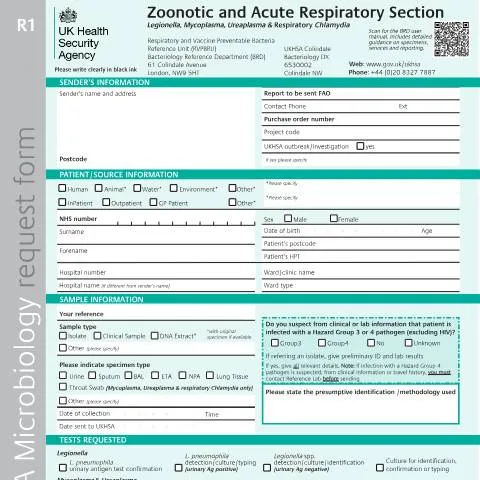
Respiratory infections can present diagnostic challenges when initial testing yields inconclusive results or when clinicians suspect involvement of specialised pathogens. The Zoonotic and Acute Respiratory Section request form serves as the gateway for healthcare professionals seeking expert analysis from the UK Health Security Agency's reference laboratories when dealing with Legionella, Mycoplasma, Ureaplasma, and respiratory Chlamydia infections.
This specialised referral mechanism becomes particularly crucial when patients present with severe respiratory symptoms following animal contact, travel to high-risk environments, or when standard laboratory testing fails to identify the causative organism. The form's comprehensive structure reflects the complex epidemiological and clinical factors that influence these infections, requiring detailed information that extends far beyond routine specimen submission.
Understanding the Referral Pathway for Specialist Respiratory Pathogens
The request form operates within a sophisticated referral network centred on UKHSA Colindale's Respiratory and Vaccine Preventable Bacteria Reference Unit (RVPBRU). Healthcare laboratories across England, Wales, and Northern Ireland utilise this pathway when encountering specimens that require specialist identification, confirmation, or typing services beyond their local capabilities.
The form's design acknowledges three distinct referral scenarios. Primary referrals occur when local laboratories lack the technical capacity for specific testing, such as Legionella culture or respiratory Chlamydia PCR. Confirmatory referrals happen when initial results require validation, particularly positive urinary antigen tests for L. pneumophila that need culture confirmation. Investigational referrals arise during outbreak investigations or when clinical presentation suggests unusual pathogen variants.
The Role of Hazard Group Classification
A critical component of the referral process involves assessing whether suspected pathogens fall into Hazard Group 3 or 4 categories. This classification system, fundamental to UK laboratory safety protocols, determines handling requirements and communication procedures. The form explicitly requires senders to evaluate this risk, with mandatory pre-submission contact required for suspected Hazard Group 4 pathogens.
Most respiratory pathogens covered by this form fall into lower risk categories, but certain Chlamydia species and atypical Legionella variants may require enhanced containment measures. This assessment directly influences specimen packaging, transport conditions, and laboratory processing protocols.
Clinical Context and Epidemiological Intelligence Gathering
The form's clinical information section reflects the epidemiological complexity of zoonotic respiratory infections. Unlike routine bacterial cultures, these pathogens often require detailed exposure history to guide testing strategies and interpret results appropriately.
| Exposure Type | Associated Pathogens | Key Clinical Indicators |
|---|---|---|
| Bird Contact | C. psittaci | Atypical pneumonia, systemic symptoms |
| Sheep/Ruminant Contact | C. abortus | Pregnancy complications, severe pneumonia |
| Water Systems | Legionella spp. | Travel history, cooling tower exposure |
| Healthcare Settings | M. pneumoniae | Macrolide resistance patterns |
The antibiotic treatment section captures crucial information about therapeutic interventions that may influence culture viability and PCR interpretation. Timing of sample collection relative to antibiotic commencement affects the likelihood of successful organism recovery, particularly for fastidious pathogens like Legionella and Mycoplasma.
Intensive Care and ECMO Considerations
Patients requiring intensive care support or extracorporeal membrane oxygenation represent a distinct clinical population where accurate pathogen identification becomes critical for targeted therapy. The form specifically captures ICU status and ECMO use, recognising that these interventions may indicate severe disease requiring rapid diagnostic resolution.
COVID-19 co-infection status adds another layer of complexity, as dual infections with atypical respiratory pathogens can complicate clinical management and infection control measures. This information helps reference laboratory staff prioritise testing and provides context for result interpretation.
Specimen Requirements and Testing Menu Navigation
The form accommodates diverse specimen types, each with specific collection and transport requirements. Respiratory specimens including sputum, nasopharyngeal aspirates (NPA), endotracheal aspirates (ETA), and bronchoalveolar lavage (BAL) samples require different processing approaches depending on the suspected pathogen.
Urine specimens serve a dual purpose: Legionella pneumophila serogroup 1 antigen detection and Mycoplasma culture. The form's design recognises that urinary antigen-positive samples require different confirmatory testing compared to antigen-negative specimens where direct culture becomes essential.
Molecular Testing Considerations
The respiratory Chlamydia PCR service encompasses three species: C. psittaci, C. abortus, and C. pneumoniae. Each requires different clinical correlation, with C. psittaci linked to avian exposure and C. abortus associated with ruminant contact and pregnancy complications.
DNA extracts may be submitted alongside original clinical specimens, providing flexibility for laboratories that have attempted initial molecular testing but require confirmation or additional analysis. This approach maximises diagnostic yield while minimising specimen volume requirements.
Laboratory Information Systems Integration
The sender's laboratory results section creates a crucial interface between local testing capabilities and reference laboratory services. This section accommodates varying levels of preliminary investigation, from basic microscopy to sophisticated molecular testing.
PCR results classification into positive, negative, and equivocal categories acknowledges the interpretive challenges associated with molecular testing for these pathogens. Equivocal results, particularly common with Mycoplasma testing, require expert interpretation considering clinical context and potential cross-reactivity issues.
Quality Assurance and Lot Number Tracking
The requirement for assay kit information and lot numbers reflects quality management principles essential for reference laboratory operations. This data enables investigation of systematic issues, supports external quality assessment participation, and facilitates troubleshooting when results appear inconsistent with clinical expectations.
Lot number tracking becomes particularly important for urinary antigen tests, where batch variations can affect sensitivity and specificity. Reference laboratories use this information to validate results and identify potential quality issues requiring investigation.
Outbreak Investigation and Public Health Intelligence
The form's outbreak investigation section connects individual case management with broader public health surveillance activities. When specimens form part of UKHSA outbreak investigations, this designation triggers enhanced testing protocols and expedited reporting procedures.
Project codes and purchase order numbers facilitate cost tracking and resource allocation, particularly important given the specialised nature of reference laboratory services. These administrative elements ensure appropriate billing while maintaining service accessibility for urgent public health investigations.
Healthcare Provider Team Coordination
Patient location information, including ward type and hospital details, enables reference laboratory staff to establish direct communication channels with clinical teams when results require immediate discussion. This is particularly crucial for Legionella infections requiring contact tracing or Chlamydia psittaci cases needing occupational health assessment.
The distinction between inpatient, outpatient, and GP patients influences result communication timing and format, with hospital inpatients typically requiring more urgent reporting compared to community-acquired cases.
Regulatory Framework and Data Protection Compliance
Form processing operates within strict regulatory frameworks governing both laboratory services and personal data handling. The UK GDPR and Data Protection Act 2018 requirements influence information collection, storage, and sharing protocols, with particular attention to sensitive health data categories.
NHS number inclusion facilitates patient identification and result correlation with existing health records, while postcode information supports epidemiological analysis and outbreak investigation activities. Patient identifiers remain essential for clinical correlation but require careful handling throughout the referral process.
The form version control system (BRDW0146.09, effective February 2026) ensures regulatory compliance and maintains audit trails essential for accreditation purposes. Reference laboratories must demonstrate traceability of form versions to satisfy CPA (Clinical Pathology Accreditation) requirements and maintain ISO 15189 compliance.
Professional Responsibility and Clinical Governance
Completion of this form creates professional responsibilities extending beyond simple specimen submission. Requesting healthcare professionals must provide accurate clinical information, assess biosafety risks appropriately, and ensure specimen integrity throughout transport and storage.
The emphasis on clear black ink completion reflects practical quality requirements essential for accurate data capture and subsequent electronic processing. Illegible forms can delay processing and potentially compromise patient care, making attention to completion quality a clinical governance issue.
Integration with National Surveillance Systems
Data captured through these forms contributes to national surveillance programmes monitoring antimicrobial resistance patterns, particularly Mycoplasma pneumoniae macrolide resistance trends. This information informs treatment guidelines and public health policy development across England, Wales, and Northern Ireland.
Reference laboratory results feed into the Second Generation Surveillance System (SGSS), enabling trend analysis and early detection of emerging resistance patterns or unusual pathogen variants. Individual case data aggregates into population-level intelligence supporting evidence-based clinical practice and public health interventions.
The form's comprehensive design ensures captured data meets quality standards required for epidemiological analysis while maintaining clinical relevance for individual patient management. This dual purpose reflects the reference laboratory's role bridging clinical service provision with public health surveillance responsibilities.
Laboratory Testing Requirements and Sample Submission Protocols
When submitting samples for zoonotic and acute respiratory investigations, adherence to specific laboratory testing requirements forms the cornerstone of effective disease surveillance. The UK Health Security Agency maintains distinct protocols for different sample types, with particular emphasis on maintaining cold chain integrity and proper documentation throughout the submission process.
For respiratory specimens, the preferred collection method involves nasopharyngeal swabs using synthetic-tipped swabs with plastic shafts, placed immediately into viral transport medium. Throat swabs may serve as an alternative when nasopharyngeal sampling proves impractical, though sensitivity rates typically decrease by approximately 15-20% compared to nasopharyngeal specimens. Lower respiratory tract samples, including sputum and bronchoalveolar lavage fluid, require collection in sterile containers without preservatives, maintaining temperatures between 2-8°C during transport.
Zoonotic disease investigations often necessitate multiple specimen types depending on the suspected pathogen. Blood samples for serology require separation of serum within four hours of collection, with paired samples collected at least 14 days apart to demonstrate seroconversion. Faecal specimens for enteric pathogens should reach the laboratory within 48 hours of collection, though rectal swabs in transport medium extend viability up to 72 hours when refrigerated properly.
The laboratory request form must specify the clinical presentation timeline, particularly for acute respiratory infections where symptom onset within seven days may influence testing algorithms. Seasonal considerations affect testing priorities, with influenza panels typically prioritised between October and March, while respiratory syncytial virus testing increases during winter months for paediatric cases.
Sample rejection occurs frequently due to inadequate labelling or inappropriate storage conditions. Each specimen container requires patient identifiers matching the request form exactly, including NHS number when available. Temperature excursions above 8°C for more than two hours typically render viral cultures invalid, though molecular testing may remain viable depending on the specific pathogen and degradation patterns.
Multi-Agency Coordination and Data Sharing Frameworks
Effective management of zoonotic and acute respiratory disease outbreaks requires seamless coordination between multiple agencies, each contributing distinct expertise and resources. The UK Health Security Agency serves as the primary coordinating body, working alongside local authorities, veterinary services, and healthcare providers through established information-sharing protocols.
Environmental health teams within local councils play crucial roles in investigating potential sources of exposure, particularly for zoonotic diseases linked to food establishments, animal premises, or environmental contamination. Their involvement typically commences when epidemiological investigations suggest common source exposures, requiring detailed inspection reports and environmental sampling results to complement clinical findings.
The Animal and Plant Health Agency becomes involved when zoonotic diseases affect livestock or companion animals, necessitating veterinary surveillance data integration with human health information. This collaboration proves essential for diseases such as salmonellosis, where animal reservoir identification directly influences public health control measures. Data sharing agreements ensure rapid information flow while maintaining confidentiality requirements under the Data Protection Act 2018.
Healthcare-associated respiratory outbreaks require coordination with NHS England regional teams and infection prevention and control specialists. Hospital outbreak investigations involve detailed staff and patient movement analysis, environmental sampling, and implementation of enhanced infection control measures. The complexity increases significantly in care home settings, where vulnerable populations require immediate protective interventions alongside epidemiological investigations.
International coordination mechanisms activate when travel-related exposures suggest imported cases or when unusual pathogens require specialist laboratory confirmation abroad. The European Centre for Disease Prevention and Control maintains rapid alert systems for communicable disease threats, while World Health Organization International Health Regulations provide frameworks for reporting potential public health emergencies of international concern.
Data quality assurance across agencies requires standardised case definitions and reporting timelines. Weekly surveillance reports aggregate information from multiple sources, identifying trends and potential clusters requiring enhanced investigation. The integration of laboratory, clinical, and epidemiological data streams through secure electronic systems enables real-time monitoring and rapid response coordination.
Legal Framework and Regulatory Compliance Obligations
The legal foundation governing zoonotic and acute respiratory disease reporting stems from multiple legislative instruments, creating comprehensive obligations for healthcare providers, laboratories, and public health authorities. The Health Protection (Notification) Regulations 2010 establish mandatory reporting requirements for registered medical practitioners, while the Health Protection (Local Authority Powers) Regulations 2010 provide enforcement mechanisms for outbreak control measures.
Notifiable disease categories encompass specific zoonotic conditions including anthrax, brucellosis, rabies, and severe acute respiratory syndrome, with distinct notification timelines ranging from immediate verbal reports to written confirmation within three working days. The legislation extends beyond clinical diagnoses to include suspected cases where clinical presentation and epidemiological factors suggest probable infection, even without laboratory confirmation.
Laboratory reporting obligations under the Health Protection (Notification) Regulations require diagnostic laboratories to notify positive results for specified organisms within one working day. This requirement applies to both NHS and private laboratories, encompassing molecular detection, antigen detection, and serological evidence of recent infection. Failure to comply with notification requirements may result in prosecution under the Health Protection (Offences) Regulations 2010.
Data protection compliance requires careful balance between public health imperatives and individual privacy rights. The UK General Data Protection Regulation permits processing personal health data without explicit consent when necessary for public health purposes, including disease surveillance and outbreak investigation. However, data controllers must implement appropriate technical and organisational measures to ensure proportionate data use and secure processing environments.
Occupational health and safety legislation intersects with disease reporting when healthcare workers experience occupational exposures to infectious agents. The Control of Substances Hazardous to Health Regulations 2002 require employers to assess biological agent risks and implement appropriate control measures, while the Reporting of Injuries, Diseases and Dangerous Occurrences Regulations 2013 mandate reporting of occupational infectious disease cases.
Cross-border information sharing operates under specific legal frameworks when cases involve travel or international exposure. The European Union's Decision on Serious Cross-Border Threats to Health continues to apply through retained EU law, requiring reporting of unusual epidemiological patterns or novel pathogens with pandemic potential. Immigration health screening programmes operate under Immigration Rules, with specific provisions for tuberculosis and other respiratory infections affecting visa applications.
Enforcement mechanisms include statutory powers for medical examination, detention, and isolation when necessary to prevent disease transmission. The Public Health (Control of Disease) Act 1984 provides magistrates' court powers to order medical examinations and impose restrictions on infected individuals who pose risks to public health. These powers require judicial oversight and must demonstrate proportionality between public health benefits and individual liberty restrictions.