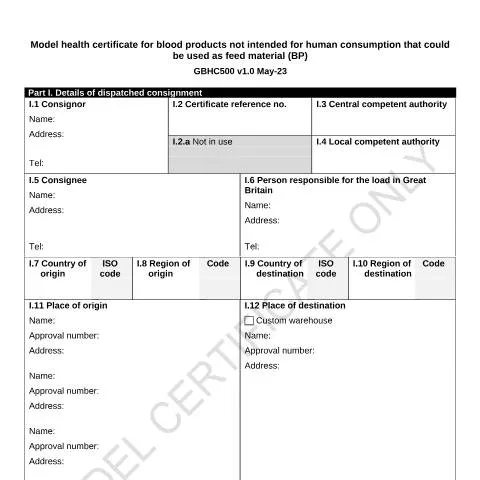
Blood Products Model Health Certificate: Essential Documentation for Non-Human Consumption Exports
The international trade of blood products derived from livestock requires meticulous documentation to ensure compliance with health and safety standards across borders. In Great Britain, the GBHC500 model health certificate serves as the cornerstone document for businesses seeking to export blood products not intended for human consumption. This specialised certificate, overseen by the Animal and Plant Health Agency (APHA) under the Department for Environment, Food and Rural Affairs, establishes the regulatory framework for blood-based materials destined for animal feed production, pet food manufacturing, or technical applications.
Unlike standard export documentation, this certificate addresses the unique risks associated with blood products, including transmissible spongiform encephalopathies (TSE), bacterial contamination, and cross-species disease transmission. The rigorous certification process reflects the heightened scrutiny these materials face in international markets, particularly following decades of regulatory evolution stemming from BSE concerns and evolving understanding of animal-derived pathogen risks.
Regulatory Framework and Competent Authority Oversight
The GBHC500 certificate operates within Great Britain's post-Brexit regulatory landscape, where domestic legislation has replaced EU directives whilst maintaining equivalent standards. The Animal and Plant Health Agency acts as the central competent authority, working alongside local competent authorities to ensure comprehensive oversight of blood product exports.
This dual-authority structure provides both national consistency and regional expertise. The central authority establishes overarching policies and maintains international agreements, whilst local authorities conduct facility inspections, sampling programmes, and day-to-day compliance monitoring. This arrangement ensures that establishments producing blood products for export receive appropriate supervision tailored to their specific circumstances and regional considerations.
Establishment Approval Requirements
Before any blood product can be certified for export, the manufacturing plant must hold formal approval from the competent authority. This approval process involves comprehensive assessment of facility design, operational procedures, quality control systems, and staff competency. The approval number referenced in section I.11 of the certificate serves as a unique identifier linking each consignment to its verified production facility.
Approved establishments undergo regular surveillance inspections to maintain their status. These inspections examine compliance with good manufacturing practices, hygiene standards, record-keeping requirements, and the implementation of hazard analysis systems. Any significant changes to facilities, processes, or ownership trigger reassessment procedures to ensure continued compliance.
Product Categories and Certification Scope
The certificate accommodates three distinct end-use categories for blood products, each carrying specific regulatory implications and market restrictions. Understanding these categories is crucial for exporters, as the intended use determines both the certification requirements and the acceptable destination markets.
| Product Category | Typical Applications | Key Restrictions |
|---|---|---|
| Animal feedingstuff | Protein supplement for livestock, aquaculture feeds | Species-specific feeding restrictions, TSE considerations |
| Manufacture of petfood | Nutritional ingredient in dog and cat food formulations | Processing temperature requirements, labelling obligations |
| Technical use | Industrial applications, research purposes | Prohibition on food chain entry |
Species-Specific Considerations
The scientific name requirement in section I.28 reflects the critical importance of species identification in blood product certification. Different species carry varying risk profiles for transmissible diseases, with ruminant-derived materials subject to particularly stringent controls due to TSE concerns. Porcine blood products face different restrictions related to African swine fever considerations, whilst avian-derived materials require assessment for avian influenza risks.
Non-ruminant blood products generally face fewer restrictions but still require comprehensive documentation of their source animals and processing conditions. The certificate's flexibility in accommodating mixed-species consignments allows for commercial practicality whilst maintaining traceability and risk assessment capabilities.
Processing and Treatment Validation
Section AH/P700 of the certificate addresses one of the most critical aspects of blood product safety: the validation of processing methods designed to inactivate pathogenic agents. Exporters must demonstrate that their products have undergone appropriate treatment through one of three accepted pathways, each with distinct evidentiary requirements.
The first option involves processing according to established GB requirements, where specific time-temperature parameters have been scientifically validated for pathogen inactivation. This approach provides regulatory certainty but requires strict adherence to prescribed conditions and comprehensive process monitoring.
Alternative processing methods may be accepted provided they demonstrate equivalent pathogen reduction capabilities. This pathway requires submission of scientific data supporting the proposed treatment regime, including validation studies and ongoing process verification procedures. Such flexibility enables innovation whilst maintaining safety standards.
Storage and Handling Requirements
The six-week ambient storage requirement referenced in section AH/P010 serves multiple purposes in blood product safety management. This extended storage period allows for the natural die-off of vegetative bacterial pathogens whilst providing a buffer for laboratory testing completion and result verification.
Storage facilities must maintain appropriate environmental conditions, with enclosed storage mandatory to prevent contamination and pest access. Temperature monitoring systems provide documented evidence of storage condition compliance, whilst segregation protocols ensure treated products cannot become contaminated with untreated materials.
Microbiological Testing and Surveillance
The certificate requires mandatory testing for Salmonella and Enterobacteriaceae immediately prior to dispatch, reflecting the ongoing risk these pathogens pose even after processing. This testing regime provides final verification of product safety whilst generating documented evidence of compliance for importing country authorities.
Random sampling protocols ensure statistical validity of testing programmes whilst managing the practical constraints of commercial operations. The competent authority's direct involvement in sampling activities provides independent verification of testing integrity and prevents conflicts of interest that might arise from industry self-testing.
Laboratory Accreditation and Methods
Testing laboratories must employ methods recognised under GB legislation, ensuring consistency and international acceptance of results. Accreditation requirements provide quality assurance for testing procedures, equipment calibration, and staff competency. Regular proficiency testing programmes verify ongoing laboratory performance and identify potential issues before they compromise product safety.
Results documentation forms an integral part of the certificate package, with specific formatting and content requirements ensuring clear communication of safety status to receiving countries. Electronic data management systems increasingly support rapid result transmission whilst maintaining audit trails for regulatory oversight.
TSE Risk Management and Ruminant Restrictions
Section AH/D200A addresses transmissible spongiform encephalopathy risks, reflecting the ongoing international concern regarding these fatal neurodegenerative diseases. The certification process includes comprehensive assessment of source animal origins, feeding histories, and surveillance programme participation.
For products containing ovine or caprine materials, additional scrutiny applies due to scrapie risks. Source holdings must demonstrate freedom from official restrictions related to TSE suspicions, with documentary evidence covering the preceding seven years. This extended surveillance period reflects the long incubation periods characteristic of TSE diseases.
Where classical scrapie has been diagnosed on source holdings, the certificate accommodates two pathways for continued product acceptance. Complete depopulation represents the most conservative approach, whilst targeted removal combined with enhanced surveillance provides a risk-managed alternative that recognises commercial realities.
Country-Level Scrapie Controls
The requirement for source countries to meet GB scrapie control standards ensures consistency with domestic risk management approaches. This equivalency assessment considers national surveillance programmes, diagnostic capabilities, control measures, and reporting systems. Regular reviews of country status reflect evolving epidemiological situations and regulatory developments.
Documentation Requirements and Consignment Tracking
The certificate's Part I sections establish comprehensive consignment identification and traceability systems essential for effective regulatory oversight. Each element serves specific purposes in the overall risk management framework, from initial producer identification through to final destination confirmation.
Batch numbering systems link finished products to their source materials and processing records, enabling rapid trace-back investigations should safety concerns arise post-export. Manufacturing plant approval numbers provide direct connection to facility oversight records, whilst transport documentation ensures chain of custody maintenance throughout the export process.
Temperature Control and Cold Chain Management
Section I.21 temperature specifications reflect the varying stability characteristics of different blood products. Ambient temperature products typically include dried or processed materials with extended shelf-life, whilst chilled products require continuous cold chain maintenance. Frozen products demand the most stringent temperature control but often provide the longest storage periods.
Temperature monitoring during transport provides documented evidence of cold chain integrity, with data logging systems increasingly standard for high-value consignments. Deviation investigations ensure that temperature excursions are properly assessed for their impact on product safety and quality.
Border Control and Third Country Transit
The certificate accommodates both direct importation scenarios and transit arrangements through Great Britain to third countries. Transit provisions recognise the commercial reality of international logistics networks whilst ensuring appropriate oversight of products passing through GB territory.
Border control post requirements ensure that imported products undergo appropriate inspection and documentation verification upon entry. These facilities provide the interface between exporting country certification and importing country acceptance, with trained inspectors validating certificate authenticity and consignment compliance.
For transit consignments, sealed container requirements prevent unauthorised access whilst maintaining product integrity during temporary storage or transport changes. Documentation continuity ensures that receiving countries can verify the complete chain of custody from origin to final destination.
Customs Warehouse Facilities
Approved customs warehouses provide secure storage for blood products awaiting onward shipment or customs clearance. These facilities must meet specific construction and operational standards, including temperature control capabilities, pest exclusion measures, and inventory management systems.
Warehouse approval processes mirror those for manufacturing establishments, with regular inspections ensuring continued compliance with operating standards. Staff training requirements ensure proper handling procedures, whilst record-keeping systems provide audit trails for regulatory oversight and commercial accountability.
Digital Certification Systems and Electronic Health Certificates
The UK has increasingly moved towards digital certification systems for blood products, particularly following Brexit and the need to establish independent regulatory frameworks. The TRACES NT system (Trade Control and Expert System - New Technology) now serves as the primary platform for managing health certificates for blood products entering or leaving Great Britain.
Digital health certificates offer several advantages over traditional paper-based systems. Processing times are significantly reduced, with electronic submissions typically processed within 2-5 working days compared to 7-10 days for paper certificates. The system also provides real-time tracking capabilities, allowing both exporters and importing authorities to monitor certificate status throughout the approval process.
However, the transition to digital systems has created specific challenges for smaller blood banks and collection centres. These organisations may lack the technical infrastructure or dedicated personnel to manage electronic submissions effectively. The MHRA has responded by establishing regional support hubs that provide technical assistance and training programmes specifically designed for smaller operators.
Authentication protocols within digital systems require robust verification processes. Each certificate must include digital signatures from authorised veterinary officers or designated competent authorities. The system cross-references these signatures against a secure database maintained by the Animal and Plant Health Agency (APHA), ensuring that only legitimately authorised personnel can issue valid certificates.
Data security considerations are paramount when handling sensitive health information through digital platforms. All electronic health certificates must comply with UK GDPR requirements, including appropriate encryption standards and secure data transmission protocols. Regular security audits are conducted to identify potential vulnerabilities and ensure ongoing compliance with data protection regulations.
Integration with existing laboratory information management systems (LIMS) has become increasingly important for larger blood processing facilities. Many organisations now utilise automated data feeds that populate certificate templates directly from laboratory test results, reducing manual data entry errors and improving processing efficiency.
Cross-Border Recognition and International Harmonisation
The recognition of UK model health certificates by international partners represents a critical aspect of maintaining global blood product supply chains. Following the UK's departure from the EU, establishing mutual recognition agreements with key trading partners has become essential for continued market access.
The United States Food and Drug Administration (FDA) maintains specific requirements for blood products originating from the UK. These requirements include additional documentation beyond standard model health certificates, particularly regarding variant Creutzfeldt-Jakob disease (vCJD) risk assessments. UK exporters must provide supplementary declarations confirming donor eligibility criteria and enhanced screening protocols.
Similarly, Health Canada has established distinct certification requirements for UK blood products, with particular emphasis on plasma-derived medicinal products. Canadian authorities require detailed batch records and manufacturing process documentation alongside standard health certificates. These additional requirements reflect Canada's risk-based approach to imported biological products.
The World Health Organization (WHO) has developed international guidelines for blood product certification that influence many national regulatory frameworks. UK model health certificates increasingly align with these WHO standards to facilitate broader international acceptance and reduce regulatory barriers in emerging markets.
Developing countries often present unique challenges for UK blood product exports. Many lack sophisticated regulatory frameworks for evaluating foreign health certificates, requiring simplified documentation approaches. The MHRA has developed streamlined certificate templates specifically for these markets, focusing on essential safety information while maintaining regulatory integrity.
Regional harmonisation initiatives, such as those promoted by the International Conference on Harmonisation of Technical Requirements for Pharmaceuticals for Human Use (ICH), continue to influence UK certification practices. These initiatives aim to reduce regulatory duplication and promote consistent safety standards across different jurisdictions.
Brexit has necessitated the development of bridging arrangements with EU member states to maintain continuity of blood product supplies. These arrangements often involve temporary mutual recognition of certification standards while longer-term agreements are negotiated. Such arrangements are particularly important for rare blood products where alternative supply sources may be limited.
Quality Assurance Frameworks and Audit Requirements
Comprehensive quality assurance frameworks underpin the integrity of model health certificates for blood products. The MHRA operates a risk-based inspection programme that evaluates both the technical accuracy of certificates and the underlying quality systems of issuing organisations.
Inspection frequencies vary according to the risk profile of different blood product categories. High-risk products, such as those derived from human plasma, typically undergo annual inspections, while lower-risk products may be inspected every two to three years. These inspections assess compliance with Good Manufacturing Practice (GMP) standards and the accuracy of certification processes.
Internal quality control procedures must be documented and regularly reviewed by organisations issuing health certificates. This includes maintaining certificate registers that track all issued certificates, including details of the certifying officer, date of issue, and any subsequent amendments or corrections. These registers are subject to regular audit by regulatory authorities.
Proficiency testing programmes ensure that laboratory personnel responsible for generating test data underlying health certificates maintain appropriate competency levels. The UK National External Quality Assessment Service (UK NEQAS) provides specialised proficiency testing schemes for blood product testing laboratories, with participation often mandatory for organisations seeking certification authority status.
Corrective and preventive action (CAPA) systems must be implemented to address any deficiencies identified during internal audits or regulatory inspections. These systems require documented procedures for investigating certificate errors, implementing corrective measures, and preventing recurrence of similar issues. The effectiveness of CAPA systems is regularly evaluated during regulatory inspections.
Staff training and competency assessment represent critical components of quality assurance frameworks. Personnel authorised to issue health certificates must complete formal training programmes covering relevant regulatory requirements, certificate completion procedures, and quality control measures. Ongoing competency assessments ensure that staff maintain current knowledge of evolving regulatory requirements.
Document control procedures ensure that only current versions of certificate templates are used and that any regulatory updates are promptly implemented. This includes maintaining master copies of all certificate templates, tracking revision histories, and ensuring that superseded versions are appropriately withdrawn from use.
The MHRA has established performance indicators for monitoring the effectiveness of certification systems, including certificate rejection rates, processing times, and customer satisfaction metrics. These indicators are regularly reviewed and benchmarked against international best practices to identify opportunities for system improvements.