Understanding Poultry Meat Health Certificates: The GBHC330 Gateway to International Trade
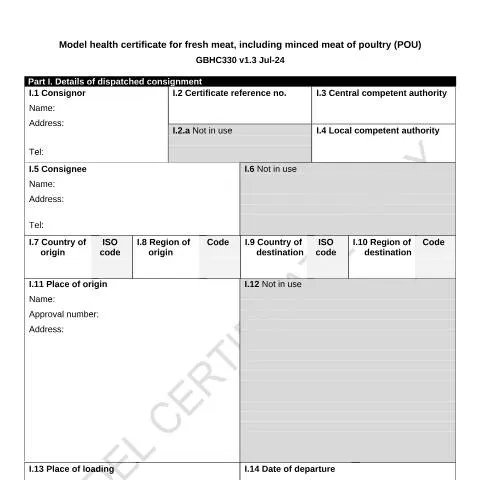
When British poultry producers seek to export fresh or minced chicken, turkey, duck or other poultry meat beyond Great Britain's borders, they enter a highly regulated world where animal health credentials become paramount. The GBHC330 model health certificate, issued by the Animal and Plant Health Agency (APHA) under the Department for Environment, Food & Rural Affairs, serves as the critical document that validates the safety and compliance of poultry meat consignments destined for international markets.
This certificate represents far more than administrative paperwork—it embodies Great Britain's commitment to maintaining the highest standards of animal health, welfare and food safety whilst facilitating legitimate trade. Each GBHC330 certificate carries the authority of official veterinarians and creates a verifiable chain of custody that importing countries rely upon when accepting British poultry products.
The current version 1.3, updated in July 2024, reflects evolving international standards and Great Britain's post-Brexit regulatory framework. Understanding its intricacies proves essential for exporters, veterinary professionals and food business operators navigating the complex landscape of international poultry trade.
Mandatory Health Attestations: What the GBHC330 Certificate Guarantees
The GBHC330 certificate provides comprehensive health guarantees across three distinct domains: animal health, animal welfare and public health. Each section contains specific attestations that must be verified before an official veterinarian can sign the certificate.
Animal Health Safeguards
The animal health section addresses the most significant disease concerns in poultry production. The certificate confirms that the meat originates from birds kept in territories or compartments free from Newcastle Disease and compliant with regulations regarding Highly Pathogenic Avian Influenza (HPAI). Where HPAI has occurred, the certificate specifies that relevant Great Britain requirements have been met.
Establishment requirements mandate that source facilities operate without animal health restrictions and maintain a 10-kilometre disease-free radius for at least 30 days prior to slaughter. This geographical buffer zone ensures that even neighbouring territories remain free from HPAI or Newcastle Disease outbreaks.
Vaccination protocols receive particular attention, with the certificate specifying whether birds have been vaccinated against avian influenza and, if so, the vaccine type and administration age. This transparency allows importing countries to assess compliance with their specific vaccination policies.
Welfare Standards and Slaughter Protocols
The certificate confirms adherence to Great Britain's animal welfare requirements throughout the slaughter process. This includes proper handling procedures before and during slaughter, ensuring that birds are treated humanely according to established welfare standards.
Slaughter documentation must specify exact dates or date ranges, confirming that birds were not processed under any disease control or eradication schemes. Transport protocols ensure that birds destined for slaughter did not encounter infected poultry during their journey to approved facilities.
Public Health Certifications
The public health component addresses food safety through multiple layers of verification. Establishments must operate under Hazard Analysis and Critical Control Points (HACCP) principles, demonstrating systematic food safety management.
Ante-mortem and post-mortem inspections by qualified veterinarians ensure that only meat deemed fit for human consumption receives certification. The certificate confirms compliance with Great Britain's production regulations and proper marking requirements for traceability.
Navigating the Application Process: From Farm to Certificate
Obtaining a GBHC330 certificate requires careful coordination between multiple parties and adherence to strict procedural requirements. The process typically begins well before the intended export date, as various preparatory steps must be completed.
Pre-Application Requirements
Exporters must first ensure that their destination country accepts GBHC330 certificates and verify any specific requirements or additional attestations needed. Some importing nations may require supplementary guarantees or modifications to standard certificate language.
The poultry must originate from approved establishments with current health clearances. Slaughterhouses, cutting plants and cold storage facilities must all hold valid approval numbers, which appear on the certificate to demonstrate regulatory compliance.
| Facility Type | Approval Requirement | Certificate Section |
|---|---|---|
| Slaughterhouse | APHA approval number | I.28 Commodity identification |
| Cutting plant | APHA approval number | I.28 Commodity identification |
| Minced meat facility | APHA approval number | I.28 Commodity identification |
| Cold storage | APHA approval number | I.28 Commodity identification |
Official Veterinarian Involvement
Only official veterinarians authorised by APHA can complete and sign GBHC330 certificates. These qualified professionals must verify all health attestations through direct inspection or review of supporting documentation before certification.
The official veterinarian examines establishment records, reviews disease surveillance data and confirms compliance with all relevant requirements. This verification process ensures that every certificate represents genuine compliance rather than administrative convenience.
Documentation and Supporting Evidence
Comprehensive documentation supports each certificate application. This includes establishment approval certificates, recent disease surveillance reports, vaccination records where applicable, and detailed consignment information including species identification, processing details and packaging specifications.
Temperature requirements must be clearly specified—whether the product travels at ambient temperature, chilled or frozen conditions. This information affects both transport arrangements and importing country requirements.
Certificate Validity and International Recognition
The GBHC330 certificate's validity depends on maintaining the integrity of the certified consignment and meeting the expectations of importing country authorities. Understanding these parameters helps exporters avoid costly delays or rejections at international borders.
Temporal Validity Constraints
While the certificate itself does not specify an expiration date, the validity period typically aligns with the product's shelf life and the importing country's requirements. Most importing nations expect certificates to accompany consignments within specific timeframes, often ranging from days to weeks after issuance.
The certificate becomes invalid if the consignment composition changes, if additional processing occurs, or if the health status of source territories deteriorates. Any disease outbreak affecting the certified region can retrospectively invalidate certificates for products originating from that area.
International Acceptance Variations
Different importing countries maintain varying acceptance criteria for GBHC330 certificates. Some nations require additional attestations or specific language modifications, whilst others may not recognise certain certificate elements.
Exporters must verify acceptance requirements with destination country authorities before shipment. The certificate reference number system allows importing officials to verify authenticity and track consignment details through established databases.
Critical Information Architecture: Decoding Certificate Sections
The GBHC330 certificate employs a standardised format that facilitates international recognition whilst accommodating specific consignment details. Understanding this architecture proves essential for accurate completion and smooth processing.
Part I: Consignment Details
Part I captures comprehensive consignment information, beginning with consignor and consignee details including complete contact information. The certificate reference number provides unique identification for tracking and verification purposes.
Competent authority information identifies both central (typically APHA) and local authorities responsible for oversight. Country and region codes use standardised ISO formats to ensure international consistency.
The place of origin section requires specific establishment details including approval numbers and complete addresses. Transport information encompasses all movement aspects—departure dates, transport modes, vehicle identification and entry Border Control Post (BCP) details.
Commodity Identification Precision
Section I.28 provides detailed commodity identification using scientific species names, processing descriptions and facility approval numbers. This granular approach enables precise tracking and verification by importing authorities.
Harmonised System (HS) codes classify products according to international trade standards, whilst temperature specifications guide handling requirements throughout the supply chain. Package quantities and seal numbers provide additional verification points for customs authorities.
Part II: Professional Certification
Part II contains the formal attestations signed by official veterinarians. This section employs coded requirements (such as AH/T005, PH/E100A) that reference specific regulatory standards whilst maintaining certificate readability.
The certification structure allows for alternative attestations using "EITHER/OR" language, accommodating different scenarios whilst maintaining regulatory clarity. This flexibility proves particularly valuable when addressing vaccination status or territory-specific requirements.
Compliance Challenges and Risk Management Strategies
Successfully obtaining and maintaining valid GBHC330 certificates requires proactive risk management and thorough understanding of potential compliance pitfalls. Exporters who anticipate challenges can implement preventive measures that protect their international trade operations.
Disease Surveillance and Response
Disease outbreaks represent the most significant threat to certificate validity. Even distant outbreaks can affect certificate eligibility if they occur within the required radius of source establishments or impact the broader territorial health status.
Effective risk management requires continuous monitoring of disease surveillance reports published by APHA and maintaining awareness of international disease situations that might affect importing country requirements. Exporters should establish alternative supply sources to maintain continuity during disease-related restrictions.
Establishment Compliance Maintenance
Approved establishments must maintain continuous compliance with health, welfare and food safety standards. Any suspension or withdrawal of establishment approval immediately affects certificate eligibility for products from that facility.
Regular communication with establishment operators ensures early awareness of potential compliance issues. Diversifying supply sources across multiple approved establishments reduces vulnerability to individual facility problems.
Documentation Accuracy and Completeness
Certificate errors or omissions can result in consignment delays or rejections at international borders. Common issues include incomplete establishment approval numbers, incorrect commodity descriptions, or missing temperature specifications.
Implementing systematic pre-submission reviews helps identify potential errors before official veterinarian involvement. Maintaining updated lists of establishment approval numbers and current HS codes prevents common transcription errors.
Strategic Applications in Modern Poultry Export Markets
The GBHC330 certificate serves diverse strategic purposes beyond basic regulatory compliance, enabling British poultry exporters to access premium markets and demonstrate competitive advantages in international trade.
Market Access and Premium Positioning
Many importing countries impose stringent health requirements that effectively limit market access to suppliers capable of providing comprehensive health certification. The GBHC330 certificate's rigorous attestations position British exporters favourably in these selective markets.
Premium markets often demand detailed traceability and health documentation that standard commercial certificates cannot provide. The comprehensive nature of GBHC330 certification enables access to high-value market segments where health assurance commands price premiums.
Supply Chain Integration and Logistics
Modern supply chains increasingly demand integrated documentation that supports efficient customs clearance and reduces border processing delays. The GBHC330 certificate's standardised format facilitates electronic processing and automated verification systems used by many importing countries.
Cold chain management benefits from the certificate's temperature specifications, which guide handling requirements throughout international transport. This clarity reduces the risk of temperature-related product rejection and supports quality maintenance during extended shipping periods.
Regulatory Relationship Management
Consistent use of properly completed GBHC330 certificates builds positive relationships with importing country authorities and establishes exporters as reliable trading partners. This reputation proves valuable when navigating regulatory changes or addressing occasional compliance issues.
The certificate's comprehensive attestations demonstrate British regulatory standards' alignment with international expectations, supporting broader trade relationship development and potentially facilitating future market access negotiations.
For British poultry exporters, the GBHC330 certificate represents both regulatory necessity and competitive advantage. Its comprehensive health attestations enable access to international markets whilst demonstrating Great Britain's commitment to maintaining world-class animal health and food safety standards. Success requires understanding not only the certificate's technical requirements but also its strategic applications in modern international trade relationships.
Regional Variations and Devolved Administration Requirements
While poultry meat health certificates follow UK-wide standards, each devolved administration maintains specific requirements that can significantly impact your certification process. In Scotland, the Food Standards Scotland (FSS) works alongside the Animal and Plant Health Agency (APHA) to ensure compliance with both UK and Scottish-specific regulations. Scottish establishments must register with FSS and may require additional documentation for certain traditional poultry products like haggis containing poultry meat.
Welsh establishments face similar devolved oversight through Food Standards Wales, particularly for Welsh-language labelling requirements on health certificates when products are destined for Welsh markets. The Welsh Government's rural affairs department coordinates with APHA on cross-border movements of poultry products, especially relevant for establishments near the Welsh-English border where different local authority jurisdictions may apply varying interpretation of guidance.
Northern Ireland presents the most complex scenario due to the Northern Ireland Protocol arrangements. Poultry meat moving from Great Britain to Northern Ireland requires specific health certificates that comply with both UK domestic standards and EU regulations. The Department of Agriculture, Environment and Rural Affairs (DAERA) in Northern Ireland maintains its own certification requirements, and businesses must ensure their model health certificates account for these Protocol-related obligations.
Local authorities across all regions maintain varying approaches to enforcement and interpretation of health certificate requirements. Some councils have developed additional guidance documents that supplement the standard model certificates, particularly in areas with high concentrations of poultry processing facilities. Understanding your local authority's specific interpretation can prevent delays and ensure smooth certification processes.
Cross-border movements within the UK require careful attention to these regional variations. A poultry processor in England shipping to Scotland must ensure their health certificate meets Scottish FSS requirements in addition to standard UK requirements. This becomes particularly complex for multi-site operations spanning different devolved administrations, where harmonising certification processes across regions requires detailed knowledge of each jurisdiction's specific requirements.
Digital Transformation and Electronic Health Certification Systems
The UK's move towards digital health certification represents a fundamental shift in how poultry meat health certificates are managed and processed. The TRACES NT (Trade Control and Expert System New Technology) system, while primarily designed for EU trade, continues to influence UK digital certification standards, particularly for businesses maintaining export relationships with EU member states.
APHA has been developing enhanced digital platforms that allow approved veterinarians and competent authorities to issue, verify, and track health certificates electronically. This system reduces processing times from several days to potentially same-day certification for straightforward cases. However, the transition requires establishments to upgrade their IT infrastructure and train staff on new digital workflows.
Electronic health certificates offer significant advantages in data accuracy and traceability. Digital systems can automatically populate certain fields based on establishment registration details, reducing human error in certificate completion. The system also maintains comprehensive audit trails, crucial for food safety investigations and regulatory compliance monitoring.
Integration with existing business management systems presents both opportunities and challenges. Forward-thinking establishments are connecting their production management software with digital certification platforms, enabling automatic generation of health certificate applications when production batches are completed. This integration requires careful attention to data protection requirements under UK GDPR, as health certificates contain commercially sensitive information about production processes and destinations.
The digital transformation also affects verification processes. Electronic certificates can include QR codes or digital signatures that allow immediate verification of authenticity by receiving establishments or border control authorities. This technology is particularly valuable for time-sensitive shipments where rapid verification prevents delays in the cold chain.
Training requirements for digital systems extend beyond technical competence to include understanding of digital security protocols. Staff must be trained on secure access procedures, password management, and recognition of potential cyber security threats that could compromise the integrity of health certification data.
Compliance Monitoring and Audit Preparation Strategies
Regular compliance monitoring forms the backbone of successful health certificate management, requiring systematic approaches that go beyond basic regulatory compliance. Establishments must develop comprehensive internal audit systems that evaluate not just the accuracy of individual certificates, but the effectiveness of their entire certification process from initial application through to final delivery confirmation.
APHA conducts both announced and unannounced inspections of establishments holding health certificate privileges. These inspections examine record-keeping systems, staff competency, and the accuracy of information provided on health certificates against actual production records. Preparing for such inspections requires maintaining detailed documentation that demonstrates consistent compliance over extended periods, typically covering the previous 12-18 months of operations.
Effective audit preparation involves creating cross-referenced filing systems that link health certificates to production batch records, veterinary inspection reports, and laboratory test results. This documentation matrix allows rapid retrieval of supporting evidence for any specific certificate during regulatory inspections. Many successful establishments maintain both physical and digital copies of critical documents, ensuring continuity even if primary systems fail.
Staff training records form a crucial component of audit preparation. Inspectors routinely verify that personnel involved in health certificate processes have received appropriate training and maintain current competency. This includes not just initial certification training, but ongoing professional development and refresher courses that keep staff updated on regulatory changes and best practices.
Internal quality assurance systems should include regular mock audits conducted by senior staff or external consultants familiar with APHA inspection procedures. These practice runs identify potential weaknesses in documentation or processes before official inspections occur. Mock audits should simulate actual inspection conditions, including time pressures and requests for immediate document production.
Corrective action procedures must be documented and demonstrably effective. When internal audits or external inspections identify non-compliance issues, establishments must show they have implemented systematic corrections that prevent recurrence. This includes root cause analysis, staff retraining where necessary, and process modifications that address underlying systemic issues rather than just symptoms.
Liaison with approved veterinarians requires ongoing attention to ensure their continued competency and familiarity with your establishment's specific processes. Regular meetings with your approved veterinarian should review certificate accuracy, discuss any regulatory changes, and address any concerns about production processes that might affect health certificate validity. These relationships often prove crucial during regulatory inspections, as veterinarian testimony can support your establishment's compliance claims.