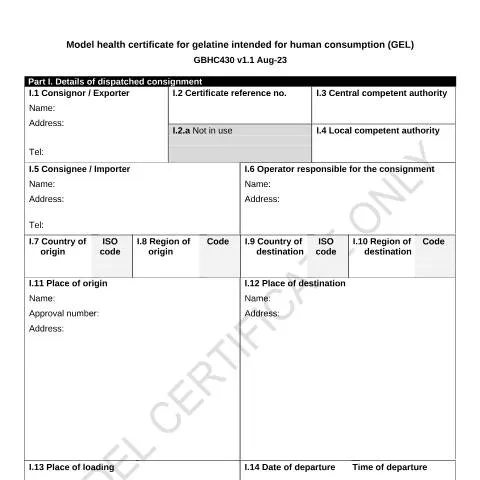
Understanding the GBHC430: A Critical Gateway for Gelatine Exports
When UK manufacturers prepare gelatine destined for international markets, they encounter a complex web of food safety regulations that demands precise documentation. The GBHC430 model health certificate represents more than administrative paperwork—it serves as the official guarantee that British gelatine products meet stringent public health standards recognised globally. This certificate, managed by the Animal and Plant Health Agency under Defra, establishes the credibility of UK gelatine in a sector where consumer safety cannot be compromised.
The significance of this document extends far beyond its technical appearance. Each GBHC430 certificate carries the authority of the UK's veterinary oversight system, providing importing countries with verifiable assurance that the gelatine has been produced under controlled conditions. For businesses operating in food manufacturing, pharmaceuticals, or cosmetics where gelatine serves as a key ingredient, this certification often determines market access and commercial viability.
The Scientific Foundation Behind Gelatine Health Certification
Gelatine production involves complex processes that transform animal collagen into a versatile ingredient used across multiple industries. The GBHC430 certificate addresses specific biological risks inherent in this transformation, particularly those related to bovine spongiform encephalopathy (BSE) and microbiological contamination. Understanding these risks explains why such detailed certification requirements exist.
The certificate's structure reflects decades of scientific research into food-borne diseases and international harmonisation of safety standards. Each section corresponds to specific control points in the manufacturing process, from raw material sourcing through final packaging. The HACCP principles referenced throughout the document represent a systematic approach to identifying and controlling biological, chemical, and physical hazards.
BSE Risk Categories and Their Implications
The certificate's most complex provisions relate to BSE risk management, reflecting the UK's historical experience with this disease. The document categorises countries into three risk levels:
- Negligible risk: Countries with comprehensive surveillance and control measures
- Controlled risk: Nations with some BSE cases but effective management systems
- Undetermined risk: Countries lacking sufficient data or control measures
These classifications directly influence which attestations must be completed on the certificate, creating a tiered certification system that matches documentation requirements to actual risk levels.
Who Requires GBHC430 Certification and When
The certificate becomes mandatory when UK-produced gelatine crosses international borders for human consumption purposes. This requirement applies regardless of whether the gelatine will be used directly in food products or serves as an ingredient in manufacturing processes. Export consignments destined for countries that recognise UK health certificates typically require this documentation at the point of departure.
Manufacturing facilities producing gelatine for export must maintain approval status with the relevant competent authority, typically the local authority or Food Standards Agency inspector responsible for their area. This approval, referenced in section I.11 of the certificate, establishes the facility's eligibility to produce certified gelatine products.
Industries Dependent on Certified Gelatine
| Sector | Primary Uses | Certification Requirements |
|---|---|---|
| Food Manufacturing | Confectionery, desserts, meat products | Full GBHC430 for all export markets |
| Pharmaceutical | Capsules, tablet coatings | Enhanced documentation often required |
| Cosmetics | Skincare products, nail treatments | Certificate plus additional quality attestations |
| Photography | Film emulsions, photographic papers | Industrial grade certification acceptable |
The Certification Process: From Application to Approval
Obtaining a GBHC430 certificate requires coordination between the exporting company, the manufacturing facility, and an Official Veterinarian authorised to sign such documents. The process typically begins several days before the intended shipment date, allowing sufficient time for inspection and verification activities.
The certifying veterinarian must physically examine the production facility and review manufacturing records to verify compliance with each attestation on the certificate. This examination goes beyond visual inspection, often involving review of batch production records, supplier declarations, and laboratory test results demonstrating microbiological compliance.
Documentation Requirements for Certification
Before certification can occur, manufacturers must prepare comprehensive documentation demonstrating compliance with GB regulations. This includes:
- Raw material declarations: Traceability documents for all animal-derived inputs
- Process validation records: Evidence that manufacturing procedures achieve required safety outcomes
- Laboratory analysis reports: Microbiological testing results for the specific batch being certified
- Supplier attestations: Declarations from raw material suppliers regarding BSE compliance
Transport Conditions and Logistics Considerations
The GBHC430 certificate includes specific provisions for transport conditions that must be maintained throughout the journey from manufacturing facility to destination. These requirements, documented in section I.18, reflect the temperature-sensitive nature of gelatine products and their potential for microbiological deterioration under inappropriate conditions.
Ambient temperature transport remains acceptable for many gelatine products, but manufacturers must demonstrate that their packaging and transport arrangements maintain product integrity. Chilled or frozen transport may be specified for certain products or destinations, particularly where extended transit times or challenging climate conditions exist.
Container and Seal Requirements
Section I.19 of the certificate requires documentation of container and seal numbers, establishing a chain of custody from the point of loading through arrival at destination. This information enables authorities to verify that certified products have not been tampered with or substituted during transport.
The seal numbers become particularly important when consignments are consolidated or transferred between different transport modes. Each transfer point must maintain the integrity of the original sealing arrangements or apply new seals under appropriate supervision.
Validity Periods and Renewal Procedures
Unlike some health certificates that specify fixed validity periods, the GBHC430 does not establish a universal expiration date. Instead, the certificate remains valid for the specific consignment it describes, typically until the goods reach their final destination and clear customs procedures. This consignment-specific approach reflects the nature of gelatine as a processed product with established shelf-life characteristics.
However, practical considerations often limit the effective validity period. Many importing countries expect health certificates to be issued within a specific timeframe before shipment, commonly within 10 days of the departure date listed in section I.14. Certificates issued significantly in advance may be questioned by importing authorities or require additional verification.
Batch-Specific Certification Requirements
The certificate's validity extends only to the specific batch or batches listed in section I.25. Manufacturers cannot use a single certificate to cover multiple production runs or combine different batches under one certification unless each batch has been individually verified by the certifying veterinarian.
This batch-specific approach ensures traceability and enables rapid response in case of food safety incidents. If problems arise with certified gelatine, authorities can quickly identify the specific production batch and associated documentation.
Compliance Challenges and Risk Management
The complex BSE-related attestations in section PH/D005 present particular challenges for certifying officers and manufacturers. These requirements vary significantly depending on the source countries of raw materials and the risk classification of those countries by international authorities. Mixed-source consignments require careful evaluation to ensure all applicable attestations are properly completed.
Manufacturers often struggle with the conditional nature of certain attestations, marked with asterisks throughout the certificate. These "keep as appropriate" sections require detailed knowledge of source countries' BSE status and the specific regulatory requirements applicable to different risk categories.
Managing Multi-Country Raw Material Sources
Modern gelatine production frequently involves raw materials sourced from multiple countries, each potentially carrying different risk profiles. The GBHC430 certificate must reflect the highest risk category represented in the consignment, meaning that even small quantities of material from undetermined risk countries can trigger the most stringent certification requirements.
This reality has led many manufacturers to implement supply chain segregation strategies, maintaining separate production lines or scheduling for different risk categories. Such approaches enable more flexible certification while maintaining the integrity required by importing authorities.
Electronic Certification and Future Developments
While the GBHC430 model shows a traditional paper-based format, UK authorities are increasingly moving toward electronic health certification systems for export products. These digital platforms offer enhanced security features, real-time verification capabilities, and improved integration with customs procedures in destination countries.
The transition to electronic certification affects how manufacturers prepare and submit documentation, often requiring integration with government digital platforms. However, the underlying certification requirements and attestations remain unchanged, ensuring continuity of food safety standards regardless of the documentation format.
As international trade in gelatine continues to expand, the GBHC430 certificate serves as a crucial bridge between UK production standards and global market access. Its detailed requirements reflect both the complexity of modern food safety regulation and the UK's commitment to maintaining high standards in exported food products. For businesses navigating this landscape, understanding the certificate's requirements represents an essential investment in sustainable export operations and market credibility.
Laboratory Testing Requirements and Compliance Standards
Before gelatine and collagen products can enter the UK market, they must undergo rigorous laboratory testing to ensure compliance with food safety standards. The Food Standards Agency (FSA) and relevant competent authorities require specific microbiological, chemical, and physical tests to be documented within the model health certificates.
Microbiological testing forms the cornerstone of safety verification. Products must be tested for pathogenic bacteria including Salmonella species, Listeria monocytogenes, and Escherichia coli. The acceptable limits are typically zero tolerance for Salmonella in 25g samples, whilst total viable counts must not exceed 10,000 colony-forming units per gram for gelatine intended for direct human consumption. For collagen products, particularly those derived from bovine sources, additional testing for spongiform encephalopathy markers may be required depending on the country of origin.
Heavy metal contamination testing represents another critical component. Lead levels must not exceed 1.0 mg/kg, whilst arsenic content should remain below 1.0 mg/kg for gelatine products. Mercury and cadmium levels are similarly restricted, with maximum allowable concentrations of 0.1 mg/kg and 0.5 mg/kg respectively. These thresholds align with Commission Regulation (EC) No 1881/2006, which continues to apply in Great Britain under retained EU law.
Chemical residue analysis encompasses veterinary drug residues, particularly antibiotics and growth promoters that may have been administered to source animals. The health certificate must confirm that products comply with maximum residue limits (MRLs) as established in UK legislation. Testing laboratories must hold appropriate accreditation, typically ISO/IEC 17025 certification, and results must be traceable to recognised reference standards.
Physical testing parameters include gel strength measurements for gelatine products, typically expressed in Bloom values. Food-grade gelatine usually requires Bloom values between 150-250, depending on intended applications. Viscosity measurements, pH levels, and moisture content must also fall within specified ranges. The health certificate should reference the specific testing methodologies employed, such as British Standard methods or internationally recognised protocols.
Sampling procedures must follow strict protocols to ensure representative testing. For bulk shipments, sampling should occur at multiple points within the consignment, with sample sizes calculated according to statistical sampling plans. The certificate must identify the specific batches tested, including production dates, lot numbers, and sampling locations within the manufacturing facility.
Documentation Requirements for Different Product Categories
The complexity of health certificate documentation varies significantly depending on the specific type of gelatine or collagen product being imported. Understanding these distinctions helps ensure appropriate certification and smooth customs clearance processes.
Pharmaceutical-grade gelatine requires the most comprehensive documentation due to its intended use in medicinal products. These products must comply with Good Manufacturing Practice (GMP) standards, and the health certificate must reference compliance with relevant pharmacopoeia monographs, such as the British Pharmacopoeia or European Pharmacopoeia. Additional certification from the Medicines and Healthcare products Regulatory Agency (MHRA) may be required, particularly for gelatine intended for parenteral applications.
The certificate must detail the specific animal species used as raw material, including age restrictions where applicable. For bovine-derived pharmaceutical gelatine, animals must typically be under 30 months of age at slaughter to minimise BSE risk. Manufacturing processes must be validated for pathogen reduction, with specific attention to prion inactivation procedures. Temperature-time profiles for rendering and subsequent processing steps should be documented within the certificate.
Food-grade gelatine intended for confectionery, desserts, or other direct consumption requires different certification elements. Religious dietary considerations often necessitate additional documentation, particularly for halal or kosher certification. The health certificate should reference compliance with relevant religious authority standards, though specific certification bodies should be identified separately from the official health documentation.
Collagen peptides and hydrolysed collagen products represent a growing market segment with specific documentation needs. These products often undergo additional processing steps, including enzymatic hydrolysis, which must be detailed in the certificate. The molecular weight distribution of peptides may need verification, particularly for products marketed with specific bioactive claims.
Technical gelatine for photographic or industrial applications requires less stringent food safety documentation but must still comply with chemical safety regulations. The health certificate should clearly identify the intended use category to avoid confusion during import procedures. Cross-contamination prevention measures become particularly important where facilities produce both food-grade and technical-grade products.
Organic gelatine and collagen products require additional certification elements demonstrating compliance with organic production standards. The certificate must reference organic certification bodies and confirm that source animals were raised according to organic farming principles. Feed restrictions, veterinary treatment limitations, and organic slaughter facility requirements must be documented.
Novel collagen products, including those derived from marine sources or produced through alternative methods, may require pre-market authorisation under novel food regulations. The health certificate should reference any relevant novel food approvals and confirm compliance with authorised specifications and conditions of use.
Post-Import Monitoring and Ongoing Compliance Obligations
Successfully importing gelatine and collagen products represents only the beginning of regulatory compliance obligations. UK importers must establish robust systems for ongoing monitoring, traceability, and incident management to maintain compliance with food safety regulations.
Traceability systems must enable rapid identification of product sources and distribution chains. The Food Safety Act 1990 and Food Hygiene Regulations require businesses to maintain records linking imported batches to specific health certificates, enabling quick response to food safety incidents. Electronic systems increasingly support these requirements, though paper-based records remain acceptable provided they offer equivalent traceability capabilities.
Importers must establish supplier verification programmes extending beyond initial health certificate review. Regular audits of overseas manufacturers help ensure continued compliance with UK standards. These audits should verify that manufacturing processes remain consistent with those described in health certificates, and that quality management systems maintain effectiveness over time. The frequency of audits typically depends on risk assessments considering factors such as product type, manufacturing complexity, and historical compliance performance.
Batch testing programmes provide additional verification of imported product quality. While comprehensive testing of every shipment may not be economically viable, risk-based sampling strategies help identify potential issues before products enter the food chain. Testing parameters should focus on the most likely contaminants or quality deviations based on product risk assessments and historical data analysis.
Incident management procedures must address various scenarios, from minor quality deviations to serious food safety concerns. The Food Standards Agency requires notification of serious incidents that could affect public health, typically within 24 hours of discovery. Withdrawal and recall procedures should be documented and regularly tested to ensure effectiveness during actual incidents.
Storage and handling requirements continue throughout the distribution chain. Gelatine products are particularly sensitive to moisture and temperature variations, which can affect gel strength and microbiological stability. Warehouse specifications should align with manufacturer recommendations and certificate requirements, with environmental monitoring systems providing continuous verification of storage conditions.
Customer communication represents another critical element of ongoing compliance. Food business operators purchasing imported gelatine or collagen must receive appropriate technical documentation enabling proper use and further traceability. This includes allergen information, usage instructions, and storage requirements that may differ from domestically produced alternatives.
Regular review of health certificates ensures continued validity and identifies opportunities for process improvements. Changes in regulatory requirements, manufacturing processes, or market conditions may necessitate certificate updates or additional documentation. Maintaining close communication with overseas suppliers and UK competent authorities helps anticipate and address these evolving requirements proactively.
Brexit-related changes continue to evolve, requiring ongoing attention to regulatory developments. The UK's independent approach to food safety regulation may diverge from EU standards over time, potentially affecting health certificate requirements and acceptance criteria. Importers should monitor FSA guidance and industry communications to ensure continued compliance with developing requirements.