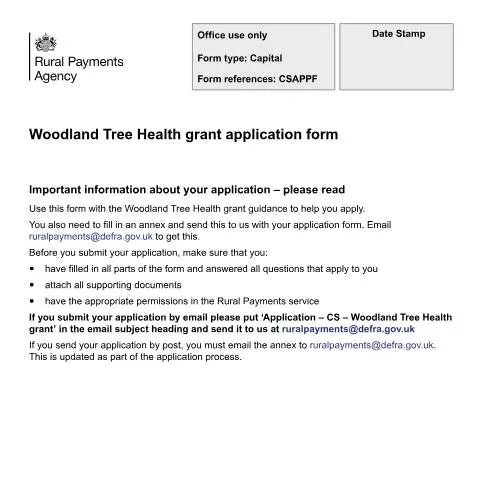
When Woodland Health Becomes a Priority: Understanding the CS69 Application Process
Tree diseases and pests have increasingly threatened Britain's woodland heritage, from ash dieback to oak processionary moth infestations. The Rural Payments Agency's Woodland Tree Health grant scheme represents a targeted response to these challenges, offering financial support to landowners and managers who take proactive steps to protect and restore their woodlands. The CS69 application form serves as the gateway to this specialised funding stream, designed specifically for those facing woodland health crises or seeking to prevent future outbreaks.
Unlike broader Countryside Stewardship agreements, this scheme focuses exclusively on tree health interventions. The application process requires careful coordination between multiple documents, including a mandatory annex that must be requested separately and submitted alongside the main form. This dual-document approach reflects the technical complexity of woodland health assessments and the need for detailed site-specific information.
Navigating the Dual Submission Requirements
The CS69 form cannot be submitted in isolation. Applicants must first contact the Rural Payments Agency at [email protected] to obtain the required annex document. This preliminary step often catches first-time applicants off guard, particularly those accustomed to self-contained application forms for other rural schemes.
The submission process varies depending on your chosen method:
| Submission Method | Main Form Requirements | Annex Requirements | Subject Line |
|---|---|---|---|
| Digital copy with no signature required | Included in same email | 'Application – CS – Woodland Tree Health grant' | |
| Post | Physical copy with handwritten signature | Must be emailed separately to same address | Standard postal delivery |
The hybrid approach for postal submissions—requiring the annex to be emailed even when the main form is posted—stems from the need for real-time updates during the assessment process. The annex contains technical data that may require modification based on initial review feedback, making electronic handling essential.
Managing the Annex Request Process
When requesting the annex, provide your proposed application timeline and a brief description of the woodland health issues you're addressing. This helps the RPA team send you the most current version and any relevant supplementary guidance. The annex typically includes detailed maps, species inventories, and intervention schedules that require precise coordination with your main application narrative.
Establishing Land Control and Management Authority
Section 1 of the CS69 form places significant emphasis on demonstrating management control over the proposed woodland areas. This requirement extends beyond simple ownership to encompass the legal authority to implement long-term management changes and meet ongoing obligations throughout the agreement period.
The Single Business Identifier (SBI) number serves as your primary reference throughout the Rural Payments system. All land parcels included in your application must be registered under this SBI, with accurate and up-to-date boundaries reflected in the system. Any discrepancies between your actual land holdings and the registered details can delay processing significantly.
Tenant Applications and Landlord Consent
Tenants face additional complexity when applying for woodland tree health grants. The Land Ownership and Control (LOC) form becomes mandatory when you lack full management control over the proposed areas. This document requires your landlord's countersignature, acknowledging their consent to the proposed interventions and their understanding of the long-term commitments involved.
Crucially, landlord refusal to sign the LOC form renders your application ineligible, regardless of the woodland's health needs or your management capabilities. This hard requirement reflects the scheme's emphasis on sustained, long-term management rather than short-term interventions.
For tenants with existing environmental management obligations written into their tenancy agreements, question 5 provides a critical safeguard. Ticking this confirmation box prevents double-funding scenarios where you might claim grant payments for activities you're already contractually required to perform. The RPA cross-references these declarations with scheme payment records to identify potential conflicts.
Common Land and Shared Grazing Considerations
Woodland areas within common land or shared grazing arrangements require additional documentation through the supplementary application form. These situations involve complex rights structures where multiple parties hold interests in the same land. The 'Common land and shared grazing supplement to the Countryside Stewardship guide' provides essential guidance for navigating these arrangements, including requirements for commoner consent and coordination with existing grazing patterns.
VAT Registration Status and Financial Planning
The VAT registration question in section 1 carries significant implications for your grant calculations and payment claims. VAT-registered businesses cannot claim VAT elements within their grant applications, as they can recover these costs through their standard VAT returns to HMRC.
Non-VAT registered applicants face a more complex situation. If you wish to include VAT in your grant claims, you must provide independent verification of your inability to reclaim VAT from HMRC. This requires a formal letter from an independent accountant—not your usual bookkeeper or a family member with accounting qualifications—confirming your VAT status and explaining why you cannot recover the VAT elements of eligible costs.
Timing Considerations for VAT Status Changes
Your VAT status may change during the grant agreement period, particularly if the woodland management activities push your turnover above the VAT registration threshold. Such changes must be reported immediately to the Rural Payments Agency, as they affect ongoing payment calculations and may require agreement modifications.
Declarations and Undertakings: Legal Commitments in Detail
Section 2 represents the most legally significant portion of the CS69 form, establishing binding commitments that extend throughout your grant agreement period. The declarations section requires confirmation of several critical elements that form the foundation of your application's validity.
The land registration declaration encompasses all holdings under your SBI number, not just the woodland areas covered by your application. This comprehensive approach ensures that any compliance issues across your entire holding won't compromise your woodland tree health grant. If you've recently acquired additional land or made boundary changes, you must submit a rural land change request or RLE1 form before submitting your CS69 application.
Understanding the Scope of Undertakings
The undertakings section establishes four key ongoing obligations that survive beyond the initial application approval:
Capability and willingness requires honest assessment of your resources, both financial and operational, to complete the proposed woodland interventions. This includes access to specialised equipment, qualified contractors, and sufficient time allocation over the agreement period.
Access rights grant RPA officials, Forestry Commission representatives, and appointed auditors broad authority to inspect your woodland areas and relevant records. This extends beyond scheduled site visits to include unannounced compliance checks and detailed examination of financial records related to grant expenditure.
Information disclosure encompasses both proactive reporting of changes and responsive cooperation with monitoring requests. You're required to participate in research studies, environmental monitoring programmes, and economic evaluations that may extend beyond your immediate grant agreement.
Authority and capacity confirmation becomes particularly important for partnerships, companies, or family arrangements where multiple parties hold interests in the woodland. The signatory must have genuine authority to bind all relevant parties to the agreement terms.
Compliance Monitoring and Enforcement Mechanisms
The warning section of the CS69 form outlines serious consequences for fraudulent applications or false statements. Prosecution for grant fraud can result in criminal charges, with cases referred to the Crown Prosecution Service for serious breaches. Beyond criminal liability, administrative penalties include immediate agreement termination and full recovery of payments made, including interest charges.
The two-year exclusion from other Defra grant schemes represents a significant business impact, particularly for rural enterprises dependent on multiple funding streams. This exclusion applies across all Defra-administered schemes, including basic payment schemes, environmental stewardship programmes, and capital grant initiatives.
The Risk Assessment Process
Applications undergo risk assessment using automated systems that cross-reference multiple databases, including previous grant applications, compliance records, and land registration histories. High-risk applications trigger enhanced scrutiny, including mandatory site visits before approval and more frequent monitoring throughout the agreement period.
Common risk factors include previous compliance issues, complex land ownership structures, applications covering large areas relative to your management experience, and proposals involving rare or particularly valuable woodland species requiring specialist intervention techniques.
Signature Requirements and Legal Validity
The signature requirements differ significantly between submission methods, reflecting different approaches to legal validity and identity verification. Postal applications require handwritten signatures from authorised representatives, establishing clear legal accountability for the declarations and undertakings.
Email submissions operate under electronic communication protocols established within the Rural Payments service framework. Your registered email address serves as sufficient identification, provided it matches your Rural Payments service account details. This streamlined approach reduces administrative burden while maintaining security through the existing digital identity verification systems.
Signatory Capacity and Authority
The capacity designation—sole trader, company director, or agent—determines the legal framework governing your application and subsequent agreement. Company directors must ensure their authority extends to environmental commitments and long-term land management decisions, which may require board resolution for significant agreements.
Agents require written authority from the beneficial landowner or manager, typically through a formal power of attorney or specific authorisation letter. This authority must cover not just the application submission but ongoing compliance obligations and potential enforcement actions throughout the agreement period.
Data Protection and Information Handling Protocols
The CS69 form operates under the Rural Payments Agency's comprehensive data protection framework, governed by the Data Protection Act 2018 and UK GDPR requirements. Your personal information, land details, and financial data are processed for specific purposes related to scheme administration, compliance monitoring, and programme evaluation.
Information sharing occurs between multiple government departments, including the Forestry Commission for technical assessments, HMRC for VAT verification, and local planning authorities for environmental impact assessments. The RPA Customer Privacy Notices provide detailed information about data retention periods, sharing arrangements, and your rights regarding personal information processing.
Understanding these protocols becomes particularly important given the long-term nature of woodland management agreements and the extensive monitoring requirements. Your data may be retained and processed for research purposes long after your specific grant agreement concludes, contributing to broader policy development and scheme effectiveness evaluation.
Understanding Grant Calculation Methods and Payment Structures
The Woodland Tree Health grant operates on a tiered payment structure that varies significantly depending on the specific intervention required and the characteristics of your woodland. Understanding these calculation methods is essential for accurate budgeting and realistic expectations about funding levels.
For felling operations, payments are typically calculated per hectare, with rates varying between £800 and £2,500 per hectare depending on terrain difficulty, tree species, and accessibility. Steep slopes or areas requiring specialist equipment command higher rates, whilst easily accessible flat terrain falls at the lower end of the scale. The Rural Payments Agency assesses each site individually, considering factors such as proximity to roads, soil conditions, and the presence of protected species or archaeological features.
When applying for restocking grants, the calculation becomes more complex. Base rates start around £1,200 per hectare for standard broadleaf species, but can increase substantially for specialist native varieties or sites requiring additional protection measures. If your woodland requires deer fencing, add approximately £3-£5 per linear metre to your calculations. Tree guards for individual specimens typically add £2-£4 per tree, depending on the protection level required.
The application form requires detailed costings broken down by activity type. You'll need to provide separate figures for site preparation (including weed control and ground cultivation), planting operations, protection measures, and any required access improvements. Each cost category has specific evidence requirements—for instance, fencing costs must include detailed specifications of post spacing, wire gauge, and gate provisions.
Payment timing follows a structured schedule that applicants must understand before committing to work programmes. Initial payments of up to 80% of approved costs may be available for eligible applicants with established track records, but new applicants typically receive payments in arrears following completion verification. Interim payments are possible for multi-year projects, but require detailed progress reporting and independent verification of completed work stages.
For monitoring and maintenance grants, ongoing payments are calculated annually based on management prescriptions. These might include £150-£300 per hectare annually for enhanced monitoring requirements, or £50-£100 per hectare for basic compliance monitoring. Maintenance payments vary widely: bracken control might attract £200-£400 per hectare depending on treatment method, whilst invasive species management can range from £500-£2,000 per hectare for intensive programmes.
Cross-Scheme Integration and Compatibility Requirements
The Woodland Tree Health grant operates within a complex landscape of overlapping environmental schemes, and successful applications must demonstrate compatibility with existing commitments and strategic alignment with broader land management objectives. This integration requirement significantly affects both application strategy and ongoing compliance obligations.
If your woodland is already enrolled in Countryside Stewardship agreements, you'll need to demonstrate how tree health interventions align with existing prescriptions. Some activities may require formal agreement variations through Natural England, particularly if proposed felling operations affect areas designated for specific wildlife outcomes. The application form includes detailed sections for declaring existing scheme memberships, with mandatory cross-referencing to agreement numbers and expiry dates.
Applicants participating in the England Woodland Creation Offer face particular integration challenges when tree health issues emerge in recently established woodlands. The grant application must clearly distinguish between remedial work addressing unforeseen health problems and standard establishment activities covered under existing agreements. Documentation requirements include independent assessment reports confirming that health issues weren't reasonably foreseeable during original planning stages.
For woodlands within Environmental Land Management scheme areas, the application process requires detailed consultation records with local delivery partners. These partnerships, typically involving Wildlife Trusts, National Trust properties, or local authority conservation teams, must provide written confirmation that proposed interventions support landscape-scale conservation objectives. The application form dedicates substantial sections to documenting these consultation processes, including meeting minutes and agreed monitoring protocols.
Woodland Carbon Code participants face additional complexity when tree health issues threaten carbon sequestration projections. Applications must include revised carbon calculations demonstrating how proposed interventions maintain or enhance long-term carbon storage potential. This typically requires engagement with approved Woodland Carbon Code validators, whose reports become integral parts of the grant application documentation.
Sites with Site of Special Scientific Interest designations require Natural England consent before any tree health interventions commence. The grant application process runs parallel to SSSI consent procedures, but cannot be approved until all statutory consents are secured. Applicants must provide detailed evidence of Natural England engagement, including case officer contact details and expected consent timescales. In some cases, grant applications may be held in abeyance for months whilst complex consent negotiations proceed.
The application form includes mandatory sections for historic environment considerations, requiring consultation with Historic England or local authority archaeological services. Scheduled monuments, listed buildings, or areas of archaeological significance may severely constrain intervention options. Tree health work near historic features often requires specialist archaeological oversight during operations, with associated costs eligible for grant support if properly documented during application stages.
For applicants managing multiple woodland parcels across different local authority boundaries, the integration requirements become particularly complex. Each authority may have distinct local planning policies affecting woodland management, and the application must demonstrate compliance with all relevant local development frameworks. This often requires separate consultation processes with multiple planning departments, environmental health teams, and biodiversity officers.
Post-Approval Compliance Monitoring and Audit Procedures
Successfully securing a Woodland Tree Health grant triggers a comprehensive compliance framework that extends well beyond initial work completion. Understanding these ongoing obligations is crucial for maintaining funding eligibility and avoiding potential repayment demands that could arise from audit findings or breach notifications.
The Rural Payments Agency operates a risk-based inspection programme that may subject your woodland to unannounced visits throughout the agreement period. High-risk factors include previous compliance issues, complex multi-phase projects, or sites within environmentally sensitive areas. Inspection teams typically include forestry specialists, ecological advisors, and administrative compliance officers, each focusing on different aspects of grant delivery.
During inspections, officials examine detailed records that you're required to maintain throughout the project lifecycle. These include daily work logs documenting weather conditions, personnel involved, and specific activities undertaken. Photographic evidence requirements are particularly stringent—you must maintain georeferenced images showing site conditions before, during, and after interventions. GPS coordinates must be recorded to Ordnance Survey standards, with accuracy tolerances typically within 5 metres of declared positions.
Financial compliance monitoring involves detailed scrutiny of all claimed expenditure against original cost estimates and approved variations. Invoice documentation must demonstrate clear audit trails linking expenditure to specific grant-eligible activities. Subcontractor arrangements require particular attention—you must maintain copies of all subcontractor insurance certificates, health and safety documentation, and evidence of appropriate professional qualifications or certifications.
The monitoring protocol varies significantly depending on the intervention type and site characteristics. Felling operations typically require quarterly photographic updates for the first year, followed by annual monitoring for up to five years. Restocking projects may require monthly updates during establishment phases, with detailed survival rate assessments at six-month intervals. Each monitoring submission must include standardised reporting forms with mandatory data fields covering weather conditions, pest pressures, and any emerging management challenges.
For sites requiring ecological monitoring, you'll need to engage appropriately qualified ecological consultants for baseline and ongoing assessments. These consultants must hold relevant professional memberships—typically the Chartered Institute of Ecology and Environmental Management—and their monitoring reports become part of your compliance documentation. Ecological monitoring costs are eligible for grant support, but must be explicitly included in original applications with detailed methodology statements.
Breach procedures can be triggered by various compliance failures, from minor administrative oversights to significant delivery shortfalls. Minor breaches—such as late submission of monitoring reports or incomplete photographic documentation—typically result in warning notices with specified remedial timescales. More serious breaches, including unauthorised changes to approved work programmes or failure to achieve specified outcomes, may trigger partial or complete grant recovery procedures.
The appeals process for compliance disputes involves multiple stages, beginning with informal discussions with case officers and potentially escalating to formal review panels. These panels include independent forestry experts, legal advisors, and Rural Payments Agency senior managers. Appeal documentation must be submitted within strict timescales—typically 28 days from initial breach notification—and should include comprehensive evidence supporting your position.
Record retention requirements extend for minimum periods of six years following final grant payments, with some categories requiring longer retention. Digital storage systems must meet specific technical standards for data integrity and accessibility, whilst paper records require secure storage with appropriate environmental controls. During audit periods, you must provide Rural Payments Agency officials with immediate access to all relevant documentation, including financial records, correspondence, and technical reports.