Photographing Protected Species: When Your Passion Meets Wildlife Law
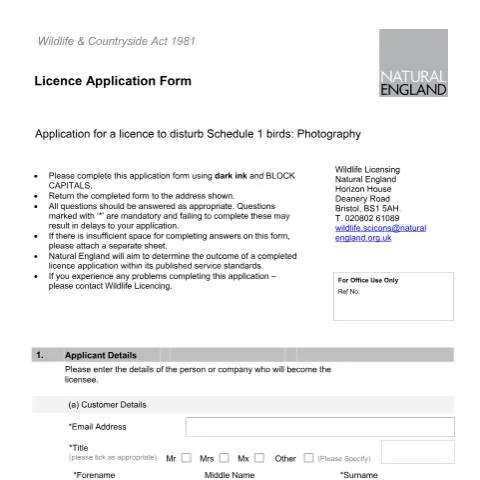
Wildlife photography in England operates within a complex legal framework where artistic ambition collides with conservation imperatives. The A28 licence application form represents Natural England's gateway for photographers seeking lawful access to Schedule 1 birds under the Wildlife and Countryside Act 1981. These specially protected species—from peregrine falcons to barn owls—require explicit authorisation before any deliberate disturbance can occur, even for the click of a camera shutter.
The form's reference code SCICONPHO WML A28 signals its place within Natural England's Wildlife Management Licensing system, specifically targeting photography under section 16(1)(h) of the Act. This legal provision recognises photography as a legitimate activity that may warrant disturbing protected wildlife, provided it meets stringent criteria and follows prescribed protocols.
The Licence Landscape: Understanding Schedule 1 Protections
Schedule 1 birds enjoy the highest level of statutory protection in England, extending beyond the general prohibitions that cover all wild birds. Whilst photographing a robin or blackbird requires no special permission, capturing images of a bittern, golden eagle, or red kite demands prior authorisation from Natural England.
The legislation recognises disturbance in its broadest sense: approaching a nest site, causing a bird to alter its behaviour, or positioning equipment that might influence breeding patterns all constitute potential offences. Professional wildlife photographers have learned this reality through costly experience, as prosecution can result in unlimited fines and criminal records that effectively end careers.
| Activity Level | Typical Species | Licence Requirement | Peak Application Period |
|---|---|---|---|
| Nest photography within 50m | Peregrine, goshawk, honey buzzard | Essential | January–March |
| Roost site documentation | Barn owl, short-eared owl | Usually required | September–November |
| Feeding area observation | Marsh harrier, osprey | Case-by-case assessment | April–June |
| Migration staging posts | Dotterel, purple sandpiper | Often required | February–April |
Applicant Profiles: From Amateur Enthusiasts to Commercial Operations
Natural England's A28 form accommodates diverse applicant categories, each presenting unique considerations for licence assessment. The Customer Details section distinguishes between individual photographers and commercial entities, with professional membership credentials carrying particular weight in applications.
Individual photographers typically fall into several distinct profiles. Amateur naturalists often seek one-off permissions for local species, providing detailed knowledge of specific sites and birds. Their applications frequently demonstrate years of observation without disturbance, building credibility through patient fieldwork. Semi-professional photographers may combine commercial sales with conservation education, requiring careful justification of their activities' broader benefits.
Commercial operations face heightened scrutiny. Film production companies, stock photography agencies, and media organisations must demonstrate compelling public interest alongside rigorous protocols. The form's business details section becomes crucial here, with Natural England assessing corporate track records and industry standards.
Professional Credentials and Their Impact
The form specifically requests professional membership details, recognising organisations like the Chartered Institute of Ecology and Environmental Management (CIEEM) or the Institute of Environmental Management & Assessment (IEMA). These credentials don't guarantee licence approval but demonstrate commitment to professional standards and continuing education in wildlife law.
Alternative applicant contacts serve practical purposes beyond mere convenience. When photographers work in remote locations or extended field seasons, reliable communication channels become essential for licence compliance monitoring and emergency coordination.
Navigating the Justification Minefield
Section 5's open text box represents the application's make-or-break element. Natural England licensing officers scrutinise these justifications against established criteria, seeking evidence that proposed activities serve legitimate purposes whilst minimising wildlife impact.
Successful justifications typically combine multiple elements. Educational value might involve collaboration with schools, nature reserves, or conservation organisations. Scientific contribution could include behavioural documentation, population monitoring support, or habitat assessment photography. Conservation awareness encompasses public engagement through exhibitions, publications, or digital media.
Weak justifications often reveal themselves through vague language or unrealistic claims. Stating intentions to "raise awareness of wildlife conservation" without specific delivery mechanisms or target audiences signals inexperience with licensing requirements. Similarly, commercial motivations disguised as conservation objectives rarely withstand scrutiny.
Crafting Compelling Justifications
Effective applications demonstrate clear understanding of the target species' ecology and conservation status. References to current population trends, local threats, or habitat pressures show applicants have researched beyond basic identification guides. Specific methodologies—hide construction, approach distances, session duration limits—illustrate thoughtful planning rather than opportunistic photography.
Partnership approaches strengthen applications significantly. Collaborating with local RSPB reserves, Wildlife Trust sites, or university research projects provides independent validation of conservation credentials whilst ensuring professional oversight of field activities.
Previous Applications: Learning from Licensing History
Section 3 explores applicants' previous interactions with Natural England's licensing system, creating transparency around past decisions and outcomes. This information influences current applications in multiple ways, with successful track records enhancing credibility whilst previous refusals or compliance issues raising red flags.
The form's checkbox options reflect real-world licensing outcomes. Granted applications establish precedent for similar future requests, particularly when conditions were met successfully. Not Granted decisions provide learning opportunities, with refusal reasons often highlighting specific deficiencies that can be addressed in subsequent applications.
Advice Only outcomes occur when Natural England determines that proposed activities don't require licensing, either because they fall outside Schedule 1 protections or won't constitute disturbance under specific circumstances. These decisions provide valuable clarification for future activities.
Understanding Deferred and Unknown Outcomes
Deferred applications typically arise when additional information is required or when seasonal timing affects assessment possibilities. Natural England may defer applications submitted too late for breeding season activities or when environmental conditions prevent proper site evaluation.
Not Yet Known reflects applications under active consideration, particularly relevant when applicants submit multiple requests or when previous decisions remain under appeal through Natural England's review processes.
Communication Channels and Processing Expectations
The form's communication preferences section acknowledges applicants' varying needs and circumstances. Email communication typically provides fastest response times and creates clear audit trails for licence conditions and compliance monitoring. Postal communication may suit applicants in areas with limited internet connectivity or those preferring traditional correspondence methods.
Telephone contact proves valuable for complex applications requiring clarification or negotiation of specific conditions. Natural England's Wildlife Licensing team, contactable through the provided Bristol office details, offers expert guidance on application preparation and condition interpretation.
Processing times vary significantly based on application complexity, seasonal pressures, and completeness of initial submissions. Standard applications for well-established photography purposes may receive decisions within several weeks, whilst novel requests or sensitive species may require months of assessment including site visits and expert consultation.
Submission Requirements and Documentation
The form emphasises completion in dark ink and BLOCK CAPITALS, reflecting Natural England's need for clear, scannable documentation in their processing systems. Mandatory fields marked with asterisks must be completed to prevent automatic rejection, whilst insufficient space provisions allow detailed responses through attached continuation sheets.
The Bristol address—Horizon House, Deanery Road, Bristol, BS1 5AH—serves as Natural England's central processing hub for wildlife licensing applications. The dedicated telephone number 020802 61089 connects applicants directly with specialist licensing staff rather than general enquiry services.
Strategic Timing and Seasonal Considerations
Successful licence applications require careful timing aligned with both species ecology and Natural England's administrative cycles. Breeding season restrictions typically run from March through August for most Schedule 1 species, with specific variations reflecting individual species' breeding patterns and habitat requirements.
Winter applications often face fewer complications, as reduced breeding activity minimises disturbance risks whilst allowing thorough site assessment and methodology development. However, some species—particularly wintering raptors or passage migrants—maintain Schedule 1 protection year-round, requiring continued vigilance and licensing compliance.
Natural England's published service standards commit to application determination within specified timeframes, though complex cases may exceed these targets. Early submission—ideally 8-12 weeks before intended activities—provides sufficient time for assessment, condition negotiation, and any necessary appeals or modifications.
The form's reference to determination "within published service standards" reflects Natural England's commitment to transparent, predictable processing whilst acknowledging the inherent complexity of wildlife licensing decisions. Applicants should factor potential delays into project planning, particularly for commercial assignments with fixed deadlines or seasonal opportunities.
Photography Equipment and Technical Considerations for Licensed Wild Bird Disturbance
When applying for an A28 licence, Natural England evaluates not only your experience but also the appropriateness of your photographic equipment and methodology. The type of equipment you intend to use can significantly influence both the likelihood of licence approval and the specific conditions attached to your permit.
Long telephoto lenses (typically 400mm and above) are generally viewed more favourably as they allow greater working distances from sensitive species. If you plan to use shorter focal lengths or require closer proximity for macro work on nesting behaviours, you'll need to provide detailed justification explaining why alternative methods cannot achieve your objectives. Natural England particularly scrutinises applications involving flash photography, as artificial lighting can cause significant stress to nocturnal species and disrupt natural feeding patterns during dawn and dusk periods.
Camera trap installations require specific consideration within your A28 application. These devices, whilst minimising direct human disturbance, can still affect bird behaviour through their physical presence and occasional infrared emissions. You must detail the exact positioning methodology, camouflage techniques, and retrieval schedules. Some sensitive locations, particularly those hosting Schedule 1 species during breeding season, may restrict camera trap usage to specific zones or time periods.
Drone photography presents additional complexities within the A28 framework. Beyond Civil Aviation Authority permissions, you must demonstrate that aerial photography cannot be achieved through conventional ground-based methods. Natural England typically requires evidence that drone usage will result in less overall disturbance than traditional hide-based photography. Flight path planning becomes crucial, as even brief overflights can cause nest abandonment in species such as stone curlews or Dartford warblers.
Digital workflow considerations also feature in comprehensive A28 applications. Natural England may request details about your post-processing intentions, particularly if you plan to create composite images or digitally remove identification features from sensitive locations. Some licences include specific conditions about image metadata retention, requiring photographers to maintain GPS coordinates and timestamp information for monitoring purposes.
Regional Variations and Local Authority Coordination
A28 licence applications can vary significantly depending on your intended photography location, as different regions across England present unique conservation challenges and administrative arrangements. Coastal areas, particularly those designated as Special Protection Areas (SPAs) under the Birds Directive, often involve coordination between Natural England and local maritime authorities.
In areas managed by the National Trust, English Heritage, or Crown Estate, your A28 licence may require additional permissions or notifications. These organisations often maintain their own photography policies that operate alongside Natural England's licensing system. For instance, photographing seabirds on National Trust clifftop colonies typically requires both an A28 licence and separate National Trust consent, with specific access route requirements to minimise erosion and vegetation damage.
Forestry England locations present particular considerations for woodland bird photography. Ancient woodland sites hosting species such as wood warblers or pied flycatchers often have seasonal access restrictions that extend beyond A28 licence conditions. Your application should demonstrate awareness of these additional constraints and explain how your photography schedule aligns with broader habitat management objectives.
Military training areas and Ministry of Defence estates require special coordination procedures. Sites such as Salisbury Plain or Stanford Training Area support significant populations of stone curlews and other ground-nesting species, but photography access depends on training schedules and safety protocols. Natural England typically processes these applications through specialist teams familiar with MOD coordination requirements.
Urban and suburban environments present different challenges, particularly around species such as peregrine falcons nesting on buildings or black redstarts in industrial sites. Local authority building control departments may need notification if your photography involves accessing private buildings or using elevated positions. Some city councils maintain specific protocols for wildlife photography in public spaces, especially during breeding seasons when protective barriers may be established around nest sites.
Northern England applications often involve coordination with Yorkshire Dales National Park Authority, Lake District National Park Authority, or Northumberland National Park Authority. These organisations may have seasonal restrictions on fell-walking or moorland access that affect your ability to reach remote nesting sites. Upland species such as ring ouzels or twites require particularly careful timing, as weather conditions can rapidly change accessibility and bird behaviour patterns.
Compliance Monitoring and Post-Licence Obligations
Obtaining an A28 licence marks the beginning, rather than the end, of your regulatory obligations. Natural England maintains active monitoring programmes to ensure licence conditions are followed and to gather data about disturbance impacts on wild bird populations.
Regular reporting requirements form a key component of most A28 licences. You'll typically need to submit detailed logs recording each photography session, including species observed, weather conditions, disturbance responses, and any unexpected behaviours noted. These reports contribute to Natural England's ongoing research into photography impacts and help inform future licensing decisions. Failure to submit required reports can result in licence suspension or refusal of future applications.
Some licences include mandatory consultation periods before commencing photography activities. If your target species shows signs of early breeding behaviour or unusual stress responses, you may need to contact Natural England's licensing team before proceeding. This is particularly relevant for climate-sensitive species whose breeding cycles may shift due to changing weather patterns.
Photographic evidence requirements extend beyond simple compliance documentation. Natural England increasingly requests that licence holders contribute their images to national monitoring databases, particularly for rare species where photographic records help track population changes and breeding success rates. While you retain copyright over your images, some licences include conditions allowing Natural England to use submitted photographs for conservation research purposes.
Violation consequences can be severe and long-lasting. Beyond immediate penalties, which may include fines up to £5,000 per offence under the Wildlife and Countryside Act 1981, licence violations can result in permanent exclusion from future A28 applications. Natural England maintains detailed records of compliance history, and serious breaches may be shared with other wildlife licensing authorities across the UK.
Third-party reporting mechanisms allow members of the public to report suspected licence violations through Natural England's incident reporting system. If you're photographing in public areas, maintaining visible identification and carrying licence documentation helps avoid misunderstandings with concerned wildlife enthusiasts or local authorities.
Equipment inspection powers allow Natural England officers to examine your photography equipment and review stored images during compliance checks. Digital cameras and memory cards may be temporarily retained if violations are suspected, making regular backup procedures essential for professional photographers relying on their equipment for ongoing work.
Licence renewal processes become significantly more complex if compliance issues arise during your initial permit period. Natural England reviews all reported incidents, consultation records, and submitted monitoring data when evaluating renewal applications. Building a strong compliance record through your first A28 licence greatly improves prospects for future permissions and may lead to reduced restrictions in subsequent licences.