Understanding the Two-Path System: Renewal or Surrender
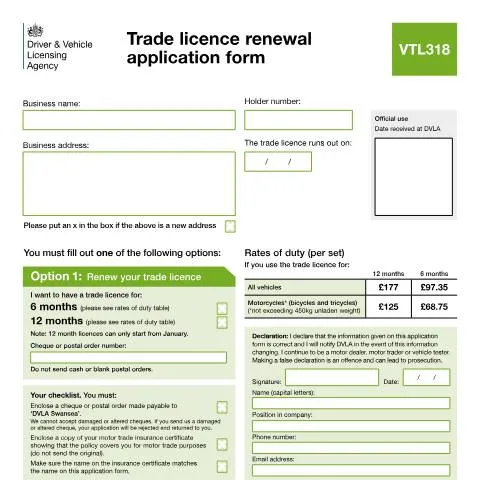
The VTL318 form presents motor traders with a crucial decision point that arrives annually or bi-annually: continue operating under trade licence privileges or formally exit the system. This binary choice structure reflects DVLA's recognition that business circumstances change, and not every trader wishes to maintain their licensing indefinitely.
The form's design centres around two mutually exclusive options. Option 1 facilitates straightforward renewal for ongoing operations, whilst Option 2 provides a clean exit route with potential tax recovery. This dual-purpose approach eliminates the need for separate surrender documentation, streamlining what could otherwise be a fragmented process.
For established motor traders, the renewal path typically follows a predictable pattern. However, the surrender option requires careful consideration of timing, particularly regarding refund eligibility and the physical return of trade plates. The DVLA's requirement for concurrent submission of form VTL308 when surrendering creates a two-form process that many traders overlook during initial planning.
The January Constraint for Annual Licences
A critical limitation embedded within the renewal system restricts 12-month trade licences to January start dates exclusively. This constraint creates planning challenges for businesses whose operational cycles don't align with the calendar year, forcing them into either 6-month cycles or extended waiting periods.
Traders establishing new businesses mid-year face particular complications. They must either commit to multiple 6-month renewals at higher per-month costs or delay full operations until the following January. The financial implications can be substantial: six-month licences for all vehicles cost £97.35 versus £177 annually, representing a 10% premium when doubled.
Navigating Insurance Documentation Requirements
The insurance certificate submission represents one of the most common rejection points in VTL318 applications. The DVLA requires a copy of the motor trade insurance certificate, specifically warning against sending originals. This seemingly straightforward requirement conceals several compliance nuances that frequently catch applicants unprepared.
The certificate must explicitly demonstrate coverage for "motor trade purposes" – general commercial vehicle insurance rarely suffices. Standard business policies often exclude the specific activities that trade plates enable, such as test driving unregistered vehicles or moving stock between premises. Traders must ensure their insurance provider understands the trade plate context and includes appropriate coverage clauses.
Name Matching Precision
Exact name correspondence between the insurance certificate and VTL318 application creates another verification hurdle. Limited companies must ensure their insurance reflects the precise registered business name, including any "Limited" or "Ltd" designations. Sole traders operating under business names face similar scrutiny – the insurance must match either the individual's legal name or the registered business name, not informal variations.
When insurance documentation proves unavailable, the form provides an alternative path requiring Companies House registration details. This fallback option primarily serves limited companies with comprehensive business registrations, though sole traders registered with Companies House may also qualify under specific circumstances.
| Business Structure | Primary Insurance Requirement | Alternative Documentation |
|---|---|---|
| Limited Company | Certificate matching exact registered name | Companies House number plus explanation |
| Partnership | Certificate covering partnership entity | Limited alternatives available |
| Sole Trader | Certificate matching legal or business name | Companies House number if registered |
Payment Mechanics and Processing Safeguards
The VTL318 payment system operates exclusively through cheques or postal orders, rejecting cash submissions and blank instruments. This traditional approach reflects security considerations and audit trail requirements, though it creates practical challenges for businesses accustomed to electronic transactions.
Cheque damage or alteration triggers automatic application rejection, forcing resubmission with associated delays. The DVLA's quality control extends beyond obvious tampering to include fold marks, stains, or corrections that might compromise cheque integrity. Traders should prepare pristine payment instruments and consider protective packaging during postal submission.
The payee designation must read exactly "DVLA Swansea" – variations or abbreviations cause processing delays. Postal orders offer greater security than personal cheques, particularly for high-value annual renewals, though they require advance purchase from Post Office branches.
Fee Structure Analysis by Usage Category
The dual-tier pricing structure creates significant cost variations depending on vehicle categories and licence duration. Motorcycle-only operations benefit from substantially reduced rates: £125 annually versus £177 for all-vehicle coverage, representing a 29% saving for specialised traders.
The motorcycle category specifically excludes vehicles exceeding 450kg unladen weight, a threshold that eliminates most commercial motorcycles and three-wheelers. Traders handling diverse stock must carefully evaluate their vehicle mix to determine appropriate coverage levels, as upgrading mid-term typically requires new applications rather than amendments.
Trade Plate Registration and Compliance Tracking
The form's trade plate listing section serves multiple administrative functions beyond simple renewal tracking. Each plate number must align with specific vehicle categories, creating accountability for proper usage and enabling targeted compliance monitoring.
Traders operating mixed fleets face complex decisions when allocating plates between "all vehicles" and "motorcycles" categories. Incorrectly categorised plates limit operational flexibility and may trigger compliance issues during roadside inspections. The DVLA's enforcement systems increasingly cross-reference plate categories with actual usage patterns.
The checkbox system for duration selection requires precision – traders must select either 6-month or 12-month terms for each plate individually. Mixed-duration renewals within single applications create processing complications, though they remain technically permissible for businesses with varying operational needs.
Holder Number Significance
The holder number field connects current applications to historical trading records, enabling continuity tracking and compliance verification. This identifier remains consistent across renewals, creating an audit trail that spans multiple licensing periods and business structure changes.
New applications require holder number assignment through separate processes, typically initiated via telephone contact with DVLA licensing departments. Existing traders must reference their current documentation to ensure accurate holder number transcription, as errors delay processing and may require manual intervention.
Declaration Responsibilities and Legal Implications
The declaration section imposes ongoing obligations that extend beyond form submission. Signatories commit to notifying DVLA of material changes, maintaining motor dealer status, and ensuring information accuracy throughout the licensing period.
The "motor dealer, motor trader or vehicle tester" qualification encompasses various business activities, from traditional dealerships to specialist testing facilities. However, the definitions require active engagement with relevant vehicle transactions – passive ownership or occasional sales rarely qualify for trade licensing privileges.
False declarations carry prosecution risks, with penalties potentially including fines, licence revocation, and criminal records. The DVLA's increasing use of data matching and cross-verification systems heightens detection risks for inaccurate submissions, making thorough preparation essential rather than optional.
Authorisation and Corporate Accountability
Position identification within company structures determines signing authority and legal responsibility. Directors, company secretaries, and designated managers typically possess requisite authority, whilst junior employees require explicit delegation documentation.
Partnerships present particular challenges, as all partners may hold joint responsibility for declarations. Limited liability partnerships often designate specific partners for regulatory submissions, creating clearer accountability chains whilst maintaining operational flexibility.
Processing Timelines and Operational Continuity
The four-week processing standard provides predictability for business planning, though actual timelines vary based on application complexity and seasonal volumes. Peak renewal periods, particularly January for annual licences, often extend processing beyond standard timeframes.
Traders approaching licence expiry must balance early submission benefits against potential administrative complications. Submissions significantly in advance may trigger verification requests or require updated documentation, whilst last-minute applications risk operational disruption if processing delays occur.
The DVLA's Swansea processing centre handles all VTL318 submissions, creating single-point accountability but potentially limiting regional flexibility. Urgent applications require telephone contact with licensing departments, though emergency provisions remain limited and typically apply only to exceptional circumstances.
Continuation Strategies During Renewal Gaps
Expired trade licences immediately invalidate associated privileges, including test driving rights and movement authorities. Traders must prepare alternative arrangements for essential operations during potential renewal gaps, including temporary insurance upgrades or third-party transportation services.
The prohibition against using trade plates on unroadworthy vehicles remains absolute, regardless of renewal status. MOT requirements apply universally unless specific exemptions apply, creating additional compliance layers that traders must navigate independently of licensing considerations.
Integration with Broader Regulatory Frameworks
Trade licensing operates within comprehensive regulatory ecosystems encompassing insurance requirements, MOT obligations, and roadworthiness standards. The VTL318 process represents just one component of ongoing compliance responsibilities that successful motor traders must coordinate systematically.
The relationship between trade licensing and other DVLA services creates opportunities for streamlined administration. Traders maintaining multiple vehicle registrations, operator licences, or specialist endorsements may benefit from coordinated renewal scheduling, though separate applications remain mandatory for each service category.
Digital integration through the gov.uk portal provides supplementary information and related services, though the VTL318 itself requires postal submission. This hybrid approach reflects transitional digitisation efforts whilst maintaining established verification procedures for high-stakes licensing decisions.
Future regulatory developments may expand digital submission options, though current security frameworks and audit requirements favour traditional documentation methods. Traders should monitor DVLA communications for procedural updates whilst maintaining familiarity with existing postal submission requirements.
VTL318 Supporting Documentation Requirements
The VTL318 trade licence renewal requires specific supporting documents that validate your continued eligibility and compliance with DVLA regulations. Understanding these requirements prevents processing delays and potential rejection of your application.
Mandatory documentation includes your current trade licence certificate, which must be submitted with the renewal form even if it has expired. The DVLA requires the original certificate or a certified copy to verify your existing licence details and history. Additionally, you must provide evidence of valid motor trade insurance that covers the specific activities outlined in your renewal application. This insurance must be current and specifically designed for motor trade operations, not standard commercial vehicle insurance.
For VAT-registered businesses, include your latest VAT registration certificate and recent VAT returns demonstrating ongoing trade activity. The DVLA may request additional financial documentation if there are gaps in your trading history or significant changes to your business structure since your last renewal.
Identity verification requirements depend on your business type. Sole traders must provide photographic identification (driving licence or passport) and proof of current address dated within three months. Limited companies need to submit the certificate of incorporation, memorandum and articles of association, and evidence that directors are authorised to act on behalf of the company.
When submitting premises documentation, ensure all addresses listed match your business registration details. If you operate from multiple sites, provide evidence for each location, including lease agreements, rates bills, or property ownership documents. The DVLA may conduct site inspections for new premises or where significant changes have occurred since your last renewal.
Digital submission considerations require high-quality scans or photographs of all documents. Each file should be clearly legible, properly oriented, and saved in accepted formats (typically PDF, JPEG, or PNG). File size restrictions may apply, so compress large documents while maintaining readability.
VTL318 Processing Timeframes and Status Tracking
Understanding VTL318 processing timeframes helps you plan business operations and avoid periods without valid trade licence coverage. The DVLA provides guidance on expected processing times, though these can vary based on application complexity and seasonal demand.
Standard processing times for complete VTL318 applications typically range from 4-6 weeks from receipt. However, applications submitted during peak periods (particularly January to March when many licences expire) may experience longer processing times. The DVLA recommends submitting renewal applications at least 8 weeks before your current licence expires to ensure continuous coverage.
Expedited processing is not routinely available for trade licence renewals, unlike some other DVLA services. The agency prioritises applications based on expiry dates and completeness rather than urgency requests. However, applications approaching critical expiry dates may receive priority handling if submitted with all required documentation.
Application tracking systems allow you to monitor progress through the DVLA's online portal using your reference number provided upon submission. Status updates typically include: application received, under review, additional information required, approved, or rejected. The system updates every 24-48 hours during normal processing periods.
When additional information is requested, you typically have 28 days to respond before the application is withdrawn. The DVLA sends correspondence to your registered address and may also contact you by telephone for urgent clarifications. Prompt response to information requests prevents processing delays and potential application rejection.
Processing delays commonly occur due to incomplete applications, unclear documentation, or changes in business circumstances not properly declared. The DVLA may suspend processing pending receipt of satisfactory evidence, particularly for premises changes, ownership transfers, or gaps in trading history.
For complex applications involving multiple business activities or unusual circumstances, processing may extend to 8-12 weeks. These include applications for new premises, significant changes to business structure, or where previous compliance issues need resolution.
Post-Renewal Compliance and Ongoing Obligations
Successfully renewing your VTL318 trade licence triggers ongoing compliance obligations that extend beyond the renewal process itself. Understanding these requirements ensures you maintain valid licence status throughout the renewal period and avoid enforcement action.
Record-keeping requirements mandate maintaining comprehensive records of all vehicles handled under your trade licence. This includes purchase and sale documentation, repair records, and movement logs showing when and where vehicles were driven under trade licence authority. The DVLA and HMRC may inspect these records during compliance checks, typically with minimal notice.
Insurance compliance requires continuous motor trade insurance coverage throughout your licence period. Any lapse in insurance coverage, even for short periods, can result in licence suspension or revocation. Notify the DVLA immediately if your insurance arrangements change, including policy renewals, provider changes, or coverage modifications.
Premises obligations include maintaining suitable facilities for your declared motor trade activities. The DVLA may conduct unannounced inspections to verify premises compliance with licence conditions. Ensure adequate security arrangements, proper vehicle storage facilities, and compliance with local planning permissions for commercial vehicle operations.
Trade plate responsibilities involve proper use, storage, and security of issued trade plates. Report lost or stolen plates immediately to prevent unauthorised use. Trade plates must be returned to the DVLA if your licence is surrendered, revoked, or not renewed. Misuse of trade plates can result in criminal prosecution and permanent disqualification from holding future trade licences.
Business change notifications must be submitted within 21 days of any material changes to your operation. This includes changes to business address, trading activities, ownership structure, or key personnel. Failure to notify changes promptly can result in licence conditions being breached and potential enforcement action.
Annual compliance reviews may be conducted by the DVLA, particularly for high-volume dealers or those with previous compliance issues. These reviews examine business records, premises suitability, insurance arrangements, and adherence to licence conditions. Maintain organised records and be prepared to demonstrate ongoing compliance with all licence requirements.
Enforcement consequences for non-compliance can include warnings, licence conditions modifications, suspension, or complete revocation. Serious breaches may result in prosecution and disqualification from holding future trade licences. The DVLA considers compliance history when processing renewal applications, so maintaining good standing is essential for future licence retention.