When Property Ownership Rights Clash: Understanding UN2 Applications for Unilateral Notice Removal
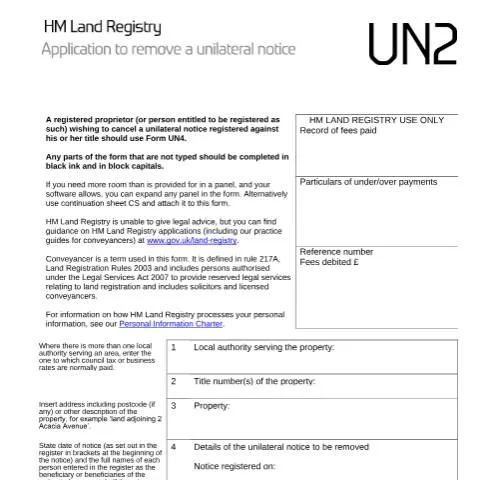
Property disputes involving unilateral notices can create significant uncertainty for registered proprietors. When someone has registered a claim against your property title without your consent, the UN2 form becomes your primary tool for reclaiming clear ownership. This HM Land Registry document provides the mechanism for removing these protective entries, but understanding when and how to use it requires careful consideration of your legal position and the underlying dispute.
The UN2 application process sits within a broader framework of land registration protections, where competing interests must be balanced against the certainty of registered title. Unlike bilateral agreements between parties, unilateral notices represent one-sided claims that can significantly impact property transactions and ownership rights.
The Legal Architecture Behind Unilateral Notice Removal
Unilateral notices serve as a warning mechanism within the Land Registry system, alerting potential purchasers and lenders to disputed claims over registered property. These entries don't prove the validity of the underlying claim—they simply ensure that any subsequent dealing with the property must take account of the notice beneficiary's alleged interest.
The UN2 form operates within strict legal parameters defined by the Land Registration Act 2002 and associated rules. Your entitlement to remove a notice depends fundamentally on your relationship to either the property or the notice itself. The form recognises three distinct categories of applicant:
- The notice beneficiary—the person who originally registered the unilateral notice
- Personal representatives of deceased beneficiaries, handling estate administration
- Trustees in bankruptcy managing the affairs of insolvent notice holders
This restricted approach reflects the Registry's cautious stance toward notice removal. Simply being the registered proprietor of the affected land doesn't automatically grant removal rights—a position that often surprises property owners facing disputed claims.
Distinguishing UN2 from Alternative Removal Routes
The UN2 procedure represents just one pathway for notice removal. Property owners facing unwanted notices must carefully assess which route applies to their circumstances. Where you lack standing as beneficiary or personal representative, the UN4 cancellation process becomes the appropriate mechanism, requiring substantial evidence to challenge the notice's validity.
This distinction proves crucial in practice. UN2 applications proceed on the basis that removal is sought by someone connected to the notice itself, while UN4 applications involve external challenges to the notice's continued registration.
Navigating the Application Requirements and Evidence Standards
The UN2 form demands precise identification of both the property and the specific notice targeted for removal. This requirement reflects the Registry's need to maintain accurate records while preventing inadvertent removal of legitimate protections.
| Information Required | Specificity Level | Common Issues |
|---|---|---|
| Title number(s) | Exact alphanumeric code | Multiple titles for single property |
| Notice registration date | Precise date from register | Multiple notices by same beneficiary |
| Beneficiary details | Full names as registered | Corporate name changes |
| Property description | Complete address with postcode | Partial property coverage |
The Registry's requirement for exact notice identification becomes particularly challenging where multiple notices exist. When the same beneficiary has registered several notices on the same date, applicants must specify precisely which notice requires removal. This granular approach prevents accidental removal of notices covering different aspects of the same dispute.
Evidence Requirements for Different Applicant Categories
Documentation standards vary significantly based on your relationship to the notice. Conveyancers benefit from streamlined procedures, being permitted to certify that they hold evidence of appointments rather than lodging original documents. This professional exemption reflects the Registry's confidence in qualified legal practitioners while maintaining appropriate oversight.
Personal representatives must demonstrate their authority through appropriate documentation—grant of probate, letters of administration, or equivalent foreign grants. The Registry accepts certified copies but destroys both originals and certified documents after processing, emphasising the importance of retaining your own records.
Trustees in bankruptcy face similar evidence requirements, typically providing copies of their appointment documentation. The form's flexibility allows conveyancers to certify holding such evidence, streamlining applications where professional representation exists.
Strategic Timing and Procedural Coordination
The UN2 application often forms part of broader property transactions or dispute resolution processes. Understanding how notice removal coordinates with other Registry applications can significantly impact both timing and costs.
When UN2 applications accompany AP1 registration applications, specific coordination rules apply. The Registry requires completion of corresponding panels on only one form, avoiding duplication while ensuring comprehensive information capture. This integrated approach proves particularly valuable during property transfers where notice removal facilitates clean title transfer.
The zero fee structure for UN2 applications contrasts sharply with most Registry services, reflecting policy decisions to encourage resolution of title disputes. However, this cost advantage must be weighed against potential delays if supporting evidence proves inadequate or if the underlying dispute remains unresolved.
Managing Partial Property Coverage
Complex applications arise where notices cover only part of a registered title. The UN2 form accommodates partial removal through attached plans showing the specific area affected. This granular approach proves essential for large developments or agricultural properties where disputes may relate to specific parcels or rights of way.
Partial removal applications require careful plan preparation, typically involving professional surveying input to ensure accuracy. The Registry's insistence on precise boundary identification reflects the permanent nature of these changes to the register.
Professional Representation and Direct Application Pathways
The UN2 process accommodates both professional and direct applications, but with markedly different procedural requirements. Conveyancers benefit from established relationships with the Registry, including direct debit arrangements and electronic communication protocols that can significantly expedite processing.
Professional applicants gain access to key number systems enabling streamlined identification and communication. More significantly, they can provide professional certifications regarding evidence holding, reducing document lodgement requirements while maintaining appropriate oversight.
Direct applicants face more stringent documentation requirements but retain full control over their applications. The Registry's commitment to plain English guidance supports self-representation, though the complexity of underlying legal issues often favours professional assistance.
Communication Preferences and Warning Systems
The Registry's evolving communication practices increasingly favour electronic correspondence. Email addresses enable faster requisition handling and, crucially, access to warning of cancellation letters for conveyancers. These advance notifications can prove vital in managing client expectations and coordinating related transactions.
Traditional postal communication remains available but may result in processing delays. The Registry's DX box system provides an intermediate option for professional users requiring paper-based correspondence while maintaining reasonable speed.
Compliance Frameworks and Legal Safeguards
UN2 applications operate within strict fraud prevention frameworks established by the Fraud Act 2006. The Registry's prominent warnings reflect serious criminal penalties for dishonest applications—up to ten years' imprisonment or unlimited fines. This stern approach underscores the Registry's commitment to maintaining register integrity while deterring fraudulent removal attempts.
Beyond criminal sanctions, inadequate application completion can result in loss of protection under the Land Registration Act 2002. This civil consequence proves particularly significant where register mistakes arise from incomplete or inaccurate applications, potentially exposing applicants to financial liability.
Data protection considerations under the Data Protection Act 2018 and UK GDPR govern personal information handling throughout the process. The Registry's Personal Information Charter provides detailed guidance on data processing practices, reflecting contemporary privacy expectations while maintaining operational efficiency.
Quality Assurance and Error Prevention
The Registry's emphasis on proper care in form completion extends beyond mere accuracy to encompass understanding of legal consequences. Applications lacking sufficient detail or appropriate supporting evidence face requisition procedures that can significantly delay processing.
Common quality issues include incomplete beneficiary identification, inadequate property descriptions, and insufficient evidence of applicant authority. The Registry's guidance emphasises block capital completion for handwritten entries, reflecting practical experience of processing challenges.
Integration with Broader Property Dispute Resolution
UN2 applications rarely exist in isolation but typically form part of comprehensive dispute resolution strategies. Understanding how notice removal fits within broader legal frameworks proves essential for effective property management.
The removal of unilateral notices doesn't resolve underlying disputes—it simply removes the Registry warning mechanism. Where substantive disagreements persist, removed notices may be re-registered, creating cyclical protection issues that require careful strategic management.
Timing considerations prove particularly crucial where property transactions depend on clear title. Early identification of notice removal requirements enables coordination with completion timescales, avoiding delays that could jeopardise related contractual arrangements.
The Registry's processing procedures, while generally efficient, require realistic timeframe planning. Applications involving complex evidence requirements or partial property coverage typically require extended processing periods that must be factored into broader transaction planning.
Professional advice often proves invaluable in assessing whether UN2 applications represent the most appropriate resolution mechanism or whether alternative approaches might better serve underlying objectives. The interplay between notice removal and substantive dispute resolution requires careful consideration of both immediate and long-term consequences for property ownership and commercial relationships.
Strategic Considerations for Property Professionals and Legal Representatives
Property solicitors, conveyancers, and estate agents frequently encounter UN2 applications during transaction processes, making professional understanding of the procedure essential for client advisory services. When acting for clients facing unilateral notices, practitioners must assess whether immediate removal is strategically advantageous or whether allowing the notice to remain temporarily serves broader transactional purposes.
The timing of UN2 applications within property transactions requires careful coordination. If a sale is proceeding and the unilateral notice relates to a dispute that may affect completion, buyers' solicitors typically require either removal of the notice or satisfactory indemnity arrangements before exchange of contracts. However, premature removal applications might prompt the beneficiary to escalate their claim through alternative legal channels, potentially creating more complex obstacles to completion.
Professional indemnity considerations also influence how practitioners approach UN2 applications. Solicitors must demonstrate they have adequately investigated the substance behind unilateral notices before advising removal, as failure to identify legitimate underlying claims could result in negligence exposure. This due diligence extends beyond the notice itself to examining the full transaction history and any related correspondence or agreements that might validate the beneficiary's position.
When representing beneficiaries whose notices face UN2 applications, legal professionals must evaluate whether the original notice was appropriately drafted and supported. Poorly constructed notices with vague or legally insufficient grounds are vulnerable to successful removal applications, whereas notices clearly articulating specific legal rights and supporting evidence present stronger defensive positions.
The interaction between UN2 procedures and professional undertakings creates additional complexity. Solicitors acting in transactions may provide undertakings to investigate and resolve notice issues, with UN2 applications forming part of these professional obligations. The timing and outcome of such applications directly impact undertaking compliance and potential professional conduct implications.
Coordinating with Parallel Legal Proceedings and Alternative Dispute Resolution
UN2 applications rarely exist in isolation, often running parallel to broader legal disputes requiring careful procedural coordination. When substantive litigation concerning the same property interests is ongoing in the County Court or High Court, the timing of UN2 applications must align with litigation strategy to avoid conflicting outcomes or procedural complications.
The relationship between UN2 procedures and pending court proceedings involves several tactical considerations. Successful removal of a unilateral notice does not prevent the beneficiary from pursuing their underlying claim through litigation, but it does remove the immediate impediment to property dealings. Conversely, if court proceedings are likely to establish the beneficiary's rights definitively, premature UN2 applications might prove counterproductive by forcing immediate crystallisation of disputes better resolved through comprehensive litigation.
Alternative dispute resolution mechanisms, particularly mediation and arbitration, interact with UN2 procedures in complex ways. Parties engaged in mediation concerning property rights may agree to suspend UN2 applications pending resolution discussions, with removal applications proceeding only if mediation fails. Such arrangements require careful drafting to ensure enforceability and clear triggers for resuming formal procedures.
When arbitration clauses exist in underlying agreements, the interaction with Land Registry procedures becomes particularly nuanced. Arbitrators cannot directly order HM Land Registry actions, but arbitration awards establishing or negating property rights provide compelling evidence for UN2 applications. Parties must consider whether to pursue arbitration before or alongside UN2 procedures, balancing the binding nature of arbitration awards against the immediate practical benefits of notice removal.
The disclosure obligations in parallel proceedings also influence UN2 strategy. Documents and evidence gathered for court litigation or arbitration may strengthen or undermine UN2 applications, requiring coordinated case management to ensure consistency across all proceedings. Professional privilege considerations must also be navigated carefully when evidence spans multiple procedural contexts.
Settlement negotiations in parallel disputes frequently involve agreements about unilateral notice treatment, with UN2 applications forming part of broader resolution packages. Such settlements must address not only the immediate notice removal but also prevent future notice registration concerning the same matters, requiring comprehensive documentation of the parties' agreed position.
Cross-Border Implications and International Property Holdings
When UK properties subject to unilateral notices involve overseas entities or international property portfolios, UN2 applications encounter additional complexity requiring specialist consideration. Foreign companies holding UK property interests through complex corporate structures may find unilateral notices impact their broader international financing and investment strategies, making swift resolution through UN2 procedures commercially critical.
The service of UN2 application documents on overseas beneficiaries involves specific procedural requirements under English civil procedure rules. Standard postal service may be insufficient for foreign addresses, potentially requiring service through diplomatic channels or international process servers, which can significantly extend application timescales. Applicants must factor these extended service periods into their strategic planning, particularly when transaction deadlines are pressing.
Currency fluctuations and international financing arrangements create additional urgency around UN2 applications involving overseas parties. Unilateral notices can trigger technical defaults under international loan agreements or affect currency hedging arrangements, making rapid resolution essential for maintaining complex financial structures. The intersection of English land law procedures with international commercial arrangements requires careful coordination between English property lawyers and overseas counsel.
Tax implications of property dealings affected by unilateral notices extend beyond domestic UK considerations when international structures are involved. Stamp Duty Land Tax, capital gains tax, and corporation tax consequences may vary depending on the resolution of disputes underlying unilateral notices, with UN2 outcomes potentially affecting tax planning strategies across multiple jurisdictions.
The evidential requirements for UN2 applications become more complex when supporting documentation originates from overseas jurisdictions. Foreign language documents require certified translation, overseas corporate documents need apostilling or similar authentication, and foreign legal concepts may require expert evidence to explain their English law equivalents. These evidential complexities can substantially increase both the cost and duration of UN2 procedures.
When unilateral notices affect properties forming part of international investment funds or real estate investment trusts, the reputational and regulatory implications of prolonged disputes extend beyond immediate transactional concerns. Fund managers and trustees must consider whether UN2 applications align with their fiduciary obligations and regulatory compliance requirements, particularly where fund documentation contains specific provisions about property title disputes.
Brexit-related considerations also impact UN2 applications involving EU-based parties or properties previously subject to European legal frameworks. Changes to mutual recognition of judgments and service procedures require updated approaches to cross-border elements of UN2 applications, with practitioners needing current expertise in post-Brexit procedural requirements.