When Property Disputes Require Formal Legal Protection
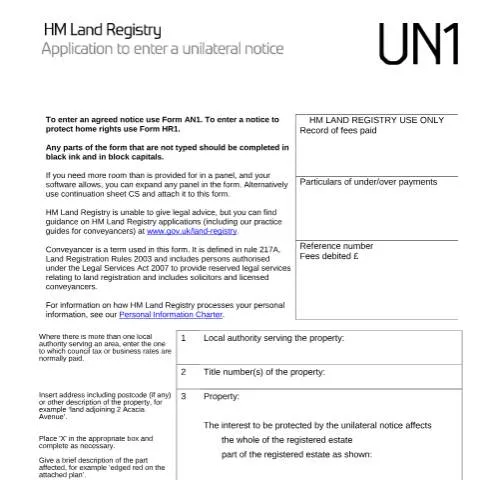
Property ownership disputes rarely announce themselves with fanfare. One day, you discover that someone has been using your land without permission, or perhaps a neighbour claims rights over part of your garden that you've never acknowledged. In these situations, simply asserting your position verbally may prove insufficient. The Unilateral Notice application (Form UN1) serves as your formal mechanism to register a legal interest against someone else's property title, creating an official record that cannot be ignored by future buyers or mortgage lenders.
Unlike other Land Registry applications that require mutual agreement between parties, a unilateral notice allows you to act independently when you believe you have a legitimate claim. This could range from beneficial interests arising from financial contributions to a property purchase, to easement rights such as access across neighbouring land, or even restrictive covenant breaches that affect your own property's value.
The UN1 form represents a significant step in property law—one that creates a permanent entry on the Land Registry title that warns all future dealings with that property. However, this power comes with substantial legal responsibilities and potential consequences that every applicant must fully understand before proceeding.
Understanding the Scope and Boundaries of Unilateral Protection
The UN1 application covers a remarkably broad spectrum of property interests, yet operates within clearly defined parameters that distinguish it from other Land Registry procedures. The form specifically handles situations where you claim an interest in registered land but cannot obtain the registered proprietor's consent to protect that interest through an agreed notice.
Qualifying Interests Under the UN1 Process
The legislation recognises numerous categories of interest that merit unilateral notice protection. Equitable interests frequently arise when someone contributes financially to a property purchase but doesn't appear on the legal title—common in family situations where parents assist adult children or unmarried couples purchase together. Contractual rights might include options to purchase, rights of first refusal, or conditional sale agreements that create binding obligations on the current owner.
Proprietary estoppel claims represent another significant category, typically emerging when someone has acted to their detriment based on assurances about future property rights. For instance, if you've spent years maintaining and improving land believing you would inherit it, only to discover the owner intends to sell to a third party, a unilateral notice might protect your position while legal proceedings unfold.
Exclusions and Limitations
Importantly, the UN1 process cannot protect public rights such as public footpaths or highway rights, nor customary rights that belong to local communities rather than specific individuals. The form explicitly requires applicants to confirm their claimed interest falls outside these categories.
| Interest Type | UN1 Applicable | Alternative Route |
|---|---|---|
| Beneficial ownership share | Yes | Agreed notice (AN1) if proprietor consents |
| Home rights (Family Law Act) | No | Specific HR1 application |
| Easement or profit à prendre | Yes | Substantive registration if provable |
| Public footpath | No | Local authority definitive map process |
| Restrictive covenant benefit | Yes | Agreed notice if enforceable |
The Strategic Decision: Timing and Tactical Considerations
Choosing when to lodge a UN1 application requires careful strategic thinking, as the timing can significantly impact both the strength of your legal position and the practical outcomes you achieve. The application creates immediate consequences that ripple through the property transaction chain, often forcing previously reluctant parties to engage in meaningful negotiations.
Pre-empting Property Sales and Mortgages
Many successful UN1 applications occur when applicants discover impending property transactions that would prejudice their interests. Once your unilateral notice appears on the title register, any prospective purchaser or mortgage lender must investigate your claim before proceeding. This caveat emptor effect often proves more powerful than lengthy legal correspondence in bringing disputed matters to resolution.
However, timing cuts both ways. Lodge your application too early, and you may appear to be fishing for a settlement rather than pursuing legitimate rights. Lodge it too late, and completed transactions may have created additional complications requiring more complex legal remedies.
Interaction with Ongoing Legal Proceedings
The UN1 application frequently complements rather than replaces formal legal action. While pursuing a claim through the courts for proprietary estoppel or breach of trust, the unilateral notice ensures your interest remains protected against third-party dealings during what can be lengthy litigation periods.
Some applicants mistakenly view the unilateral notice as a complete legal remedy in itself. In reality, it functions as a holding measure that preserves your position while you pursue substantive legal remedies through appropriate channels.
Navigating the Application Architecture: Panels and Practicalities
The UN1 form's structure reflects the Land Registry's systematic approach to capturing essential information while maintaining flexibility for diverse factual situations. Understanding how each panel functions within the broader application framework prevents common errors that can delay processing or weaken your legal position.
Property Identification and Interest Definition
Panel 2 requires precise title number identification, which you can obtain through the Land Registry's online title search facility for a nominal fee. Where your interest affects only part of the registered estate, Panel 3 demands specific description—typically referencing a plan that you must prepare and attach. The Registry favours edged red plans that clearly delineate affected areas, following established conveyancing conventions.
The choice between whole property and partial interest protection carries significant implications. Whole property notices create broader protection but may appear disproportionate if your actual interest is limited. Conversely, overly narrow partial descriptions might fail to capture the full extent of your legitimate claim.
Fee Structure and Payment Mechanisms
Current application fees reflect the Registry's cost-recovery model, with rates published annually on the government website. Professional users typically utilise direct debit arrangements linked to their Land Registry account numbers, while individual applicants more commonly submit cheques payable to 'Land Registry'.
The fee payment method affects processing timelines, as cheque payments require additional clearing time before substantive consideration begins. Electronic payment systems generally expedite the administrative aspects, though they cannot accelerate the substantive legal assessment that follows.
The Critical Choice: Self-Certification Versus Professional Validation
Panels 11 and 12 present applicants with a fundamental choice between self-certification of their claimed interest or obtaining professional validation from a qualified conveyancer. This decision carries far-reaching implications for both the application's prospects and the applicant's potential legal exposure.
Self-Certification Through Panel 11
Completing Panel 11 requires you to describe your interest in clear, factual terms while accepting personal responsibility for the accuracy of your statements. The Registry provides minimal guidance on acceptable description formats, expecting applicants to articulate their claims using established legal terminology.
Common descriptions include: "Beneficial owner of a 50% share arising from financial contribution to the purchase price" or "Entitled to an easement of way over the land edged blue on the attached plan pursuant to an agreement dated...". The key lies in providing sufficient detail to establish a prima facie case without overstating your position.
Professional Certification Alternative
Panel 12 allows qualified conveyancers to certify the validity of your claimed interest based on their professional assessment. This route offers several advantages: professional validation may reduce the likelihood of successful cancellation applications, while the conveyancer's professional indemnity insurance provides additional protection against errors.
However, many conveyancers approach UN1 certificates cautiously, recognising their potential professional liability if the claimed interest proves unfounded. Expect thorough documentary review and potentially significant legal costs before a responsible conveyancer will provide certification.
Understanding Warning and Cancellation Mechanisms
Every unilateral notice operates within a framework of procedural safeguards designed to prevent abuse while maintaining legitimate protection. The registered proprietor receives formal notification of your application and enjoys specific rights to challenge your notice through established cancellation procedures.
The Warning Notice Process
Following successful UN1 registration, HM Land Registry serves a warning notice on the registered proprietor, informing them of your claimed interest and their right to apply for cancellation. This notification typically occurs within days of your application's approval, ensuring proprietors cannot claim ignorance of registered interests.
The warning notice period creates a critical window during which both parties should engage constructively to resolve the underlying dispute. Many cases settle during this phase once the proprietor recognises the seriousness of your claim and the practical impediments your notice creates for future dealings.
Cancellation Applications and Hearings
Proprietors may apply for notice cancellation using Form UN4, triggering a formal determination process that may ultimately require a First-tier Tribunal hearing. During cancellation proceedings, you must substantiate your claimed interest with documentary evidence and legal argument—the initial UN1 application merely establishes a prima facie case requiring further proof.
Successful defence against cancellation applications often depends on preparation quality during the initial UN1 submission. Comprehensive documentation and precise interest descriptions create stronger foundations for subsequent legal challenges.
Documentary Requirements and Evidence Management
While the UN1 application doesn't mandate extensive supporting documentation, strategic document submission can significantly strengthen your position and expedite processing. The Registry's approach balances administrative efficiency against the need for sufficient evidence to justify notice registration.
Essential Documentation Categories
Property purchase documentation becomes crucial when claiming beneficial ownership interests. Bank statements, mortgage applications, and solicitor correspondence demonstrating financial contributions provide compelling evidence of equitable entitlement. For easement claims, historical deeds, planning permissions, and correspondence acknowledging access rights establish the foundation for your assertion.
Contemporary documentation often proves more persuasive than historical materials. Recent correspondence acknowledging your interest, payment receipts for property maintenance, or insurance documents listing you as an interested party create strong evidential foundations.
Certification and Original Document Requirements
The Registry's document handling policies distinguish between first registration applications requiring original deeds and subsequent applications accepting certified copies. For UN1 applications on registered titles, certified copies suffice for most purposes, reducing risks associated with original document transmission.
Professional certification by solicitors or licensed conveyancers meets Registry requirements, while some documents may qualify for self-certification under specific circumstances. Bank statements, for instance, can often be self-certified if accompanied by appropriate statutory declarations.
Managing Expectations: Outcomes and Ongoing Obligations
Successful UN1 registration marks the beginning rather than the conclusion of your legal journey. The notice creates ongoing obligations and opens pathways for resolution that require continued attention and potential additional legal action.
Your registered notice alerts all future dealings with the property, creating leverage for negotiation while imposing responsibility to pursue your underlying claim through appropriate legal channels. The Registry's role remains administrative—they register interests but don't determine their ultimate validity or enforce proprietary rights.
Consider the unilateral notice as securing your place in the queue while you pursue substantive legal remedies. Whether through negotiated settlement, formal mediation, or court proceedings, you must ultimately establish and enforce your claimed interest through methods extending far beyond the Land Registry's administrative processes.
The UN1 application represents a powerful tool for property interest protection, but one that demands careful consideration, strategic timing, and ongoing legal commitment. Used appropriately, it provides essential security during uncertain times while opening pathways toward satisfactory resolution of complex property disputes.
Strategic Considerations When Filing UN1 Applications
The decision to file a UN1 application requires careful strategic planning, particularly when multiple parties hold interests in the same property or when complex ownership structures are involved. Property professionals and legal advisers often encounter scenarios where the timing and scope of a unilateral notice application can significantly impact the outcome of broader property transactions or disputes.
One critical consideration involves the interaction between UN1 applications and existing registered charges or restrictions on the title. If the property already has a mortgage or secured loan registered against it, your unilateral notice will rank after these prior interests in terms of priority. However, this doesn't necessarily diminish the value of your application—particularly if you're claiming an interest that arose before the charge was created, such as a constructive trust arising from contributions to the purchase price made prior to the mortgage completion.
The timing of your UN1 application relative to other property dealings can prove crucial. For instance, if you're aware that the registered proprietor is actively marketing the property for sale, submitting your application promptly ensures that any prospective purchaser will be alerted to your claimed interest during their conveyancing searches. This early warning can prevent situations where you might otherwise lose your interest to a bona fide purchaser for value without notice.
When dealing with commercial properties, additional strategic factors come into play. Business tenancies, development agreements, and option contracts often generate complex webs of interests that may warrant protection through unilateral notices. In such cases, you'll need to consider whether your claimed interest falls within the categories that can be protected by a UN1 application, or whether alternative forms of protection (such as agreed notices or restrictions) might be more appropriate.
For properties held by companies or in complex ownership structures, the interaction between your claimed interest and corporate insolvency procedures requires careful analysis. A properly registered unilateral notice may provide some protection if the company owning the property enters administration or liquidation, but the extent of this protection depends on the nature of your underlying interest and when it arose relative to any subsequent charges or security interests.
Professional advisers should also consider the potential for cross-border complications, particularly where the claimed interest involves overseas parties or relates to international transactions. While the Land Registry's jurisdiction covers English and Welsh property regardless of the parties' nationality, practical issues around service of notices and enforcement may arise if disputes develop.
Managing Objections and Disputes Following UN1 Registration
Once HM Land Registry accepts your UN1 application and enters the unilateral notice on the register, the registered proprietor receives formal notification of this entry. This notification marks the beginning of a potential dispute resolution process, as the proprietor has the right to apply for cancellation of your notice if they believe it lacks merit.
The proprietor can initiate cancellation proceedings by completing form UN4 and providing evidence that your claimed interest is unfounded or has been discharged. Common grounds for cancellation applications include arguments that no valid interest ever existed, that any interest has been satisfied or released, or that the interest claimed doesn't fall within the categories protectable by unilateral notice.
When facing a cancellation application, you'll receive notice from the Land Registry requiring you to substantiate your claim within a specified timeframe—typically 15 business days from the notice date. Your response must include compelling evidence supporting the existence and continuing validity of your interest. This might comprise contracts, correspondence, bank statements showing financial contributions, witness statements, or expert valuations depending on the nature of your claim.
The Land Registry's examination of cancellation disputes follows established procedures designed to balance the rights of both parties while maintaining the integrity of the register. The registrar will consider all evidence submitted by both sides but won't conduct detailed investigations into complex factual disputes that would be better resolved through court proceedings.
If the registrar determines that your evidence doesn't adequately support the existence of a protectable interest, they may cancel the unilateral notice. However, this decision doesn't prevent you from pursuing your underlying claim through alternative legal channels—it simply means the Land Registry doesn't consider the interest suitable for protection through their registration system.
In some cases, cancellation disputes reveal that both parties have legitimate but competing claims to different aspects of the property's value or use. These situations might lead to negotiated settlements where the unilateral notice is withdrawn in exchange for alternative arrangements, such as formal agreements about future dealings with the property or financial settlements reflecting the value of competing interests.
For complex disputes involving substantial financial stakes, parties often find that the Land Registry's determination process serves as a useful preliminary filter before considering more formal legal proceedings. A successful defence of your unilateral notice against cancellation provides valuable validation of your position, while an unsuccessful defence helps clarify the weaknesses in your case that would need addressing in any subsequent litigation.
Integration with Broader Property and Legal Strategies
The UN1 application process rarely operates in isolation but typically forms part of broader property acquisition, development, or dispute resolution strategies. Understanding how unilateral notices interact with other legal mechanisms and commercial arrangements is essential for maximising their effectiveness while avoiding potential conflicts or unintended consequences.
In property development contexts, unilateral notices frequently protect interests arising from development agreements, profit-sharing arrangements, or conditional contracts tied to planning permissions. Developers and their advisers must carefully coordinate the timing of UN1 applications with planning application submissions, funding arrangements, and construction contracts to ensure all parties' interests receive appropriate protection without creating unnecessary complications for project financing.
The interaction between unilateral notices and matrimonial property rights deserves particular attention, especially in cases involving family homes where one spouse isn't named on the registered title. While the Family Law Act 1996 provides automatic protection for certain spousal rights, these protections have limitations and may not cover all scenarios where a spouse has contributed financially to property acquisition or improvement.
For investment properties and commercial transactions, UN1 applications often complement other security arrangements such as personal guarantees, corporate charges, or escrow arrangements. Legal advisers must ensure that these various protections work cohesively rather than creating conflicting priorities or enforcement difficulties.
The relationship between unilateral notices and insurance considerations also requires attention. Professional indemnity policies for solicitors, surveyors, and other property professionals may have specific requirements or exclusions relating to Land Registry applications and property registration matters. Similarly, title insurance policies may be affected by the presence of unilateral notices on the register, potentially requiring disclosure or affecting premium calculations.
Cross-jurisdictional property portfolios present additional complexity where English or Welsh properties form part of international investment strategies. The protection offered by UN1 registration may need coordination with security registrations in other jurisdictions, particularly where the underlying commercial arrangements span multiple legal systems or involve overseas corporate structures.
Technology considerations increasingly influence how property professionals manage UN1 applications within their broader practice management systems. Integration with case management software, automated deadline monitoring, and electronic document management becomes crucial when handling multiple applications or complex transactions involving several properties and numerous parties with potentially competing interests.