When Rentcharges Change Hands Through Adverse Possession
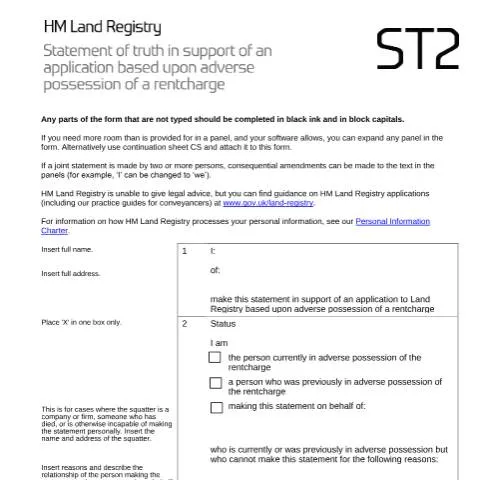
The ST2 statement of truth form sits at the crossroads of property law and administrative reality, addressing one of the more specialised aspects of land ownership in England and Wales. This document comes into play when someone has been collecting payments from a rentcharge for an extended period without formal ownership rights, and now seeks to regularise their position through HM Land Registry's adverse possession procedures.
Rentcharges themselves represent a particular form of property interest where periodic payments are due from land to a rentcharge owner. When these payment streams become orphaned through abandonment, death, or simple neglect by the registered owner, they may fall under the control of someone else entirely. The ST2 form provides the mechanism for such persons to formalise their claim through the legal doctrine of adverse possession.
Unlike standard adverse possession claims involving physical land occupation, rentcharge adverse possession centres on the consistent collection and control of rental income streams. This creates unique evidential challenges that the ST2 form is specifically designed to address, requiring detailed documentation of payment patterns, contact attempts with registered owners, and the circumstances surrounding the claimant's assumption of control.
Identifying the Rightful Claimant: Who Files an ST2
The form accommodates three distinct categories of applicant, each with different evidential requirements and legal standing. Current collectors represent the most straightforward category – individuals or entities actively receiving rentcharge payments and seeking to convert this de facto control into registered ownership. These applicants must demonstrate continuous collection over the statutory period, typically twelve years for registered rentcharges.
Former collectors present a more complex scenario, particularly where collection has ceased due to circumstances beyond their control. The form requires detailed explanation of why collection stopped and evidence that the cessation wasn't voluntary abandonment. Common situations include property sales where rentcharge collection rights weren't properly transferred, or administrative changes that inadvertently severed collection arrangements.
Third-party representatives handle cases involving incapacitated or deceased collectors. This category encompasses executors dealing with estate rentcharges, attorneys acting for mentally incapacitated persons, and corporate representatives managing rentcharges for dissolved companies. Each scenario requires specific supporting documentation – grants of probate, lasting powers of attorney, or corporate dissolution certificates respectively.
| Applicant Type | Required Evidence | Common Complications |
|---|---|---|
| Current collector | Payment records, correspondence attempts | Irregular payment patterns |
| Former collector | Historical records, cessation circumstances | Proving non-voluntary cessation |
| Third-party representative | Authority documents, relationship evidence | Establishing legal standing |
Navigating the Rentcharge Registration Landscape
Section 3 of the ST2 form addresses a fundamental distinction that significantly affects the application process: whether the rentcharge holds registered or unregistered status. Registered rentcharges carry title numbers and appear on HM Land Registry records, making verification relatively straightforward. Applicants need only provide the title number, allowing the Registry to cross-reference existing records and identify any registered proprietors or charges.
Unregistered rentcharges present considerably greater challenges, as they exist outside the formal registration system and rely on historical documentation for proof of existence and extent. These often derive from ancient manorial arrangements, Victorian development schemes, or early twentieth-century estate planning structures that predate compulsory registration requirements.
For unregistered rentcharges, applicants must provide comprehensive documentation including original deeds, apportionment orders, and any available historical correspondence. The Registry requires sufficient evidence to establish the rentcharge's legal existence, its original extent, and any subsequent modifications through formal apportionment procedures.
Apportionment adds another layer of complexity, particularly where rentcharges originally covered multiple properties but have been formally divided. The form requires details of any apportionment orders, including the authority that made them and the specific portions allocated to different properties. Missing or incomplete apportionment documentation can significantly delay processing or result in application rejection.
Proving Adverse Possession: The Critical Timeline Evidence
Section 5 demands precise chronological documentation of the adverse possession period, with particular attention to continuity and gaps. The statutory period for rentcharge adverse possession varies depending on registration status – twelve years for registered rentcharges under the Land Registration Act 2002, potentially thirty years for unregistered rentcharges under the Limitation Act 1980, though this depends on specific circumstances.
Continuity proves crucial because any significant gaps in collection or control can reset the limitation period. The form requires explicit declaration of any interruptions, with detailed explanations of circumstances and duration. Common acceptable interruptions include brief periods of uncertainty following property transfers, temporary payment disputes resolved in the claimant's favour, or short-term administrative delays in payment processing.
Unacceptable gaps typically involve periods where another party exercised clear control over the rentcharge, where the claimant voluntarily relinquished collection rights, or where legal proceedings established someone else's superior claim. The Registry scrutinises these periods carefully, often requiring additional witness statements or documentary evidence to clarify circumstances.
Dating precision becomes particularly important where the adverse possession period spans changes in legislation. The Land Registration Act 2002 introduced new procedures that affect applications, and claims straddling the implementation date may need to satisfy requirements under both old and new regimes.
Documenting Acts of Possession: Beyond Simple Payment Collection
Section 6 requires comprehensive details of the specific acts constituting adverse possession, extending well beyond mere payment collection. Effective adverse possession typically involves assuming the full range of ownership responsibilities and exercising exclusive control over the rentcharge income stream.
Payment collection forms the core evidence, but the Registry expects detailed records including amounts received, dates of collection, payment methods, and any correspondence with payers. Irregular or partial collection weakens claims significantly, particularly where evidence suggests the registered owner retained some control or where payments were made under licence rather than as of right.
Administrative actions strengthen possession claims considerably. These include issuing formal demands for unpaid amounts, pursuing legal proceedings against defaulting payers, negotiating payment arrangements during financial difficulties, or corresponding with solicitors regarding rentcharge obligations. Each action demonstrates the exercise of ownership powers rather than mere passive receipt of payments.
Communication attempts with registered owners provide crucial negative evidence – showing that despite reasonable efforts, no active owner emerged to assert superior rights. The form requires details of all contact attempts, including letters to last known addresses, enquiries through previous solicitors, and searches for current whereabouts. Successful contact that resulted in the owner's acquiescence to the claimant's control strengthens rather than weakens the claim.
- Direct payment collection with formal receipts
- Pursuit of arrears through legal proceedings
- Negotiation of payment plans with struggling payers
- Correspondence with solicitors regarding obligations
- Attempts to locate and communicate with registered owners
The Permission Paradox: Distinguishing Licence from Adverse Possession
Section 7 addresses one of the most complex aspects of rentcharge adverse possession claims – establishing that collection occurred without permission from the registered owner. Adverse possession requires hostile possession, meaning collection must occur against the owner's interests rather than with their consent or licence.
Express permission clearly defeats adverse possession claims, but implied permission creates more subtle difficulties. The Registry examines circumstances surrounding the commencement of collection, looking for evidence that the registered owner knew of and acquiesced to the arrangement. Factors suggesting permission include prior relationships between the parties, family connections, or business arrangements that might explain the collection arrangement.
Expired permissions present particular challenges for timing calculations. Where collection began under licence or permission that subsequently expired or was determined, adverse possession can only commence from the expiry date. The form requires precise details of any permission arrangements, including their scope, duration, and circumstances of termination.
Constructive permission may arise where the registered owner's conduct suggests acceptance of the claimant's role. This might include referring enquirers to the claimant for rentcharge matters, accepting the claimant's administrative decisions, or failing to object despite clear knowledge of the collection arrangement. The Registry evaluates such conduct carefully, considering whether a reasonable owner would have objected if they intended to maintain their rights.
Compliance with Schedule 6: Meeting Modern Registration Requirements
Section 11 addresses the specific requirements of Schedule 6 to the Land Registration Act 2002, which governs adverse possession applications for registered land interests including rentcharges. These provisions introduce procedural safeguards designed to protect registered proprietors while allowing legitimate adverse possession claims to proceed.
Paragraph 1(2) applications require confirmation that the standard notification procedures don't apply, typically because the registered proprietor cannot be traced despite reasonable enquiries. Applicants must demonstrate comprehensive search efforts including land registry records, electoral rolls, company databases, and professional directories as appropriate.
The re-entry prohibition requires confirmation that the registered proprietor hasn't reasserted control over the land from which the rentcharge issues. This extends beyond simple rentcharge collection to encompass any actions demonstrating renewed interest in the underlying property rights. Recent contact from the proprietor, attempts to sell or mortgage the land, or assertion of other rights associated with the property could trigger this provision.
Trust restrictions present particularly complex issues, as Schedule 6 excludes certain trust interests from adverse possession claims. The form requires confirmation that the rentcharge isn't subject to trusts where beneficiaries hold interests in possession, but determining trust status often requires legal analysis of historical documents and current beneficial interests.
The paragraph 5 conditions offer alternative routes for contested applications, allowing claims based on proprietary estoppel or situations where it would be unconscionable to dispossess the adverse possessor. These conditions require detailed factual evidence supporting the claim, often involving representations made by the registered proprietor or circumstances creating legitimate expectations of continued possession rights.
Strategic Considerations for Complex Rentcharge Scenarios
The ST2 form's effectiveness depends heavily on understanding the broader context of rentcharge law and the specific circumstances of each claim. Historical rentcharges often involve complex chains of ownership, successive apportionments, and documentation gaps that require careful reconstruction through available records.
Modern development rentcharges typically offer clearer documentation but may involve multiple parties with competing interests. Estate rentcharges securing maintenance obligations present particular challenges where the charging arrangements interact with management company structures or residents' association responsibilities.
Redemption rights complicate many claims, as rentcharge owners may have statutory or contractual rights to demand capital payments in lieu of continuing annual charges. The Registry considers whether such rights affect the adverse possession claim, particularly where the claimant has exercised or purported to exercise redemption powers.
Professional advice becomes essential for complex cases involving multiple properties, substantial rental values, or disputed factual circumstances. The form's statement of truth requirements create personal liability for false or misleading information, making accurate completion crucial for avoiding future legal complications.
Successful ST2 applications result in the claimant's registration as proprietor of the rentcharge, but this doesn't automatically resolve all related issues. Questions of liability for historical arrears, responsibility for future collection costs, and relationships with existing payers may require separate resolution through negotiation or legal proceedings.
Practical Challenges and Common Pitfalls in ST2 Applications
Filing an ST2 statement of truth for adverse possession of rentcharge presents unique challenges that differ markedly from standard adverse possession claims. The most frequent stumbling block occurs when applicants misunderstand the nature of rentcharge ownership versus physical land possession. Unlike conventional adverse possession where you occupy visible boundaries, rentcharge possession involves demonstrating control over an intangible right to collect periodic payments.
One critical pitfall involves the calculation of the twelve-year limitation period. Many applicants incorrectly start counting from when they first occupied the land subject to the rentcharge, rather than from when they began exercising the rentcharge owner's rights. The limitation period begins when you start collecting the rentcharge payments or treating the rentcharge as your own property right. This distinction has caught out numerous applicants who assumed their physical occupation of the charged land was sufficient.
Documentation gaps represent another significant challenge. Unlike physical boundaries that can be surveyed and photographed, proving adverse possession of a rentcharge requires meticulous record-keeping of payment collections, correspondence with rent payers, and evidence of exercising rentcharge owner's powers. Applicants often struggle to demonstrate continuous possession when they cannot produce twelve years of payment records or evidence of consistent rent collection efforts.
The requirement for "possession adverse to the true owner" creates particular complications in rentcharge cases. You must show not only that you collected payments, but that your actions were inconsistent with the true rentcharge owner's rights. This becomes complex when the original rentcharge owner has died, disappeared, or when ownership has become unclear through corporate changes or family disputes. The HM Land Registry requires clear evidence that your possession was truly adverse, not merely caretaking or collecting on behalf of the rightful owner.
Boundary identification poses unique problems for rentcharge applications. While the rentcharge itself is intangible, it typically applies to specific parcels of land described in the original deed creating the rentcharge. Applicants must precisely identify which properties remain subject to the rentcharge, particularly challenging when dealing with developed estates where original plot boundaries have been altered or subdivided over decades.
Another frequent error involves insufficient evidence of the applicant's belief in their right to the rentcharge. The ST2 requires you to state your honest belief that you owned the rentcharge throughout the limitation period. However, many applicants cannot demonstrate this belief convincingly, particularly when they began collecting payments purely opportunistically or when they knew of potential competing claims but proceeded regardless.
Evidential Requirements and Supporting Documentation
The evidential burden for ST2 rentcharge applications demands comprehensive documentation spanning the entire twelve-year period. Primary evidence includes detailed payment records showing consistent collection of the rentcharge from liable parties. These records must demonstrate not merely occasional payments, but systematic collection efforts that mirror those of a true rentcharge owner. Bank statements, receipt books, and correspondence with rent payers form the core documentary evidence.
Correspondence files prove particularly valuable in establishing adverse possession. Letters demanding payment, responses to queries about the rentcharge, and communications with solicitors or estate agents all help demonstrate your exercise of ownership rights. The HM Land Registry looks favourably upon evidence showing you dealt with third parties as the rentcharge owner, such as providing rentcharge certificates for property transactions or negotiating payment arrangements with new property owners.
Property transaction records provide crucial supporting evidence. When properties subject to the rentcharge change hands, the new owners typically receive rentcharge demands. Evidence that you issued these demands, received payments from new owners, and were recognised as the rentcharge creditor strengthens your adverse possession claim significantly. Conveyancing files from solicitors handling property sales can provide independent verification of your apparent ownership.
Expert evidence may prove necessary in complex cases, particularly regarding rentcharge interpretation or historical title issues. Property lawyers specialising in rentcharge law can provide opinions on whether your actions constituted sufficient adverse possession, while chartered surveyors can assist with identifying the precise extent of land subject to the rentcharge. However, such expert evidence represents additional cost and delay in the application process.
Contemporary statements from witnesses who observed your rentcharge collection activities over the twelve-year period add credibility to your application. Property owners who paid the rentcharge to you, neighbours who witnessed your collection efforts, or professional advisers who recognised your ownership can provide statutory declarations supporting your claim. These statements carry particular weight when they come from independent parties with no financial interest in your application's success.
The original rentcharge deed requires careful analysis and inclusion with your application. This document establishes the rentcharge's creation, describes the charged land, and sets out the payment obligations. You must demonstrate clear understanding of these original terms and show how your actions aligned with the rentcharge owner's rights and obligations. Missing or unclear original documentation can seriously undermine your application.
Financial records extending beyond mere payment receipts help establish your treatment of the rentcharge as a capital asset. Evidence of including the rentcharge in personal financial statements, insurance policies covering the rentcharge, or tax returns declaring rental income all support your claim to ownership. Conversely, the absence of such records may suggest you never truly believed you owned the rentcharge.
Post-Application Procedures and Registry Decision Process
Once HM Land Registry receives your ST2 application, the formal examination process begins with an initial completeness check. Registry staff verify that all required forms are present, fees paid, and supporting documents included. Incomplete applications face immediate rejection, requiring resubmission with additional fees. This preliminary stage typically takes two to three weeks, after which you receive acknowledgement of a complete application.
The substantive examination phase involves detailed legal and factual analysis by specialist Land Registry caseworkers trained in adverse possession law. These officers scrutinise your evidence against established legal criteria, paying particular attention to the continuity and exclusivity of your rentcharge possession. They may request additional evidence or clarification on specific points, particularly regarding gaps in your payment collection records or ambiguities in your supporting documentation.
Notification procedures form a critical component of the process. HM Land Registry must serve notice of your application on the current registered proprietor of the rentcharge, if identifiable, and any other parties with registered interests. This notification triggers a two-month objection period during which affected parties can challenge your application. The Registry publishes standard notice forms and maintains detailed records of service attempts.
Objection handling represents the most contentious aspect of many applications. Objections typically challenge either the factual basis of your adverse possession claim or raise legal arguments about the sufficiency of your evidence. Common objections include assertions that you collected payments as an agent rather than owner, that your possession was not truly adverse, or that interruptions in your collection activities broke the continuity required for adverse possession.
The Registry's dispute resolution procedures provide structured mechanisms for addressing objections. Initial stages involve correspondence between parties through the Registry, with opportunities for objectors to provide counter-evidence and for applicants to respond to specific challenges. More complex disputes may require formal hearings before specialist adjudicators with expertise in property law and adverse possession principles.
Decision-making criteria focus on legal compliance rather than equitable considerations. Registry adjudicators must determine whether your evidence satisfies the statutory requirements for adverse possession, regardless of the fairness or reasonableness of the outcome. This strict legal approach means that sympathetic circumstances cannot overcome evidential deficiencies, while technically sound applications succeed despite potential unfairness to previous owners.
Successful applications result in your registration as proprietor of the rentcharge, with the Registry issuing official title documents. This registration provides statutory protection and enables you to exercise all rights associated with rentcharge ownership, including enforcement against defaulting rent payers and dealing with the rentcharge through sale or transfer.
Appeal mechanisms exist for dissatisfied parties, both applicants whose claims are rejected and objectors whose challenges are unsuccessful. Appeals lie to the First-tier Tribunal (Property Chamber), which provides independent judicial review of Registry decisions. Tribunal procedures allow for fresh evidence and legal argument, though appeals face strict time limits and may incur significant legal costs regardless of outcome.