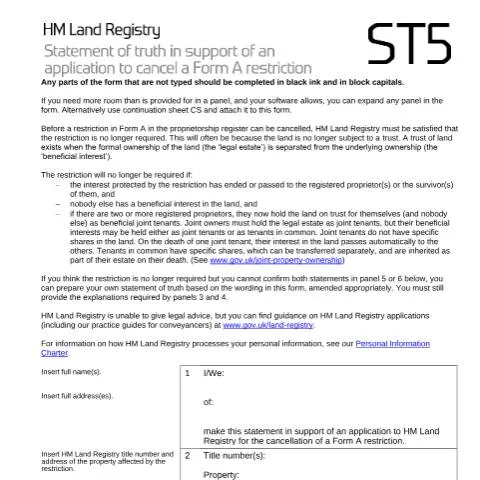
When Property Trusts Come to an End: The Critical Role of Form ST5
Property ownership in England and Wales often involves complex trust arrangements where the legal title holders differ from those who actually benefit from the property. When circumstances change—through death, divorce, or financial restructuring—these trust relationships may cease to exist. Yet HM Land Registry maintains protective restrictions on the title register that continue to safeguard interests that may no longer require protection. Form ST5 serves as the formal mechanism to demonstrate that such restrictions have become redundant and should be cancelled.
This statement of truth carries significant legal weight, as it directly influences property ownership records held by HM Land Registry. The form requires applicants to make solemn declarations about beneficial ownership, with serious consequences for dishonest statements. Understanding when and how to use ST5 properly can mean the difference between a straightforward administrative process and prolonged complications affecting property transactions.
Understanding Form A Restrictions and Their Purpose
Before examining the cancellation process, it's essential to grasp why Form A restrictions exist in the first place. These restrictions appear in the proprietorship register of a property title when HM Land Registry recognises that a trust of land exists. A trust of land occurs when the formal legal ownership (the legal estate) becomes separated from the underlying beneficial ownership (the beneficial interest).
This separation commonly arises in several scenarios:
- Joint ownership with unequal contributions: Where co-owners have invested different amounts in the property purchase
- Family arrangements: When parents add adult children to the title whilst retaining beneficial control
- Relationship breakdowns: During divorce proceedings where ownership structures become disputed
- Commercial situations: Where businesses hold property on behalf of beneficiaries
The Form A restriction typically prevents any disposition of the property unless specific conditions are met, such as obtaining consent from trustees or providing evidence that beneficial interests have been properly protected. This safeguard prevents unauthorised sales or mortgage arrangements that could prejudice beneficial owners.
However, circumstances change. The trust arrangement that originally justified the restriction may evolve or cease entirely. When this happens, the restriction becomes an unnecessary administrative burden that can complicate future property dealings. Form ST5 provides the pathway to remove these obsolete protections.
Qualifying Circumstances for Restriction Cancellation
Not every change in circumstances warrants restriction cancellation. HM Land Registry has established specific criteria that must be satisfied before considering removal. The restriction will no longer be required only when all of the following conditions are met:
| Condition | Requirement | Evidence Needed |
|---|---|---|
| Interest Status | The protected interest has ended or passed to registered proprietors | Death certificates, transfer deeds, court orders |
| Beneficial Ownership | No third parties retain beneficial interests | Sworn statements, financial documentation |
| Joint Ownership Structure | Multiple proprietors hold as beneficial joint tenants | Declaration of trust, legal confirmation |
The distinction between joint tenants and tenants in common proves crucial here. Joint tenants hold equal, undivided interests that pass automatically to survivors upon death. Tenants in common possess specific, quantified shares that form part of their estate and can be inherited or transferred independently. Only when joint proprietors hold both legal and beneficial interests as joint tenants can the restriction typically be cancelled.
Complex ownership scenarios require careful analysis. Where beneficial interests have been separately mortgaged or charged, or where any beneficial owner faces bankruptcy proceedings or charging orders, the restriction must remain in place regardless of other circumstances. These financial encumbrances create ongoing third-party interests that the restriction continues to protect.
Navigating the Statement of Truth Requirements
Form ST5 demands more than simple box-ticking—it requires comprehensive statements of truth that carry legal consequences. The form's structure reflects this gravity through detailed panels requiring specific confirmations and explanations.
Panel 3 demands a thorough explanation of what happened to the beneficial interest originally protected by the restriction. This isn't merely a procedural requirement but a substantive declaration that HM Land Registry will scrutinise. Applicants must provide accurate, relevant information supported by certified copies of supporting documents.
Common scenarios requiring explanation include:
- Death of beneficial owners: Requiring death certificates and probate documentation
- Transfer arrangements: Needing transfer deeds or assignment documents
- Settlement agreements: Requiring court orders or mediation outcomes
- Mortgage redemption: Showing discharge of secured beneficial interests
Panel 4 specifically addresses how interests passed to registered proprietors. The explanation must demonstrate a clear chain of title showing how beneficial ownership consolidated with legal ownership. Vague statements like "inherited by operation of law" prove insufficient—HM Land Registry requires specific details about the mechanism of transfer.
The confirmations in Panels 5 and 6 represent binding declarations about current ownership status. Panel 5 applies where only one registered proprietor will remain, whilst Panel 6 covers situations with multiple continuing proprietors. Both panels require dual confirmations: first about exclusive beneficial ownership, and second about the absence of separate charges or insolvency proceedings.
Alternative Statement Formulations
HM Land Registry recognises that not all situations fit neatly within the standard Panel 5 or 6 confirmations. Where circumstances prevent standard confirmations but restriction cancellation remains appropriate, applicants can prepare customised statements of truth based on the form's wording but amended appropriately.
This flexibility proves valuable in complex scenarios such as:
- Partial beneficial interest transfers requiring ongoing protection for remaining interests
- Corporate ownership structures with specific beneficial arrangements
- Trust variations that alter but don't eliminate beneficial ownership patterns
However, even customised statements must address the explanatory requirements of Panels 3 and 4, ensuring HM Land Registry receives sufficient information to assess the application properly.
Documentation Standards and Certification Requirements
Form ST5's effectiveness depends heavily on supporting documentation quality. HM Land Registry's explicit preference for certified copies rather than originals reflects both practical and security considerations. Original documents risk loss during processing, whilst certified copies provide adequate verification when properly prepared.
The certification process requires specific wording: "I certify that this is a true copy of the original" written at the top of page 1, followed by signature, printed name, and date. This seemingly simple requirement carries legal weight—false certification constitutes a serious offence with potential criminal consequences.
Document categories commonly required include:
- Death certificates: For deceased beneficial owners or registered proprietors
- Probate grants: Demonstrating authority to deal with deceased estates
- Transfer deeds: Showing formal assignment of beneficial interests
- Court orders: Particularly in divorce or insolvency proceedings
- Mortgage discharges: Confirming release of beneficial interest charges
- Declarations of trust: Evidencing changes in beneficial ownership structures
Documentation timing matters significantly. Documents must reflect the current position rather than historical arrangements. Where significant time has elapsed between triggering events and the ST5 application, HM Land Registry may require additional evidence confirming that declared circumstances continue to apply.
Application Timing and Procedural Coordination
Form ST5 doesn't operate in isolation but forms part of a coordinated application process with Form RX3. This procedural linkage reflects HM Land Registry's systematic approach to restriction management, ensuring that cancellation applications receive proper scrutiny whilst maintaining register accuracy.
The timing guidance emphasises lodging ST5 with RX3 "as soon as the statement of truth has been made." This isn't merely administrative convenience but reflects practical necessity. Delayed lodgement may require additional supporting evidence confirming that ST5 declarations remain current up to the actual lodgement date or completion date of accompanying dispositions.
Strategic timing considerations include:
- Property sale coordination: Ensuring restriction cancellation precedes exchange of contracts
- Mortgage arrangements: Removing obstacles to refinancing or additional lending
- Estate administration: Coordinating with probate processes and beneficiary distributions
- Relationship breakdown resolution: Timing with financial remedy proceedings or consent orders
Where applications accompany property dispositions, HM Land Registry may require confirmation that ST5 declarations remain accurate up to completion. This additional scrutiny prevents situations where ownership circumstances change between application and transaction completion, potentially prejudicing purchaser or lender interests.
Signature Requirements and Capacity Considerations
Form ST5's signature requirements reflect the document's legal significance and the diverse circumstances of property owners. Joint statements require all declarants to sign, reflecting the principle that each person making assertions bears individual responsibility for their accuracy.
Special provisions apply where signatories face capacity limitations. Where someone cannot sign or cannot read the statement, Rule 215A of the Land Registration Rules 2003 requires conveyancer involvement. This typically means a solicitor must provide appropriate certification confirming proper explanation and understanding.
Capacity scenarios requiring professional certification include:
- Physical disabilities: Preventing normal signature execution
- Literacy issues: Where declarants cannot read the statement content
- Language barriers: Requiring translation and interpretation services
- Mental capacity concerns: Where understanding may be compromised
The conveyancer's role extends beyond mere witnessing to ensuring genuine understanding and voluntary execution. This protection mechanism prevents situations where vulnerable individuals make statements without comprehending their implications or consequences.
Corporate and Trust Entity Considerations
Where registered proprietors include companies, limited liability partnerships, or trust entities, signature requirements become more complex. Corporate entities must ensure that signatories possess appropriate authority under their constitutional documents. Trust entities require signatures from properly appointed trustees with current authority.
Documentation may need to include:
- Board resolutions authorising specific individuals to sign
- Powers of attorney granting signature authority
- Trust deeds confirming trustee appointments and powers
- Certificate of good standing from Companies House
Notification Procedures and Third-Party Protections
HM Land Registry's warning notice on Form ST5 highlights a crucial aspect often overlooked by applicants: potential notification to affected parties. The Registrar may send notice of the application, accompanied by a copy of the statement of truth, to various parties including current owners, suspected owners, or anyone else the Registrar considers should be informed.
This notification power serves multiple purposes:
- Fraud prevention: Alerting legitimate owners to unauthorised applications
- Interest protection: Ensuring affected parties can respond to inappropriate cancellation attempts
- Transparency maintenance: Providing visibility of register changes to stakeholders
The notification process isn't automatic but depends on HM Land Registry's assessment of circumstances. Factors influencing notification decisions may include:
- Complexity of ownership history
- Potential for disputed interests
- Value of property involved
- Clarity of supporting documentation
- Time elapsed since restriction imposition
Recipients of notification possess rights to object or provide additional information that might affect the application outcome. This creates potential for delays where notified parties raise legitimate concerns or provide contradictory evidence.
Managing notification risks requires careful preparation and stakeholder communication before application submission. Where potential disputes exist, addressing them proactively through direct communication or legal resolution proves more effective than facing objections during HM Land Registry processing.
The criminal law warning at the form's conclusion underscores the serious consequences of dishonest statements. Making false declarations with intent to gain advantage or cause loss constitutes a serious offence carrying potential imprisonment and unlimited fines. This isn't merely theoretical—HM Land Registry actively investigates suspected fraud and works closely with law enforcement agencies to pursue prosecutions.
Successful ST5 applications result in restriction cancellation and cleaner title registers that facilitate future property dealings. However, the process demands careful attention to detail, comprehensive supporting evidence, and honest, accurate declarations. Professional legal advice often proves invaluable, particularly in complex ownership scenarios or where substantial property values are involved.
Common Pitfalls and How to Avoid Rejection
The HM Land Registry processes thousands of ST5 forms annually, yet a significant proportion face initial rejection due to preventable errors. Understanding these common stumbling blocks can save considerable time and prevent delays in your property transaction or refinancing arrangements.
Incomplete supporting documentation represents the most frequent cause of ST5 rejection. Many applicants assume that simply completing the form suffices, overlooking the critical requirement for substantive evidence. For instance, if you're removing a restriction that was placed due to matrimonial proceedings, you'll need to provide either a final divorce order, a consent order approved by the court, or a deed of release signed by both parties. The Land Registry cannot process your application based solely on your statement that proceedings have concluded.
Similarly, timing discrepancies often trigger scrutiny. If your restriction was imposed following a charging order, but you're claiming it should be cancelled because the underlying debt has been satisfied, the dates on your discharge certificate must align logically with the restriction's original purpose. A discharge dated before the restriction was even registered will raise immediate red flags and likely result in requisitions for clarification.
Inadequate legal reasoning in the statement of truth section frequently undermines otherwise valid applications. Vague assertions such as "the restriction is no longer needed" or "circumstances have changed" provide insufficient basis for the Land Registry to assess your claim's validity. Instead, you must articulate the specific legal grounds with precision. For example: "The restriction was registered to protect the beneficial interest of [name] arising from their financial contribution to the purchase price. This interest has now been formally released by way of deed dated [date], copy enclosed as exhibit A."
Property identification errors, though seemingly basic, occur more frequently than expected. Using an outdated title number, incorrect postal address, or mismatched property description can result in your application being allocated to the wrong file or returned as unmatchable. Always verify these details against your most recent official copy of the register before submission.
Signature and witnessing defects represent another significant rejection category. The statement of truth requires your personal signature—not a company stamp or electronic signature—and this signature must be witnessed where specified in the form's guidance notes. The witness must be independent, over 18, and able to verify your identity. Family members living at the same address may not be acceptable witnesses in certain circumstances.
For corporate applicants, additional complexity arises around proper authorisation. The person signing must have clear authority to bind the company, evidenced through board resolutions, powers of attorney, or other corporate documentation. Simply being a director may not suffice if the company's articles of association require specific procedures for property-related decisions.
Understanding the Land Registry's requisition process can help you prepare more effective initial submissions. When deficiencies are identified, you'll receive a requisition notice outlining specific concerns and requesting additional information or corrections. These requisitions typically allow 15 working days for response, though extensions may be granted in complex cases. Failure to respond adequately within the specified timeframe will result in your application being cancelled, requiring complete resubmission with fresh fees.
Interaction with Other Legal Procedures and Court Orders
The ST5 form operates within a broader legal ecosystem, and its effectiveness often depends on coordination with other legal procedures, court orders, and statutory processes. Understanding these interconnections is crucial for ensuring your restriction cancellation doesn't inadvertently conflict with ongoing legal proceedings or create unintended consequences.
Matrimonial proceedings frequently involve multiple overlapping restrictions and legal mechanisms. Where divorce proceedings are ongoing, you may encounter both a matrimonial home rights notice (protecting a non-owning spouse's occupation rights) and a restriction preventing disposal without court consent. These mechanisms serve different purposes and may require separate removal procedures. The matrimonial home rights notice typically expires automatically upon divorce decree absolute, while the restriction may need formal court order variation or ST5 application depending on how it was originally imposed.
In cases involving financial remedy proceedings, timing becomes particularly critical. If you're seeking to remove a restriction that was registered to preserve assets pending financial settlement, you must ensure that any proposed removal aligns with court directions or consent orders. Premature removal could constitute contempt of court or breach of undertakings given during proceedings. Always verify with your legal representatives that restriction cancellation is appropriate and properly authorised.
Insolvency procedures create complex interactions with restriction cancellations. Where a restriction was registered to protect a trustee in bankruptcy's interests, removal typically requires either the trustee's formal consent, a court order releasing the property from the bankruptcy estate, or evidence that the bankruptcy has been annulled or discharged. Individual voluntary arrangements (IVAs) may involve similar considerations, particularly where property formed part of the arrangement's terms.
The interaction between charging orders and restriction cancellations requires careful navigation. A charging order creates a legal charge over property to secure judgment debt payment, often accompanied by a restriction preventing disposal without court leave. Simply paying the underlying debt may not automatically entitle you to restriction removal—you may need to apply for charging order discharge through the court system first, then use that discharge order as supporting evidence for your ST5 application.
Proprietary estoppel claims represent another area where restriction cancellation intersects with broader legal principles. Where a restriction was registered to protect someone's claimed beneficial interest based on promises or assurances about property rights, removal may require either formal release by the beneficiary, court determination that no valid claim exists, or evidence that the claimed interest has been satisfied through alternative means.
For properties subject to trust arrangements, restriction cancellation must carefully consider all beneficiaries' interests and the trustees' duties. Where a restriction was registered to ensure compliance with trust terms or to protect minority beneficiaries, removal may require either unanimous beneficiary consent, court authorisation under the Trustee Act 1925, or evidence that the trust purposes have been fulfilled or varied appropriately.
Planning and environmental considerations occasionally intersect with restriction cancellations. Where a restriction was registered to ensure compliance with planning obligations or environmental conditions, removal may require confirmation from the relevant local planning authority or environmental agency that obligations have been satisfied. This is particularly relevant for properties subject to section 106 agreements or environmental restoration requirements.
The relationship between mortgage arrangements and restrictions requires careful analysis. While most mortgage-related restrictions remain in place until mortgage discharge, some may be registered for specific purposes that become redundant during the mortgage term. For example, a restriction requiring lender consent for certain types of disposal might become unnecessary if the mortgage terms are subsequently varied to permit such disposals. However, any removal must have explicit lender agreement to avoid potential mortgage term breaches.
Technical Considerations for Complex Property Structures
Modern property ownership often involves sophisticated structures that create unique challenges for restriction cancellation. Understanding how ST5 applications interact with these complex arrangements is essential for property professionals, trustees, and corporate entities managing substantial property portfolios.
Multiple title scenarios frequently complicate restriction cancellation procedures. Where a single development comprises multiple registered titles—perhaps following subdivision of a larger site—restrictions may have been applied across all titles to ensure coordinated management or to protect rights affecting the entire development. Removing restrictions from individual titles within such arrangements requires careful consideration of whether the restriction's underlying purpose remains valid for other parts of the development.
For instance, if a restriction was registered across multiple titles to ensure compliance with an estate management scheme, removing it from one title might undermine the scheme's effectiveness for neighbouring properties. In such cases, you may need to demonstrate either that the particular title is no longer subject to the scheme's requirements or that alternative arrangements have been implemented to maintain the scheme's integrity.
Commonhold arrangements present particular complexities for restriction management. The Commonhold and Leasehold Reform Act 2002 created specific mechanisms for commonhold community statements and their enforcement. Where restrictions were registered to support commonhold arrangements, removal typically requires compliance with the community statement's variation procedures, which may involve unit-holder voting and potentially court approval for significant changes.
The interaction between lease extensions, enfranchisement, and existing restrictions creates another layer of technical complexity. Where leasehold properties are subject to restrictions—perhaps protecting the landlord's right to consent to assignments or alterations—the extension of lease terms or freehold acquisition may affect these restrictions' continued relevance. However, automatic removal doesn't occur; specific ST5 applications are typically required, supported by evidence of the lease extension or enfranchisement completion.
Corporate restructuring scenarios often necessitate restriction modifications rather than simple cancellations. Where restrictions were registered to protect particular corporate entities' interests, but those entities have undergone merger, acquisition, or dissolution, the restriction may need updating rather than removal. This might involve substituting new entity names, updating corporate structures, or reflecting changed ownership patterns while maintaining the restriction's underlying protective purpose.
For pension scheme property holdings, restriction cancellations must navigate both property law and pensions legislation. Where restrictions were registered to ensure compliance with pension fund investment rules or to protect scheme members' interests, removal may require trustee board resolutions, actuarial advice, or regulatory clearance from The Pensions Regulator. The complexity increases where scheme mergers or wind-ups are involved, potentially requiring court directions for restriction modifications.
International ownership structures add jurisdictional considerations to restriction cancellation procedures. Where overseas entities hold UK property subject to restrictions, removal may require evidence of compliance with foreign legal requirements, currency control regulations, or tax clearance procedures. Anti-money laundering regulations may also impose additional verification requirements for restriction cancellations involving international structures.
The treatment of security trust arrangements in commercial lending creates sophisticated restriction scenarios. Where multiple lenders participate in secured lending arrangements through security trustee structures, restrictions may protect complex intercreditor arrangements. Cancellation typically requires not just primary lender consent but also verification that intercreditor agreements permit the proposed removal and that subordinated lenders' interests remain adequately protected.
Development finance arrangements often involve staged restriction releases tied to construction milestones, sales targets, or financial covenant compliance. Managing these arrangements requires careful documentation of trigger events and may involve partial restriction modifications rather than complete cancellations. The ST5 process must accommodate these commercial realities while maintaining proper legal protection for all parties' interests.
Finally, environmental liability considerations increasingly influence restriction management decisions. Where restrictions were registered to ensure ongoing environmental monitoring, remediation obligations, or contamination management, removal may require environmental consultant reports, regulatory authority clearance, or insurance arrangements to manage residual risks. The intersection of property law and environmental regulation continues to evolve, creating new considerations for restriction cancellation procedures.