The Hidden Complexity Behind Family Court Payments
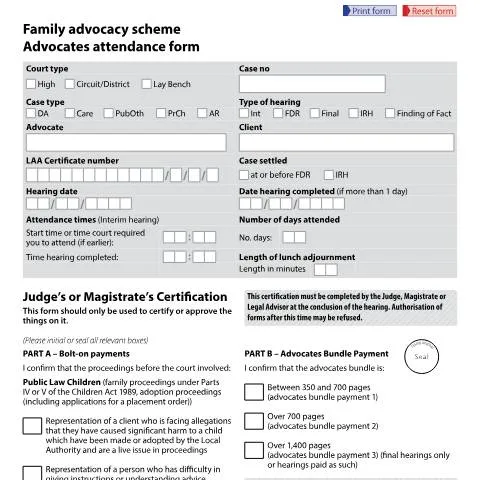
When solicitors and barristers represent clients in family proceedings, particularly those involving children, the standard hearing fees often fail to reflect the true complexity and duration of their work. Form EX506 addresses this disparity by providing a mechanism for advocates to claim additional payments—known as 'bolt-ons'—that recognise the extra demands placed upon legal representatives in challenging family cases.
This certification form operates within the Family Advocacy Scheme and serves as the gateway for claiming supplementary payments when proceedings involve allegations of significant harm to children, clients with communication difficulties, or extensive documentary evidence requiring expert witness testimony. The form's significance extends beyond mere administrative process—it represents the justice system's acknowledgment that certain family cases demand exceptional advocacy skills and time investment.
The Legal Aid Agency's remuneration structure, governed by the Civil Legal Aid (Remuneration) Regulations 2013 and the Standard Civil Contract, establishes these bolt-on payments to ensure adequate representation in cases where vulnerable parties—particularly children—depend on skilled advocacy for protection and fair outcomes.
Navigating the Dual Payment Structure
Form EX506 addresses two distinct categories of additional payments, each responding to different aspects of case complexity. Understanding these categories proves essential for advocates seeking appropriate remuneration for their work.
Part A: Bolt-On Payment Categories
The form's Part A focuses on circumstance-based enhancements to standard hearing fees. These payments acknowledge situations where advocacy demands exceed normal expectations, either due to the severity of allegations or the particular vulnerabilities of clients involved.
For public law children proceedings—those involving local authority intervention under Parts IV or V of the Children Act 1989 or adoption proceedings—three specific bolt-on categories apply. The most frequently claimed involves representing clients facing allegations of causing significant harm to a child, where the local authority has formally made or adopted such allegations as a live issue in proceedings.
The legislation defines significant harm with precision, encompassing death, substantial head injuries, fractures, burns, scalds, fabricated illness, extensive bruising across multiple body parts, multiple injury types, life-threatening ill-treatment including suffocation or starvation, and sexual abuse. This comprehensive definition ensures that advocates dealing with the most serious child protection cases receive recognition for the additional preparation, sensitivity, and skill required.
A second public law bolt-on addresses representation of clients experiencing difficulty giving instructions or understanding advice. This provision requires verification through medical reports from qualified psychologists or psychiatrists, confirming mental disorders as defined under the Mental Health Act 1983 or significant impairments affecting intelligence or social functioning.
| Bolt-On Type | Public Law Rate | Private Law Rate | Key Requirements |
|---|---|---|---|
| Significant harm allegations | 25% of hearing fee | 25% of hearing fee | Live allegations by local authority |
| Client communication difficulties | 25% of hearing fee | Not applicable | Medical verification required |
| Expert witness cross-examination | 25% of hearing fee | 20% of hearing fee | Independent expert attendance |
Part B: Advocates Bundle Payment Structure
The second payment category addresses the practical reality of modern family proceedings: the substantial documentation bundles that advocates must master before hearings. Part B recognises three tiers of bundle complexity, with payments scaling according to document volume.
Bundle Payment 1 applies to bundles containing between 350 and 700 pages, acknowledging that substantial preparation time becomes necessary once documentation exceeds typical case volumes. Bundle Payment 2 covers bundles exceeding 700 pages, while Bundle Payment 3—available only for final hearings or those paid at equivalent rates—addresses bundles surpassing 1,400 pages.
These thresholds reflect the Legal Aid Agency's recognition that effective advocacy requires thorough document review, cross-referencing, and strategic preparation that increases exponentially with bundle size rather than linearly.
Judicial Certification: The Critical Validation Process
Form EX506's most distinctive feature lies in its requirement for judicial certification at the hearing's conclusion. This process transforms the form from a simple claim document into a court-validated record of proceedings, lending credibility and accuracy to payment requests.
The judge, magistrate, or legal adviser must complete the certification section before the hearing concludes, with the form explicitly warning that authorisation may be refused for forms submitted after this time. This immediacy requirement ensures accuracy while proceedings remain fresh in judicial memory and prevents retrospective claims based on incomplete recollections.
Judicial officers must initial or seal relevant boxes confirming specific circumstances that justify bolt-on payments. For significant harm allegations, they verify that such allegations were indeed live issues requiring active defence. For communication difficulties, they confirm the client's verified impairments affected proceedings. For expert witness bolt-ons, they certify that independent experts attended for cross-examination purposes.
The certification process extends beyond simple box-ticking. Judges must verify attendance times, hearing completion dates, and the number of days attended for multi-day proceedings. They also record lunch adjournment lengths, recognising that extended breaks can significantly impact daily hearing fees and overall case duration.
Distinguishing Public and Private Law Applications
Form EX506 operates across both public law and private law children proceedings, but with important distinctions that affect payment eligibility and rates. Understanding these differences proves crucial for advocates operating in family courts.
Public Law Proceedings Scope
Public law children cases encompass proceedings under Parts IV or V of the Children Act 1989, including care orders, supervision orders, emergency protection orders, and adoption proceedings with placement order applications. These cases involve local authority intervention where child welfare concerns reach statutory thresholds.
In public law contexts, all three bolt-on categories remain available, with significant harm allegations specifically requiring that local authorities make or adopt the allegations. This distinction prevents private disputes from accessing enhanced payments designed for statutory child protection work.
The communication difficulties bolt-on applies exclusively to public law cases, reflecting the higher likelihood of encountering clients with complex needs in local authority proceedings. The medical verification requirement ensures appropriate gatekeeping while recognising that vulnerable adults often become involved in child protection cases through circumstances beyond their control.
Private Law Proceedings Parameters
Private law children proceedings involve disputes between individuals concerning child welfare, excluding ancillary relief matters. Typical examples include residence and contact disputes, specific issue orders, and prohibited steps orders where parents or family members seek court intervention in private disagreements.
Private law cases access only two bolt-on categories: significant harm allegations and expert witness cross-examination. The communication difficulties bolt-on remains unavailable, reflecting policy decisions about resource allocation between statutory and private family work.
Significantly, expert witness bolt-on rates differ between public and private law, with private cases receiving 20% rather than 25% of the hearing fee. This differential acknowledges varying case complexity while maintaining incentives for quality representation across both sectors.
Expert Witness Provisions and Independent Evidence
The expert witness bolt-on represents one of Form EX506's most nuanced provisions, requiring careful attention to witness independence and cross-examination substance. The regulations specifically exclude social workers, Cafcass officers, and CAFCASS Cymru guardians from independent expert status, regardless of their qualifications or testimony complexity.
True independent experts typically include child psychologists, psychiatrists, paediatricians, forensic accountants, or other specialists instructed by parties or courts to provide objective analysis beyond standard professional involvement. These experts must attend court specifically for evidence-giving purposes, not merely as observers or advisers.
The cross-examination requirement demands that expert evidence face substantial challenge from any party during the hearing. Perfunctory questioning or clarification requests insufficient to trigger bolt-on payments. Instead, advocates must engage in meaningful challenges to expert methodology, conclusions, or factual foundations.
Interestingly, the bolt-on applies even when experts attend as directed but circumstances prevent their oral evidence—for instance, when cases settle immediately before testimony or when expert attendance becomes unnecessary due to concessions. This provision recognises that preparation for expert cross-examination requires substantial advance work regardless of eventual testimony.
Completion Procedures and Administrative Requirements
Form EX506 demands precise completion across multiple sections, with specific information required for valid submissions. The advocate section requires Legal Aid Agency certificate numbers, hearing dates, case numbers, and detailed attendance times including start times and completion times.
Attendance time recording proves particularly important for interim hearings, where advocates must note both their actual attendance start time and any earlier time the court required their presence. This distinction recognises that courts sometimes direct early attendance for case management purposes, even when hearings begin later.
Case settlement timing affects payment calculations, particularly for Financial Dispute Resolution (FDR) hearings and Issues Resolution Hearings (IRH) where early settlement might impact fee entitlements. The form captures whether cases settle at or before these specific hearing types, enabling appropriate fee adjustments.
Multi-Day Hearing Considerations
Complex family cases often span multiple days, requiring careful attention to Form EX506 completion across extended proceedings. Advocates must record the total number of days attended and hearing completion dates when proceedings exceed single-day duration.
Lunch adjournment lengths require recording in minutes, acknowledging that family cases sometimes involve extended breaks for negotiations, client consultations, or judicial deliberation. These breaks can significantly impact daily fee calculations and overall case management.
The form's design accommodates various hearing types—interim, Financial Dispute Resolution, final, Issues Resolution Hearings, and fact-finding hearings—each potentially triggering different payment calculations and bolt-on eligibilities.
Regulatory Framework and Contract Compliance
Form EX506 operates within a complex regulatory framework established by the Civil Legal Aid (Remuneration) Regulations 2013 and Section 7 of the 2013 Standard Civil Contract. These instruments create binding obligations for both advocates and the Legal Aid Agency regarding payment claims and verification procedures.
The regulations establish detailed criteria for bolt-on eligibility, moving beyond Form EX506's summary provisions to address edge cases, appeals procedures, and quality assurance mechanisms. Advocates submitting claims implicitly certify compliance with these broader regulatory requirements, making accurate form completion legally significant.
Section 7 of the Standard Civil Contract provides additional guidance on bolt-on applications, including examples of qualifying circumstances and common misconceptions about eligibility. This guidance proves essential for advocates seeking to understand how general regulatory principles apply to specific case circumstances.
The judicial certification requirement creates a quality control mechanism that reduces fraudulent or mistaken claims while ensuring that payment decisions rest on accurate information. Courts cannot authorise payments for circumstances they did not observe or verify, creating natural limits on claim inflation.
Crown Copyright and Form Authenticity
Form EX506 bears Crown copyright dating to 2014, indicating its official status and the importance of using current versions. The HM Courts & Tribunals Service periodically updates forms to reflect regulatory changes, procedural improvements, or policy modifications.
Using outdated forms can result in processing delays or claim rejections, making it essential for advocates to verify they possess current versions before hearing attendance. The form's reference number and date provide authentication markers that administrative staff use to validate submissions.
The Crown copyright designation also emphasises that Form EX506 represents official government policy on family advocacy remuneration, carrying legal weight beyond simple administrative convenience. Judicial officers completing certifications act as agents of the court system, lending official authority to their validations.
Strategic Implications for Family Law Practice
Form EX506 influences family law practice in ways extending beyond immediate payment considerations. The bolt-on structure creates incentives for advocates to accept challenging cases involving vulnerable clients or complex allegations, supporting access to justice for those facing serious child protection concerns.
The significant harm bolt-on particularly affects case allocation decisions within chambers and solicitor firms. Cases involving serious allegations require experienced advocates capable of handling sensitive cross-examination and complex evidence presentation, while the enhanced payment structure helps ensure such expertise remains available.
Bundle payment provisions encourage thorough case preparation while recognising the practical reality that modern family proceedings often involve substantial documentation. The tiered structure acknowledges that preparation time increases non-linearly with document volume, supporting quality advocacy in document-heavy cases.
For junior advocates, understanding Form EX506 requirements proves essential for career development and practice management. The form's completion requires familiarity with case law, procedural requirements, and client assessment skills that extend well beyond basic advocacy competence.
The expert witness provisions create strategic considerations about when to instruct independent experts and how to conduct effective cross-examination. The bolt-on structure provides financial support for thorough expert challenge while maintaining quality thresholds that prevent routine questioning from triggering enhanced payments.